Quick Summary
- Audit one area at a time, ranked by risk to patients and by recent change.
- Trace real records from start to end, because the gaps sit in the breaks.
- Write findings as short factual statements with evidence and the requirement.
- An audit only counts when every finding is tracked to verified closure.
A pharmaceutical compliance audit is a structured check of whether your company does what its procedures and the rules say, and can prove it. Most gaps I find in internal audits are not exotic. They are an expired supplier qualification, a deviation without a root cause, a training record that is missing for one shift. The skill is finding them fast, before an inspector or a partner does. Within my pharmaceutical compliance consulting work, I use the six-step method below for audits that take days, not months.
The table gives the method at a glance. After that I explain each step, what to sample and the mistakes that waste the most time.
The Six Steps at a Glance
| Step | What you do | Output |
|---|---|---|
| 1. Set scope and criteria | Choose the area, products and rules to audit against | Audit plan |
| 2. Read before you visit | Review procedures, past findings and metrics | Risk-ranked question list |
| 3. Trace real records | Follow samples from start to end | Evidence notes |
| 4. Talk to people at the point of work | Ask staff to show, not tell | Observations |
| 5. Rate and report findings | Grade by risk and write them clearly | Audit report |
| 6. Track fixes to closure | Assign owners and verify results | Closed action list |
Step 1: Set Scope and Criteria
An audit that tries to cover everything finds little. Choose one area, such as the deviation process, one site or one product line, and name the criteria: your own procedures plus the rules that apply. For manufacturing that includes current good manufacturing practice, published by the FDA on its CGMP regulations page.
Decide who audits. Internal auditors know the business but may be too close. An outside consultant brings pattern recognition from many companies. Whoever does it, they should not audit their own work. Write a one-page plan with scope, dates, sampling approach and who must be available.
Step 2: Read Before You Visit
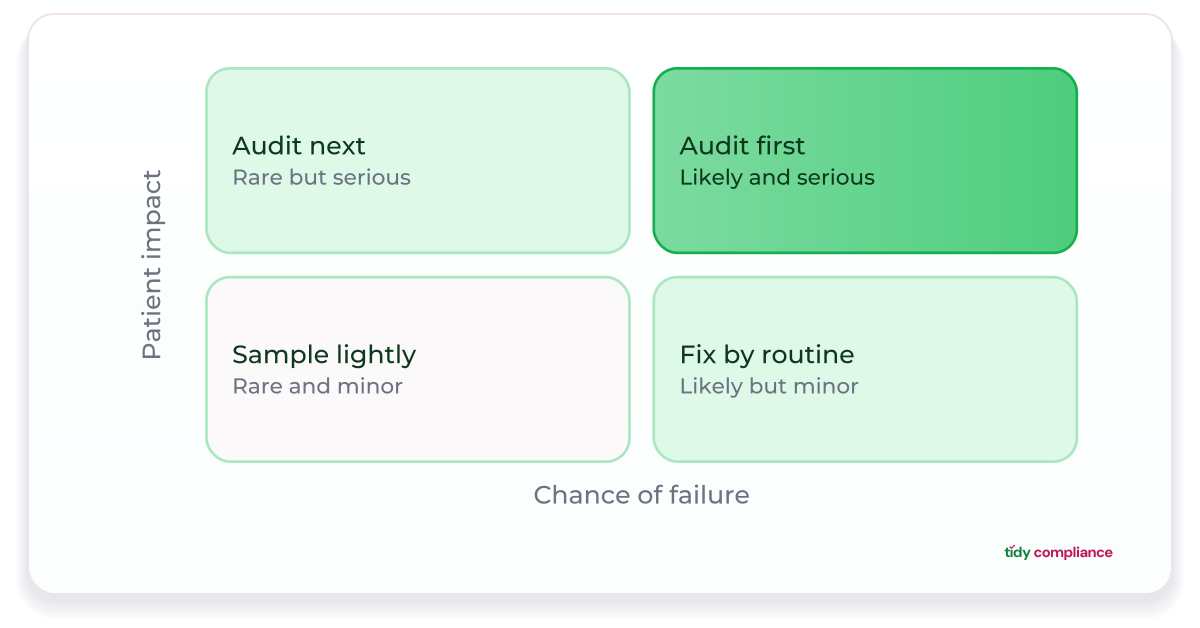
The fastest finds come from paper you read at your desk. Pull the procedures for the area, the last audit report, open CAPAs, recent deviations, complaint trends and training reports. Look for repeat issues, overdue actions and procedures last revised years ago.
From that reading, write a list of questions ranked by risk. Five sharp questions beat fifty generic ones. For example: why have deviations on this filling line doubled this year, and what did the last two CAPAs change?
- Last audit report and the status of its actions
- Open deviations and CAPAs older than your own time limits
- Procedures not reviewed within your review cycle
Step 3: Trace Real Records From Start to End
Tracing is the core technique. Pick a sample, such as three released batches or five closed deviations, and follow each from beginning to end. For a batch, check the material receipt, the supplier qualification, the production record, the test results, the review and the release. For a deviation, check the report, investigation, root cause, action and effectiveness check.
Look for breaks in the chain: a material without a qualified supplier, a signature before the work was finished, a result that was retested without an explanation. Data integrity gaps often show here. The FDA explains expectations for electronic records in its Part 11 guidance, which helps when you review audit trails and signatures.
| Sample | What to trace | Typical gap |
|---|---|---|
| Released batch | Materials, records, tests, review, release | Review done after release or without a second person |
| Closed deviation | Report, root cause, action, effectiveness | Root cause stated as human error only |
| Training file | Procedure revision to training completion | Staff working before training was finished |
| Supplier | Qualification, agreement, audit | Expired qualification still in use |
| Computerized system | Access list, audit trail, validation | Shared accounts or unreviewed audit trails |
Step 4: Talk to People Where the Work Happens
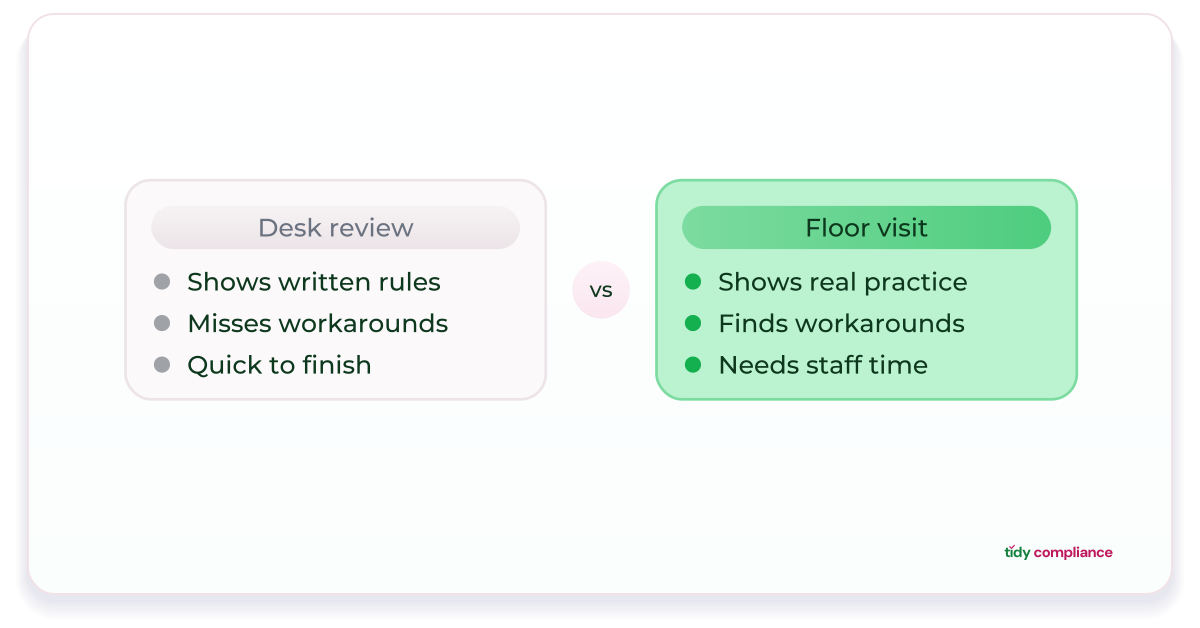
Documents show what should happen. People show what does. Ask operators, analysts and warehouse staff to walk you through a task and show the record they fill in. Listen for phrases like "we usually" and "the procedure says but".
Keep it friendly. The audit is about the system, not the person. Staff who feel blamed hide problems, and you learn less. Ask open questions: what slows you down, what do you work around, what would you change in this procedure? The answers often point to the real weak spot long before any record does.
Step 5: Rate and Report Findings
Group findings by risk to patients, product quality and data reliability. Many teams use three levels: critical, major and minor. Define them in your audit procedure in advance so ratings stay consistent between auditors.
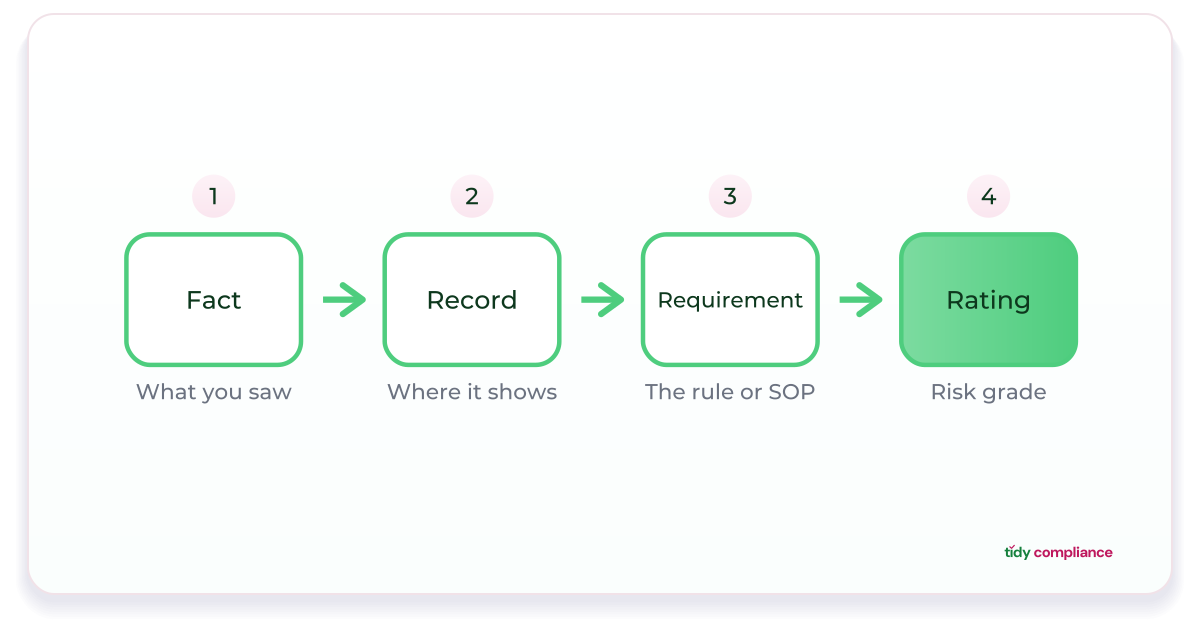
Write each finding as a short factual statement with the evidence and the requirement. "Three of five sampled deviations had no documented root cause; procedure section 6.2 requires one" is clear. "Investigations are weak" is not. Send the draft to the area owner for factual accuracy before you issue it, and agree on response dates.
| Rating | Meaning | Typical response time |
|---|---|---|
| Critical | Direct risk to patients or serious data integrity failure | Immediate action, escalate to senior leaders |
| Major | Significant departure from requirements or a repeat issue | Action plan within days, closure within an agreed period |
| Minor | Isolated lapse with limited risk | Fix at the next routine cycle |
The time limits are yours to set in your own procedure. Keep them realistic so you can meet them.
One more habit helps at this stage: keep a running list of questions for later while you work. Small observations, such as an odd handwriting change or a spare key in the wrong place, rarely justify a finding alone, but two or three together point to a weak area. Review the list at the end of each day and decide which items need a second look before you leave the site. Auditors who wait until the report stage to connect the dots usually have no way to go back and check.
Step 6: Track Fixes to Closure
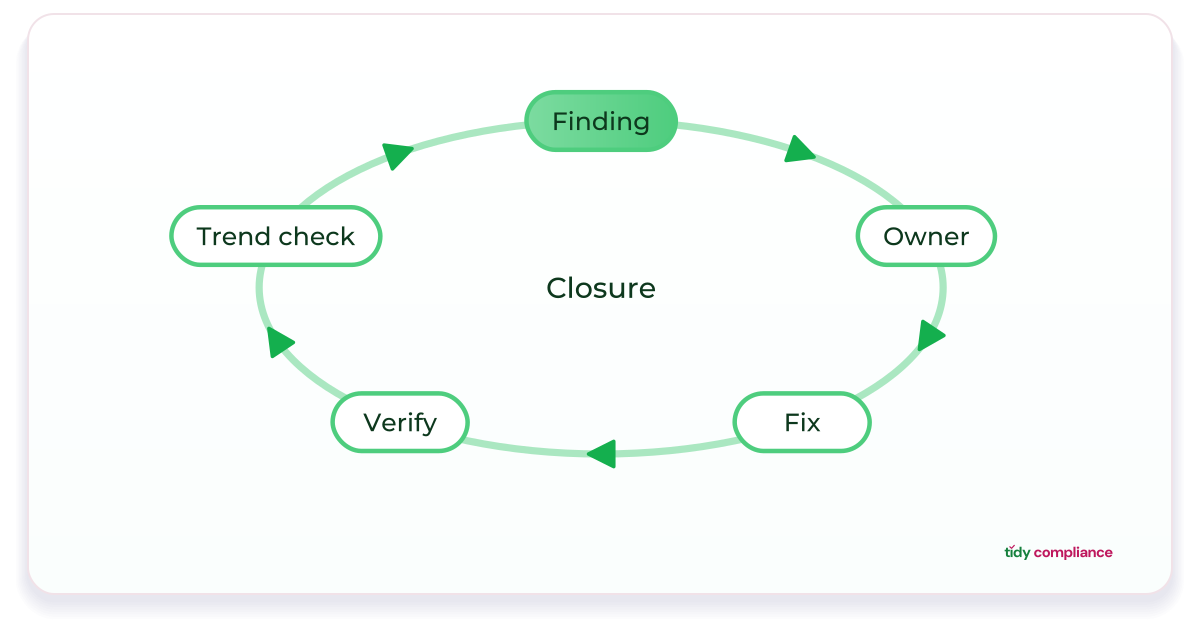
An audit without follow-up is theater. Put every finding into your CAPA system or action list with an owner, a date and a check. Review open items in the monthly compliance meeting, as described in my guide to pharmaceutical compliance management. Verify closure by looking at fresh records, not by trusting a status line.
Repeat findings deserve a second look at the root cause. If the same gap appears twice, the earlier action treated a symptom. Rewrite the action, not just the due date.
Mistakes That Waste Audit Time
Audits go wrong in predictable ways. The table lists the ones I see most and the habit that avoids each of them.
| Mistake | In practice | Better habit |
|---|---|---|
| Checking the procedure, not the practice | Long review of documents, no time on the floor | Split time between desk, records and observation |
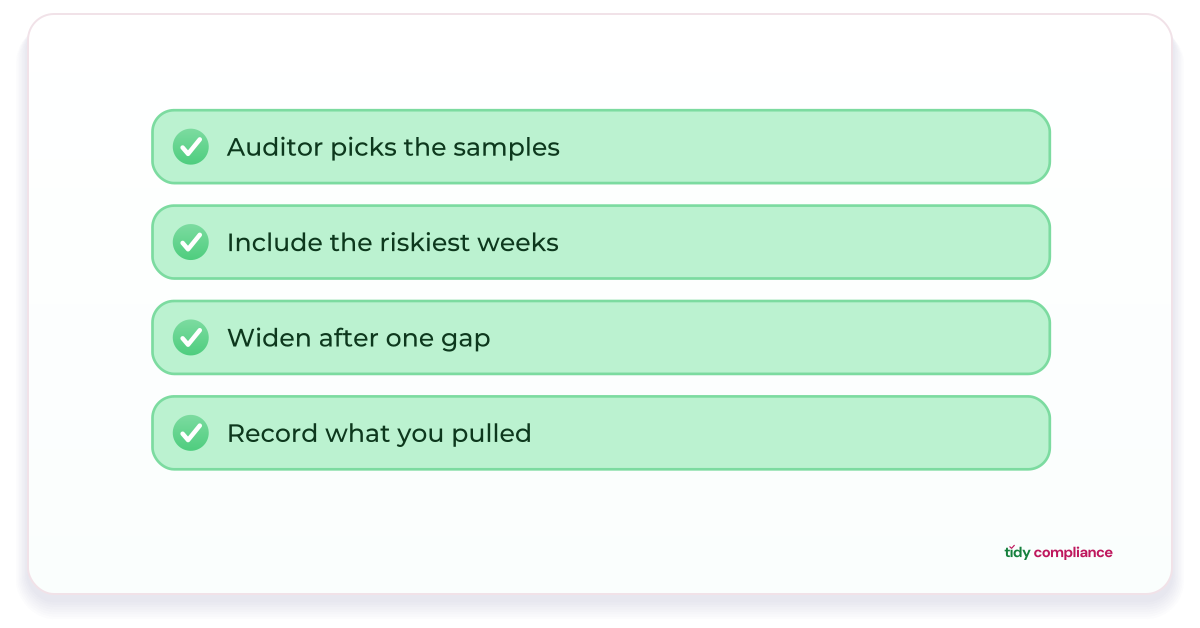
| Sampling only the easy records | Auditee picks the samples | Auditor picks samples, ideally from the riskiest weeks |
| Vague findings | Statements with no evidence or requirement | One fact, one record, one requirement |
| Surprise ambush | Staff defensive, little learned | Announce scope, keep the tone factual |
| No follow-up | Report filed, actions drift | Owner, date and verification for each finding |
Sampling deserves a word. If you check three records and find nothing, you have learned little. Choose the sample by risk: batches with deviations, records signed by new staff, changes made close to release. A small, risk-based sample finds more than a large random one, and it takes less time. State how you chose the sample in the report, so readers understand the limits of what you checked.
Close the audit with a short meeting. Share what you saw, thank the people who helped and explain how findings will be rated and when a draft will arrive. Nobody should read a finding for the first time in the written report.
Finding Gaps Fast: Where I Look First
If you only have a day, start where gaps cluster. In my client work I check these five places first, in this order, because each often exposes issues elsewhere.
- Deviations and CAPAs: look for age, repeats and weak root causes.
- Training files for people who did critical tasks in the last month.
- Supplier list against the materials actually received.
- User access lists on systems that hold GxP records.
- Change records against what the floor does today.
If the five look healthy, the rest usually is too. If two or more show problems, plan a deeper audit. The pharmaceutical compliance checklist gives you the full list of areas to cover in that deeper round.
How to Choose Between Internal and External Audits
Both have a place. Internal audits are cheaper and frequent, and they build ownership. External audits bring fresh eyes, independence and credibility with partners and boards. A common pattern is internal audits each quarter on rotating areas and an outside audit once a year.
| Option | Strength | Weakness |
|---|---|---|
| Internal audit | Knows the business, low cost, can repeat often | Closeness to the work and politics |
| External consultant | Independent view and pattern recognition | Higher cost and less context |
| Software-supported checks | Alerts on overdue items and trends | Does not replace walking the process |
Tools can help you track audits and CAPAs, and my ranking of pharmaceutical compliance software shows what they cost and where they fit. A tool will not find a gap on its own, though. A person still has to ask the questions.
- Do you have a written audit plan for the year?
- Are the auditors independent of the area they audit?
- Do findings reach senior leaders?
- Do you verify closure with fresh records?
Sources
FDA: CGMP Regulations, FDA: Part 11 Electronic Records Guidance.
Questions About Pharmaceutical Compliance Audits
What Is a Pharmaceutical Compliance Audit?
It is a structured, documented check of whether your company follows its procedures and the rules that apply, with evidence for each finding. It can be internal, external or run by a partner or customer.
How Often Should We Audit?
Set a yearly plan that covers every area on a risk basis. High-risk areas such as sterile operations or data integrity get audited more often than low-risk ones, and you audit again after major changes.
How Long Does an Internal Audit Take?
A focused audit of one area often takes a few days of fieldwork plus time for planning and reporting. Scope drives the length more than company size.
What Is the Difference Between a Gap Assessment and an Audit?
A gap assessment compares your system with requirements and lists what is missing, usually at the start of a program. An audit tests whether the system works in practice and whether people follow it.
Who Should Lead an Internal Audit?
Someone trained in auditing who does not audit their own work. In small companies that may be a quality lead from another area or an outside consultant.
How Should We Prepare for an FDA Inspection?
Run an internal audit on your highest-risk areas, close open actions, check that records are retrievable and brief staff on how to answer questions. Your regulatory counsel should lead on any contact with the agency.
Can Software Run the Audit for Us?
Software can schedule audits, store evidence and track CAPAs. It cannot interview staff or judge whether a root cause is credible, so a trained person still does the audit.
Disclaimer: This article is for general information only and isn’t legal, financial or tax advice. Treat figures as estimates from typical work and confirm details with your providers before you act.
Was this guide helpful?
Thanks for your feedback.
Odessa Whitfield
Odessa leads the Tidy editorial team and works with the compliance consultants to turn real client projects into practical guides on regulations, frameworks, policies and audit preparation. Before joining Tidy, she worked in compliance and risk roles, writing and maintaining policy sets for regulated organizations. Every article goes through a consultant who has done the work in practice, and she updates guides when a rule, framework or tool changes. She works remotely from the United States.