Quick Summary
- A good pharmacy audit follows five phases: scope, sample, test, score and fix.
- Review the areas that carry the most risk first: controlled substances, billing, licenses and patient privacy.
- Score every finding by likelihood and impact, and give each one an owner and a due date.
- An internal audit finds gaps early. It does not replace the rules of your state board or advice from your attorney.
A pharmacy audit that ends with a thick report and no changes is a waste of a week. The audits that work are short, sample-based and finish with a list of fixes that someone owns. In my pharmacy compliance consulting work, I run the same five phases for a single store and for a small chain, and only the size of the samples changes.
This framework covers what to review and why. It is general guidance, not legal advice. State rules and payer contracts vary, so check the specifics with your board of pharmacy, your contracts and your attorney.
The Five Phases Side by Side
| Phase | Key question | Output |
|---|---|---|
| 1. Scope | What do we review and against which rules? | A one-page scope and a rule list |
| 2. Sample | Which records do we pull? | Sample sets with dates and sizes |
| 3. Test | Do the records match what the rule requires? | Pass or fail notes per record |
| 4. Score | Which gaps matter most? | A ranked finding list |
| 5. Fix | Who does what by when? | An action plan with proof of closure |
Phase 1: Decide What the Audit Covers
Write the scope on one page. List the services you offer, such as retail dispensing, compounding, long-term care, immunizations or mail order, and list the sets of rules that apply to each: your state board rules, federal controlled substance rules, drug supply chain rules, privacy and security rules, your payer and PBM contracts, and workplace safety rules. If you cannot name the source of a rule, mark it as open and ask your board or attorney.
Choose the period too. I look back 12 months for most areas and 90 days for logs. A scope that is too wide produces a report nobody finishes, so start with the areas below and add more next year.
What to Review in Each Area and Why
Controlled substances
Controlled substances come first because mistakes carry the most serious consequences. Pull the last inventory, a month of receiving records and a sample of dispensing records. Compare counts to records, check that discrepancies were explained and confirm who has access to storage.
Billing and claims
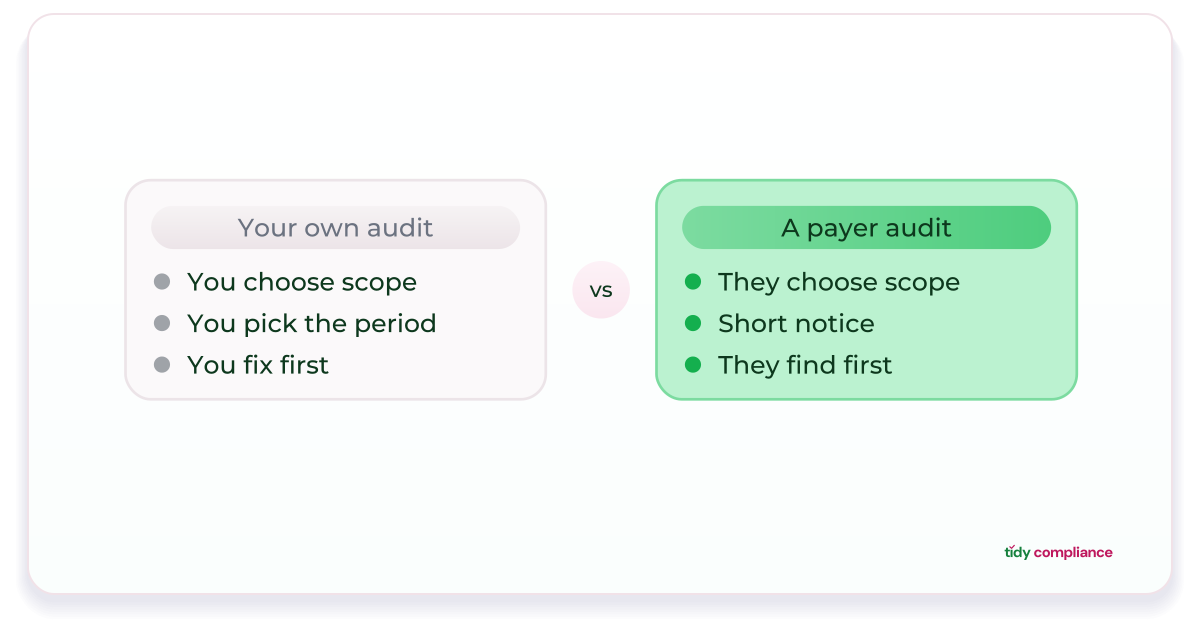
Payers audit by sampling claims and requesting proof. Pull 20 claims and match each to a prescription, a signature log and, where relevant, prescriber information. The failure pattern I see most is a missing signature or a quantity that does not match the record.
Licenses, staff and training
Check every license against an expiry list, every employee against an exclusion check and every training record against the requirements for the role. Gaps here are easy to fix and easy for an inspector to find, so they should be zero.
Privacy and security
Look for a current risk analysis, a list of systems that hold patient data, business associate agreements and an access list that matches the current staff. Walk the counter and the back room, and look at what a patient could see or hear.
Drug supply chain and storage
Test whether you can retrieve transaction records for a drug received last month, whether suppliers were verified and whether temperature and expiry logs are complete. Check the current FDA guidance for your pharmacy type, because rules and timing for dispensers have been updated more than once.
How to Sample Without Spending a Week
Sampling is what makes an audit fast. Instead of reviewing every record, pull a small, random set and see how many fail. If none fail, you have decent confidence. If more than one in ten fails, widen the sample and look for the cause.
My starting sizes are 20 claims, 10 staff files, 30 days of logs and every controlled substance discrepancy in the period. Choose records with a method that you cannot influence, such as every fifth claim in a date range. Write down the method, so a second person could repeat it.
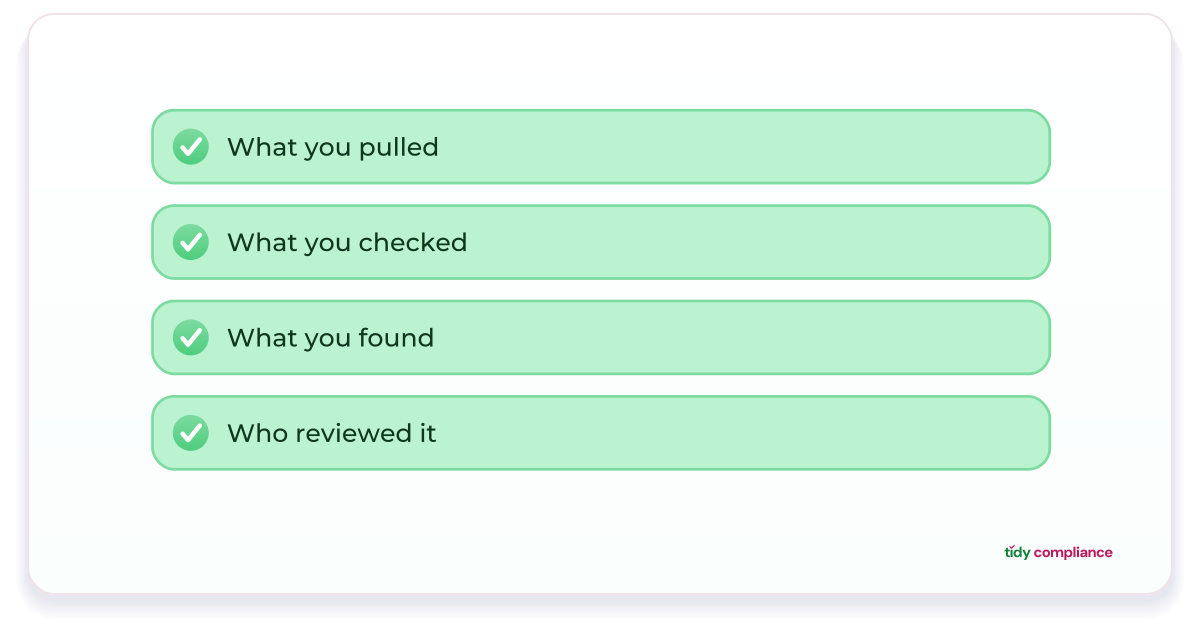
Keep the working papers: a list of what you pulled, what you checked and what you found. If an inspector asks how you know your program works, that list is your answer. For areas where a sample is too thin, such as new services, review the whole population once.
Scoring Findings So the Right Ones Get Fixed First
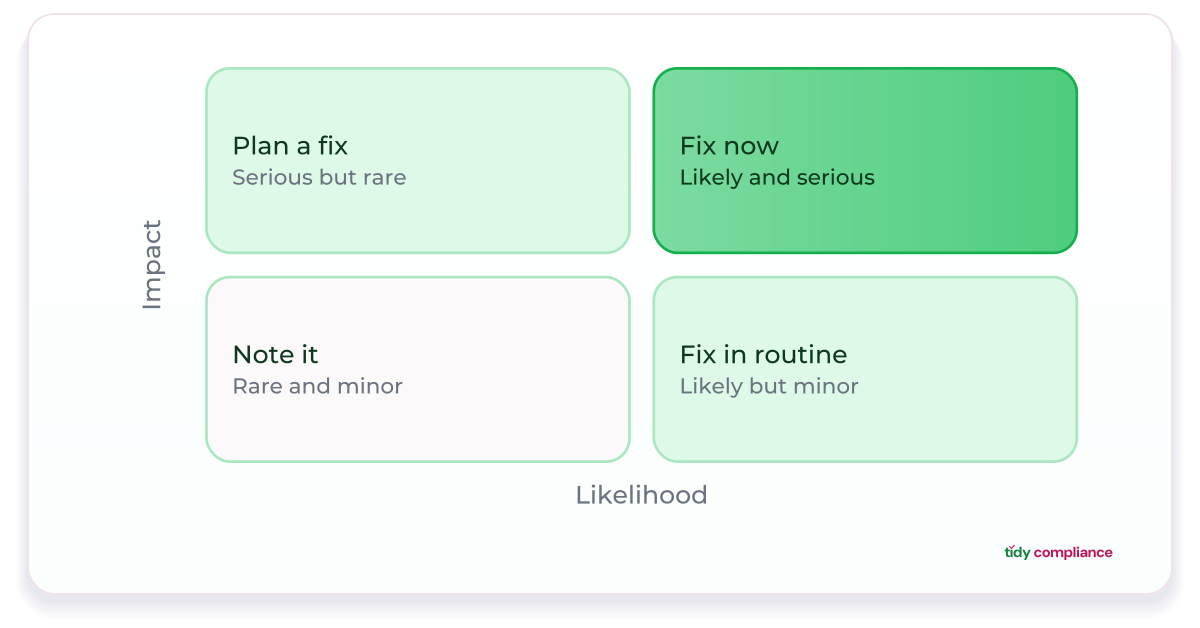
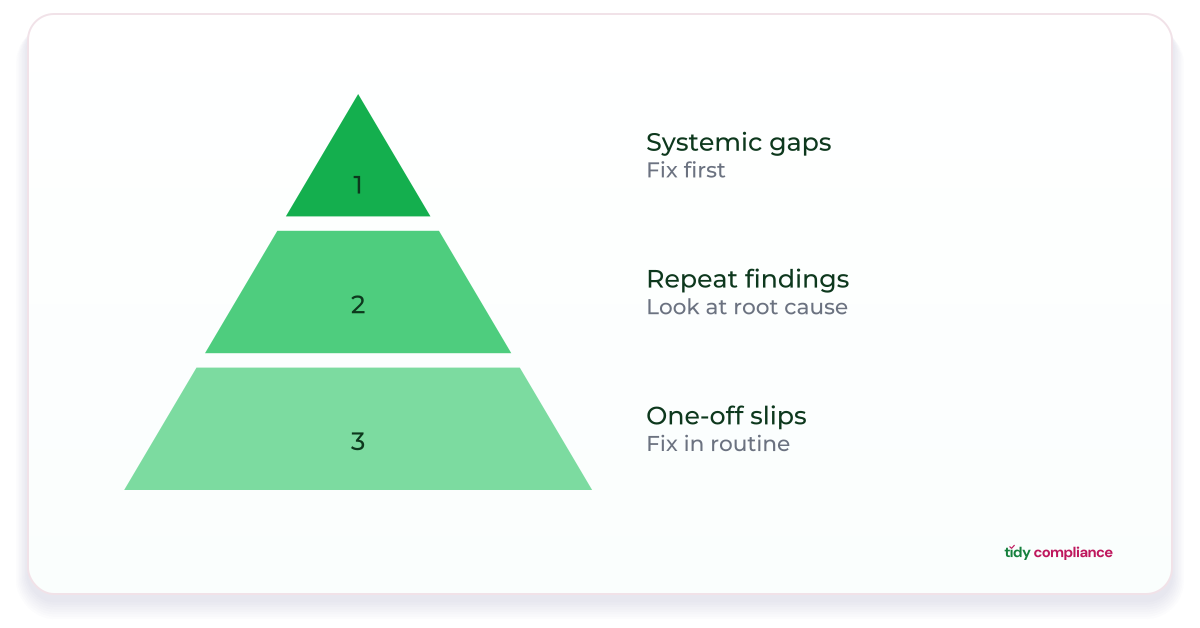
Give every finding two ratings from 1 to 3: how likely it is to be found or to cause harm, and how serious the consequence is. Multiply them. A 9 is a fix-now item, a 4 to 6 goes into the quarter, and 1 to 3 goes into the yearly cleanup. A controlled substance discrepancy with no explanation scores high on both. A missing signature on one claim scores lower, until it repeats.
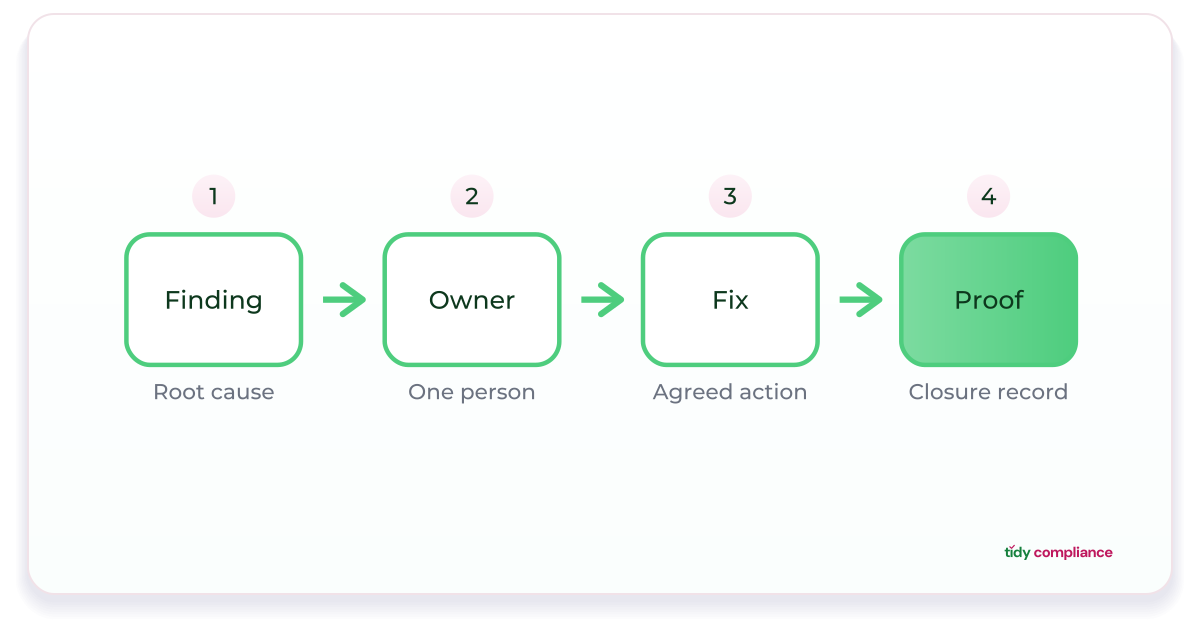
Group findings by root cause, not by area. Five findings that all trace back to nobody owning the monthly checks are one finding. Fix the owner problem, and the five close together. I rarely see more than six root causes in a first audit of a single pharmacy.
Write each finding in three parts: what you found, which rule or contract it relates to and what the proof looks like when it is fixed. Avoid words like "poor" or "inadequate". Facts are easier to fix than adjectives.
Turning Findings Into Fixes
The fix phase decides whether the audit mattered. Put every finding in a tracker with an owner, a due date and a proof field. Review it every two weeks for 90 days. Anything that stays open past its date goes to the pharmacist in charge or the owner.
Close the loop with the checklist you use every month. My pharmacy compliance checklist turns the main audit areas into nine routine checks, so the same problems do not return. When your tracker is long, a tool can help keep it in one place, and I compare options in my review of pharmacy compliance software.
After the Audit: Habits That Keep the Score Down
An audit is a snapshot. What keeps the next one clean is routine: monthly log reviews, quarterly claim samples and yearly training. I describe those habits in my guide to pharmacy compliance best practices. Report the number of open high-rated findings to the owner each quarter. When that number is zero for two quarters in a row, widen the scope to include something new.
Ask the People Who Do the Work
Records show what was written down. Conversations show what happens. Spend 15 minutes with a technician, a cashier and a pharmacist, and ask each to walk you through a situation: a prescription that looks wrong, a patient who asks for a copy of their records, a delivery that arrives with a damaged seal. Do not quiz them on rule numbers. Listen for whether they know the next step and whom to call.
Gaps between the written procedure and the spoken answer are some of the most useful findings. Two staff members who describe the same task in two different ways mean the procedure is unclear or outdated. Fix the procedure, then train on it. Keep your notes short and anonymous, so people stay open next year.
Mistakes That Make a Pharmacy Audit Useless
The most common mistake is auditing only what you already know is fine. Owners pick the tidy areas and skip the corner where the counting sheets live. Include at least one area you are nervous about. The second is auditing alone with a conflict of interest: the person who built the process rates it. The third is no follow-up. A report that is not tracked fades within a month.
A fourth mistake is chasing small errors while a large one waits. If you spend three days correcting label wording and nobody looked at the access list to the controlled substance safe, the priorities were wrong. Use the scores from phase four to decide where the next hour goes.
Writing the Report So Someone Reads It
Keep the report to two pages. Open with the count of findings by rating, then list the top five with owners and dates. Put the sample details and working papers in an appendix. The owner needs to know what to decide this week, and the inspector, if one ever asks, needs to see that you looked. A short report that is read and acted on is worth more than a long one.
Date the report and store it with the tracker. Next year, compare the numbers. A falling count of high-rated findings is the clearest proof that your program is working.
How to Choose Between a Self-Audit and Outside Help
Run the first audit yourself if you have a pharmacist who can step back from daily work and a day to spend. Bring in help when you compound, when you operate several sites, when a payer audit is already on the calendar or when you have never done one. Outside reviewers see patterns across pharmacies, and they are not afraid of the owner. Many pharmacies split the work: the pharmacist runs the routine checks, and an outside reviewer tests the high-risk areas once a year.
Questions About Pharmacy Compliance Audits
How Often Should a Pharmacy Run an Internal Compliance Audit?
Once a year for the full scope, plus a quick quarterly check of the high-risk areas such as controlled substances, billing samples and expiring credentials. Run an extra one after a new service, a new location, a change of owner or a system switch.
Who Should Perform the Audit?
Someone who does not run the process being checked. In a small pharmacy that can be a pharmacist from another site, a trusted consultant or the owner reviewing areas they do not manage day to day. Self-review by the person who does the work finds fewer gaps.
How Many Records Should I Sample?
There is no universal number. I use 20 claims per quarter, 10 staff files, 30 days of temperature logs and every controlled substance discrepancy in the period. If you find errors in a sample, widen it before you decide how big the problem is.
What Is the Difference Between an Audit and a Mock Inspection?
An audit is a structured review with samples, scoring and a written report. A mock inspection simulates the visit, so the person walks the pharmacy as an inspector would and asks staff questions. Both are useful, and many pharmacies do the audit first and a mock inspection a few weeks later.
What Do I Do with the Findings?
Rate each one, assign an owner and a due date, fix it and attach proof. Report the open count at each quarter. Findings that stay open without an owner are the ones that return as repeat findings in a real review.
Can I Use the Same Audit for Payer Audits and State Inspections?
Partly. The records overlap, but payers measure you against your contract and manual, and boards measure you against state rules. Add a payer section that uses your PBM contract language, and confirm the state rules with your board.
Should I Tell Staff Before the Audit?
Yes, for the process, and no for the dates of spot checks. Staff should know why you audit and that the goal is to fix systems, not to blame people. Unannounced spot checks of logs and counts show how the pharmacy works on a normal day.
Sources
- U.S. Food and Drug Administration, Drug Supply Chain Security Act
- DEA Diversion Control Division
- HHS Office of Inspector General, exclusions program
Disclaimer: This article is for general information only and isn’t legal, financial or tax advice. Treat figures as estimates from typical work and confirm details with your providers before you act.
Was this guide helpful?
Thanks for your feedback.
Odessa Whitfield
Odessa leads the Tidy editorial team and works with the compliance consultants to turn real client projects into practical guides on regulations, frameworks, policies and audit preparation. Before joining Tidy, she worked in compliance and risk roles, writing and maintaining policy sets for regulated organizations. Every article goes through a consultant who has done the work in practice, and she updates guides when a rule, framework or tool changes. She works remotely from the United States.