Quick Summary
- The strongest pharmacy compliance programs rely on a few habits repeated on a schedule, not on big one-off projects.
- One expiry calendar prevents the most common quiet failure: lapsed licenses, certificates and agreements.
- Monthly screening and quarterly claim samples find problems while they are small.
- Every habit needs a named owner, a frequency and a place where the proof is kept.
Pharmacies that rarely have trouble in reviews do not know more rules than everyone else. They repeat a short list of habits so often that the habits become the routine. In my pharmacy compliance consulting work, the gap between a calm pharmacy and a stressed one is rarely a missing policy. It is whether anyone checks.
Here are seven habits, each with a do and an avoid. They are general practices, not legal advice. Rules vary by state and by contract, so confirm specifics with your board of pharmacy and your attorney.
The Seven Habits Side by Side
| Habit | How often | Main risk it controls |
|---|---|---|
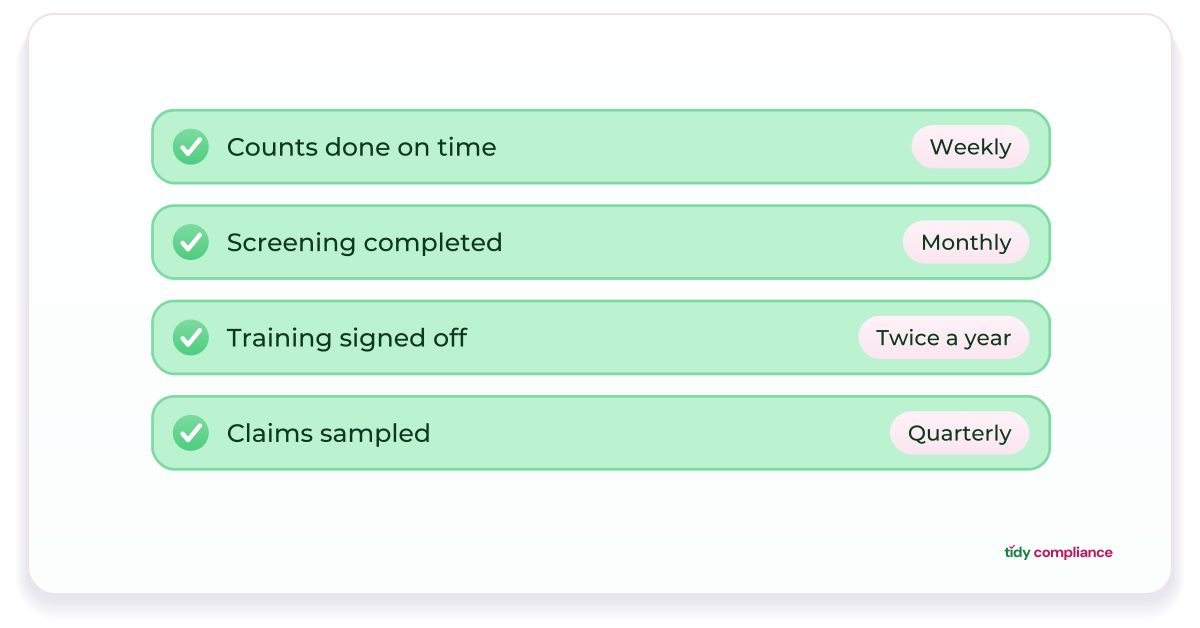
| Expiry calendar | Monthly review | Lapsed licenses and agreements |
| Controlled substance counts | Weekly spot counts | Unexplained discrepancies |
| Staff and vendor screening | Monthly | Employing excluded persons |
| Role-based training | Twice a year | Repeat mistakes at the counter |
| Privacy routine | Yearly risk review, quarterly access check | Patient information incidents |
| Claim samples | Quarterly | Recoupments in payer audits |
| Findable records | Quarterly retrieval test | Slow answers in reviews |
1. Keep One Calendar for Everything That Expires
The easiest findings in any review are things that lapsed. A pharmacist’s license, a technician’s certificate, a vendor agreement and an annual training all expire on different dates, and each is owned by a different person. One calendar with one owner closes that gap.
Do this: List every license, certification, agreement and training date in one place, with reminders at 90, 60 and 30 days.
Avoid this: Leaving renewal dates in each person’s head or in separate folders.
2. Count Controlled Substances on a Routine You Can Defend
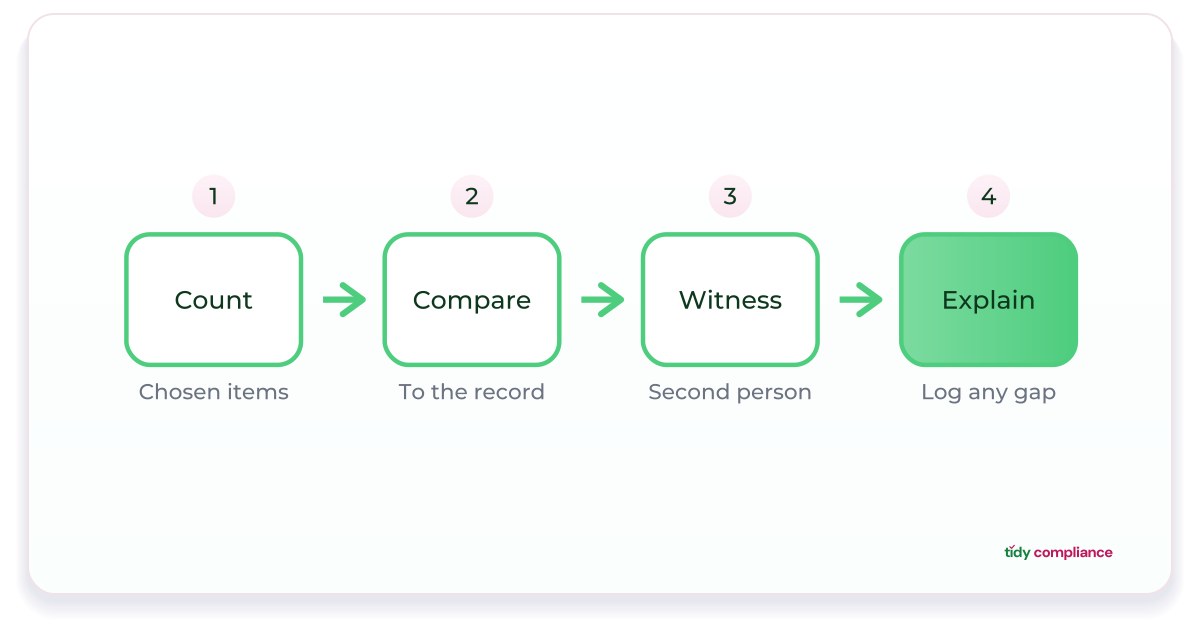
Controlled substance rules come from federal and state sources, so check the intervals that apply to you. Beyond the minimum, a short weekly spot count catches a problem while it is small and the records are fresh. A discrepancy found on Tuesday with a note is a process question. The same discrepancy found six months later is a bigger one.
Do this: Run spot counts on a schedule you set, have a second person witness discrepancies and write down the explanation the same day.
Avoid this: Waiting for the required inventory to find out whether the counts match.
3. Screen Staff and Vendors Every Month
If you bill federal health programs, employing an excluded person can lead to penalties. People appear on the list after they are hired, so a one-time check is not enough. A monthly check takes minutes and the saved result is the proof you will want later.
Do this: Check every employee, contractor and owner against the OIG exclusion list monthly and save the result with the date.
Avoid this: Screening only at hire.
4. Train for the Moments Staff Actually Face
Technicians and cashiers meet privacy and safety questions more often than pharmacists. Give each role a few likely situations and a clear next step. Short refreshers twice a year work better than one long annual session, and a quiz shows whether it landed.
Do this: Use short, role-based sessions with real cases such as a suspicious prescription, a records request or a lost patient bag.
Avoid this: One annual slide deck that everyone clicks through.
5. Protect Patient Information at the Counter and in the System
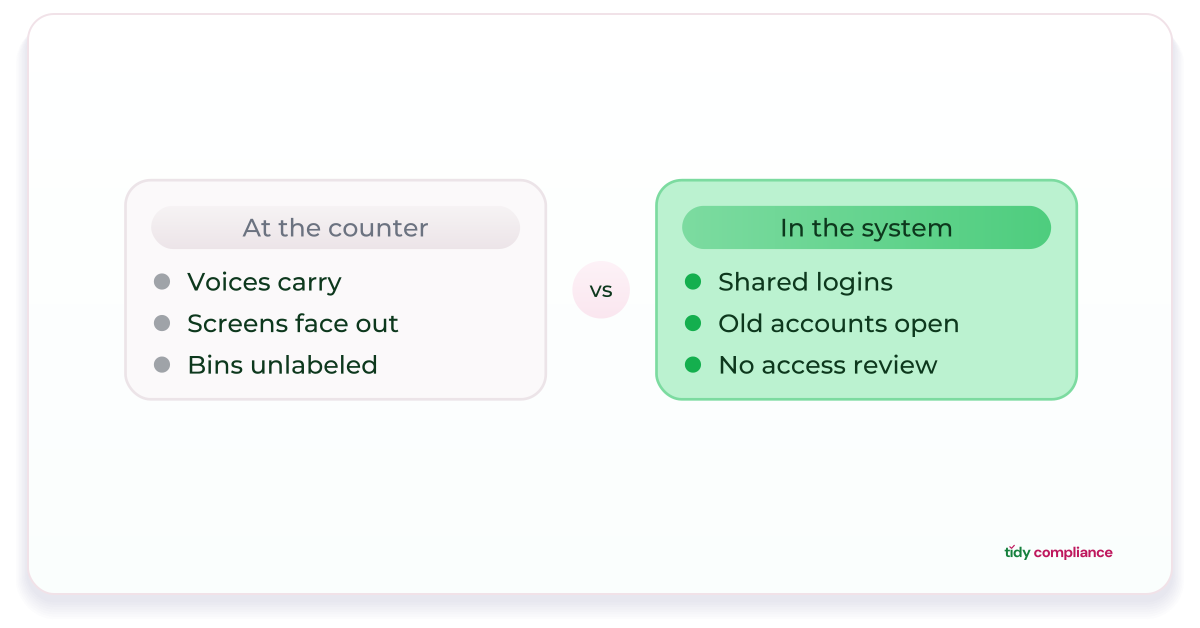
Most privacy incidents in a pharmacy are ordinary: a label left on a counter, a voicemail with too much detail, an old employee account that still works. A yearly risk analysis, an access list that you compare with the staff list each quarter and a shredder close most of that.
Do this: Review a risk analysis yearly, give each person their own login and shred paper with patient details.
Avoid this: Shared logins at the pickup counter and unlabeled recycling bins.
6. Sample Claims Before a Payer Does
Payer audits look for missing signatures, quantity mismatches and early refills. A small quarterly sample finds the pattern before the audit letter arrives. If you see the same error three times, fix the workflow, not the single claim. My pharmacy compliance audit method shows how to sample and score.
Do this: Pull 20 claims each quarter, match them to prescriptions and signatures and write up each error.
Avoid this: Assuming the pharmacy system catches everything.
7. Keep Records Where You Can Find Them in an Hour
A review often starts with a request for records within a day or less. Ask a colleague to request three random records and time it. If it takes more than an hour, reorganize. Software can help once a spreadsheet stops being enough, and I compare the options in my review of pharmacy compliance software.
Do this: Use one system or one folder structure for all proof, with the same names for every month.
Avoid this: Proof split across a binder, an inbox and a personal laptop.
Why the Habits Stick in Some Pharmacies and Fade in Others
Habits stick when three things are true. Someone owns each one by name. The habit sits on a calendar next to work that matters, such as ordering or payroll. And the owner asks about it, even briefly, every quarter. When one of the three is missing, the habit fades within two or three busy months.
The same ones fade first. Weekly counts go early because nothing breaks the week they are skipped. Training refreshers go next, because everyone is busy. Make each habit small: a ten-minute count, a fifteen-minute refresher at the start of a staff meeting. A small habit that happens beats a thorough one that does not.
A Simple Order for Adopting the Habits
Adopt one or two habits per quarter. In the first quarter, build the expiry calendar and start monthly screening. In the second, add weekly counts and the first training refresher. In the third, review privacy and run the first claim sample. In the fourth, test record retrieval and run a self-audit. By the end of the year all seven are in place, and each one has had time to settle before the next arrives. The nine routine checks I use for this are in my pharmacy compliance checklist.
Where Software Helps and Where It Does Not
Tools make habits easier to keep. A system can send reminders for expiry dates, collect training sign-offs, store logs with access limits and show what is overdue. It cannot decide whether a discrepancy is serious or whether a training case fits your staff. A useful test is to ask what the tool does when a person forgets. If it reminds the owner and shows the gap on a dashboard, it supports a habit. If it only stores files, it is a filing cabinet.
If You Run a Single Store With a Small Team
You can keep all seven habits with a few hours a month. Combine the training with a regular staff meeting, run the claim sample yourself and keep the calendar in a shared spreadsheet. Use a one-page version of the audit once a year. The habit that most often gets dropped in a small pharmacy is the monthly screening, because it feels like paperwork. Put it on the same day as your inventory count, and it will happen.
When an incident does happen, resist the urge to add a new rule for every mistake. Ask which of the seven habits would have caught it. Usually the answer is one you already have, and the fix is to do it more reliably.
Measure the Habits, Not Just the Outcomes
Findings and recoupments are lagging signals. By the time they arrive, the problem is old. I prefer four leading measures that you can pull in minutes:
- The number of expired or expiring items found at the monthly sweep.
- The number of overdue training items.
- The error rate in the quarterly claim sample.
- The minutes it takes to produce three random records.
Report them to the owner on one page each quarter. A number moving the wrong way tells you where to look.
Share the results with the whole team once a quarter, in plain words. When technicians see that a monthly sweep found three expired items and that the number went down after the last refresher, they connect the habit to the result. People keep routines that visibly work, and they drop routines that feel like paperwork for its own sake.
What to Do the Week After a Near Miss
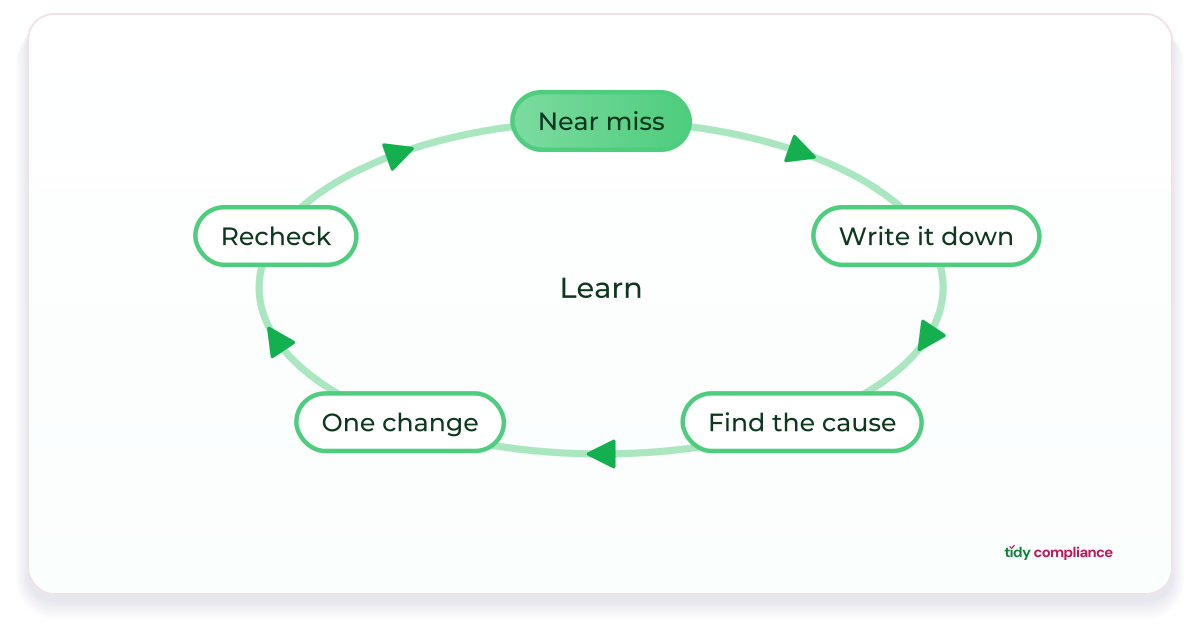
A near miss is a free lesson: a wrong strength caught at the counter, a delivery that arrived short, a log found blank on a Monday. Write down what happened in three lines, name the habit that caught it or should have, and decide on one small change. Share it at the next staff meeting without naming anyone. Pharmacies that do this build a short history of fixes, and that history is useful evidence when a reviewer asks how you improve.
Keep the list to one change per near miss. Teams that answer every incident with five new rules end up with procedures nobody can follow, and the habits above get buried.
How to Choose Where to Start
Pick the habit that fits your biggest known gap. If you have never listed your expiry dates, start there. If counts are only done at the required interval, add the weekly spot count. If you do not know where you stand, run an audit first. Then add habits on a calendar with an owner, and let tools carry the reminders.
Questions About Pharmacy Compliance Best Practices
What Is the Single Most Useful Pharmacy Compliance Habit?
A single expiry calendar for licenses, certifications, vendor agreements and training. It takes an hour to build, and it prevents the most common quiet failure. If I could ask a client to adopt only one habit, this would be it.
How Do I Get Busy Staff to Keep Up the Logs?
Put the log where the work happens, keep it to a few fields and review it weekly. A temperature log on the refrigerator door gets filled in. A log in an office binder does not. Show staff the reason once, and they usually keep the habit.
Do Small Pharmacies Need Written Procedures?
Yes, but short ones. A one-page procedure for each routine task is enough: who, how often, what record to keep. Long manuals are rarely read, and an out-of-date manual is worse than none.
How Often Should I Review Pharmacy Policies?
Once a year, and after any change in services, systems or rules. Put the review dates on the same calendar as licenses so they do not slip.
What Should I Do When a Staff Member Makes a Mistake?
Record the facts, fix the immediate problem, ask what in the process allowed it and change the process. Blame teaches people to hide errors, and hidden errors are what turn into findings.
Are Best Practices the Same as Legal Requirements?
No. Best practices are habits that help you meet requirements. The requirements themselves come from your state board, federal agencies and your contracts, so check them with your board and your attorney.
How Do I Know My Habits Are Working?
Measure them. I track expired items found at the monthly sweep, overdue training, open audit findings and the time it takes to produce three random records. Falling numbers mean the habits stick.
Sources
Disclaimer: This article is for general information only and isn’t legal, financial or tax advice. Treat figures as estimates from typical work and confirm details with your providers before you act.
Was this guide helpful?
Thanks for your feedback.
Odessa Whitfield
Odessa leads the Tidy editorial team and works with the compliance consultants to turn real client projects into practical guides on regulations, frameworks, policies and audit preparation. Before joining Tidy, she worked in compliance and risk roles, writing and maintaining policy sets for regulated organizations. Every article goes through a consultant who has done the work in practice, and she updates guides when a rule, framework or tool changes. She works remotely from the United States.