Quick Summary
- Eleven checks cover filings, conflicts, fees, marketing, valuation, custody, trading, communications, vendors, training and testing.
- For each point, find the policy and one real example of it in use, and mark the point open if you cannot find both in ten minutes.
- Fix missing records first, then unwritten rules, then outdated policies.
- The checklist organizes your work and does not replace advice from your securities counsel.
Most compliance gaps in private equity firms are dull. A filing working paper that cannot be found, a fee allocation nobody wrote down, a personal trade report from last quarter that is still blank. A checklist catches these while they are cheap to fix.
I use a version of this list at the start of every private equity compliance consulting project, because it shows within a day whether a firm needs a light tidy-up or a full review. It is a compliance aid, and it does not replace advice from your securities counsel on what the rules require for your situation.
How to Use This Checklist
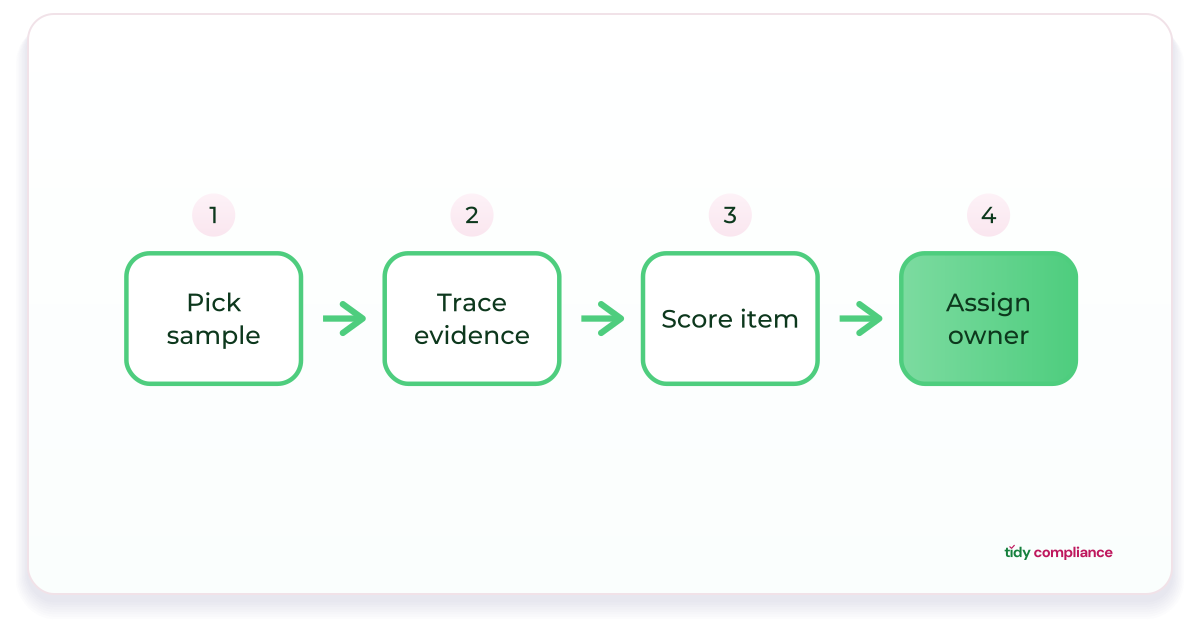
Go through the eleven points with the person who runs compliance and the people who own each area. For every point, look for two things: the written policy and one real example of it in use. If you cannot find both in ten minutes, mark the point open. Open items go on a list with an owner and a date.
| Check | What to verify | Where the proof lives |
|---|---|---|
| 1. Registration and filings | Forms are current and each number traces to a source | Filing calendar, working papers |
| 2. Compliance program | Written policies, named officer, annual review done | Policy manual, review report |
| 3. Conflicts register | Each conflict is listed, disclosed and approved | Register, fund documents |
| 4. Fees and expenses | Allocation rules written and applied the same way | Expense policy, allocation memos |
| 5. Marketing review | Materials reviewed, numbers sourced, finals stored | Approval log, source files |
| 6. Valuation | Method written, approvals recorded | Valuation policy, committee notes |
| 7. Custody and cash | Audit delivery on time, wire approvals and call-backs | Audit reports, wire log |
| 8. Personal trading and MNPI | Reports and approvals are complete and reviewed | Trade reports, restricted list |
| 9. Communications and records | Allowed channels defined and records kept | Retention schedule, archive |
| 10. Vendors and training | Providers reviewed, staff trained by role | Vendor files, training log |
| 11. Testing and follow-up | Controls tested, issues tracked to closure | Test results, issue log |
The Eleven Checks in Detail
Each check below says why it matters, how it goes wrong and what to look for.
1. Registration and Filings
Registered advisers file Form ADV and update it at least once a year, and many private fund advisers also file Form PF. The common gap is a number that cannot be traced. Keep a calendar, a preparer, a reviewer and the working papers.
- The filing calendar lists every form and due date
- Each figure links to a source file
- Answers match your fund documents and marketing
2. The Compliance Program Itself
Registered advisers need written policies and procedures, a designated chief compliance officer and a review at least once a year. Check the date of the last review, whether it was written down and whether it led to changes. A review that changed nothing, year after year, is suspicious.
- The officer is named and has time and authority for the job
- The annual review report exists and has follow-up items
- Policies describe what the firm really does
3. Conflicts Register
List each conflict, where it is disclosed, who approves it and how it is monitored. Typical entries are deal allocation between funds, fees from portfolio companies, affiliate services and co-investments. The register is a short document that answers many investor questions.
- Each conflict has a disclosure location and an approver
- New conflicts are added when a deal or fund changes
- The register feeds the annual review
4. Fees and Expenses
This is the area where investors and examiners ask the sharpest questions. Write the rules for allocating expenses between funds, portfolio companies and the firm, and for treating broken-deal costs and fee offsets. Then check a sample of recent expenses against the rules.
- The allocation policy is written and dated
- A sample of expenses matches the policy
- Unusual items have a short memo explaining the decision
5. Marketing Review
Decks, websites, emails and questionnaire answers all describe your firm. Track who drafted each item, who reviewed it and where its numbers came from, and store what you sent. Performance claims need particular care, and your counsel should review your approach to them.
- An approval log exists with names and dates
- Every figure links to a source
- Old materials are retired when numbers change
6. Valuation
Describe how you value each type of holding, who approves values and what happens when a value moves sharply. The auditor and your investors will ask for the method, so the answer should be the same from quarter to quarter.
- A valuation policy covers each asset type
- Approvals are recorded with the inputs used
- Changes in method are explained and approved
7. Custody and Cash Controls
Check that audited statements reach investors on time where your approach relies on an audit. Then look at the cash side: who starts and approves wires, how capital calls are verified and how a change of bank details is confirmed. Payment fraud tends to start with a convincing email, so a call-back to a known number is a cheap defense.
- Audit delivery dates are on the calendar
- Two people approve every wire
- Bank detail changes require a call-back
8. Personal Trading and MNPI
Deal teams hold information that can move a market. Your code of ethics should say who must report personal trades, who approves them and how restricted lists work. Review a sample of reports and approvals for gaps and late filings.
- Staff have signed the current code of ethics
- Trade reports are complete and reviewed by someone other than the trader
- A restricted list exists and is updated for live deals
9. Communications and Records
Decide which channels staff may use for business and how those messages are kept. The risk is the personal phone and the chat app that nobody archived. Write the rule, train people and test it with a sample. Tools that archive communications can help, and my notes on private equity compliance software cover options.
- The allowed channels are written down
- A retention schedule names each record type and owner
- A sample of messages is retrievable on request
10. Vendors and Training
Fund administrators, auditors, legal counsel, technology providers and consultants all touch your data and your obligations. Keep a list, a risk rating and a review date for each. Train staff by role, and keep the completion records.
- The vendor list is current with owners and ratings
- Critical vendors have been reviewed in the last year
- Training is assigned by role and tracked
11. Testing and Follow-Up
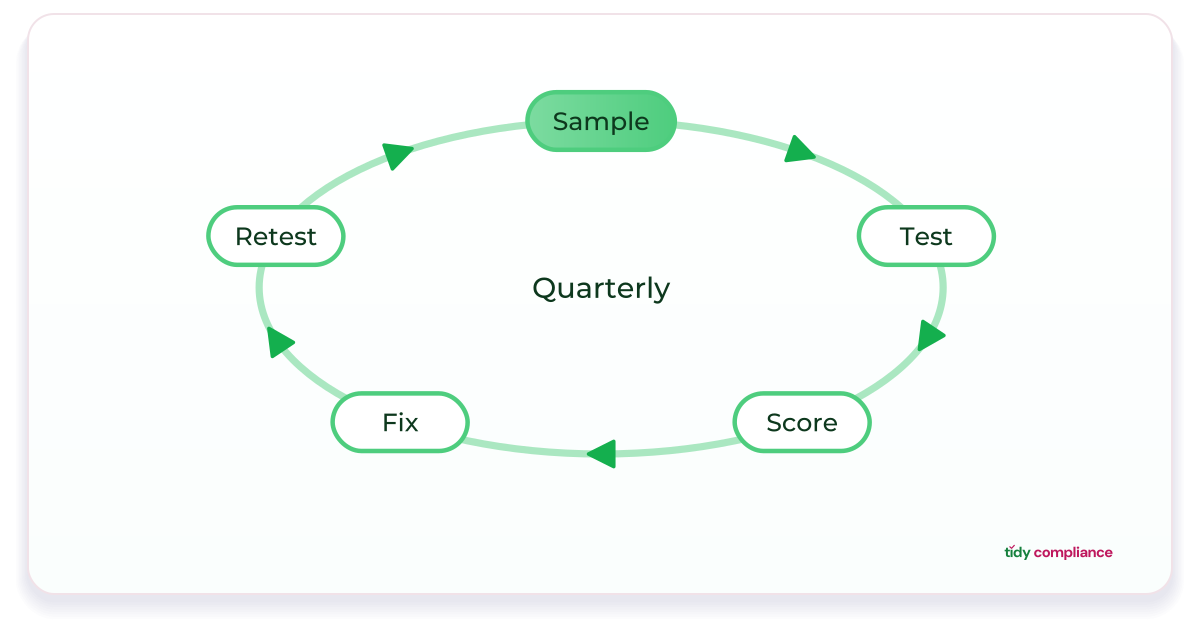
Choose a few controls each quarter, check a sample against the policy and write down what you found. Track every issue to closure. The annual review then draws on a year of evidence instead of memory.
- A test plan covers each area at least once a year
- Issues have an owner and a due date
- Closed issues show the fix and the date
Scoring Your Results
Mark each point green if you found the policy and a real example, yellow if one is missing or outdated and red if both are missing. Four or more yellow or red points suggest a deeper review before your next filing or investor meeting. My private equity compliance guide explains how the pieces connect, and it helps you read the result.
Fix reds first, and give every item an owner and a date. Many gaps take an hour once someone owns them. Bigger projects, such as a new valuation policy or an archive, go on a calendar. To decide who owns what in the long run, use the private equity compliance framework.
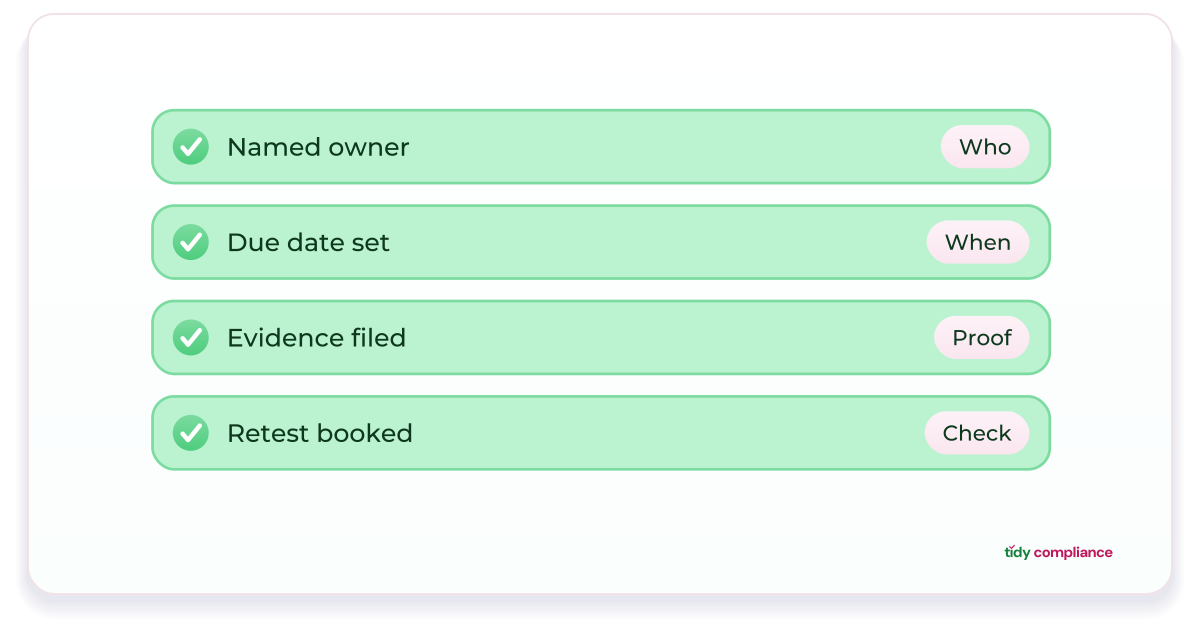
A worked example helps. Picture a twelve-person manager with two funds. The review finds that filing working papers exist for one fund only, the fee policy was written two years ago and no longer matches how broken-deal costs are split, and personal trade reports are collected but nobody signs off on them. That is three open items, each with a different owner. The filing papers are a one-week job for the finance lead. The fee policy needs a partner decision, so it goes on the next partner meeting agenda. The trade report review is assigned to the chief compliance officer, with a monthly sign-off. After a month, the firm can show a plan, owners and the first closed item, and that story is much better than an empty folder.
Repeat the exercise with a fresh sample each quarter. Choose different deals, different employees and different months, so you do not keep checking the files you already cleaned up.
How to Choose What to Fix First
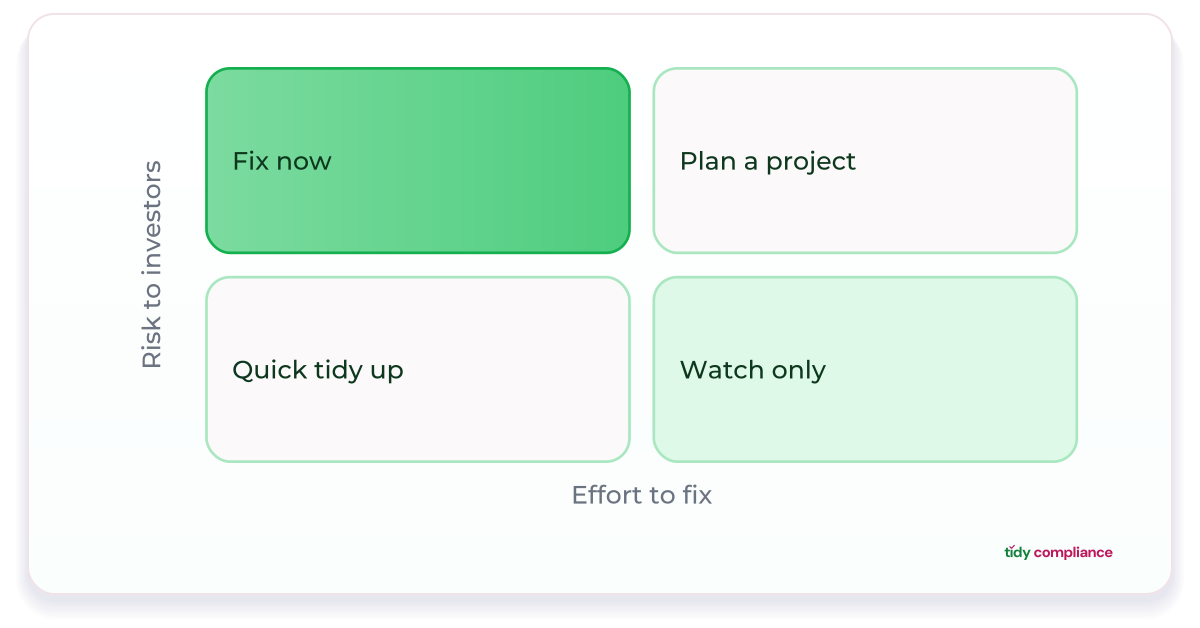
Start with items that would be hardest to explain to an examiner or an investor. Fees, trading reports and filing sources come first. Then fix the unwritten rules, and finally refresh outdated documents.
- Recover missing records and working papers this week.
- Write the fee, trading and communications rules next.
- Schedule testing and the annual review with owners and dates.
- Repeat the checklist every quarter for high-risk points and once a year for the full list.
Keep the finished checklist with its evidence in one folder, dated, so next quarter you can compare results and see what moved.
Questions About the Private Equity Compliance Checklist
What Is a Private Equity Compliance Checklist?
It is a short list of areas and records that you can use to check whether your firm's practices and files match the rules and promises that apply to you. It helps you find gaps before a filing, an investor review or an examiner's request.
Is This Checklist Legal Advice?
No. It organizes the work and helps you find gaps. Requirements depend on how your firm is registered, where you operate and what your fund documents say, so confirm them with your securities counsel.
How Often Should I Run Through It?
Once a quarter for the high-risk points such as fees, trading and communications, and once a year for the full list. Run it also after you launch a fund, add a service provider or change your systems.
Who Should Complete the Checklist?
The chief compliance officer coordinates it, and the owners of each area supply the evidence. An outside reviewer adds a fresh view, especially for points where the person who runs the process also marks it.
What If I Find Many Open Items?
Rank them by risk and by effort, assign an owner and a date and start with the items that would be hard to explain in an exam or an investor review. A written plan with dates is a good sign in itself.
Does a Small Firm Need All Eleven Points?
Yes, though each point can be lighter. A two-person manager may have a one-page fee policy and a short expense memo. The point is that the rule is written, applied and recorded.
What Evidence Should I Keep for Each Point?
The policy, a sample of the policy in action, the owner's name and the date of the last review. For testing, keep the sample, the result and what you changed.
Sources
Disclaimer: This article is for general information only and isn’t legal, financial or tax advice. Treat figures as estimates from typical work and confirm details with your providers before you act.
Was this guide helpful?
Thanks for your feedback.
Odessa Whitfield
Odessa leads the Tidy editorial team and works with the compliance consultants to turn real client projects into practical guides on regulations, frameworks, policies and audit preparation. Before joining Tidy, she worked in compliance and risk roles, writing and maintaining policy sets for regulated organizations. Every article goes through a consultant who has done the work in practice, and she updates guides when a rule, framework or tool changes. She works remotely from the United States.