Quick Summary
- Total cost is gap assessment plus documents, remediation, tools and yearly upkeep, and scope multiplies every one of them.
- Published provider estimates for a company of up to 50 people put first-year spending between roughly $43,500 and $115,000 when the line items are added up.
- Remediation is the largest and least predictable line, so get the gap list before you set a budget.
- Ask for ranges with assumptions, because these figures come from vendors who sell the services.
The honest answer to "what does NIST 800-171 cost?" is a range, and the range is wide because your scope and your starting point drive it. I get asked for a single number at least once a week. The most useful thing I can give you is the formula and the line items, so you can see where your own number will land. This is also the first question I cover in NIST 800-171 compliance consulting calls.
The figures below come from published provider estimates and DoD cost estimates, and they were current when I wrote this. Providers sell these services, so treat the numbers as planning ranges. Confirm what applies to your contracts with your counsel.
The Cost Formula
I use one simple formula for a first-year budget, and a second for every year after that.
| Period | Formula |
|---|---|
| First year | Gap assessment + documents and SSP + remediation + tools + your own staff time |
| Every year after | Tools + sustainment (reviews, training, updates) + any formal assessment fee |
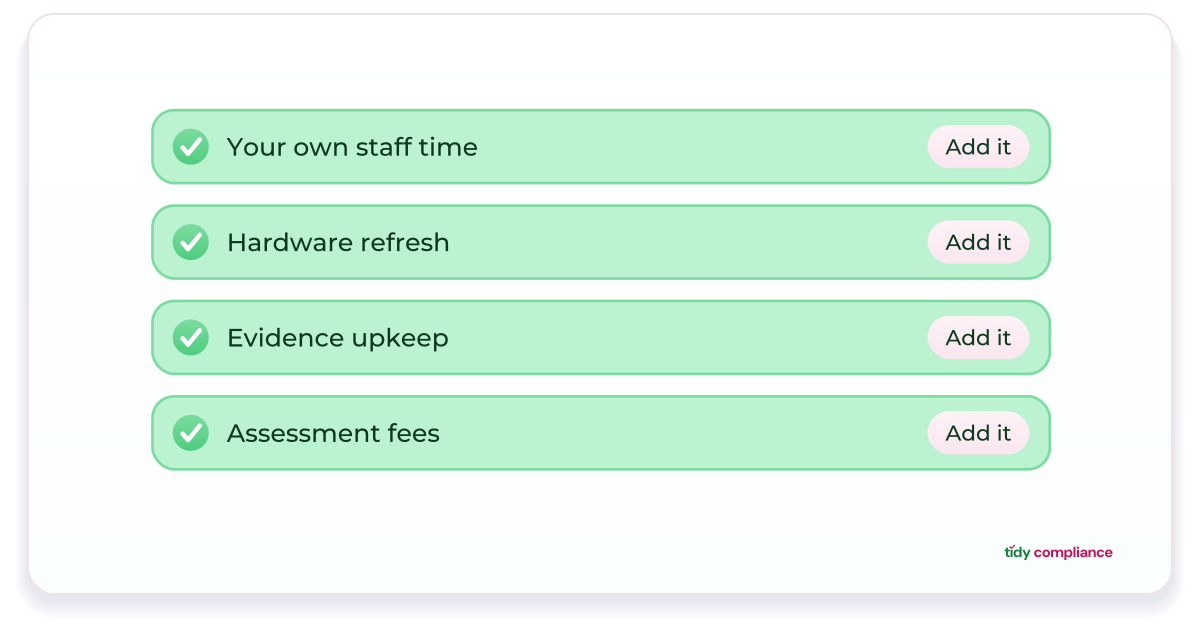
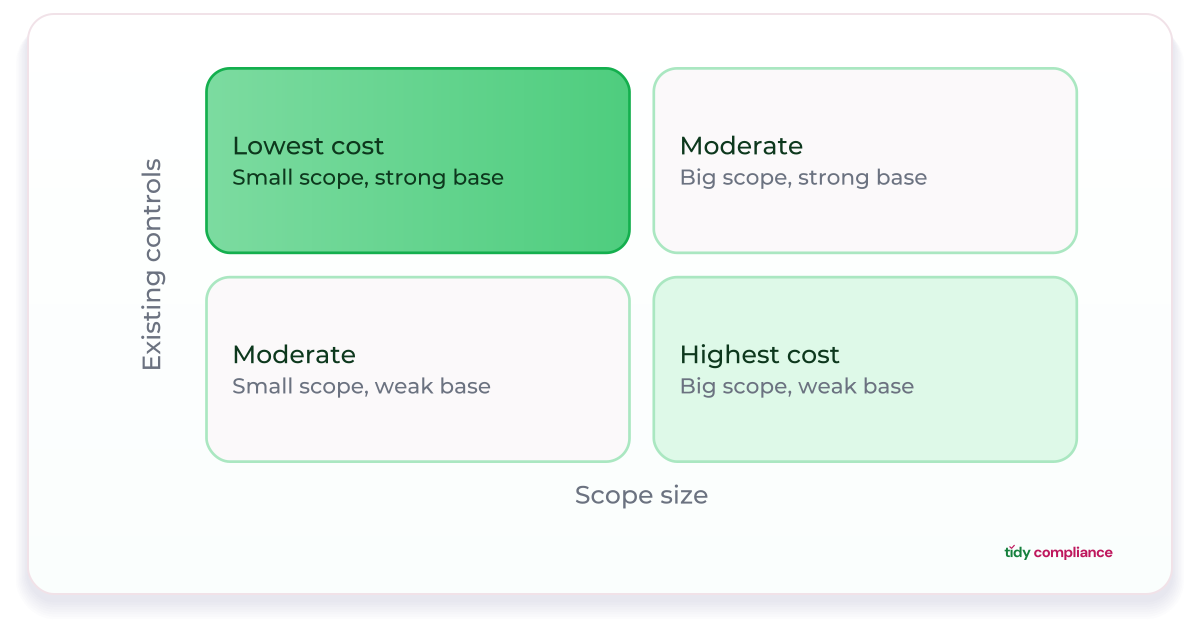
Your own staff time is the line most budgets forget. A project owner spending a few hours a week for several months is a real cost, even if no invoice arrives. Scope then multiplies the whole formula. The fewer systems and people that touch CUI, the smaller each line becomes, which is why the first step in my NIST 800-171 compliance guide is mapping where CUI lives.
What Each Line Item Costs
The table below shows provider estimates published by IBSS, a company that sells these services, for a company of up to 50 employees and for one with 51 to 250 employees. Bands overlap and vary by provider, so use them as anchors for a conversation.
| Line item | 1 to 50 employees | 51 to 250 employees |
|---|---|---|
| Gap assessment (optional) | $3,500 to $10,000 | $10,000 to $20,000 |
| Documents and SSP | $10,000 to $20,000 | $20,000 to $30,000 |
| Remediation and implementation | $20,000 to $60,000 | $60,000 to $100,000 and up |
| Security tools (annual) | $10,000 to $25,000 | $25,000 to $50,000 and up |
| Annual sustainment | $5,000 to $10,000 | $10,000 to $15,000 |
Gap assessments show the widest spread. Some providers publish a fixed-scope snapshot for under $1,000, while a full evidence-based review for a larger or multi-site environment can pass $20,000. The price difference mostly reflects depth: a questionnaire is cheap, and testing each requirement against its assessment objectives takes real hours.
A Worked Example: 25 People, One Cloud Environment
Here is how the formula plays out for a made-up contractor with 25 employees, 10 of whom handle CUI. The contractor uses one cloud file service, a managed IT provider and no dedicated security person. I built the example from the small-company bands above, so it shows how pieces add up and is not a quote.
| Line item | Low end | High end |
|---|---|---|
| Gap assessment | $3,500 | $10,000 |
| Documents and SSP | $10,000 | $20,000 |
| Remediation | $20,000 | $60,000 |
| Tools (first year) | $10,000 | $25,000 |
| First-year total | $43,500 | $115,000 |
| Yearly cost after (tools plus sustainment) | $15,000 | $35,000 |
The low-end version assumes the contractor already has multi-factor authentication, an IT provider that can document its controls and a team that can write procedures with guidance. The high-end version assumes a flat network, many shared accounts and a lot of manual evidence. Most real companies sit between the two, and one or two items that nobody planned for, such as replacing old hardware that cannot be configured safely, add cost late in the project.
Notice what the example leaves out: formal assessment fees, new hardware and the hours your own people spend. Add a line for each of those when you build your version, even if the amount is only an estimate. A budget with visible assumptions is far easier to defend to your leadership than one number with no explanation.
What Moves Your Number Up or Down
Five things change the bill most. Scope comes first, followed by your starting security maturity, because a company with documented policies and basic controls pays less than one starting from nothing. Next come the number of locations and cloud services, the quality of your IT provider's documentation and the speed of your own approvals. Slow decisions stretch consulting hours.
- Fewer systems and users with CUI lowers every line.
- Existing policies and an IT provider with good records lower the documents line.
- Multi-site and hybrid setups raise the gap assessment line.
- Old hardware and shared accounts raise remediation.
- Broad platforms raise tools cost, and focused tools can lower scope.
If your top concern is choosing software without overspending, the NIST 800-171 compliance tools comparison lists published prices and the kind of problem each tool solves.
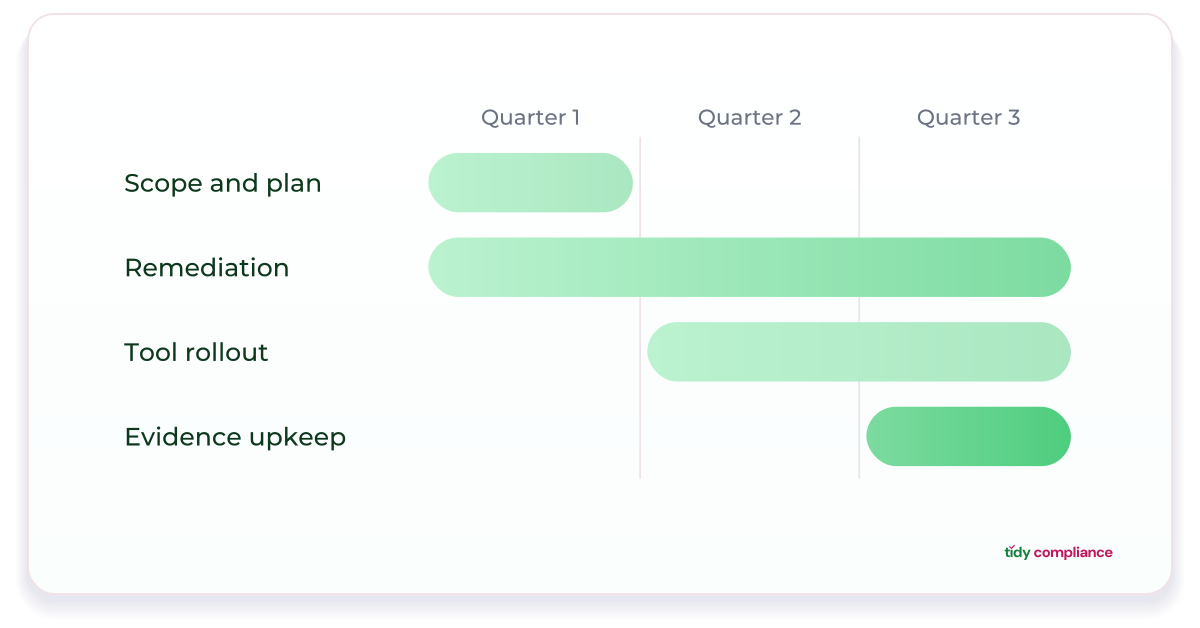
Timing affects cost as well. Work spread over two or three quarters lets you pay for remediation in steps and reuse your own staff for easy fixes. A rush before a contract deadline pushes you toward premium consulting rates and fast tool purchases, and it leaves less time to collect evidence that shows controls running over time. I tell clients to treat the deadline as the end of the plan, not the start.
Hardware deserves its own mention. Older laptops, firewalls and printers sometimes cannot support the encryption or logging a requirement asks for, and replacing them is a real expense. Inventory your devices early, and flag anything near the end of its life, so the replacement cost appears in your first budget and not in month five.
Assessment Costs on Top of Preparation
Preparation and assessment are separate budgets. The DoD cost estimates in the CMMC program rule put a Level 2 self-assessment at about $37,196 for a small entity over a three-year cycle, and a Level 2 certification assessment by a third party at about $104,670 for a small entity over the same cycle. Those figures cover assessment activities and exclude implementation, and they apply to the CMMC program, not to every contract that references NIST 800-171.
Which assessment applies to you depends on your contract and the program rules at the time. Check the current status before you budget, and do not assume the numbers carry over. If you plan for a formal assessment, my article on the NIST 800-171 compliance audit shows the phases that decide how smooth it goes.
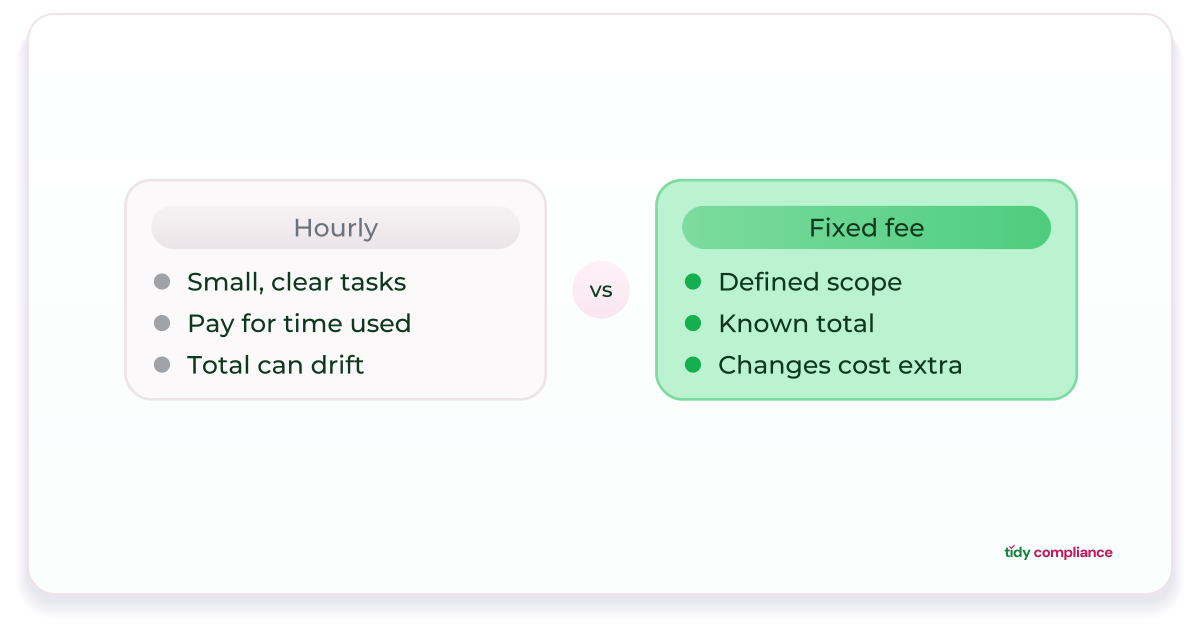
Consulting itself can be priced several ways. Hourly rates suit small, uncertain tasks, a fixed fee suits a defined deliverable such as a gap assessment and a retainer suits the yearly upkeep. Whichever form you choose, ask for the number of hours the provider assumed, because a fixed fee that hides a few hours of work is easy to compare, while one that hides forty is not.
One cost surprises people late: evidence over time. Some requirements are only convincing when you can show a control ran for months, such as quarterly access reviews or monthly log checks. If you start the clock late, you either wait or you present thin evidence. Starting the recurring controls early costs little and shortens the calendar more than almost any other step, and it spreads the staff time across the year instead of stacking it before a review.
Where I See Companies Save Money
The savings I see most often are not clever. Companies that map scope early avoid fixing systems that never needed it. Those that write the System Security Plan from their real setup avoid a second draft. And companies with a small team save by using the settings they already pay for before buying new tools, such as the security features in their existing email and identity platform.
Small companies in particular can often cut the remediation line in half by moving CUI into an enclave, which I describe in NIST 800-171 compliance for small business. The tradeoff is some change in how people work, and a rule for moving files in and out.
How to Build Your Own Budget
Also decide in advance who signs off on spending. Many projects stall when a needed purchase waits weeks for approval, and the delay costs more in consulting time than the purchase itself. Agree on a limit for the project owner, and a quick path for anything above it.
A budget is a decision tool, so keep it short enough to update every quarter.
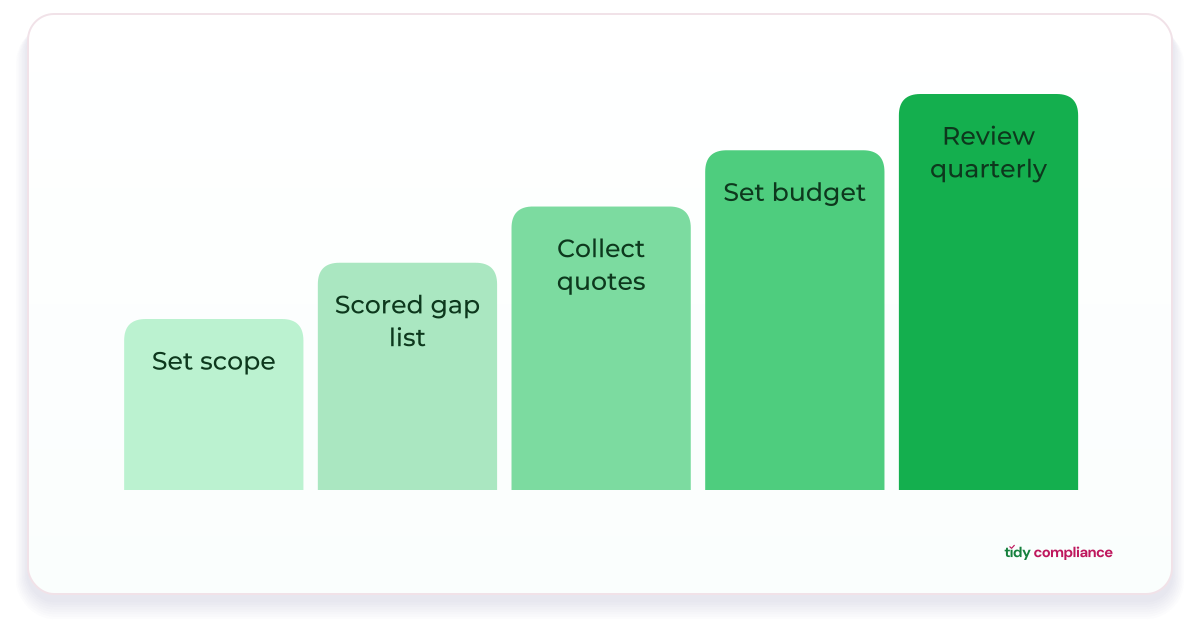
Start with scope, then ask for a scored gap list before you commit money to remediation. With that list, each line becomes a quote request with clear assumptions. Add a contingency of 15 to 25 percent for hardware, delays or an extra requirement that shows up in testing. When you compare quotes, check what each one includes and who owns the documents.
Questions About NIST 800-171 Compliance Costs
How Much Does NIST 800-171 Compliance Cost for a Small Company?
Published provider estimates for a company of up to 50 people put a first-year program in the tens of thousands of dollars, with a wide range because scope and starting point differ. Treat any single number with caution and ask for a range that comes with the assumptions behind it. The worked example in this article shows how the pieces add up.
What Is the Biggest Cost Driver?
Remediation, which is the work of fixing the gaps, and behind it, scope. A company with CUI on a few devices fixes far less than one with CUI everywhere. Decide where CUI lives before you ask anyone for a quote.
Is a Gap Assessment Required?
No. It is optional, and some companies run a self-review with their own staff. An outside gap assessment costs money, but it often pays for itself by showing what to fix first and what to leave alone. Prices range widely, from a fixed-scope snapshot to a full evidence-based review.
Are There Ongoing Costs After the First Year?
Yes. Expect tool subscriptions, access reviews, log monitoring, training, updates to the System Security Plan and time for annual reviews. Published estimates put sustainment for a small company in the low tens of thousands of dollars per year, depending on tools.
Do Assessment Fees from the Government or a Third Party Come on Top?
Depending on your contract, a formal assessment can add fees. The DoD estimates in the CMMC rule list assessment activity costs separately from remediation, and they differ by level and company size. Check which assessment applies to you before you set a budget.
Can I Reduce the Cost by Doing the Work Myself?
You can, especially the scoping, the review and the documents, if you have someone with time and the right skills. Outside help tends to pay off on the technical gaps and when the first draft of the System Security Plan has to match a complex environment.
How Do I Compare Quotes?
Ask each provider what is in scope, how many systems and users they assumed, which deliverables you receive and who owns them afterward. A low quote that excludes the System Security Plan or remediation support is not comparable with a higher one that includes them.
Sources
- IBSS, NIST SP 800-171 assessment cost: what defense contractors pay in 2026
- The Defense Compliance Report, NIST 800-171 gap analysis cost and steps
- NIST SP 800-171 Revision 2
Disclaimer: This article is for general information only and isn’t legal, financial or tax advice. Treat figures as estimates from typical work and confirm details with your providers before you act.
Was this guide helpful?
Thanks for your feedback.
Odessa Whitfield
Odessa leads the Tidy editorial team and works with the compliance consultants to turn real client projects into practical guides on regulations, frameworks, policies and audit preparation. Before joining Tidy, she worked in compliance and risk roles, writing and maintaining policy sets for regulated organizations. Every article goes through a consultant who has done the work in practice, and she updates guides when a rule, framework or tool changes. She works remotely from the United States.