Quick Summary
- Strong risk and compliance programs run on a few habits repeated on a schedule, not on big one-off projects.
- Named owners and written scoring scales fix more problems than any new tool.
- Test controls, keep evidence in one place and map one control to many requirements.
- Report on one page each quarter and end with a decision you need.
Organizations with calm audits rarely have better tools than the rest. They have habits: someone owns each item, scores follow a written rule, controls are tested and leaders see one page. In my risk and compliance consulting work, I can usually tell how a program will fare in an audit by asking who owns the top three risks and when each was last reviewed.
Here are ten habits, each with a do and an avoid. They are general practices, not legal advice, and your obligations depend on your industry, so confirm specifics with your regulator or attorney.
The Ten Habits Side by Side
| Habit | How often | Main problem it prevents |
|---|---|---|
| Named owners | Review at role changes | Risks nobody manages |
| Cause, event, result wording | When adding a risk | Vague entries |
| Written scoring scale | Yearly review of scale | Opinion-based scores |
| One control library | Update with each change | Duplicate testing |
| Independent testing | Quarterly or yearly per control | Untested assumptions |
| Findable evidence | Each control cycle | Audit scrambles |
| Quarterly top-risk review | Quarterly | Stale registers |
| Early indicators | Monthly | Surprises |
| Assessment and checklist | Yearly and monthly | Gaps between reviews |
| One-page report | Quarterly | Lack of decisions |
1. Give Every Risk and Control a Named Owner
A risk without an owner is a statement, not a plan. When something goes wrong, you want to know whom to call. When a quarter ends, you want to know who updates the score. Review owners every time people change roles, because the register ages fastest at that moment.
Do this: Put a person, not a team, next to every register entry and every control, with a backup.
Avoid this: Assigning a risk to a department or leaving the owner field blank.
2. Write Risks as Cause, Event and Result
A well-written risk points at its control. "Because access is not reviewed, a former contractor could view client files" tells you to build an access review. Vague labels invite long debates and short actions.
Do this: Phrase each entry like this: because of X, Y could happen, leading to Z.
Avoid this: Labels such as "data risk" or "vendor risk" that no control can address.
3. Score With a Written Scale
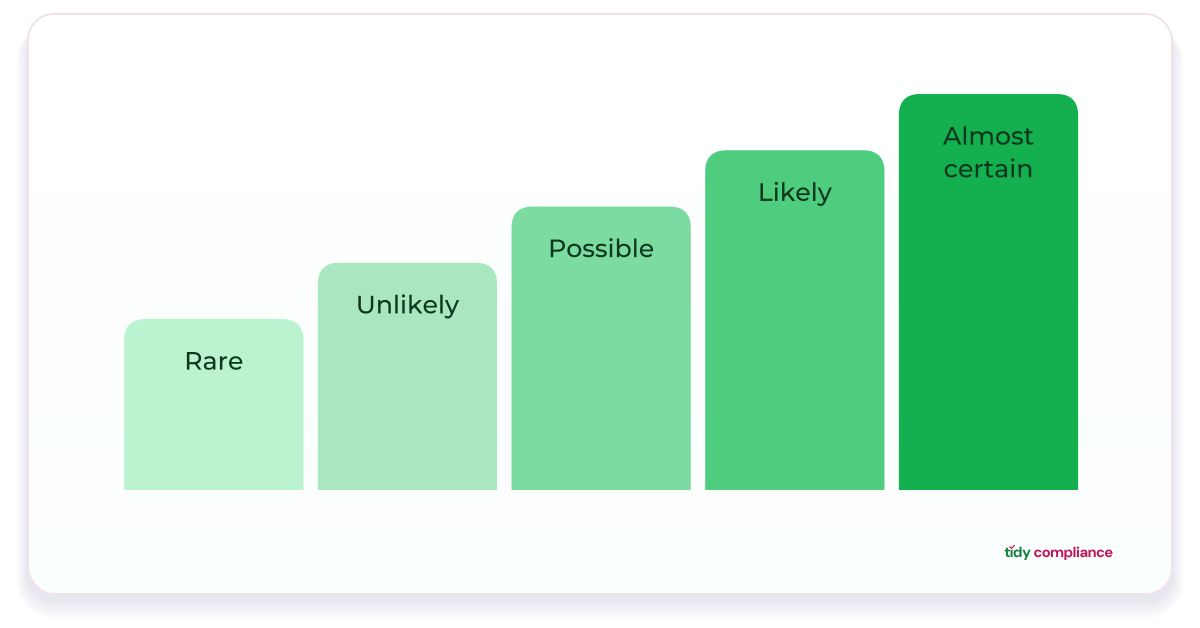
When scoring is a matter of opinion, the loudest voice wins. A written scale lets two people reach nearly the same number and lets you compare quarter to quarter. The scoring formula I use is in my guide to the risk and compliance framework.
Do this: Define each level of likelihood and impact in words and examples, and use the same formula every time.
Avoid this: Scores that depend on who is in the room.
4. Map One Control to Many Requirements
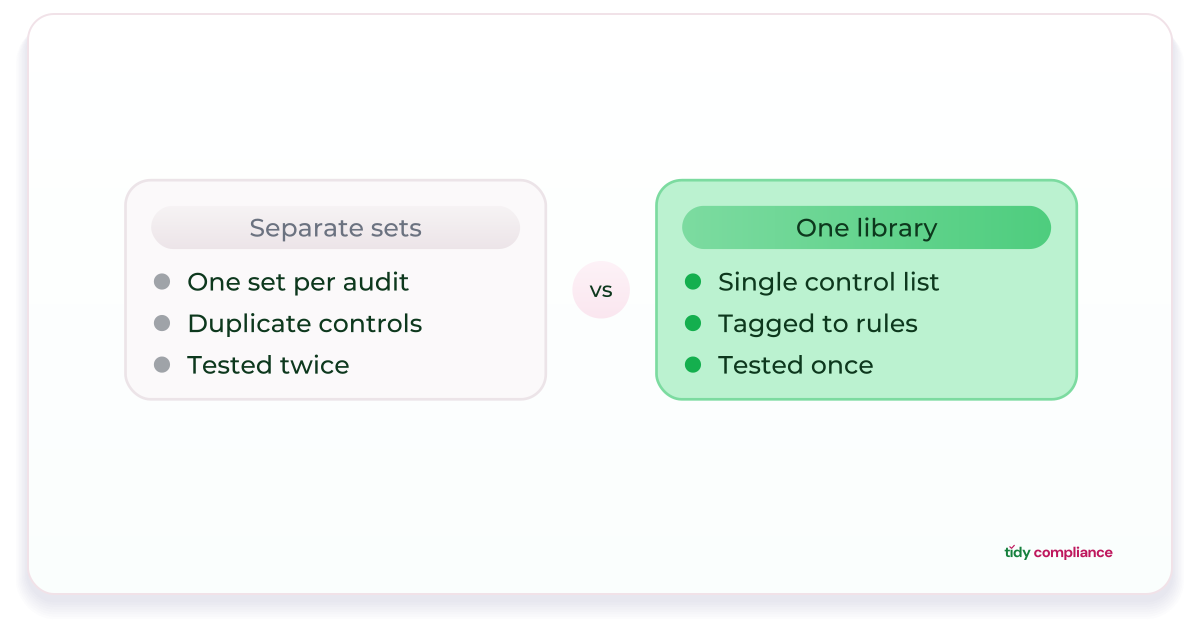
The largest saving in a mature program comes from testing once and reusing evidence. If you face two or three frameworks, a shared library cuts duplicate work sharply. It also shows gaps: a requirement with no control mapped to it is a finding waiting to happen.
Do this: Keep a single control library and tag each control with every rule, standard and contract clause it supports.
Avoid this: Separate control sets for each audit.
5. Test Controls, Don't Assume Them
A control that has never failed a test may never have been tested. Failed tests are useful, because they lower the control score and push a fix. Test high-risk controls quarterly and others yearly.
Do this: Set a sample, a method and a pass rule for each control, and have someone independent run the test.
Avoid this: Marking a control effective because it exists on paper.
6. Keep Evidence Where You Can Find It
Evidence collected in the moment is complete and cheap. Evidence rebuilt months later is partial and costly. If you are choosing a system for it, I compare the main options in my review of GRC software, including what each one leaves out.
Do this: Use one location and one naming pattern for proof, and attach it when the control runs.
Avoid this: Hunting through inboxes at audit time.
7. Review the Top Risks Every Quarter
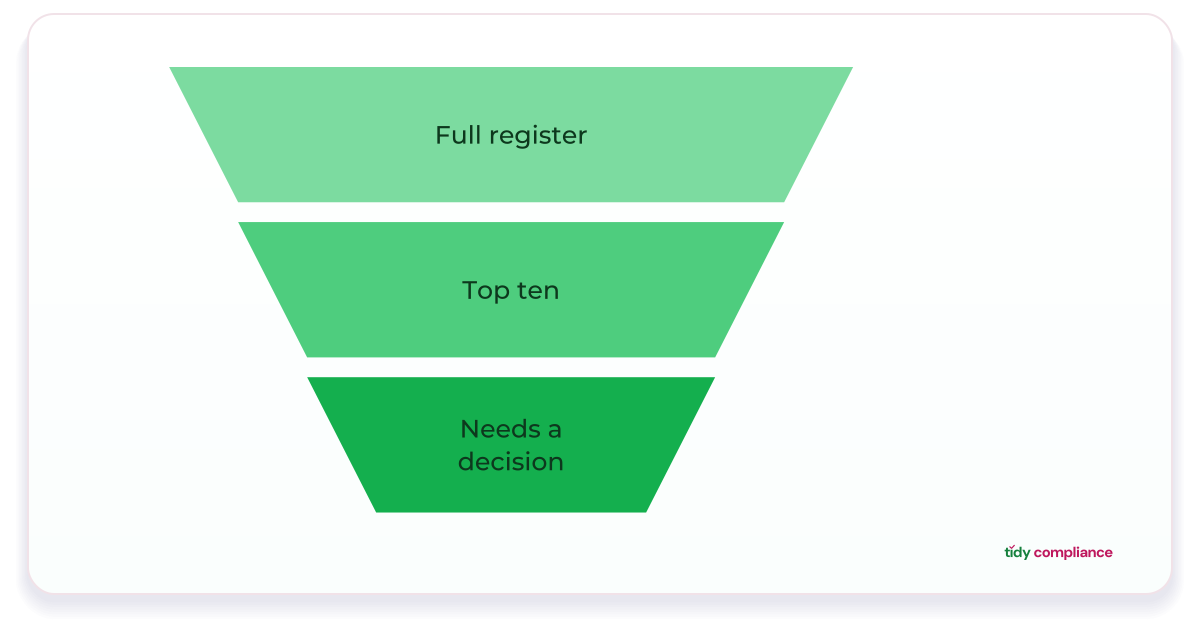
Risks move. A new vendor, a staffing change or a new rule can shift a score in weeks. A quarterly look keeps the register current and gives leadership a rhythm. The review should end with decisions, not just updates.
Do this: Hold a 45-minute review with the sponsor, look at the top ten and decide on actions with dates.
Avoid this: A yearly review where the register is updated once and forgotten.
8. Track Indicators That Move Early
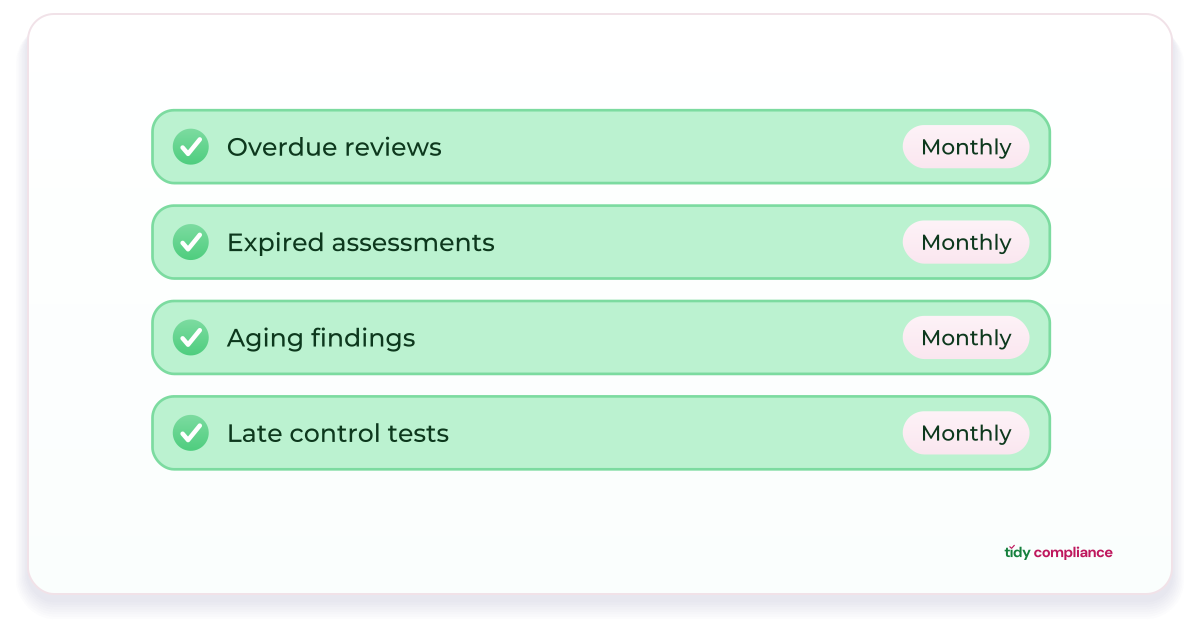
Lagging measures tell you what already went wrong. Leading ones tell you where to look. I like measures you can pull in minutes, because those are the ones that actually get updated.
Do this: Pick three to five measures such as overdue reviews, expired vendor assessments and open high findings, and chart them.
Avoid this: Reporting only incidents and findings after they have happened.
9. Do a Regular Assessment and Keep a Checklist
A yearly risk and compliance assessment gives a baseline. A short risk and compliance checklist keeps the monthly work visible. Together they stop gaps from piling up between reviews.
Do this: Run a yearly assessment against your obligations and a monthly pass with a short checklist.
Avoid this: Relying on memory for recurring tasks.
10. Report on One Page and Ask for a Decision
Leaders want to know what changed and what you need. A one-page layout, repeated each quarter, builds familiarity. End with a clear request, such as budget for a control, a deadline extension or acceptance of a residual risk.
Do this: Show the top risks, change since last quarter, failed tests and one decision you need.
Avoid this: A 40-page report that nobody reads.
Why the Habits Stick in Some Organizations and Fade in Others
They stick when three things are true: a named person owns each one, the work sits on a calendar next to other work that matters, and a leader asks about it every quarter. If one of the three goes missing, a habit fades within two or three busy months. The first to go are testing and quarterly reviews, because nothing breaks the month they are skipped.
Make each habit small. A 45-minute review, a sample of ten records, a one-page report. A small habit that happens beats a thorough one that does not. Over a year, the small ones add up to a program that stands up in an audit.
Expect resistance in the first quarter. Control owners see testing as extra work, and managers see scoring as paperwork. Show them one early win, such as a duplicate test removed or an audit request answered in an afternoon. People keep habits that save them time.
A Simple Order for Adopting the Habits
Adopt two or three habits per quarter. In the first, name owners, rewrite risks in cause, event and result form and agree on the scoring scale. In the second, build the control library and set the first tests. In the third, start collecting evidence in one place and hold the first quarterly review. In the fourth, add indicators, run an assessment and send the first one-page report. By the end of the year all ten are in place.
Where Tools Help and Where They Do Not
A platform can send reminders, store evidence with access limits, map controls to requirements and draw the quarterly chart. It cannot decide whether a risk is likely or whether a control is good enough. A useful question to ask a vendor is what the tool does when a control owner forgets. If it escalates to a manager and shows the gap on the dashboard, it supports a habit. If it only stores files, you still own the follow-up.
Buy after the method works on a spreadsheet. Teams that buy first often end up with a tool full of empty fields and a quarterly meeting that happens outside it.
What to Do After an Incident
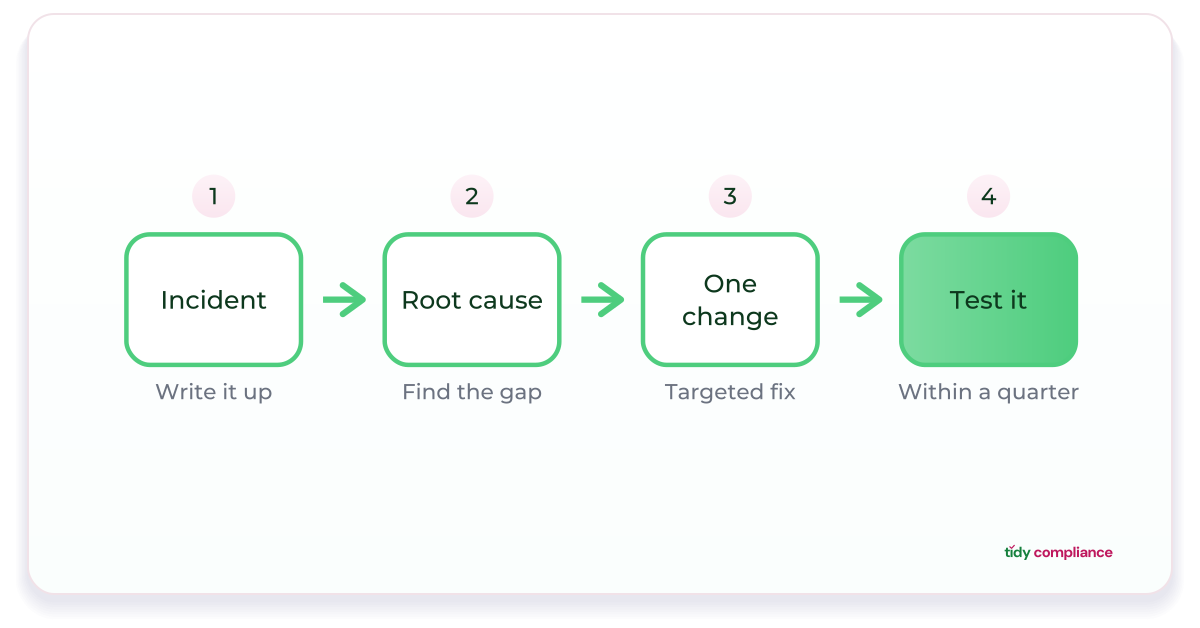
An incident is the best test of the program. Within a week, write down what happened, which risk it belongs to, which control should have caught it and whether the control ran. Update the likelihood score, lower the control rating if it failed and set one fix with an owner and a date. Share a short, blame-free summary with the people involved.
Resist adding five new rules. One targeted change, tested within a quarter, does more than a stack of policies nobody can follow. Over a year, the list of incidents and fixes becomes useful evidence that your program learns.
If You Run a Small Team
You can keep most of the ten with a few hours a month. Use a spreadsheet with 20 risks, a one-page scoring rule and a short monthly checklist. Combine the quarterly review with an existing leadership meeting. Software becomes useful when the number of frameworks or locations grows, and until then a clear method beats a big tool.
How to Choose Where to Start
Pick the habit that fixes your biggest known gap. If you cannot say who owns the top risks, start with owners. If scores keep changing with the person, write the scale. If audits are a scramble, start with evidence and testing. Add habits one quarter at a time, and give each an owner and a date.
Questions About Risk and Compliance Best Practices
Which Risk and Compliance Practice Should I Start With?
Start with ownership. Name a person for every risk and every control, then build everything else on that. Without owners, registers go stale and tests do not happen. It costs nothing and changes the quality of every later step.
How Many Risks Should I Track?
For most small and mid-sized organizations, 20 to 40 well-defined risks are enough. A long register hides the ones that matter. Review the top ten every quarter and the rest once a year.
How Do I Get Leadership to Pay Attention?
Give them one page, in the same layout each quarter, with the top risks, what changed, what failed and what decision you need. Leaders respond to a clear request with a date.
What Is a Key Risk Indicator?
It is a measure that moves before the problem arrives, such as the number of overdue access reviews, expired vendor assessments or open high findings. Pick three to five and watch the trend.
Should Compliance and Risk Be Separate Teams?
In small organizations one person often does both. What matters is that people who test controls do not test their own. As you grow, separate the roles that run controls from those that review them.
How Do I Keep Policies from Going Stale?
Give each policy an owner and a review date, and put every date on one calendar. Review after any change in services, systems or rules, and retire policies that no longer match how you work.
Do These Practices Replace Legal Advice?
No. They are general habits that help you meet requirements. For questions about how a specific rule applies to you, ask a qualified attorney or your regulator.
Sources
Disclaimer: This article is for general information only and isn’t legal, financial or tax advice. Treat figures as estimates from typical work and confirm details with your providers before you act.
Was this guide helpful?
Thanks for your feedback.
Odessa Whitfield
Odessa leads the Tidy editorial team and works with the compliance consultants to turn real client projects into practical guides on regulations, frameworks, policies and audit preparation. Before joining Tidy, she worked in compliance and risk roles, writing and maintaining policy sets for regulated organizations. Every article goes through a consultant who has done the work in practice, and she updates guides when a rule, framework or tool changes. She works remotely from the United States.