Quick Summary
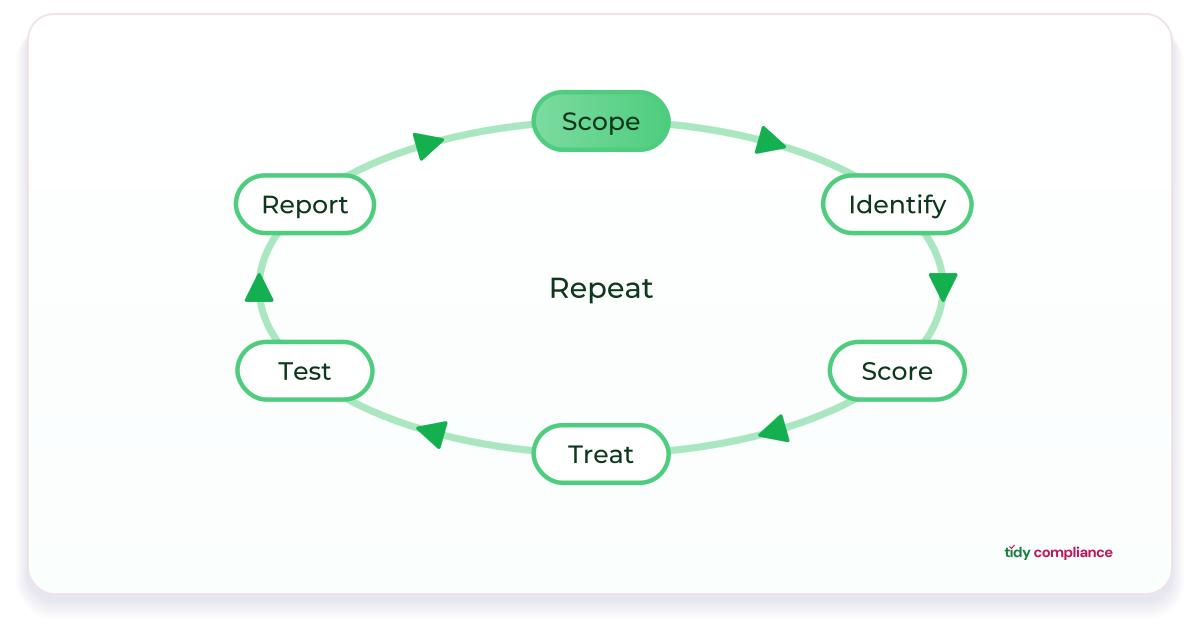
- A framework is a repeatable cycle: scope, identify, score, treat, test and report.
- Score risk with a simple formula so two people reach the same number: likelihood times impact, reduced by how well the control works.
- Every risk needs an owner and a control, and every control needs a test and a piece of evidence.
- Frameworks such as ISO 31000, NIST and COSO are sources for structure. Use only as much of them as your team can run.
Most risk and compliance programs start as a pile: a spreadsheet of risks, a folder of policies, a calendar of audits and a few people who remember how it fits together. A framework puts the pieces into one cycle that runs the same way every quarter. In my risk and compliance consulting work, I build the same six steps for a ten-person clinic and for a regional bank, and the main difference is the number of rows in the register.
The model below draws on ideas from ISO 31000, the NIST Risk Management Framework and COSO, but it is shorter than any of them. It is general guidance, not legal advice, and the rules that apply to you depend on your industry, so check specifics with your regulator or attorney.
The Six Steps at a Glance
| Step | What you do | What you produce | Typical cadence |
|---|---|---|---|
| 1. Scope | Define what the framework covers and who decides | Scope note and owner list | Yearly |
| 2. Identify | List risks and obligations | Risk register and obligations list | Yearly, plus after changes |
| 3. Score | Rate each risk with one formula | Ranked register | Quarterly for top risks |
| 4. Treat | Choose and assign controls | Control library with owners | As needed |
| 5. Test | Check that controls work | Test results and evidence | Per control schedule |
| 6. Report | Show status and decisions | One-page report | Quarterly |
Step 1: Scope the Framework Before You List Anything
Write down what the framework covers: which business units, which locations, which systems and which sets of rules. Name one executive sponsor and one day-to-day owner. A framework without a sponsor loses every budget conversation, and one without a day-to-day owner stops in the second quarter.
Decide your risk appetite in plain words, too: what loss, delay or finding the organization will accept and what it will not. Two sentences are enough. They give you a line for the scoring step.
Step 2: Identify Risks and Obligations
Collect risks from three sources: interviews with the people who run the work, past incidents and audit findings, and the list of rules and contracts that apply to you. Keep the first pass to a day. You are looking for the risks that would keep an owner awake, not for a complete catalog.
Write each risk as a cause, an event and a result, for example: "Because vendor access is not reviewed, a former contractor could view patient files, leading to a privacy incident." That sentence tells you what control to look for. Vague entries such as "data risk" cannot be scored or owned.
Keep a separate obligations list: each regulation, standard or contract clause, with the part of the organization it touches. Later, you map controls to it. This is how one control serves several rules.
Step 3: Score Risks With One Formula
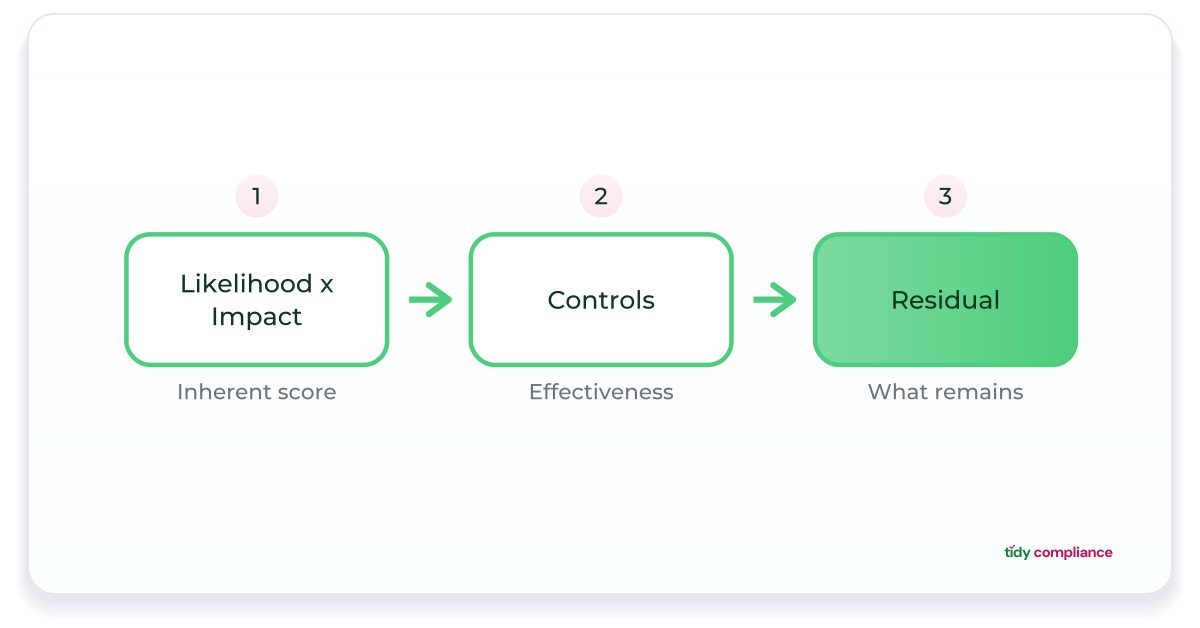
Teams argue about scores when each person uses a different scale. Fix that with a written rule. Rate likelihood and impact from 1 to 5, and rate how effective your current controls are as a percentage. The formula is:
Define the scale in words. A likelihood of 5 might mean "expected within a year," and an impact of 5 might mean "regulator action or a loss above a stated amount." Your amounts and wording belong to you. The point is that two people reading the definitions reach nearly the same number.
A worked example
Take the former-contractor risk above. A team rates likelihood 4 because access reviews are irregular, and impact 4 because patient files are involved. Inherent risk is 16. A quarterly access review exists but covers only half the systems, so the team rates control effectiveness at 50 percent. Residual risk is 8. After adding the missing systems, effectiveness moves to 80 percent and residual risk falls to 3.2.
| Risk | Likelihood | Impact | Inherent | Control effectiveness | Residual |
|---|---|---|---|---|---|
| Former contractor keeps access | 4 | 4 | 16 | 50% | 8.0 |
| Policy not updated after a rule change | 3 | 3 | 9 | 60% | 3.6 |
| Vendor misses a security obligation | 3 | 5 | 15 | 40% | 9.0 |
Step 4: Treat the Risks That Matter
For each risk above your appetite line, choose one response: reduce it with a control, transfer it with insurance or a contract, avoid it by stopping the activity or accept it with a named signature. Accepting is legitimate, but it needs a person, a date and a review.
Put every control in one library with an owner, a frequency, a description of the evidence and the obligations it supports. When a control maps to four rules, you test it once and reuse the result four times. The most common waste I see is four teams testing the same access review for four different audits. If you are choosing tooling for the library, my ranking of GRC software shows which platforms handle shared controls well.
Step 5: Test That Controls Work
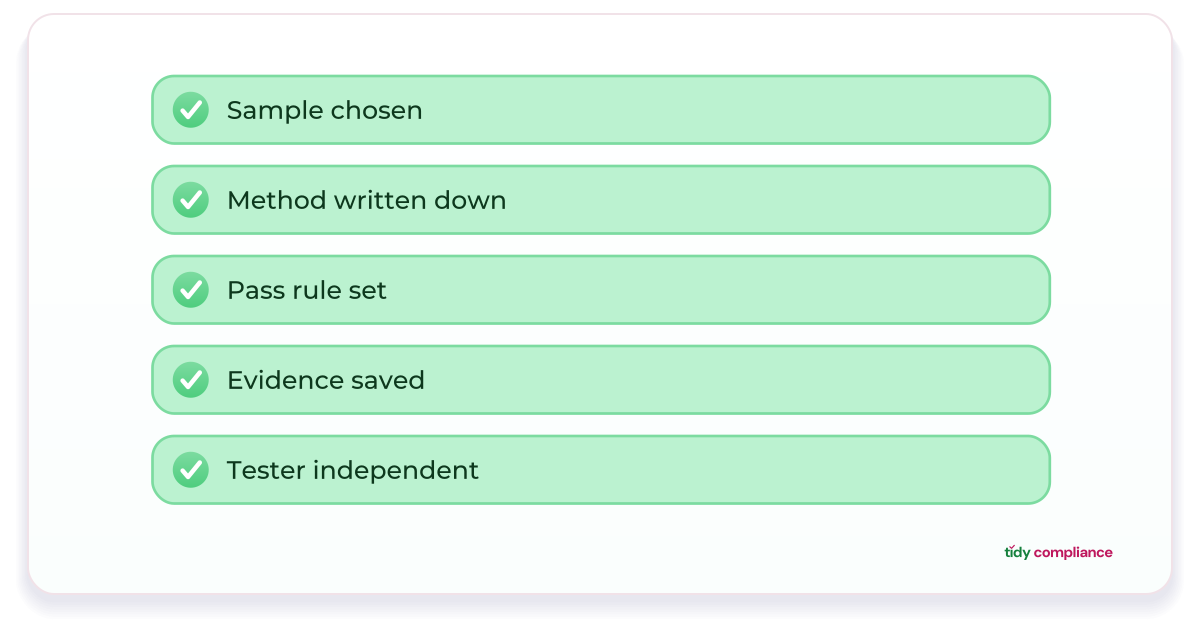
A control that has never been tested is an assumption. Set a test for each control: a sample, a method and a pass or fail rule. High-risk controls get tested quarterly, medium ones yearly. A person who does not run the control should do the test.
When a test fails, record it as a finding with an owner and a due date, and lower the control effectiveness in the score until it is fixed. This is how the formula stays honest. If effectiveness only ever goes up, the scores are decoration. A one-time review of every control against your obligations is the job of a risk and compliance assessment, and a routine monthly pass is easier with a risk and compliance checklist.
Step 6: Report on One Page
Leadership needs five things each quarter: the top ten residual risks, the change since last quarter, the failed control tests, the overdue actions and the decisions you need. One page, same layout every time. Trends matter more than single numbers, so show the last four quarters.
Close the loop by feeding what you learn back into step 1. A new product, a new vendor or a new rule changes the scope. A near miss changes the likelihood score. The framework is a cycle, and the habits that keep it turning are in my guide to risk and compliance best practices.
Who Owns What in the Framework
Frameworks fail on ownership more than on method. Three roles are enough for most organizations. The risk owner is the person who runs the process where the risk lives, and they decide how to respond. The control owner runs the control and keeps the evidence. The program lead keeps the register, runs the quarterly review and writes the report. The same person can hold two roles in a small team, but nobody should test their own control.
| Role | Decides | Keeps |
|---|---|---|
| Executive sponsor | Risk appetite and budget | Quarterly decisions list |
| Program lead | Method, scores and calendar | Register and report |
| Risk owner | Response to each risk | Treatment plan |
| Control owner | How the control runs | Evidence per cycle |
| Independent tester | Pass or fail | Test notes |
Where Frameworks Break in Practice
I see four patterns. The first is the register that grows and never shrinks, because nobody retires a risk after a fix. Close risks when the residual score falls under your line and note the date. The second is scores that cluster at 9 because everyone avoids extremes. A scale with written definitions fixes that. The third is controls with no evidence trail, so a test is an opinion. The fourth is a framework that never meets leadership, so nothing is decided.
One client had a register of 140 entries and a quarterly review that lasted three hours. We merged duplicates, retired 60 closed items and ranked the rest. The meeting dropped to 40 minutes, and the top ten finally got attention. Fewer, better-scored risks beat a long list every time.
A First-Year Calendar for the Framework
Sequence matters, and the first year rarely goes as planned. In the first month, write the scope and name owners. In months two and three, hold the risk interviews, build the register and agree on the scoring scale. Month four is for ranking and choosing responses. In months five and six, build the control library and map it to your obligations. Run the first round of tests in the second half of the year, starting with the highest residual scores, and deliver the first full quarterly report at the end of the third quarter.
Expect one delay. Interviews slip, or a control owner turns out to be on leave. Build in a buffer of a few weeks, and do not skip the test step to catch up. A framework that reports on tested controls is far more convincing than one that reports on intended ones.
How to Choose the Right Depth for Your Organization
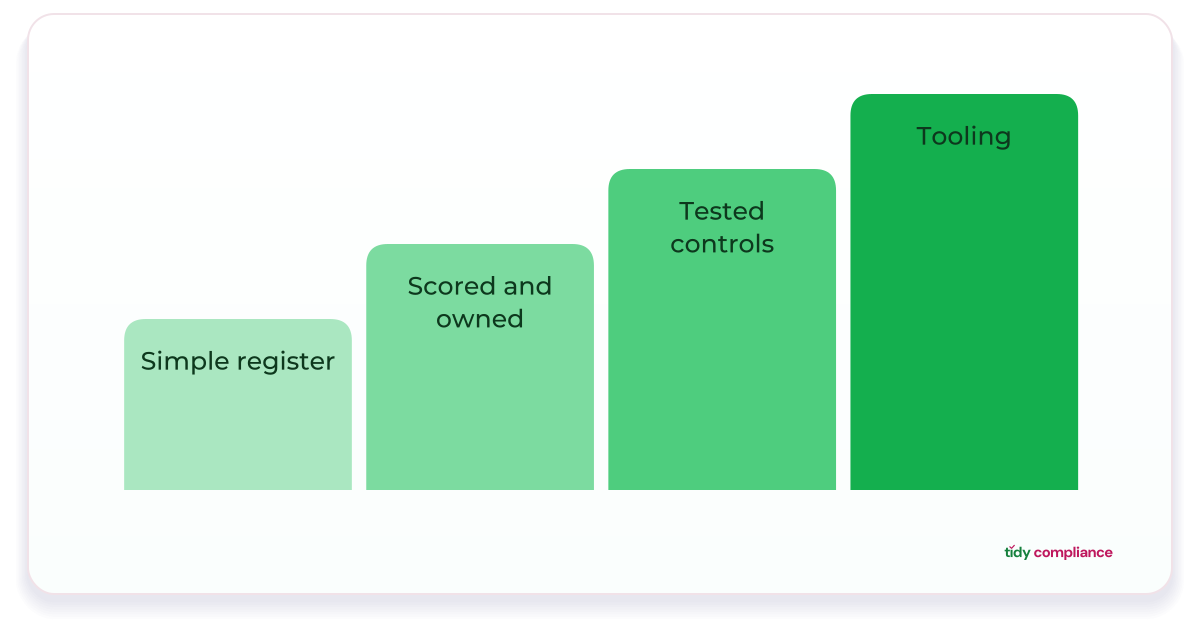
Match the framework to your size. A team of 20 can run steps 1 to 6 with a spreadsheet, 20 risks and a 30-minute quarterly meeting. A group with several regulators needs a shared control library and test schedules. A large organization with multiple business units adds a second line of review, so owners and testers are separate people.
Start small, run two quarters and then add what hurt most to leave out. Frameworks that start large rarely survive the first audit season.
Questions About Risk and Compliance Frameworks
What Is a Risk and Compliance Framework?
It is a repeatable method for finding the risks and obligations that apply to your organization, scoring them, assigning controls and owners, testing that the controls work and reporting the result. It is the structure that turns scattered tasks into one program.
Do I Need to Follow ISO 31000, NIST or COSO?
None is mandatory for most organizations, unless a customer, regulator or contract asks for one. They are good sources for vocabulary and structure. I borrow the cycle from them and keep my own version short enough that a small team can run it.
How Many Risks Should Be on the Register?
Enough to cover the important ones, usually 20 to 40 for a small or mid-sized organization. A register with 300 entries is rarely maintained. If a risk has no owner and no control, it is a wish, not an entry.
How Often Should I Update the Scores?
Review the top risks every quarter and the full register once a year. Update right away after a major change such as a new service, a new system, an incident or a new regulation that applies to you.
What Is the Difference Between Inherent and Residual Risk?
Inherent risk is the exposure before controls. Residual risk is what remains after controls, given how well they work. The formula below uses control effectiveness to get from one to the other.
Can the Same Framework Cover Several Regulations?
Yes, and that is the point. Map each control to every requirement it supports, test it once and reuse the evidence. A shared control library saves the most time when you face two or more audits a year.
Should a Small Business Build a Full Framework?
Build a light one: a short register, a scoring rule, named owners and a quarterly review. You can add depth as you grow. Starting with software before you have the method usually produces a tool full of empty fields.
Sources
- ISO 31000 risk management
- NIST Risk Management Framework
- COSO internal control and enterprise risk management guidance
Disclaimer: This article is for general information only and isn’t legal, financial or tax advice. Treat figures as estimates from typical work and confirm details with your providers before you act.
Was this guide helpful?
Thanks for your feedback.
Odessa Whitfield
Odessa leads the Tidy editorial team and works with the compliance consultants to turn real client projects into practical guides on regulations, frameworks, policies and audit preparation. Before joining Tidy, she worked in compliance and risk roles, writing and maintaining policy sets for regulated organizations. Every article goes through a consultant who has done the work in practice, and she updates guides when a rule, framework or tool changes. She works remotely from the United States.