Quick Summary
- Start with a register of obligations, because every other point depends on it.
- Every point needs proof you can open in two minutes, not just a tick.
- Ownership, vendor oversight and testing are the most common weak spots.
- Review the full list yearly and after any rule, vendor or business change.
Risk and compliance work goes wrong in a predictable way: the organization knows its rules in outline, owns a pile of policies and still cannot say which obligations carry the most risk or who is responsible for them. I use the ten points below at the start of every risk and compliance consulting project, because they follow the order in which a regulator, auditor or customer reviewer tends to ask questions.
Treat the list as a working tool. Each point says what to have, what proof to keep and where organizations usually slip. Read the table first to see the whole picture, then go to the sections that apply to you. Nothing here is legal advice, and your counsel decides what a specific rule means for you.
The 10 Points at a Glance
| Point | What to have | Proof to keep |
|---|---|---|
| 1. Scope and obligations | A register of the laws, regulations, standards and contracts that apply to you | Obligations register with owners |
| 2. Governance and ownership | A named lead, a committee or sponsor and written responsibilities | Charter and role descriptions |
| 3. Risk assessment | A scored list of risks tied to each obligation | Dated risk register |
| 4. Policies and procedures | Approved documents that match daily work | Policy library with version history |
| 5. Controls | Checks that prevent, detect or correct each high risk | Control list with owners and test dates |
| 6. Training and awareness | Role-based training and a way to refresh it | Completion records and attestations |
| 7. Third-party oversight | A vendor list ranked by risk, with agreements and reviews | Vendor file and review dates |
| 8. Monitoring and testing | A calendar of checks, internal audits and spot tests | Test results and issue log |
| 9. Issue and incident handling | A route to report, investigate and fix problems | Case log with outcomes |
| 10. Reporting and review | A regular report to leadership and a yearly program review | Board or management minutes |
If you want to compare the checklist with the models behind it, my explanation of the risk and compliance framework shows how these points map to a working structure. The checklist itself starts below.
1. Scope Your Obligations
You cannot manage a duty you have not listed. Start with the laws and regulations for your sector, then add standards you have chosen to follow and the promises written into customer contracts, insurance policies and grant terms. A healthcare group might list HIPAA, state privacy rules, payer contracts and a security framework. A lender might list consumer protection rules, anti-money-laundering duties and its examiner expectations.
Give every obligation an owner and a plain-language summary of what it asks. The most common slip I see is a register that stops at statutes and ignores contract clauses, which are often the ones a customer checks first. Keep the register short enough to maintain: a spreadsheet with one row per obligation beats a 90-page memo nobody reopens.
- Source of each obligation (law, standard or contract)
- Business area and system it touches
- Named owner and next review date
2. Assign Governance and Ownership
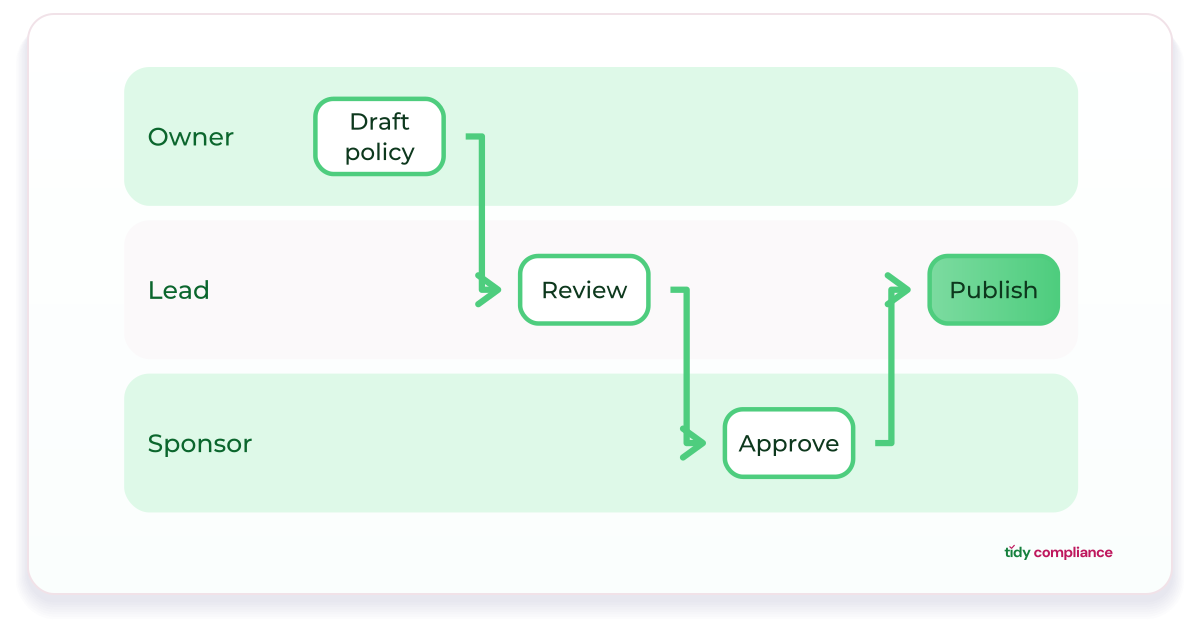
Someone must be able to say yes or no to a risk and have the authority to follow through. Name a compliance lead, give that person access to leadership and write down who owns each area. In small organizations the lead often has another job as well, which works if the time is protected and the role is written in the job description.
Add a simple decision path: who approves a policy, who accepts a risk you decide not to fix and who hears about problems first. The U.S. Department of Justice asks prosecutors to look at whether a program has real resources and authority, and its Evaluation of Corporate Compliance Programs document, updated in September 2024, is a useful read even when no prosecutor is involved.
3. Run a Risk Assessment
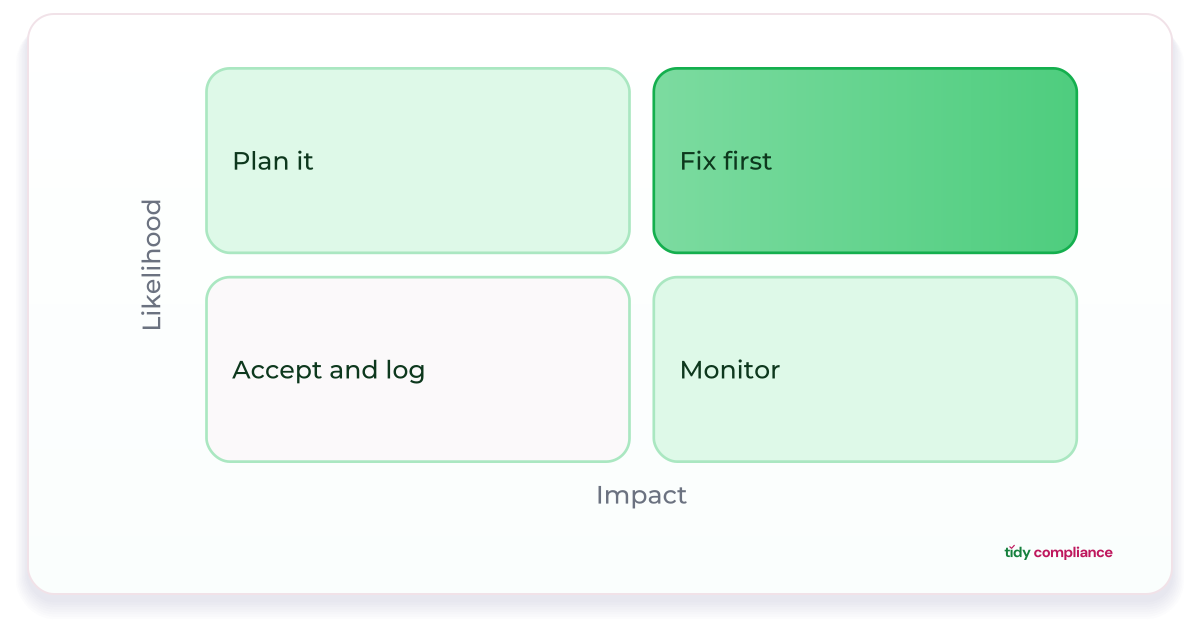
A risk assessment ranks what could go wrong by likelihood and impact so you spend effort where it counts. Take each obligation from the register, ask what failure would look like, and score it on a simple scale. Four or five levels are enough. Fine-grained numbers invite false precision.
Involve the people who do the work. A finance manager knows where invoices bypass approval, and a clinic manager knows which front-desk habit exposes records. A workshop of two hours with each area gives you better inputs than a questionnaire sent by email. The detailed method is in my guide to a risk and compliance assessment.
4. Write Policies and Procedures People Use
A policy states what the organization expects. A procedure shows how to do it. You need both for the high-risk areas, and you need them to match reality. Copying a template without changing it produces documents that describe tools you do not own and approvals nobody gives.
Use a standard layout: purpose, scope, rules, responsibilities, exceptions and review date. Keep each policy to a few pages and link to forms. Every policy needs an approver and a version history, because a reviewer will ask who signed off and when. A yearly review is the usual rhythm, with extra reviews after a rule change or an incident. Habits that keep the library alive are in my list of risk and compliance best practices.
5. Put Controls in Place and Test Them
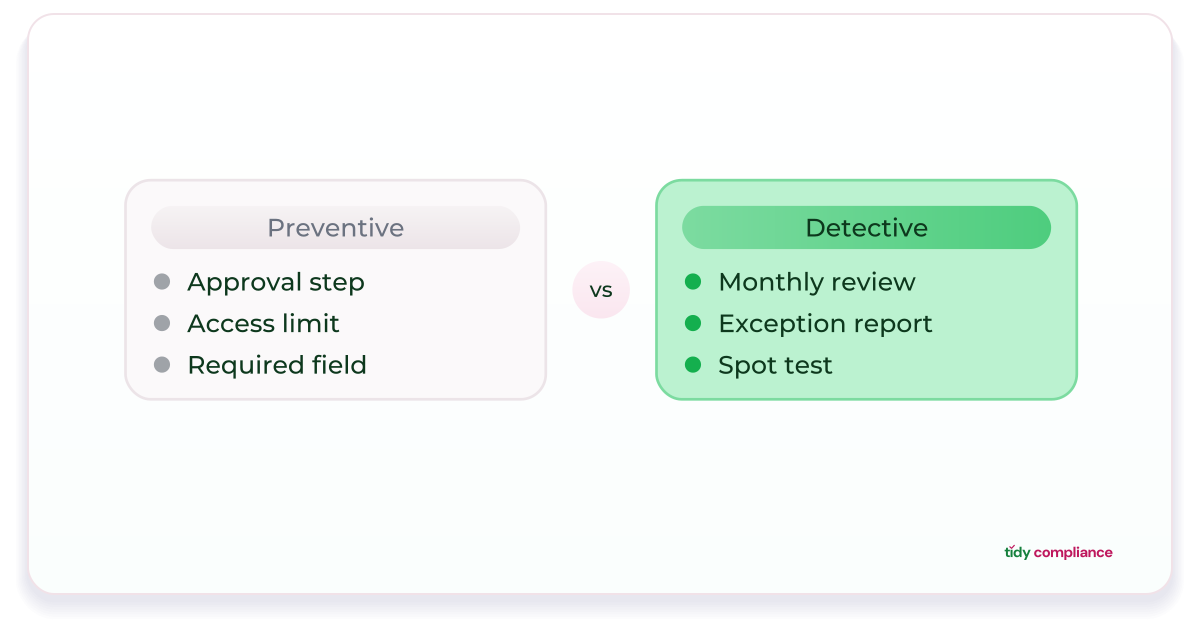
Controls are the checks that keep a risk in bounds: an approval step, an access review, a reconciliation, a locked cabinet, a second pair of eyes on a filing. For each high-rated risk, list the control, its owner, how often it runs and how you know it ran.
Prefer a few controls that really operate over a long list on paper. Many reviews turn up controls that were designed well and not performed for months. Record each run with a date and a name. A screenshot or a signed form is evidence, and a verbal assurance is not.
- Each high risk has at least one control
- Control frequency is realistic for the team
- Every run leaves a dated record
- Failed checks create an issue with a due date
6. Train Your People by Role
Training should show each group what to do in situations it meets. Front-line staff need short, concrete scenarios. Managers need to know how to escalate. Executives need to understand their oversight duties. A single yearly slide deck for everyone satisfies a calendar item and little else.
Track completion by person and keep short quizzes or attestations. Refresh content after rule changes and after incidents. New hires should complete the core modules in their first weeks, before they handle sensitive work on their own. The completion record is what you will show when someone asks whether people were trained.
7. Oversee Third Parties
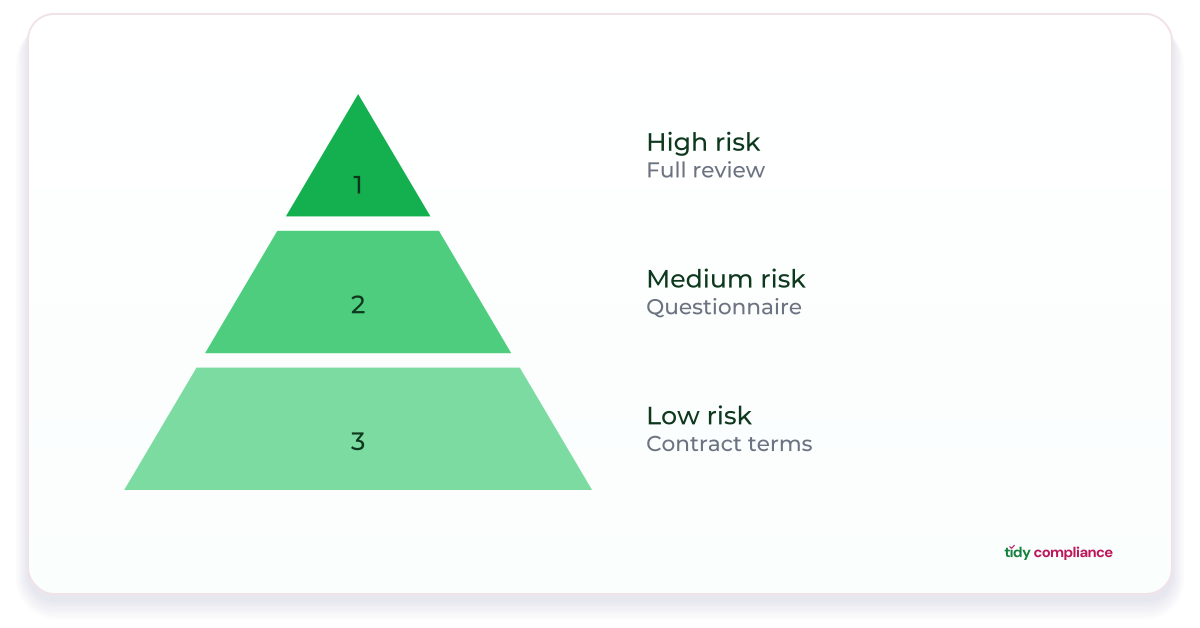
Vendors, contractors and partners often hold your data or perform regulated tasks. Build a list, rank each one by the risk it creates and match the depth of review to the rank. A payroll provider needs more attention than a catering supplier.
For high-risk vendors, ask for security and compliance evidence, check that contracts contain the clauses you need and set a review date. I have seen organizations carry a vendor for years after the contract ended, with accounts still active. Offboarding belongs on the checklist as much as onboarding.
8. Monitor and Test on a Calendar
Monitoring tells you whether controls still work. Put checks on a calendar: monthly sampling for fast-moving areas, quarterly reviews for access and vendors, a yearly internal audit for the whole program. Assign testers who do not run the control they test. In a small team, that can mean swapping reviews between departments.
Report test results in the same format every time, with the sample size, the finding and the owner of the fix. Over a year, the pattern of findings shows where the program is weak. A monitoring plan that finds nothing for two years deserves a second look at the test design.
9. Handle Issues and Incidents
Problems will surface: a missed deadline, a complaint, a lost device, a hotline report. What matters is whether people know how to raise them and what happens next. Provide a channel that works without fear of blame, assign an investigator, set response times and record the outcome.
Close each case with a root cause and a fix, then check that the fix was applied. The HHS Office of Inspector General lists detection and response as one of seven elements in its General Compliance Program Guidance, and the same logic applies outside healthcare. Rules about notifying regulators vary by sector and jurisdiction, so confirm those with your counsel and write them into the response plan.
10. Report to Leadership and Review Yearly
Leadership needs a short, regular view of the program: open risks, overdue actions, incident counts, training completion and upcoming rule changes. One page every quarter is enough. Include the items you are worried about, since a report with only good news teaches readers to stop reading it.
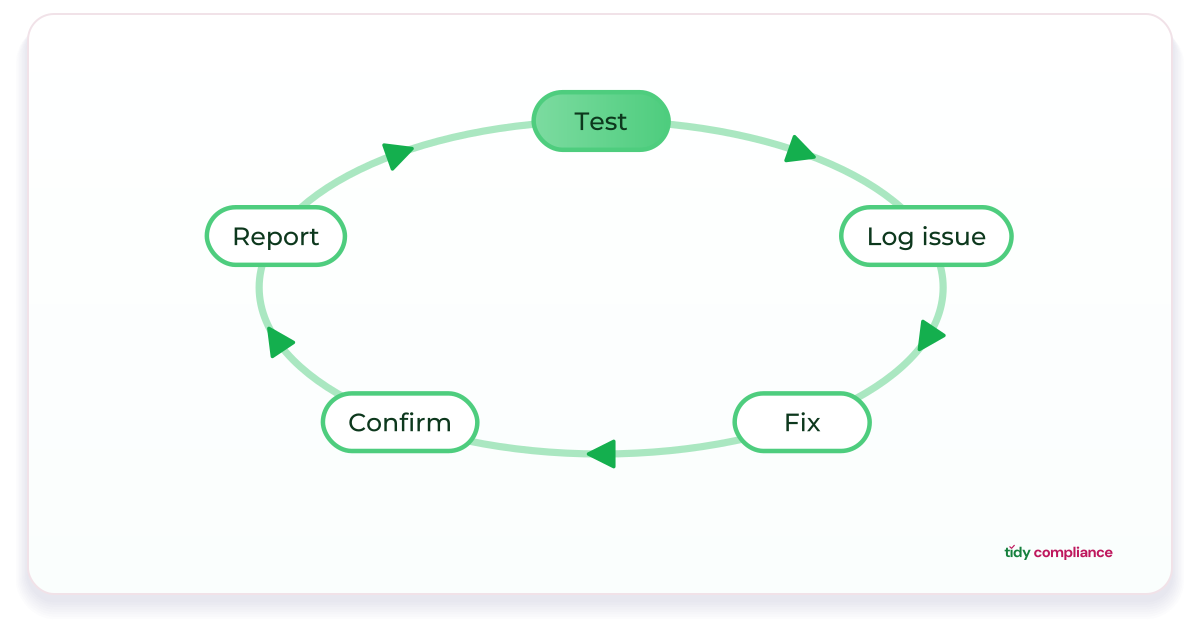
Once a year, review the whole program against this checklist. Confirm the obligations register, rescore risks, retire controls that no longer matter and plan the next twelve months. Keep the minutes. That meeting turns ten separate tasks into one program. If you want to see how the structure fits together, my explanation of a step-by-step framework shows the cycle in full.
A 90-Day Order of Work for a Fresh Start
If you are starting from little, do not attack all ten points at once. Later steps use the output of earlier ones, so order matters. This sequence works for teams that cannot pause daily work.
| Weeks | Focus | Result you can show |
|---|---|---|
| 1 to 3 | Obligations register and governance (points 1 and 2) | Register with owners and a named lead |
| 3 to 6 | Risk assessment workshops (point 3) | Scored risk register |
| 5 to 9 | Fix the top risks, write the key policies, start controls (points 4 and 5) | Approved policies and a control list |
| 8 to 11 | Training and vendor ranking (points 6 and 7) | Completion records and a ranked vendor list |
| 10 to 13 | Monitoring calendar, issue process and first leadership report (points 8 to 10) | First report and a testing calendar |
Expect delays. Approvals take longer than planned because they depend on busy people, and vendor reviews depend on outside replies. Put those tasks first on the calendar and give someone the job of chasing them. After the first cycle, the program becomes a yearly review of what changed.
How to Use the Checklist Without Fooling Yourself
A checklist creates false comfort when every box is ticked on paper. To keep it honest, ask for proof next to each point and have someone outside the team spot check a few items every year. Where proof is missing, the item is open, whatever the box says.
- Each point has a named owner
- Each point has a dated record you can open in under two minutes
- Open items sit in a plan with dates
- An outsider reviews a sample at least once a year
If you want that outside view, a gap assessment compares your answers with the requirements and ranks what is missing. The tooling question comes next: my ranking of GRC software compares platforms that can hold the registers, controls and evidence from this list.
Sources
U.S. Department of Justice: Evaluation of Corporate Compliance Programs, HHS OIG: General Compliance Program Guidance, ISO 37301: Compliance management systems.
Questions About the Risk and Compliance Checklist
What Is a Risk and Compliance Checklist?
It is a structured list of the steps that show you know your obligations, have ranked your risks, have controls and records in place and can prove it. The ten points above cover scope, governance, assessment, policies, controls, training, vendors, monitoring, issue handling and reporting.
How Often Should I Update My Risk and Compliance Checklist?
Review the whole list at least once a year and again after a new rule, a merger, a new product or a serious incident. Items such as access reviews and vendor checks work better on a quarterly cycle.
Who Should Own the Checklist?
A named compliance or risk lead, with each point assigned to a business owner. The lead tracks progress and reports to leadership. The business owners do the work, because they know the processes.
Can a Small Organization Use the Same Ten Points?
Yes. The points stay the same and the effort scales. A small team can keep the register in a spreadsheet, hold one risk workshop a year and run training in short sessions. The proof still has to exist.
What Is the Difference Between Risk Management and Compliance Management?
Risk management looks at anything that could harm your goals, including money, operations and reputation. Compliance management focuses on meeting your legal, regulatory and contractual duties. A joined-up program uses one register and one calendar for both.
Do I Need Software to Complete the Checklist?
Not at the start. A spreadsheet and a shared folder carry a small program for a while. Software helps once you have many obligations, several owners and recurring evidence requests, and it is worth choosing after your process is clear.
Is This Checklist Legal Advice?
No. It is a compliance consulting tool. Questions about what a specific law requires, whether to report an event or how to respond to a dispute belong with your attorney.
Disclaimer: This article is for general information only and isn’t legal, financial or tax advice. Treat figures as estimates from typical work and confirm details with your providers before you act.
Was this guide helpful?
Thanks for your feedback.
Odessa Whitfield
Odessa leads the Tidy editorial team and works with the compliance consultants to turn real client projects into practical guides on regulations, frameworks, policies and audit preparation. Before joining Tidy, she worked in compliance and risk roles, writing and maintaining policy sets for regulated organizations. Every article goes through a consultant who has done the work in practice, and she updates guides when a rule, framework or tool changes. She works remotely from the United States.