Quick Summary
- The SEC regulates advisers, broker-dealers, funds and public companies under different rules.
- A written, tailored compliance program with a CCO and annual review sits at the center.
- Marketing, records and custody are frequent exam areas.
- Check current rules and dates with counsel, because several are phased in.
SEC compliance means following the federal securities rules that apply to your business and keeping proof that you did. The Securities and Exchange Commission oversees investment advisers, broker-dealers, funds, exchanges and public companies, and the rules for each are different. If you are unsure where you fit, SEC compliance consulting starts by answering exactly that.
This guide goes from the basics to the details that decide exam results. You will see who is regulated, what the main duties are, how exams work and what a practical program looks like. Where the rules are changing, I tell you what has been decided and where to check the current status.
Who the SEC Regulates
| Group | Main laws and rules | Typical duties |
|---|---|---|
| Investment advisers | Investment Advisers Act and its rules | Compliance program, code of ethics, books and records, marketing, custody, Form ADV |
| Broker-dealers | Securities Exchange Act, SEC rules and FINRA rules | Supervision, recordkeeping, customer protection, communications retention |
| Investment companies and funds | Investment Company Act | Compliance program, governance, valuation, disclosure |
| Public companies | Securities Act and Exchange Act | Periodic reports, disclosure controls, insider trading policies, governance |
| Transfer agents, exchanges and others | Exchange Act | Rules specific to the role |
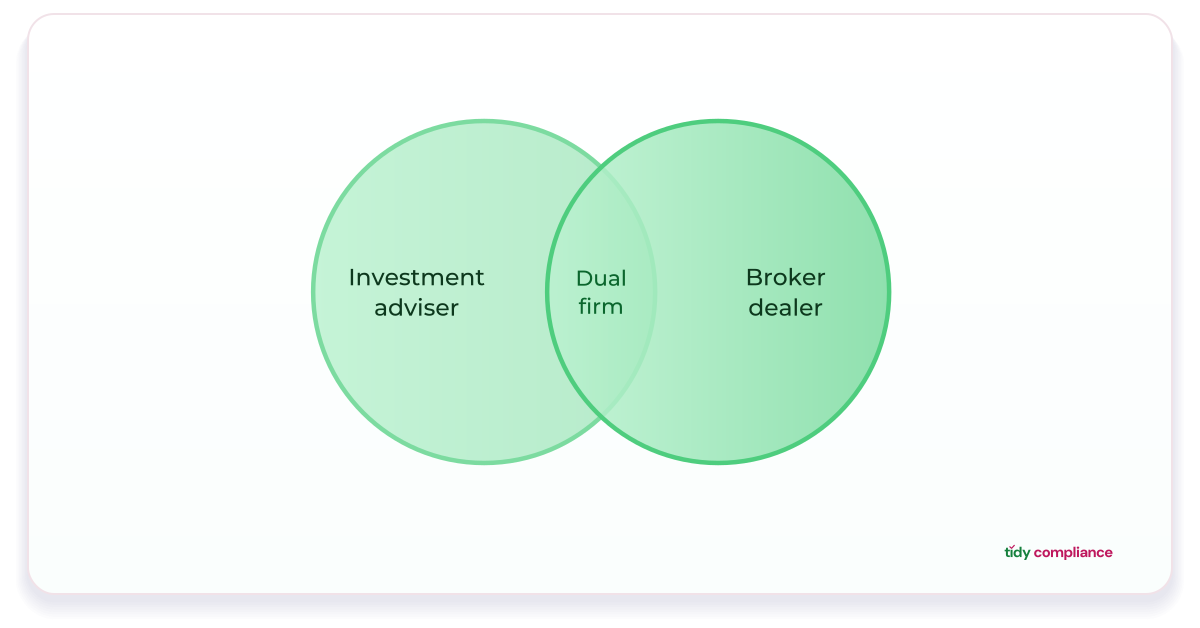
Many firms sit in more than one group. A wealth manager may be an adviser and own a broker-dealer. A fund sponsor may have an adviser, a fund and employees who trade personally. In each case the program has to cover each regulated activity.
The Compliance Program at the Center
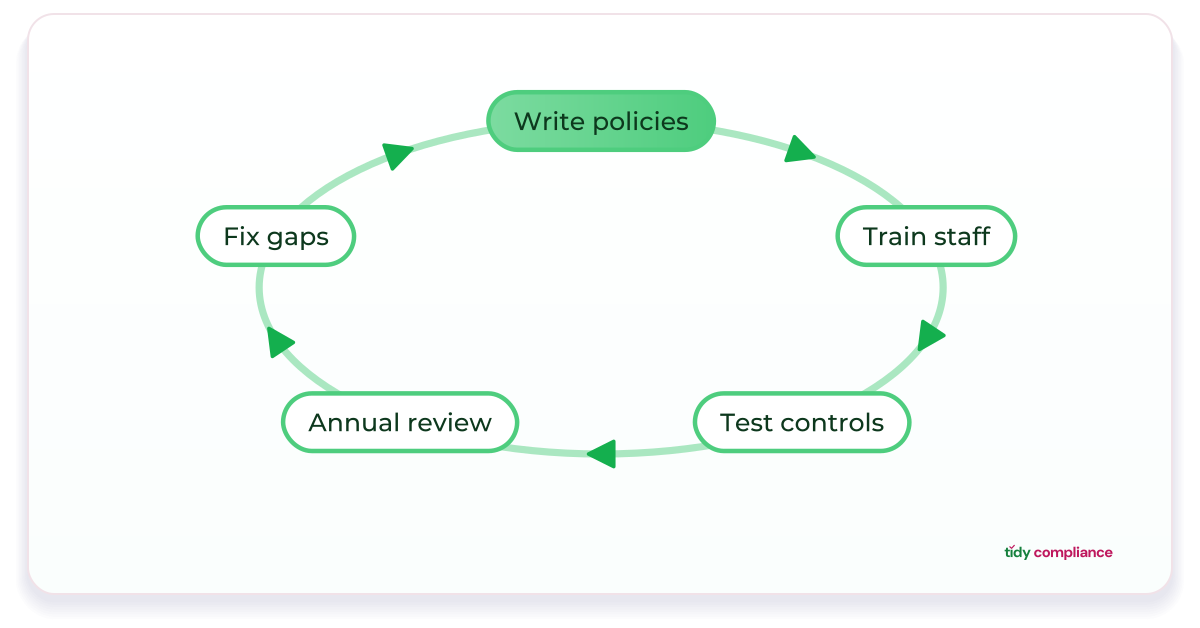
For registered investment advisers, the heart of the rules is a written compliance program. Rule 206(4)-7 requires policies and procedures reasonably designed to prevent violations, an annual review and a chief compliance officer. The text is on eCFR. Other registrants have similar structures under their own rules.
A good program fits your business. It covers how you take clients, manage portfolios, trade, value assets, advertise, hold client assets, keep records and protect data. Each policy has an owner and a date, and each area is tested.
The Main Areas Examiners Care About
The Division of Examinations describes its work and publishes priorities on its exam page. Check the latest list, since focus areas change. These areas appear again and again in my client work.
| Area | What is included | Common weakness |
|---|---|---|
| Marketing | Advertisements, testimonials, endorsements, performance | Claims with no support file, website edits without review |
| Books and records | Required documents and their retention | Scattered storage, personal channels used for business |
| Code of ethics | Personal trading and conflicts | Late reports and no testing |
| Custody | Client assets and access | Unrecognized custody through standing letters or fee deduction |
| Conflicts and fees | Disclosure of fees and conflicts | Form ADV out of date with practice |
| Data protection | Safeguards and incident response | No tested incident plan |
Marketing deserves special attention because the Marketing Rule changed how advisers present themselves. The SEC summarizes it in a small entity compliance guide, which covers misleading statements, testimonials and endorsements, third-party ratings and performance. Records of advertisements must be kept.
How an SEC Exam Works
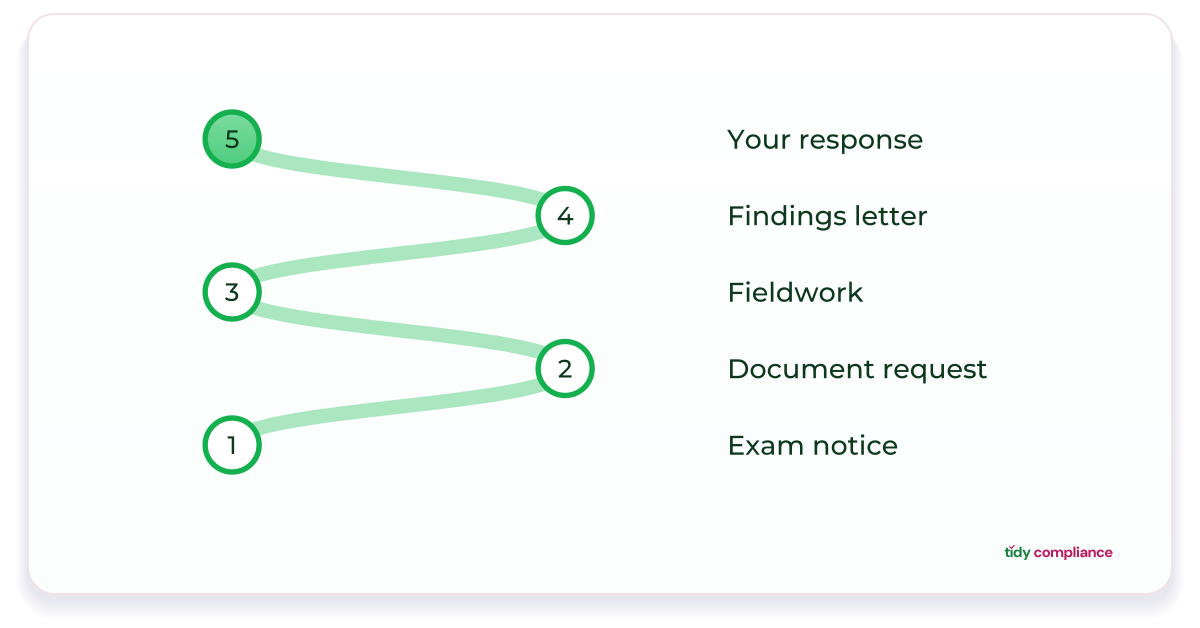
Exams usually begin with a letter that lists documents to send within a short window. Examiners review the documents, may visit the office and interview staff, and then send a deficiency letter if they find gaps. You respond with a plan and dates. Some exams end with no findings, others lead to referrals if issues are serious.
You cannot predict exactly when an exam comes, so the useful habit is to stay ready. An evidence folder, a records map and a testing log let you answer fast. The checklist in my SEC compliance checklist helps you prepare, and an SEC compliance audit tests how ready you are.
Preparing for an Exam Without Panic
The best preparation is dull and continuous. Keep the program documents current, keep the testing log up to date and keep the evidence folder indexed. When a letter arrives, assign one coordinator, set an internal deadline a few days before the SEC's, and review every document before it goes out. Send what is asked for, in the format asked for, and keep a copy of everything you send.
Staff should know whom to tell if an examiner calls or visits. Brief them on being honest, clear and brief, and on passing questions through the CCO. After the exam, hold a short review and add any lessons to the program, whether or not findings came.
Public Companies Face a Different Set of Duties
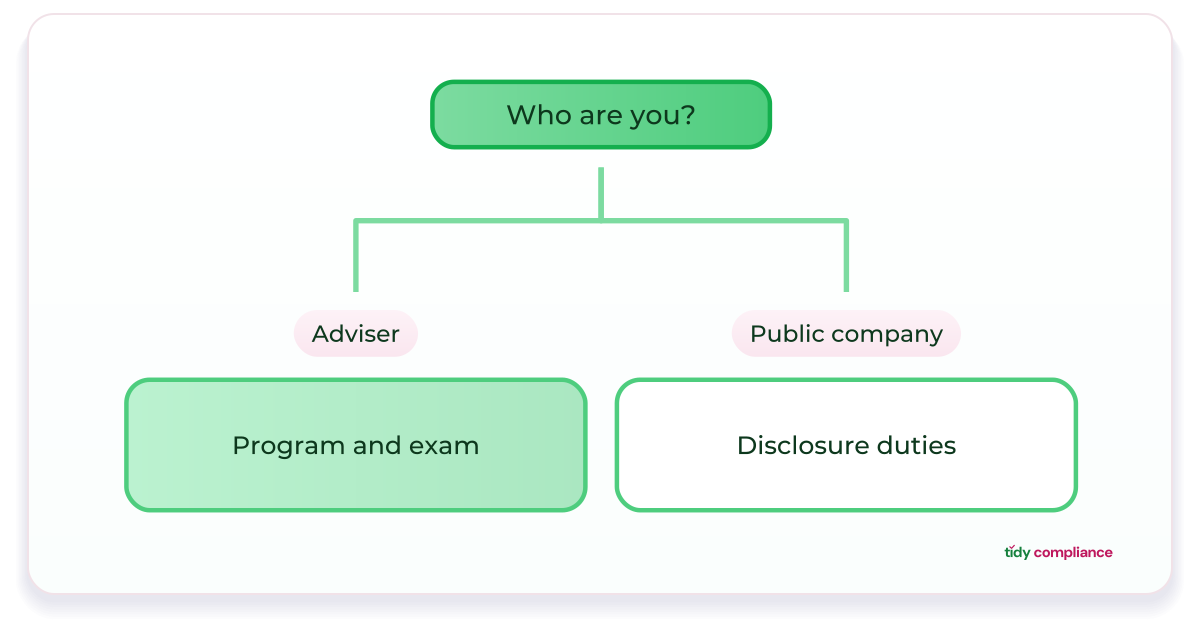
Public companies file periodic reports, keep disclosure controls and follow rules on insider trading and fair disclosure. Compliance teams there work with legal, finance and investor relations. Their tools often center on reporting and disclosure management, a segment covered in my SEC compliance software ranking.
Because public company rules are detailed and consequences can be serious, securities counsel is central. A compliance consultant supports with process: calendars, evidence, training and testing.
Core Duties for Advisers in More Detail
Advisers owe their clients a fiduciary duty, which in practice means acting in the client's best interest, disclosing conflicts and giving advice that fits the client's goals. Rules turn that duty into concrete tasks. You keep required books and records, deliver and update your Form ADV brochure, follow custody requirements, apply the Marketing Rule and supervise your people.
Form ADV deserves attention because it is the public description of your business. Advisers update it at least annually, and sooner for material changes. When fees, services or conflicts change in practice and the form does not, the mismatch is easy for an examiner to see. Add a line to your annual review: compare the form with how the business actually runs.
| Duty | What it asks | Evidence to keep |
|---|---|---|
| Fiduciary duty | Act in your client’s interest and disclose conflicts | Disclosures, suitability notes, conflict log |
| Form ADV | Keep the public brochure accurate and current | Filed forms, review notes |
| Books and records | Keep required documents organized and available | Records map, retrieval tests |
| Custody | Follow rules when you hold or can access client assets | Custody analysis, statements |
| Supervision | Oversee staff conduct | Supervision procedures, review logs |
Mistakes I See in Beginner Programs
New firms tend to make the same few errors. They buy a manual and never tailor it. They name a CCO and never give them time. They keep records where it is convenient rather than where it is controlled. They treat marketing as a design task instead of a regulated activity. And they assume the first exam is years away.
| Mistake | Why it hurts | Better habit |
|---|---|---|
| Unedited template manual | Policies do not match practice | Walk each policy with the owner |
| No testing | Nothing proves the program works | Quarterly sample tests in a log |
| Personal channels for business | Records cannot be retrieved | Approved channels and an archive |
| Marketing without review | Unsupported claims go public | One approval step with sign-off |
A first program does not have to be perfect, but it has to be real. Examiners are more forgiving of a young program that shows steady testing and fixes than of an old one that shows only paperwork.
A Simple Annual Compliance Calendar
| When | Task | Owner |
|---|---|---|
| Each month | Review SEC releases, personal trading reports and new ads | CCO |
| Each quarter | Test two or three areas and report to leadership | CCO |
| Within the filing window after year end | Update Form ADV and other annual filings | CCO and operations |
| Annually | Complete the program review, retrain staff and refresh the evidence folder | CCO and leadership |
Put the calendar where the whole team can see it, and attach evidence to each task when it is done. Tools that combine reminders and evidence storage are compared in the SEC compliance software article.
How the Program Scales With Your Size
A compliance program for a three-person adviser and one for a global asset manager share the same skeleton. What changes is the depth. Small firms keep a short manual, test a few areas each quarter and rely on spreadsheets and a shared drive. Mid-sized firms add specialist roles, a testing calendar and tools for personal trading and communications. Large firms add committees, independent testing, surveillance systems and legal specialists for each business line.
| Firm size | Typical setup | Main risk |
|---|---|---|
| Small adviser | Part-time CCO, short manual, spreadsheet records | One person holds too many jobs |
| Mid-sized firm | Full-time CCO, testing calendar, compliance software | Manual falls behind growth |
| Large firm | Compliance team, committees, surveillance systems | Gaps between business lines |
Whatever your size, the test is the same. A newcomer should be able to find the right policy, an examiner should be able to see testing and the CCO should be able to say what changed since last year.
How to Start a Program From Zero
If you have little in place, work in this order. Each step produces a record you can show.
- Confirm your firm type, services and registration status
- Appoint a CCO or equivalent and give the role authority
- Write or tailor the core policies for your actual services
- Create a records map and an advertising approval step
- Set up testing and the annual review calendar
- Train staff and build an evidence folder
For habits that keep a program healthy, see the SEC compliance best practices. A first-year program for a small adviser usually takes a few months of part-time effort, and later years are mostly updates and testing.
One more point for first-time registrants: your registration filings are public statements. The information you give about fees, services, conflicts and disciplinary history is read by clients and examiners alike, so treat each filing as a document you must be able to defend. Keep the support behind every answer, and have someone other than the author read it before you submit.
Keeping Up With Rule Changes
The SEC adopts new rules and updates guidance regularly. Recent years brought changes to marketing, safeguarding and incident response, and several rules have staged compliance dates. Do not rely on memory or on a date in an article. Check the SEC's current rule pages, ask counsel what applies and write the effective dates on your calendar when you confirm them.
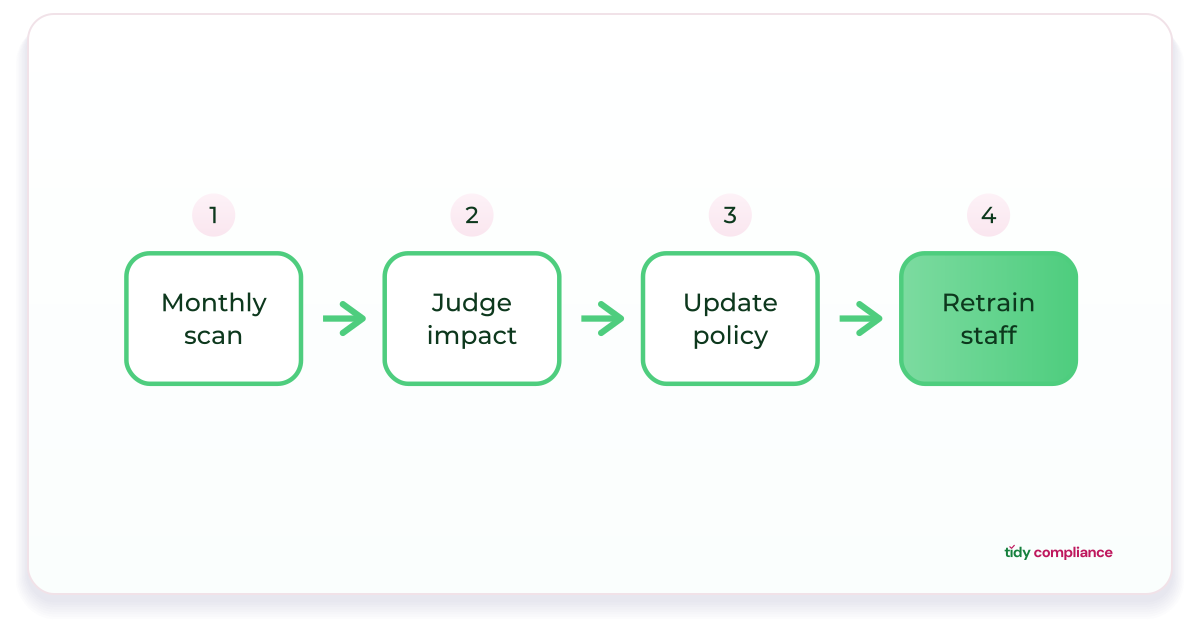
A simple routine helps. Assign one person to scan SEC releases monthly, summarize relevant items in two lines and add actions to the compliance calendar. It takes thirty minutes a month and avoids most surprises.
Sources
SEC: Marketing Rule small entity compliance guide, SEC Division of Examinations, eCFR: Rule 206(4)-7, compliance programs of investment advisers.
Questions About SEC Compliance
What Is SEC Compliance?
It is the practice of following the federal securities rules that apply to your firm and keeping records that prove it. The rules differ for advisers, broker-dealers, funds and public companies.
Who Has to Comply with SEC Rules?
SEC registrants such as investment advisers, broker-dealers, funds and public companies, among others. Your counsel can confirm which rules apply.
What Is a Compliance Program?
Written policies and procedures, a designated chief compliance officer, an annual review and records that show the program works.
What Triggers an SEC Exam?
Exams can come from routine cycles, risk-based selection, tips or follow-ups. You cannot predict the timing, so stay ready with an evidence folder.
How Much Does SEC Compliance Cost?
It depends on your firm type, size and services. Costs include staff time, software and outside help. A fixed quote after a gap assessment gives a clearer picture.
Can a Small Firm Handle SEC Compliance In-House?
Many do for routine work, and bring in outside help for gap assessments, manual rewrites or exam preparation.
Where Can I Find Current SEC Requirements?
On the SEC's website, in the rule text and in staff guidance. Ask securities counsel to confirm which rules and dates apply to your firm.
Disclaimer: This article is general information about SEC compliance and is not legal advice. Which rules apply depends on your firm type, size and services, and rules and exam priorities change, so confirm current requirements with your securities counsel.
Was this guide helpful?
Thanks for your feedback.
Odessa Whitfield
Odessa leads the Tidy editorial team and works with the compliance consultants to turn real client projects into practical guides on regulations, frameworks, policies and audit preparation. Before joining Tidy, she worked in compliance and risk roles, writing and maintaining policy sets for regulated organizations. Every article goes through a consultant who has done the work in practice, and she updates guides when a rule, framework or tool changes. She works remotely from the United States.