Quick Summary
- Run the assessment in six phases, each with an output you can show.
- Find shadow AI first, because vendor features and staff tools hold much of the risk.
- Score controls by evidence, not by what people say exists.
- Fix high-impact, low-effort gaps in 30 days and schedule the rest.
An AI compliance assessment tells you how ready you are today: what AI you use, which rules touch it and where the gaps are. It is the first thing I run in any AI compliance consulting project, because every later decision depends on it. This guide shows how to run one yourself, what to score and what to do with the result.
You do not need special software. A spreadsheet, two workshops and a few weeks are enough for most mid-sized companies. What you need is honesty, because an assessment that shows green everywhere has probably missed something.
The Assessment in Six Phases
The phases below run in order. Each produces something you can show, which is what separates an assessment from a conversation.
| Phase | Key question | Output |
|---|---|---|
| 1. Scope | Which business units and systems are in? | Scope statement and owner list |
| 2. Discover | What AI do we actually use? | Inventory with data and vendor details |
| 3. Classify | How risky is each system? | Risk level per system |
| 4. Test controls | Do policies, testing and oversight exist and work? | Control scores with evidence |
| 5. Rate gaps | Which gaps matter most? | Ranked gap list |
| 6. Plan | Who fixes what, by when? | Remediation plan with owners |
Phase 1: Set a Scope You Can Finish
Start with the business units where AI affects people or sensitive data: HR, finance, customer service, product and marketing. A narrow, finished assessment beats a company-wide one that stalls. Write down what is in, what is out and why, and name one owner per unit who can answer questions about tools and data.
Agree on the yardstick before you begin. If you operate in the EU, use its risk categories. Otherwise use the NIST AI Risk Management Framework as the reference, because it maps well onto most customer questionnaires and regulator expectations. See the NIST framework page for the four functions: govern, map, measure and manage.
Phase 2: Find the AI You Actually Use
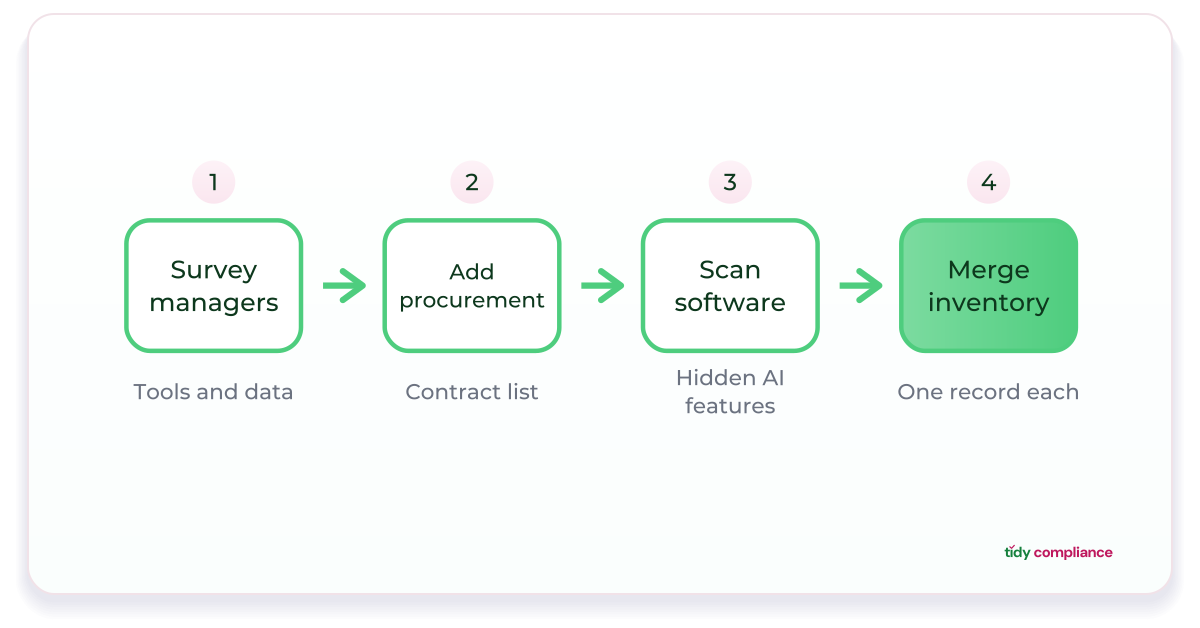
Send a short survey to every manager and ask three questions: which AI tools does your team use, what data goes into them and who decided to use them. Add procurement data and your software list, then look for AI features in tools you already pay for. The overlap between the survey and the contract list is usually small, and the difference is your shadow AI.
Record each system with its purpose, owner, vendor, data types, people affected and whether outputs are reviewed by a person. The AI compliance guide explains the inventory fields in more detail.
Phase 3: Classify Each System by Risk
Use three questions on every system. Does it influence a decision about a person? Does it handle personal, health, financial or confidential data? Can its mistakes cause real harm before a human notices? Two yes answers put it in the high-risk group.
| Signal | Low risk | High risk |
|---|---|---|
| Decision impact | Drafts or suggests, a person decides | Scores, ranks or decides about people |
| Data | Public or non-personal | Personal, health, financial or confidential |
| Reversibility | Errors are cheap to fix | Errors affect jobs, money, health or access |
| Transparency | Output is easy to check | Output is hard to explain |
Phase 4: Test the Controls, Do Not Just Ask
For each high-risk system, check six control areas: governance, data quality, testing, transparency, human oversight and monitoring. For every area, ask for proof. A policy exists or it does not. A test report is dated or it is missing. An approver is named or nobody owns the system.
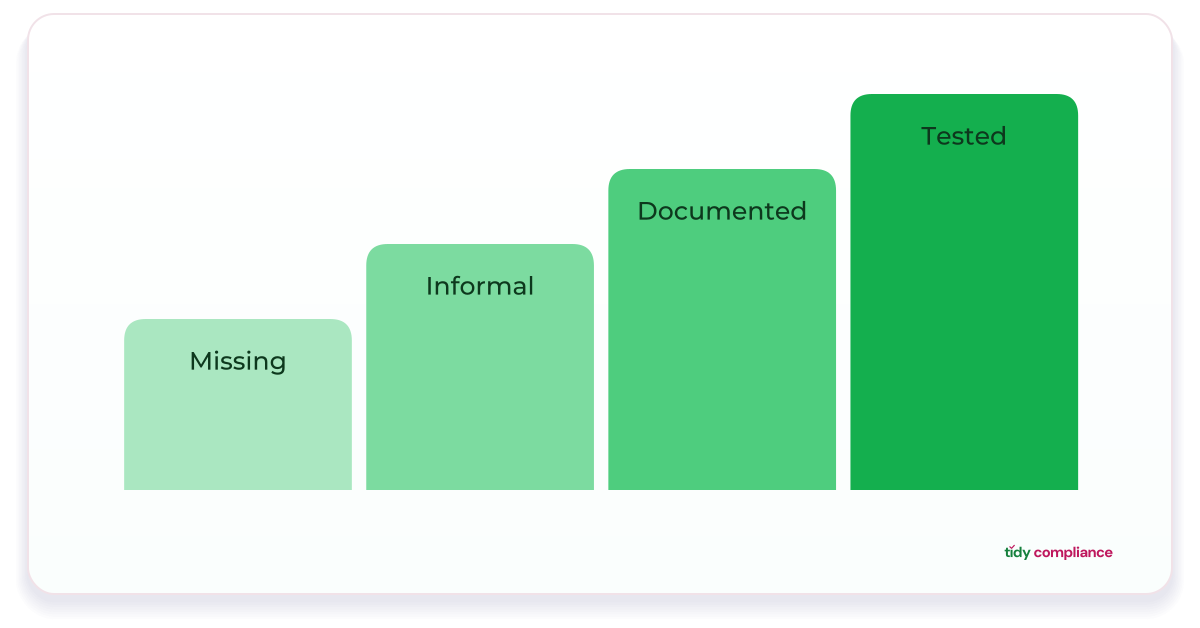
Score each area with a simple scale: 0 missing, 1 informal, 2 documented, 3 documented and tested. Keep the rating tied to the evidence in your folder. Interviews are a starting point only. I have seen teams describe a bias test in detail and then fail to produce a single result file.
- Governance: an owner, an approver and a review date
- Data: source, permission to use it and quality checks
- Testing: accuracy and bias results from the last release
- Transparency: users know when they deal with AI
- Oversight: a person can stop or override the system
- Monitoring: alerts and a log someone reads
Phase 5: Rate the Gaps So You Can Rank Them
Rate each gap on two axes: how bad if it goes wrong and how likely. Multiply or plot them, and then add effort. A missing owner on a customer-facing model is a high-impact, low-effort fix. A full bias testing program for a legacy model is high-impact, high-effort. Do the first now and schedule the second.
| Gap | Impact | Likelihood | Effort | Order |
|---|---|---|---|---|
| No owner for hiring screen | High | High | Low | Fix this month |
| No bias testing on credit model | High | Medium | High | Schedule with budget |
| Public chatbot used with client data | High | High | Low | Policy and block now |
| Inventory not updated | Medium | High | Low | Add to quarterly routine |
Phase 6: Turn Findings Into a Plan
A plan needs owners, dates and a way to show completion. Limit the first plan to ten or fewer actions. Review it monthly and close items with evidence. Re-run the assessment yearly, and whenever you add a high-risk system or a major vendor. If you want an outside review of the result, an AI compliance audit tests whether your controls hold up under examination.
A Worked Example From a 120-Person Services Firm
A professional services firm asked me for a readiness check before answering a large customer questionnaire. The survey found eleven AI tools. Procurement knew of four. The rest were features inside a CRM, a meeting recorder, two writing tools used by individuals and a recruiting platform that had added candidate ranking in a recent update.
Classification put the recruiting platform in the high-risk group, since it ranked people. The meeting recorder was also flagged, because it stored client conversations with a vendor that had no data processing agreement on file. Control testing then showed the recruiting tool had an owner but no bias test, and nobody could say how the ranking worked.
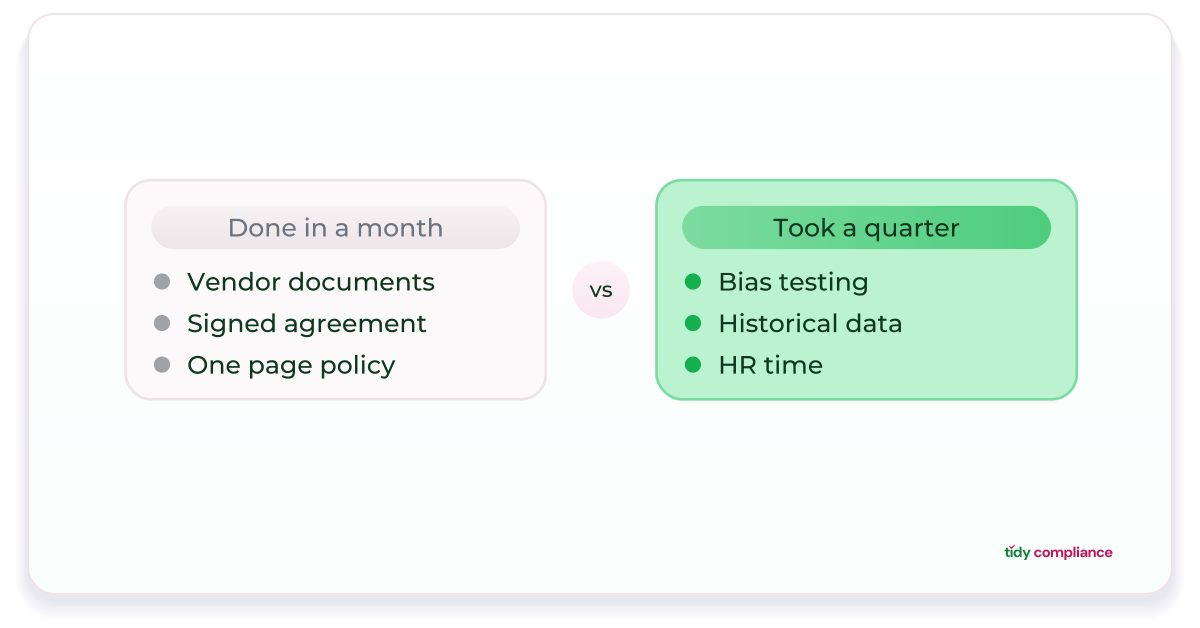
The result was a plan with eight actions. Three were done within a month: ask the vendor for documentation and test results, sign the missing agreement and publish a one-page staff policy. The bias testing took a quarter, because it needed historical data and HR time. The assessment cost the firm a few working days of staff time, and the customer questionnaire was answered with documents instead of promises.
Questions to Put to Every AI Vendor
Vendor tools hold much of your exposure, so add a standard question set to every review. Keep it short enough that vendors actually answer it.
| Topic | Question | What a good answer looks like |
|---|---|---|
| Data use | Is our data used to train your models, and can we opt out? | A clear contract term and a setting you can check |
| Location and access | Where is data stored and who at the vendor can see it? | Named regions, access controls and logging |
| Testing | What accuracy and bias testing do you run and can you share results? | Dated reports or a summary under NDA |
| Changes | How do you tell us about model or feature changes? | Release notes and notice before material changes |
| Incidents | How and how fast will you tell us about an incident? | A stated notification period and a contact |
Who to Involve and How Long It Takes
Keep the working group small. One person from compliance or legal leads. Add IT or security, someone from data or engineering, HR for people-related tools and one business owner per unit in scope. Most of their time goes to the discovery and control-testing phases. Plan about two hours a week for each unit owner over four weeks, and more for the lead.
| Company size | Typical duration | Main time cost |
|---|---|---|
| Under 50 staff | 1 to 2 weeks | Inventory and one workshop |
| 50 to 500 staff | 3 to 6 weeks | Survey, vendor checks, control testing |
| Over 500 staff | 2 to 4 months | Many systems, model validation and approvals |
What the Final Report Should Contain
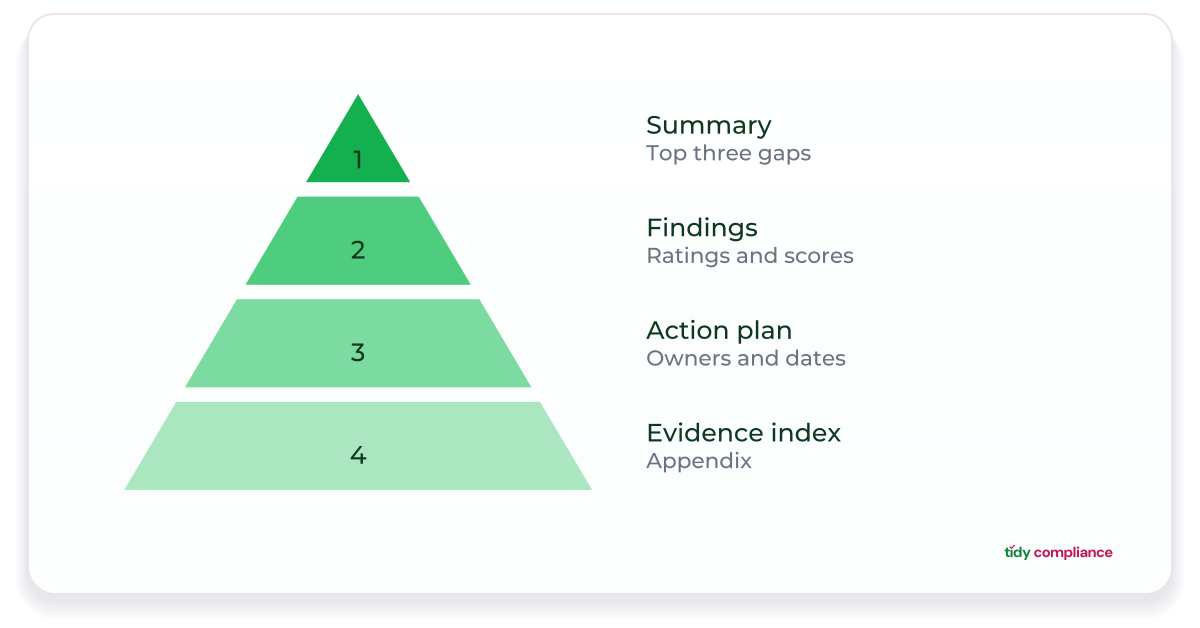
Keep the report short enough that leadership reads it. Four to six pages is plenty. Open with a one-paragraph summary that names the three biggest gaps and what they could cost you. Follow with the inventory, the risk levels, the control scores and the ranked action plan.
Add an appendix with the evidence index, so a reviewer can trace every score to a file. Leave out long descriptions of frameworks, which readers can look up. Name an owner and a date for every action and agree the first review meeting before you send the report. Reports without a scheduled follow-up tend to become shelf documents within a month.
If you present to a board or investors, show the trend over time. A first assessment with many gaps is normal. What counts is that the same gaps shrink in the next one, which is why I suggest you keep the scoring scale unchanged between rounds.
Mistakes That Make Assessments Useless
- Scoring policies instead of practice, so everything looks fine
- Skipping vendor tools, which hold most of the risk
- Leaving out HR and marketing, where AI use grows fastest
- Producing a report with no owners or dates
Once the first assessment is complete, the AI compliance checklist keeps your controls current, and the best practices help you keep them lean. If you need tooling, see the AI compliance tools ranking.
Sources
NIST: AI Risk Management Framework, European Commission: Regulatory framework for AI, ISO/IEC 42001 AI management systems.
Questions About AI Compliance Assessments
What Is an AI Compliance Assessment?
It is a structured review of your AI systems, policies and controls against the rules and frameworks that apply to you. The result is a ranked list of gaps with owners and dates.
How Long Does an AI Compliance Assessment Take?
A focused assessment for a mid-sized company usually takes three to six weeks. The discovery phase takes longest because surveys and vendor checks depend on other people.
Can We Run an Assessment Ourselves?
Yes, for the first pass. Use a spreadsheet and the six phases above. Bring in an outside reviewer when high-risk systems are involved or when a customer or regulator needs an independent view.
What Framework Should I Assess Against?
If the EU AI Act applies, use its risk categories. For everything else, the NIST AI Risk Management Framework is a good reference because it is voluntary, widely recognized and easy to map to customer questions.
How Often Should We Repeat the Assessment?
At least once a year, and whenever you add a high-risk system, change a major vendor or enter a new market. Keep the inventory current in between.
What Is the Difference Between an Assessment and an Audit?
An assessment tells you where you stand and what to fix. An audit tests whether your controls work and whether your evidence holds up, often against a defined standard. Assessments come first.
Do Small Companies Need a Formal Assessment?
A light version helps every company that uses AI on customer or employee data. A single workshop, an inventory and a one-page gap list are enough for a small team.
Disclaimer: This article is for general information only and isn’t legal, financial or tax advice. Treat figures as estimates from typical work and confirm details with your providers before you act.
Was this guide helpful?
Thanks for your feedback.
Odessa Whitfield
Odessa leads the Tidy editorial team and works with the compliance consultants to turn real client projects into practical guides on regulations, frameworks, policies and audit preparation. Before joining Tidy, she worked in compliance and risk roles, writing and maintaining policy sets for regulated organizations. Every article goes through a consultant who has done the work in practice, and she updates guides when a rule, framework or tool changes. She works remotely from the United States.