Quick Summary
- AI compliance combines AI-specific laws, existing laws applied to AI and voluntary frameworks.
- Start with an inventory of every AI system, including vendor features and staff use of public tools.
- Match controls to risk: people-affecting decisions get the strictest treatment.
- Evidence written during the work is what proves compliance later.
AI compliance means showing that the way you build, buy and use AI systems follows the rules that apply to you, and that you can prove it. Most companies already use AI somewhere, in a chatbot, a hiring screen, a fraud model or a writing tool, and few have written down what those systems do or who answers for them. If you want outside help setting that up, AI compliance consulting covers the full path.
This guide starts from zero. You will see which rules and frameworks exist, how they fit together, what a working program contains and where to begin. I keep the legal parts at the level of what has been decided and tell you where to check the current status, because several AI rules are still being phased in or revised.
What AI Compliance Covers
AI compliance is a program, not one law. It combines three layers: laws that name AI directly, existing laws that already apply to AI use, and voluntary frameworks that regulators and customers increasingly treat as the yardstick. A good program covers all three with one inventory and one set of records.
| Layer | Examples | What it asks of you |
|---|---|---|
| AI-specific laws | The EU AI Act, some US state laws on automated decisions, city rules on hiring tools | Classify your systems by risk, meet duties for the riskier ones, keep documentation and tell people when AI is involved |
| Existing laws applied to AI | Privacy and data protection law, consumer protection, anti-discrimination, sector rules in finance and healthcare | Lawful data use, honest claims, fair outcomes, explanations for decisions that affect people |
| Voluntary frameworks and standards | NIST AI Risk Management Framework, ISO/IEC 42001 | A shared way to govern, map, measure and manage AI risk, often requested in customer questionnaires |
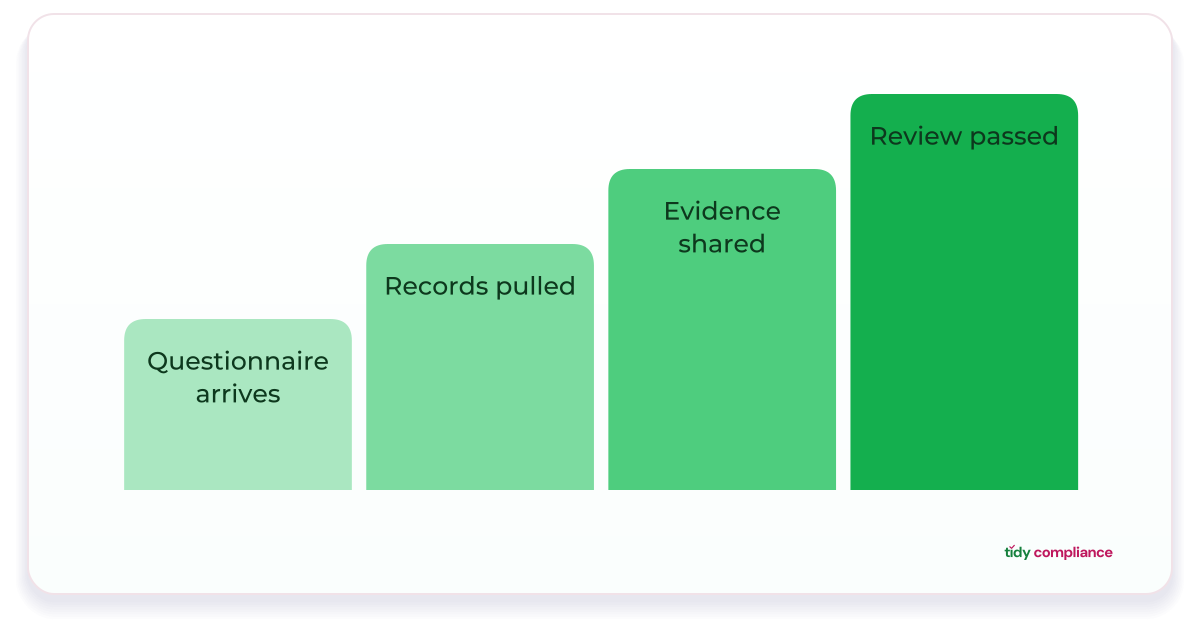
Customers often ask for the third layer first. Buyers send questionnaires long before any regulator calls, and a clear answer on governance is what closes those deals. My overview of the AI compliance checklist turns the layers into ten concrete points.
Who Needs an AI Compliance Program
You need one if you develop AI, if you buy tools that contain AI, or if your staff use public AI tools for work. The third group is the one companies overlook. A marketing team pasting customer data into a chatbot has created a data protection question without any procurement process, and nobody in compliance heard about it.
Size changes the effort, not the need. A 30-person company can run its program from a spreadsheet and a short policy. A bank needs model risk management, validation and committee sign-off. The questions are the same: what AI do we use, what data goes in, who decides, and what happens when it is wrong.
The Main Rules and Frameworks, in Plain Terms
The EU AI Act is the first broad AI law. It sorts systems by risk: some practices are prohibited, high-risk systems carry detailed duties, certain systems such as chatbots carry transparency duties and the rest face few requirements. It also sets duties for providers of general-purpose AI models. The European Commission explains the structure on its regulatory framework page. Application dates are phased and the legislation is still being refined, so check the current status before you plan around a date.
The United States has no single federal AI statute. Instead you work with existing enforcement, such as the FTC, which has said that its consumer protection rules apply to AI claims and AI-driven practices (see the FTC business guidance), plus state and local rules. New York City, for example, regulates automated tools used in hiring decisions, and several states have passed or proposed laws on high-risk automated decisions. Because this area moves quickly, I tell clients to track the states where they operate and to ask counsel which ones apply.
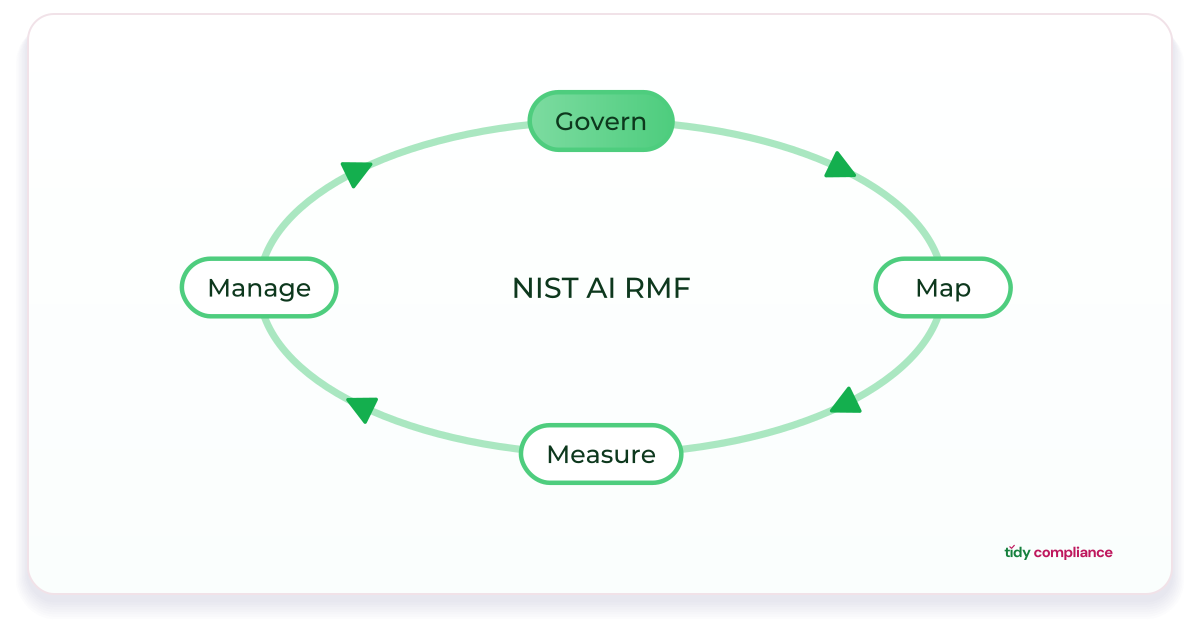
The NIST AI Risk Management Framework is voluntary and organizes the work into four functions: govern, map, measure and manage. NIST also published a profile for generative AI. ISO/IEC 42001 is a certifiable management system standard for AI, comparable to ISO 27001 for security. Neither is a law, and many regulators and buyers still use them as the reference for what good looks like.
| Source | Type | Best used for |
|---|---|---|
| EU AI Act | Law with risk tiers | Companies that place AI on the EU market or whose output is used in the EU |
| NIST AI RMF | Voluntary framework | Building a risk process that works in any country and answering US customer questionnaires |
| ISO/IEC 42001 | Certifiable standard | Companies that want an auditable management system and third-party proof |
| FTC and state rules | Enforcement and local law | Checking claims, data use and fairness in US operations |
Step One Is an Inventory of Every AI System
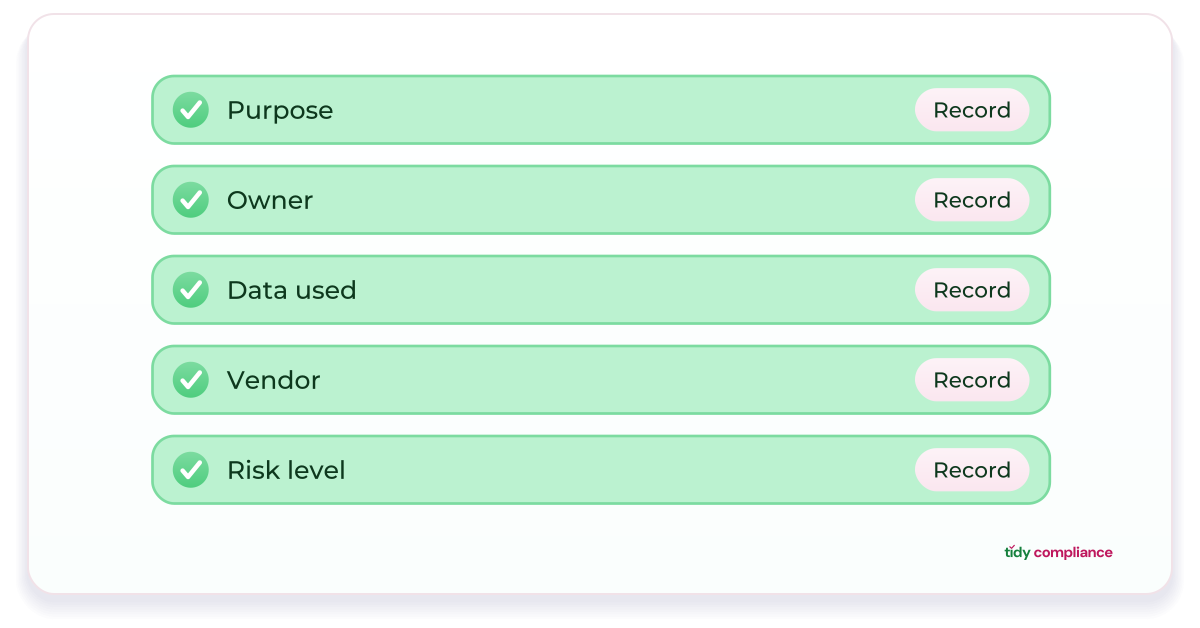
You cannot assess what you have not found. List every system that uses AI: models you build, vendor tools with AI features, embedded features in software you already own and the public tools your staff use. For each, record the owner, the purpose, the data it touches, the vendor, who is affected and whether a person reviews its output.
In my client work the first inventory almost always turns up more systems than leadership expected, often because a vendor added an AI feature to a product that was already approved. Ask procurement for contracts renewed in the last year and ask department heads what they use. Then ask the staff, because the honest answers come from them.
Classify by Risk, Then Match the Controls
Once the inventory exists, sort every system into a small number of risk levels. Use the legal categories if the EU AI Act applies to you, and add internal levels for everything else. The point is proportion: a spelling assistant needs a short policy, a credit scoring model needs documentation, testing and a named owner.
| Risk level | Typical examples | Minimum controls |
|---|---|---|
| Prohibited or off-limits | Practices your policy or the law rules out | Do not build or buy; record the decision |
| High | Hiring screens, credit decisions, medical support, safety functions | Impact assessment, data quality checks, testing for bias and accuracy, human oversight, logs, named owner |
| Limited | Customer chatbots, content generators | Tell users they deal with AI, review outputs, filter sensitive data |
| Minimal | Spam filters, internal search | Basic acceptable use rules and inventory entry |
What a Working AI Compliance Program Contains
Keep the first version small. Six elements carry most of the weight, and each one can start as a single page.
- An AI policy that says what staff may and may not do, including public tools and sensitive data
- An inventory with owners, reviewed at least twice a year
- A risk classification method and a short impact assessment form for high-risk uses
- Vendor review questions for any tool that contains AI, built into procurement
- Testing and monitoring for accuracy, bias and drift, with results written down
- An incident process for harmful or wrong outputs, with named decision makers
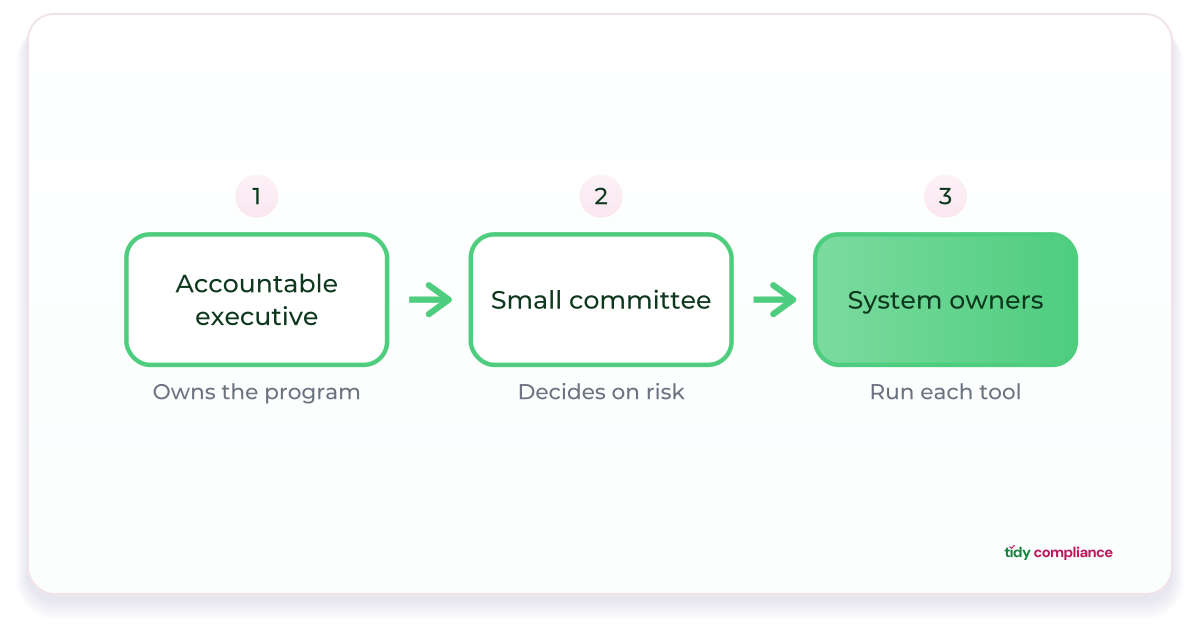
Governance sits on top. Assign one accountable executive and a small cross-functional group from legal, security, data, HR and the business. Meet monthly at first. Groups that meet quarterly with no agenda tend to approve everything or nothing. If you already run a security or privacy program, extend it. The review habits in my guide to AI compliance best practices fit into it without a new committee.
Evidence Is What Makes It Compliance
Auditors, regulators and large customers all ask the same thing: show me. A policy nobody follows counts for little, and a decision with no record might as well not have happened. For each high-risk system keep the purpose statement, the data sources, the test results, the approval and the monitoring log in one place.
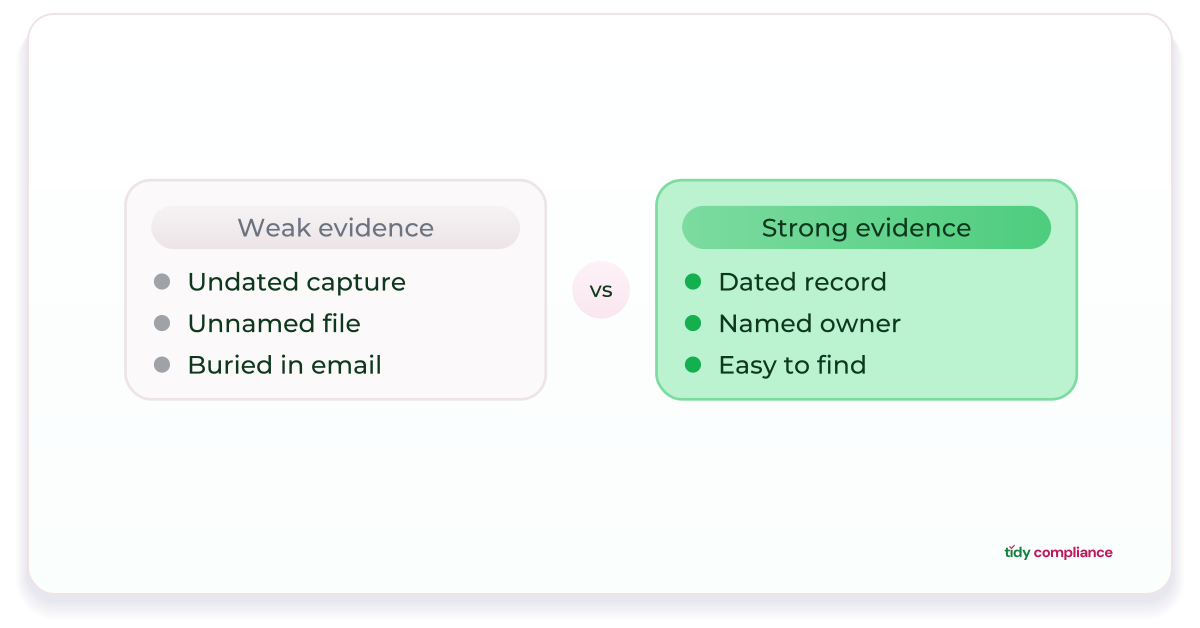
Good evidence is dated, attributable and easy to find. Name each file by system and date, store it in a controlled folder and keep an index. When someone asks about a model six months from now, you should be able to answer in minutes. A formal review of that evidence is what an AI compliance audit examines, and a structured self-check is covered in my AI compliance assessment guide.
Where Tools Help and Where They Do Not
Software can keep the inventory, collect vendor answers, schedule reviews and store evidence. It cannot decide your risk level or judge whether a model treats groups fairly. Pick tools after you know your process. If you are comparing options, my ranking of the best AI compliance tools shows which fit which size of program.
Your First 90 Days
If you are starting from nothing, this order works for most mid-sized companies. Expect delays in the vendor reviews, because they depend on other people.
| Weeks | Focus | What you can show |
|---|---|---|
| 1 to 3 | Appoint an owner, publish a short AI policy and send a staff survey | Policy, owner, survey results |
| 4 to 6 | Build the inventory and classify each system | Inventory with risk levels |
| 7 to 9 | Run impact assessments for high-risk systems and add AI questions to vendor reviews | Assessments, vendor question set |
| 10 to 13 | Set up monitoring, an incident process and the review calendar | Monitoring log, incident procedure, calendar |
After the first cycle, the work becomes a routine of reviews and changes. That routine is also the best protection against surprises, because new rules rarely require a new program, only an update to the one you have.
Sources
NIST: AI Risk Management Framework, European Commission: Regulatory framework for AI, ISO/IEC 42001 AI management systems, FTC: Artificial intelligence business guidance.
Questions About AI Compliance
What Is AI Compliance?
AI compliance is the practice of making sure your AI systems follow the laws, regulations and standards that apply to them, and keeping the records that prove it. It covers AI-specific laws, existing laws such as privacy and consumer protection, and voluntary frameworks that customers expect.
Does My Company Need an AI Compliance Program If We Only Use Vendor Tools?
Yes, usually. Buying a tool does not move all responsibility to the vendor. You still decide what data goes in, how outputs are used and who is affected. A light program with an inventory, a policy and vendor questions is often enough for low-risk use.
Is the EU AI Act Relevant to a US Company?
It can be. The law applies to providers and users of AI systems whose output is used in the EU, regardless of where the company sits. Ask your counsel whether your products or customers bring you in scope, and check the current application timeline, since it is phased.
What Is the Difference Between NIST AI RMF and ISO/IEC 42001?
The NIST framework is voluntary guidance with four functions: govern, map, measure and manage. ISO/IEC 42001 is a management system standard that an auditor can certify. Many companies use NIST to design the process and ISO to prove it to customers.
Who Should Own AI Compliance in a Company?
One accountable executive, often in legal, risk or security, supported by a small group from data, HR and the business. Ownership split across many teams with no lead is the most common reason programs stall.
How Long Does It Take to Build a Basic AI Compliance Program?
A basic program with a policy, inventory, risk levels and vendor questions often takes about three months for a mid-sized company. Larger organizations with many models need longer, mainly for impact assessments and testing.
Do I Need a Lawyer for AI Compliance?
For legal interpretation, yes. A compliance consultant builds the program, records and training, and prepares the facts. Counsel advises on which laws apply to you and how to read them. Using both usually costs less than asking counsel to do everything.
Disclaimer: This article is for general information only and isn’t legal, financial or tax advice. Treat figures as estimates from typical work and confirm details with your providers before you act.
Was this guide helpful?
Thanks for your feedback.
Odessa Whitfield
Odessa leads the Tidy editorial team and works with the compliance consultants to turn real client projects into practical guides on regulations, frameworks, policies and audit preparation. Before joining Tidy, she worked in compliance and risk roles, writing and maintaining policy sets for regulated organizations. Every article goes through a consultant who has done the work in practice, and she updates guides when a rule, framework or tool changes. She works remotely from the United States.