Quick Summary
- CMMC has three levels, and the type of information in your contracts decides which one you need.
- Level 2 is built on the 110 security requirements in NIST SP 800-171 and is where most small contractors spend their effort.
- Scope is the biggest lever: the less of your company touches controlled information, the less you have to prove.
- The program rules are phased and can change, so check the current rule and your contract before you plan dates.
CMMC is the way the Department of Defense checks that its suppliers protect sensitive information. If you sell to the defense supply chain, even through a prime, you will meet it sooner or later. Many owners first hear about it from a contract clause or a customer questionnaire, and the vocabulary can feel like a wall.
This guide takes you from the basics to the advanced topics in the order I teach them in CMMC compliance consulting engagements. Where rules or schedules matter, I tell you to check the current text instead of quoting dates that may move. It is general information and not legal advice.
The Basics: What CMMC Is and Why It Exists
Defense contractors have long been required to protect government information on their systems. The program adds verification: instead of taking a company's word for it, the DoD requires a score or a certification. The program is set out in a federal rule, which is linked in the sources below.
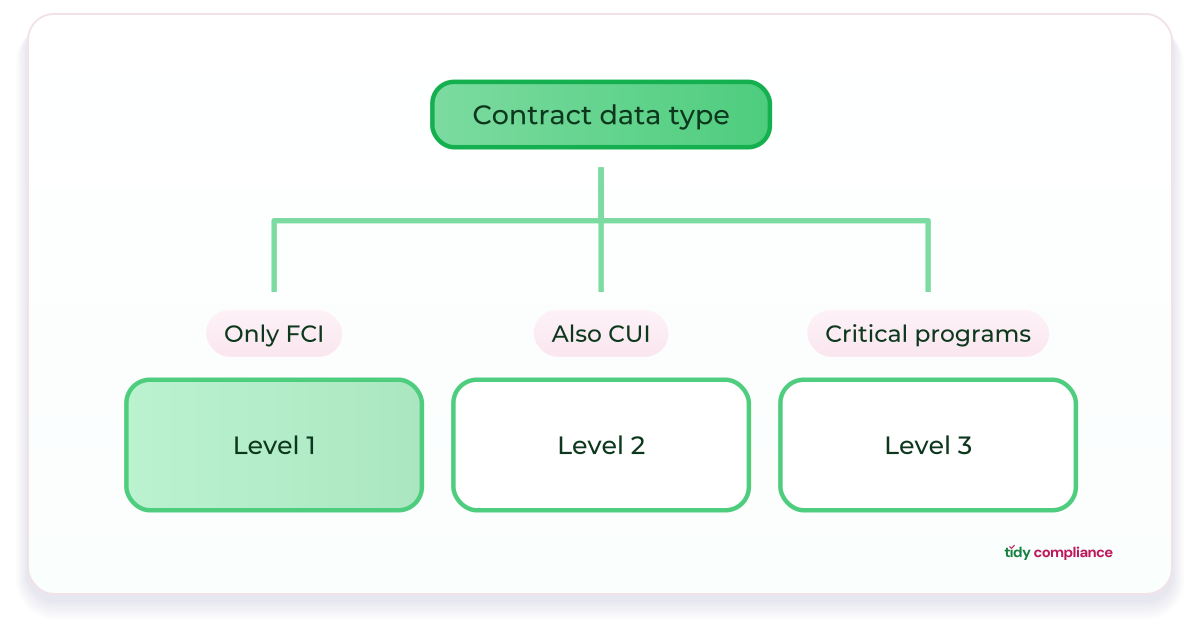
Two kinds of information drive everything. Federal contract information is information provided by or generated for the government under a contract, not intended for public release. Controlled unclassified information is information the government marks for protection. If you handle only the first kind, your requirements are modest. If you handle the second kind, they grow a lot.
The Three Levels Side by Side
| Level | Information protected | Requirement set | Verification |
|---|---|---|---|
| Level 1 | Federal contract information | 17 basic safeguarding practices | Annual self-assessment |
| Level 2 | Controlled unclassified information | 110 requirements from NIST SP 800-171 | Self-assessment or third-party assessment, depending on the contract |
| Level 3 | Controlled unclassified information in the most critical programs | Level 2 plus selected NIST SP 800-172 requirements | Government-led assessment |
Most small and mid-sized suppliers I work with land at Level 1 or Level 2. Level 3 applies to a small group of programs, and I would not plan for it unless a contract says so. Which Level 2 path applies to you, self or third party, comes from the contract language, so read it before you budget. My CMMC compliance cost guide shows how much that choice changes the price.
The Intermediate Layer: Scope, the System Security Plan and Evidence
Once you know your level, three documents carry the work. The scope statement says which systems, people and facilities are covered. The system security plan describes how each requirement is met in your environment. The evidence set proves it.
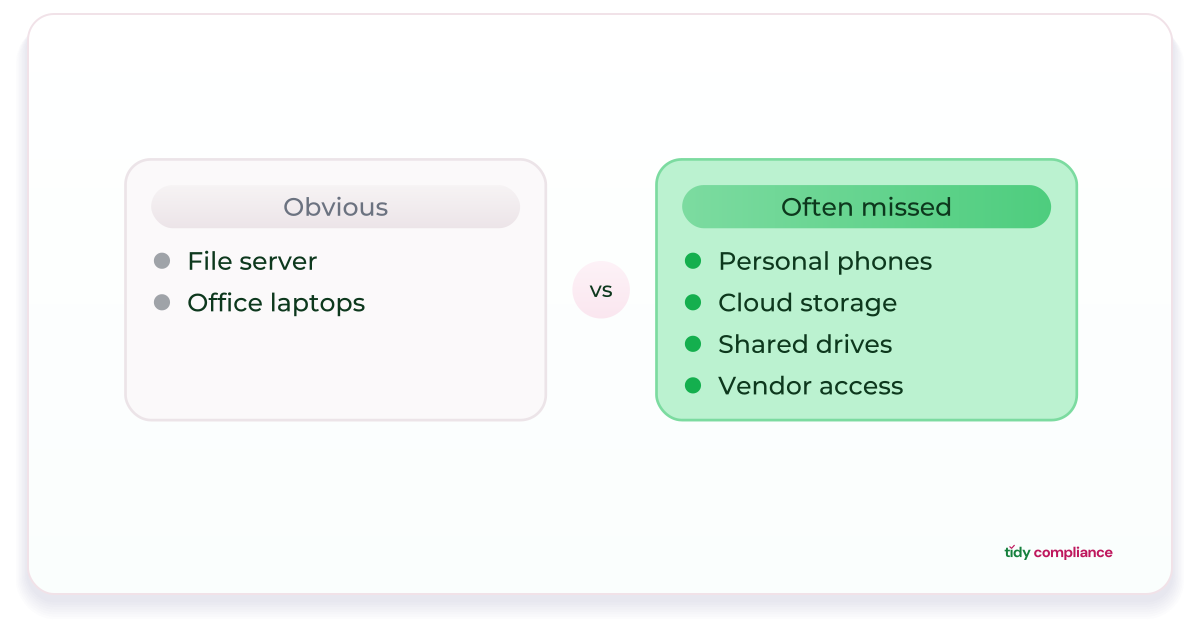
Scope deserves the most thought. The systems that store or process controlled information are in. So are the ones that protect them and some that support the people who use them. I ask clients to trace the data from the contract to the laptop to the backup, then draw it. Every extra system you find on that drawing is a system you have to defend.
The plan is where many first-timers fail. It is not a template to fill in on a Friday. It is a description of how your own network behaves, and an assessor will compare it with what they see. A short, accurate plan beats a long, aspirational one every time.
The 14 Requirement Families
NIST SP 800-171 Revision 2 groups its 110 requirements into 14 families, such as access control, awareness and training, audit and accountability, configuration management, identification and authentication, incident response, media protection and system and communications protection. For a first read, group them into five working areas:
- People and access: who can reach controlled information and how that is granted and removed.
- Devices and configuration: how computers and servers are set up, patched and monitored.
- Data protection: encryption, media handling and secure transfer.
- Detection and response: logging, alerts and incident handling.
- Governance: policies, training, risk assessment and the system security plan.
The CMMC compliance checklist turns these areas into items you can tick off one by one.
Assessments: Self, Third Party and What Gets Scored
An assessment tests every requirement in scope. For a self-assessment your own team does it, scores it and records the result. For a certification assessment an authorized third-party organization does it. Either way the scoring model works the same way: requirements carry point values, and not-met items subtract from a total of 110.
Before you commit to a date, run an internal review. My article on the CMMC compliance assessment shows how to evaluate your readiness in a structured way, and the CMMC compliance audit framework explains what happens in the formal one. The short version: the assessor looks at documents, talks to your people and tests your controls, and all three have to agree.
The Advanced Topics: Providers, Inheritance and Continuous Compliance
After the first assessment the harder questions appear. Cloud and managed service providers that handle controlled information need their own documentation, and you need a clear matrix showing who is responsible for which requirement. Controls can sometimes be inherited from a provider that already meets the requirement, and you still have to document that you rely on them.
Continuous compliance is the other advanced topic. Certification is time-limited, and an authorized official affirms continued compliance on a schedule. Your environment changes every month, with new staff, new software and new vendors, so the plan and the evidence have to change with it. Companies that assign one named owner for the program keep their result, and those that hand it to whoever has time tend to lose it.
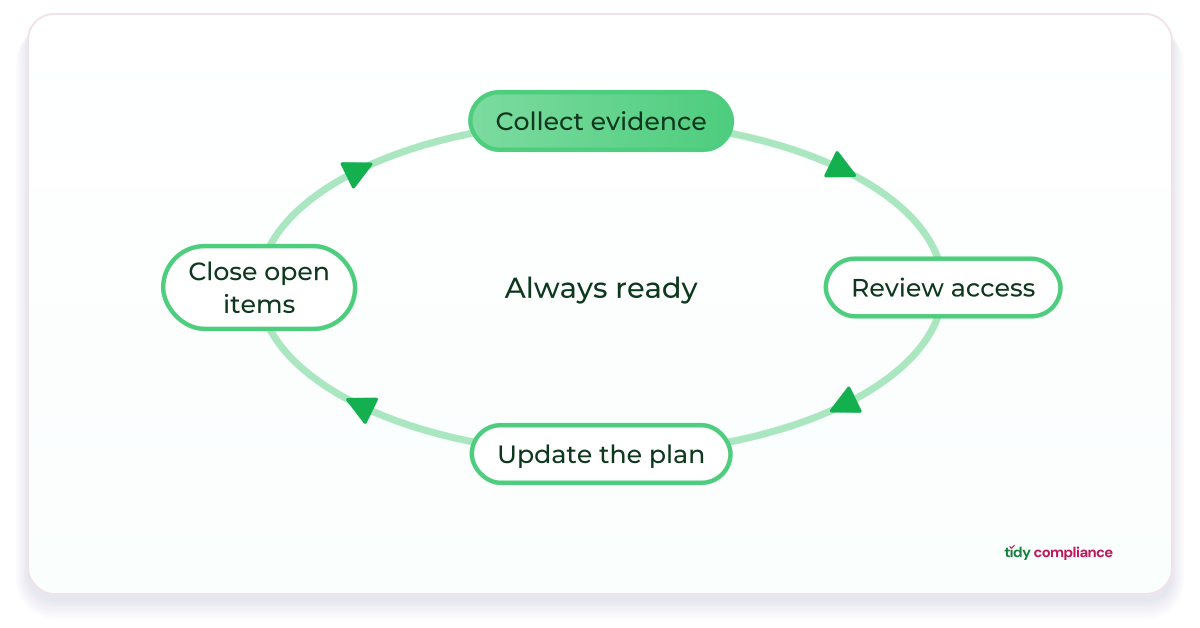
Tooling helps at this stage. Platforms collect evidence automatically and alert you when a setting drifts, and my overview of CMMC compliance tools explains which kinds of tool fit which size of company.
Beginner Mistakes I See Again and Again
Beginners rarely fail because the requirements are mysterious. They fail because of habits that feel reasonable. The first habit is starting with tools. A platform promises a dashboard and a score, and a month later the company has a score for a scope that was never defined.
The second is copying a policy template and calling it done. Assessors interview the people who are supposed to follow the policy, and a template that says "the security officer reviews logs weekly" falls apart when nobody has that title. Write the policy for the person who really does the job, and put their name on it.
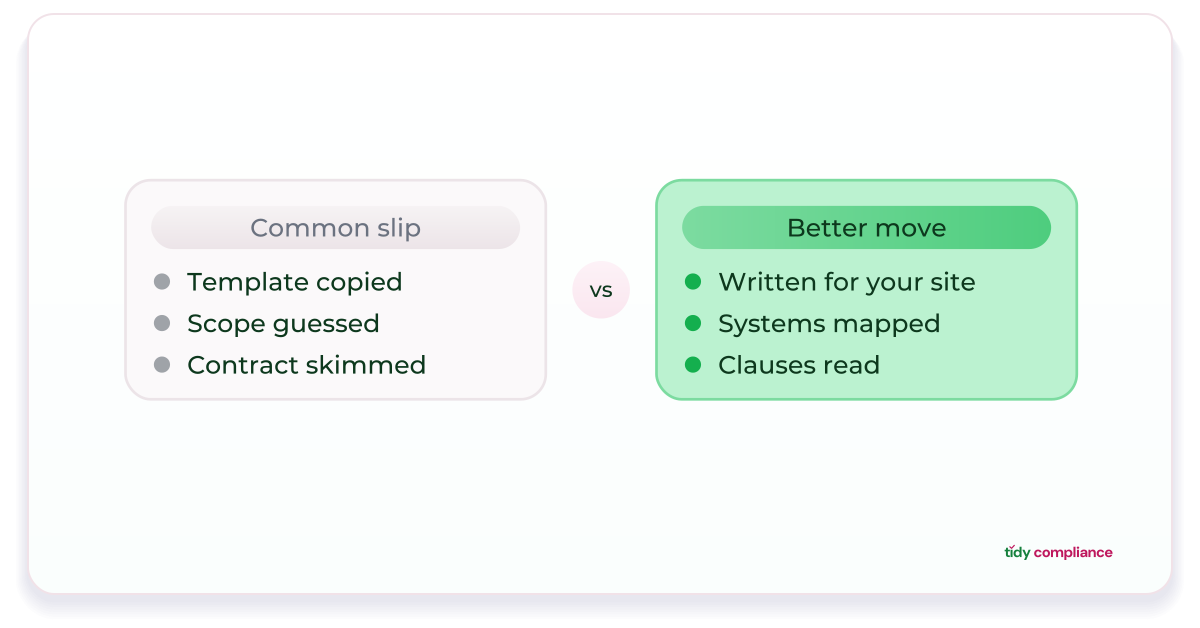
The third is treating the contract language as background reading. The flow-down clauses decide your level, your assessment path and your reporting duties. Read them with a highlighter, and ask your prime for clarification in writing when a sentence is unclear. A few emails at this stage cost nothing, and a wrong assumption can cost a bid.
How Long the Journey Takes
People want a number. The honest answer is that it depends on your scope and your starting point, and I will not quote a duration that applies to everyone. What I can describe is the shape. Scoping and the gap assessment come first and move quickly. Remediation is the long middle, and it is longest where technical changes depend on other teams or on vendors. The mock assessment and evidence cleanup come last.
| Stage | What decides the length | Common delay |
|---|---|---|
| Scope and gap assessment | Number of systems and locations | Unknown systems found late |
| Remediation | Number and type of gaps | Waiting for budget or vendor changes |
| Plan and evidence | Quality of existing documentation | Policies nobody has signed |
| Mock assessment | Availability of staff for interviews | Findings that need a second round |
Start earlier than feels necessary. Whatever your timeline, check the current program rules for the phase that applies to your contracts, and plan backward from the date your customers need proof.
Ten Terms You Will Hear on Your First Call
Vocabulary is half the battle on a first call. These are the terms that come up most, in the order they usually appear.
| Term | Plain meaning |
|---|---|
| FCI | Federal contract information, not meant for public release |
| CUI | Controlled unclassified information that the government marks for protection |
| C3PAO | An authorized third-party organization that performs certification assessments |
| SSP | System security plan, the document describing how each requirement is met |
| POA&M | Plan of action and milestones, a list of open items with owners and dates |
| SPRS | The DoD system where assessment scores and status are posted |
| Enclave | A separate environment built to hold controlled information |
| Flow-down | A requirement a prime passes to its subcontractors |
| Affirmation | A formal statement by an authorized official that compliance continues |
| Inheritance | Relying on a provider that already meets a requirement |
If a consultant or vendor uses a term that is not on this list, ask for a plain explanation. Clear language is a good sign of real experience.
The Order of Work I Recommend
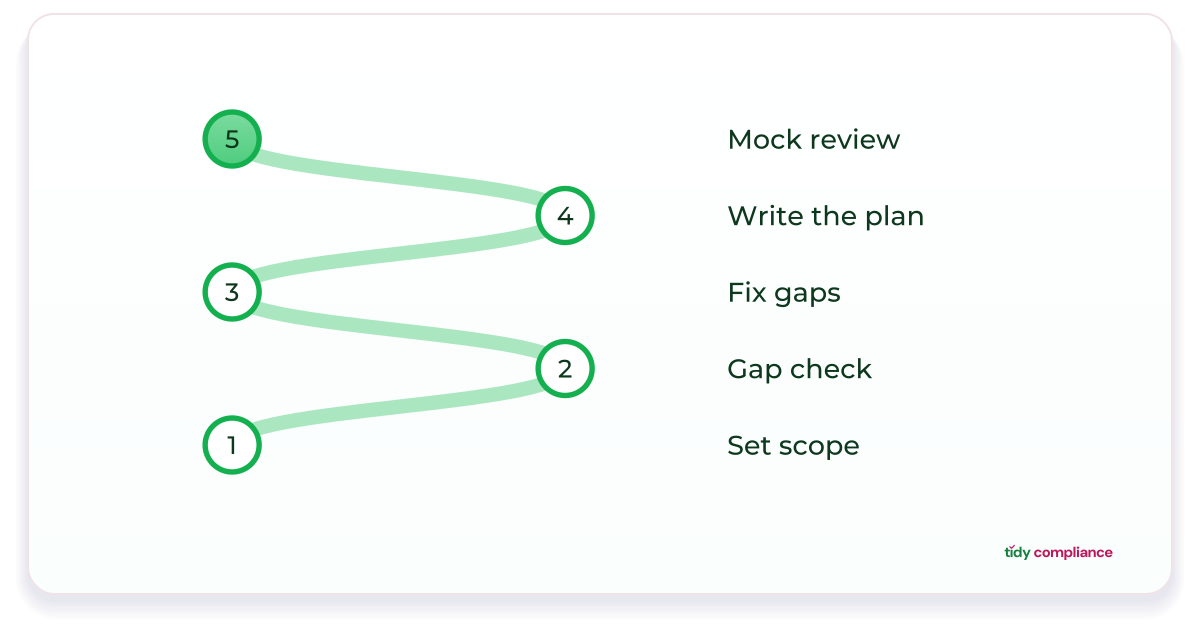
People ask me where to start more often than anything else. The sequence below works for most small contractors:
- Read your contracts and find the information types and the required level.
- Draw the data flow and decide your scope.
- Run a gap assessment against the requirement set.
- Write the system security plan and fix the highest-risk gaps first.
- Train staff and collect evidence as you go.
- Run a mock assessment, then schedule the real one.
The order matters because each step feeds the next. Companies that buy tools in step one often discover in step three that they bought for the wrong scope.
Questions About the CMMC Compliance Guide
What Does CMMC Stand For?
Cybersecurity Maturity Model Certification. It is the Department of Defense program that checks whether contractors protect federal contract information and controlled unclassified information in their own systems.
Who Needs CMMC?
Contractors and subcontractors in the defense supply chain that handle federal contract information or controlled unclassified information. Your contract tells you which level applies, and primes pass requirements down to their subcontractors, so a small supplier can be affected without ever talking to the DoD.
What Is the Difference Between FCI and CUI?
Federal contract information is information provided by or generated for the government under a contract that is not meant for public release. Controlled unclassified information is a narrower category the government marks for protection under law or policy. CUI triggers the higher level.
What Is NIST SP 800-171?
It is the NIST publication that lists the security requirements for protecting controlled unclassified information on nonfederal systems. Level 2 of the program is built on its 110 requirements, so the document is the heart of most preparation work.
What Is SPRS?
The Supplier Performance Risk System is the DoD database where contractors post assessment scores and status. Your contract may require a current entry, so confirm how and when to submit before you bid.
Can I Do CMMC Without Hiring Anyone?
Level 1 is realistic for a small team with careful reading. Level 2 usually needs technical skill for logging, identity and encryption, plus time to write the system security plan. Many companies bring in help for the gap assessment and the plan, then run the controls themselves.
How Do I Know Where to Start?
Start by finding out which information you hold and what your contracts require. Then map where that information lives. Only after that do you compare your controls with the requirements, because scope decides almost everything that follows.
Sources
- Cybersecurity Maturity Model Certification (CMMC) Program, final rule, Federal Register
- NIST SP 800-171 Revision 2, Protecting CUI in Nonfederal Systems
Disclaimer: This article is for general information only and isn’t legal, financial or tax advice. Treat figures as estimates from typical work and confirm details with your providers before you act.
Was this guide helpful?
Thanks for your feedback.
Odessa Whitfield
Odessa leads the Tidy editorial team and works with the compliance consultants to turn real client projects into practical guides on regulations, frameworks, policies and audit preparation. Before joining Tidy, she worked in compliance and risk roles, writing and maintaining policy sets for regulated organizations. Every article goes through a consultant who has done the work in practice, and she updates guides when a rule, framework or tool changes. She works remotely from the United States.