Quick Summary
- Start with a register of obligations, because every other point depends on knowing what applies to you.
- Every obligation needs one named owner, and the whole program needs one lead.
- A policy counts only when a control proves it works, so keep dated evidence as you go.
- Test controls between audits, log every issue and report to leadership on a fixed rhythm.
When a company asks me for a compliance management checklist, I ask a different question first: can you name every obligation you have? If the answer is a pause, the checklist starts at point 1. Good compliance management consulting follows the same order, because policies and training written for the wrong list of obligations only create more paperwork.
The eight points below each have two paragraphs, a set of steps and a short note on tools. Use them to verify where your program stands today. The list is a planning aid and not legal advice, and your counsel should confirm what a specific rule requires of you.
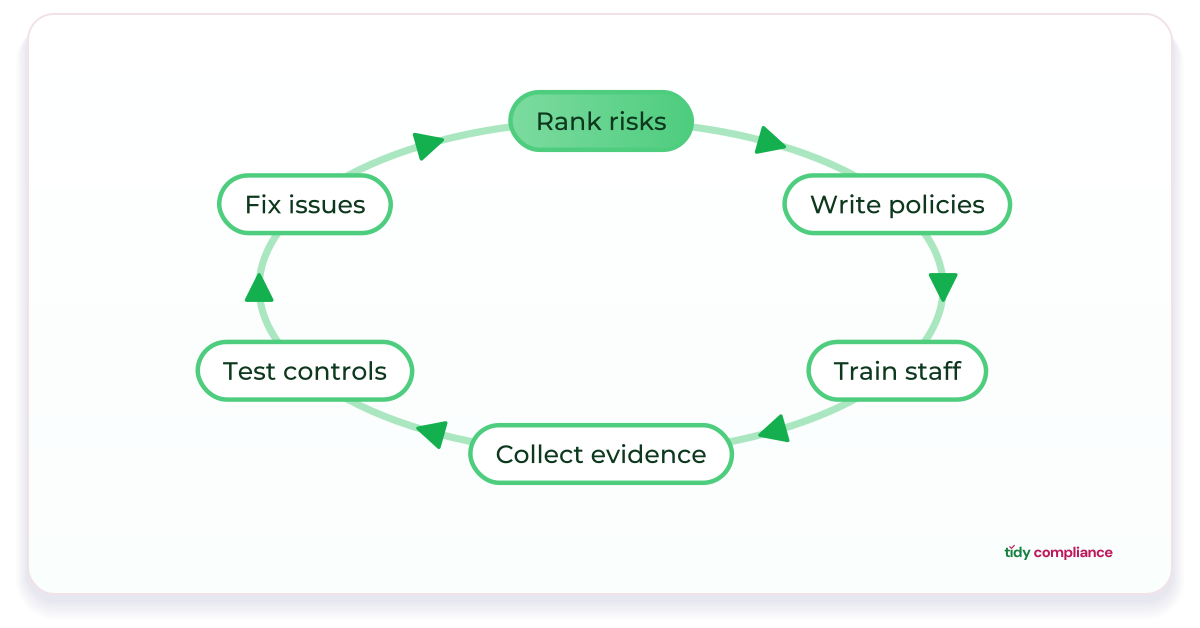
The 8 Points at a Glance
Read the table once, then work through the points in order. The first three set the scope, and the rest build on them.
| Point | First step |
|---|---|
| 1. Obligations Register | List every regulator, contract and framework that applies to your business |
| 2. Named Owners and Roles | Name a program lead with real authority and time |
| 3. Risk Ranking | Define what high, medium and low mean in your business |
| 4. Policies and Controls | Start with the highest-risk obligations from point 3 |
| 5. Training and Awareness | List which roles touch the high-risk obligations |
| 6. Evidence on a Schedule | List the evidence each control should produce |
| 7. Monitoring and Testing | Choose a check frequency for each rating from point 3 |
| 8. Issues, Fixes and Reporting | Create one issue log for findings from tests, audits and staff reports |
Obligations Register
Every compliance program starts with a plain list of what applies to you. That means laws, regulator rules, contract clauses, customer requirements and the frameworks you chose to follow. Most companies I meet carry this list in someone's head, and the person is usually about to change jobs.
Keep each line short: the obligation, where it comes from, which part of the business it touches and who owns it. A register of 40 to 80 lines is normal for a mid-sized company. Questions about how a rule reads or whether it applies to you go to your counsel, and the register shows exactly what to ask.
Steps to Take
- List every regulator, contract and framework that applies to your business.
- Write each obligation in one plain sentence with its source.
- Mark which team or system it touches.
- Assign one owner per line.
- Note the review date for each source, so changes get noticed.
- Ask your counsel to confirm the lines you are unsure about.
Supporting Tools
A spreadsheet with one row per obligation is enough to begin with. Move it into a governance, risk and compliance platform once the list grows past what one person can keep current.
Named Owners and Roles
An obligation without an owner is a wish. Give every line in the register one accountable person, and name a lead for the whole program. In the audits I support, the most common root cause behind a missed requirement is a task that three people each thought belonged to someone else.
Write down who decides, who does the work and who is told. Keep the roles short and tied to job titles, so the list survives a resignation. Leadership should see the owner list at least once a year and confirm it still matches reality.
How to Do It
- Name a program lead with real authority and time.
- Assign one accountable owner to each obligation.
- Define who approves policy changes.
- Record backups for every owner.
- Add compliance duties to job descriptions.
- Review the owner list after every reorganization.
What You Need
An org chart and a simple responsibility table (who decides, who does, who is informed) are all you need. Store it next to the register so the two stay in sync.
Risk Ranking
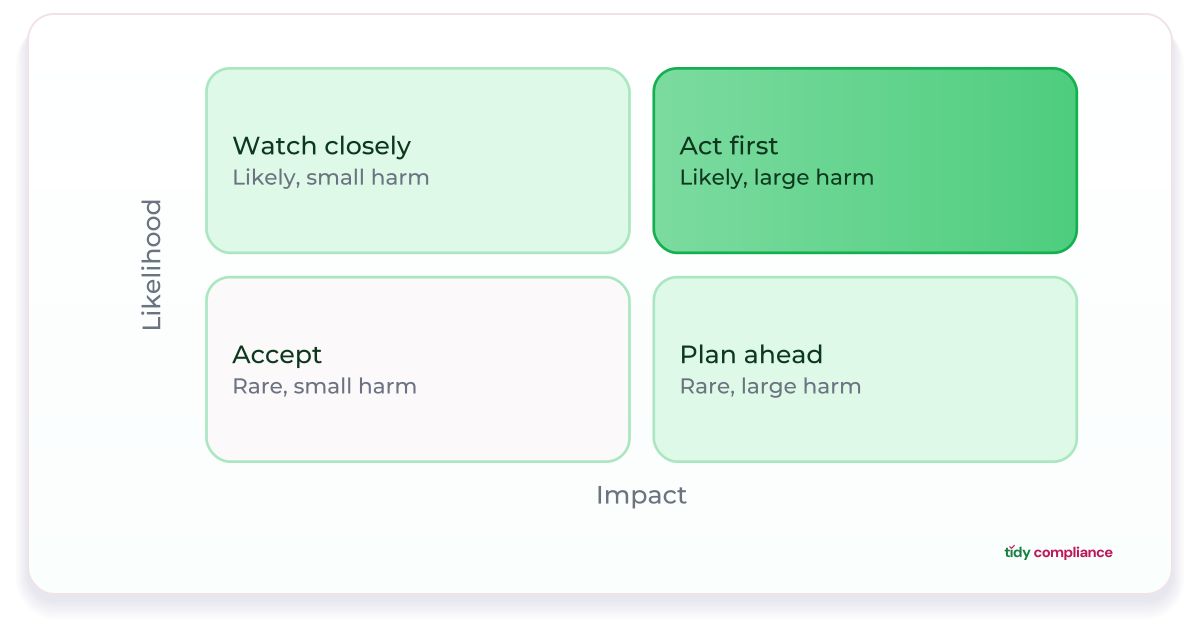
You cannot give every obligation the same attention. Rank them by two questions: how likely is a failure, and how bad would it be? A late filing and a data breach are both failures, but they need different amounts of effort and different levels of leadership attention.
Score each line high, medium or low and write one sentence on why. Keep the scale small, because five-point scales invite debates about the difference between a 3 and a 4. The ranking tells you where to spend the first month and which items get monthly checks instead of annual ones.
What to Work Through
- Define what high, medium and low mean in your business.
- Score likelihood and impact for every obligation.
- Combine the two into one rating.
- Write the reason for each high rating.
- Agree the ranking with the owners and leadership.
- Re-score after incidents, audits and major changes.
Where Evidence Comes From
A three-by-three grid on one page works well for most small and mid-sized companies. Keep the scoring rules next to the grid, so a new owner scores the same way the last one did.
Policies and Controls
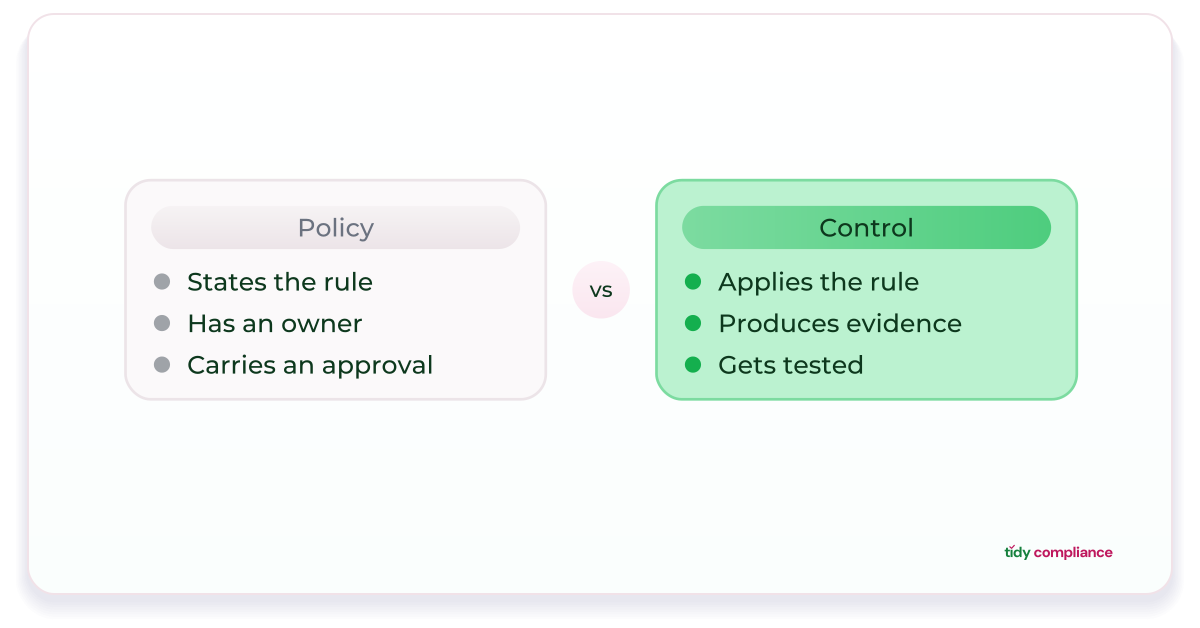
A policy says what you will do, and a control is the habit or setting that makes it happen. You need both for each higher-risk obligation. I often find a beautifully written policy next to a process that nobody follows, and an assessor reads that gap as a finding.
Write policies in short sections with an owner and an approval date. Then connect each one to at least one control that someone can show on request, such as a monthly report, a system setting or a signed checklist. If you cannot show a control working, the policy is a promise only.
Walk-Through
- Start with the highest-risk obligations from point 3.
- Write a short policy for each, with owner and approval date.
- List the control that proves each policy works.
- Test one control per policy yourself before anyone else does.
- Publish policies where staff actually look for them.
- Retire old versions so only one current copy exists.
Useful Resources
Use plain document templates with a version table. Many teams keep policies in a shared drive with read-only access and a change log, and that is enough for most audits.
Training and Awareness
People break rules by accident far more often than on purpose. Training closes that gap when it matches the person's job. A finance clerk needs different examples than a sales rep, and a manager needs to know what to do when someone raises a concern.
Plan one core session for everyone and short role-based sessions for the high-risk groups. Keep attendance and quiz records, because they are the evidence an auditor asks for first. Refresh the content when a policy or a law changes, and not only on the yearly date.
Actions in Order
- List which roles touch the high-risk obligations.
- Write one core course for all staff and short courses for those roles.
- Add a quick check at the end of each course.
- Train new hires within their first weeks.
- Record attendance and results in one place.
- Follow up with people who miss or fail a session.
Supporting Tools
A learning platform helps with reminders and records. A recorded session, a short quiz and a signed attendance sheet also work if your team is small.
Evidence on a Schedule
Evidence is the proof that a control ran. Collect it as you go, and do not rebuild it the week before an audit. A monthly access review exported on the first of the month is worth more than a screenshot taken under pressure.
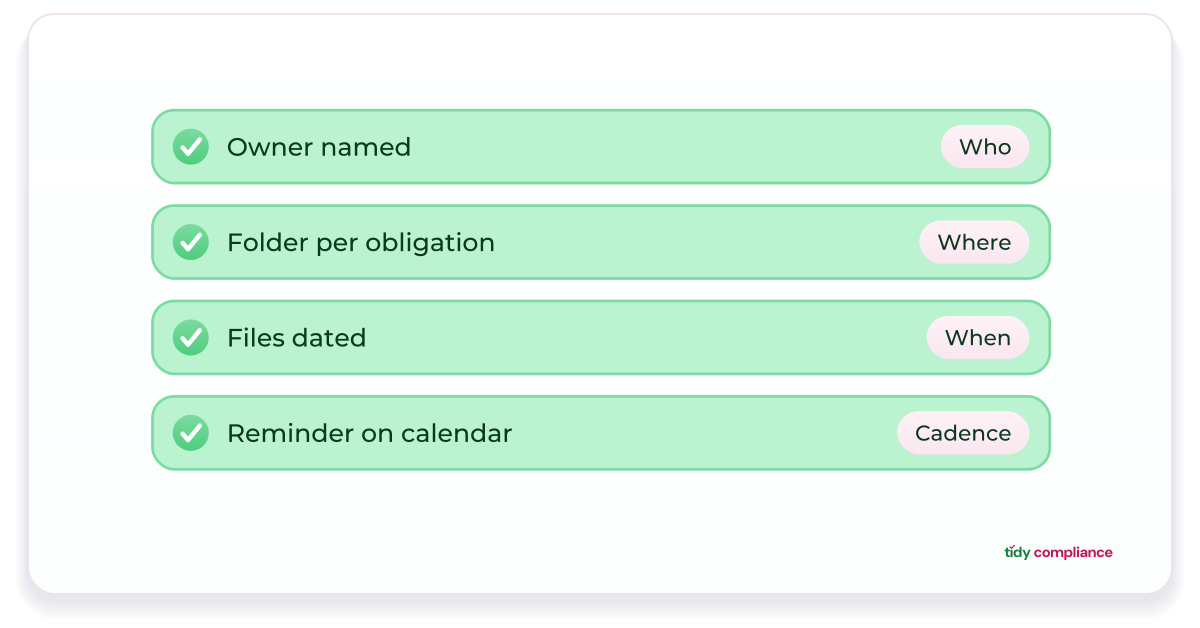
Set a collection calendar with an owner and a folder per obligation. Name files by date and control, so anyone can find them. In my experience a team that practices this for a quarter cuts its audit preparation time in a way that is easy to notice.
Work Plan
- List the evidence each control should produce.
- Set how often it is produced, such as weekly, monthly or yearly.
- Create one folder per obligation with a clear naming pattern.
- Assign a person and a due date to each item.
- Check the folders monthly for gaps.
- Keep old evidence for the period your contracts and counsel require.
What You Need
A shared drive with a fixed folder structure is the base. Platforms that pull evidence from your systems automatically save time once you have many controls.
Monitoring and Testing
A control that worked last year may have stopped working after a system change. Monitoring checks it between audits. Testing is a deeper look: pick a sample, follow it from start to finish and see if the control did its job.
Match the effort to the risk ranking. High-risk obligations get a monthly or quarterly check, and low-risk ones can wait for the annual review. Use someone who does not run the control, because people are poor judges of their own process.
Order of Work
- Choose a check frequency for each rating from point 3.
- Define a sample size and what a pass looks like.
- Assign testers who do not own the control.
- Record results in the same place as the evidence.
- Escalate failed checks to the program lead.
- Report test results to leadership every quarter.
Where Evidence Comes From
Test sheets in a spreadsheet are fine. If you use a platform, look for one that keeps test history, so you can show an auditor how a control performed over time.
Issues, Fixes and Reporting
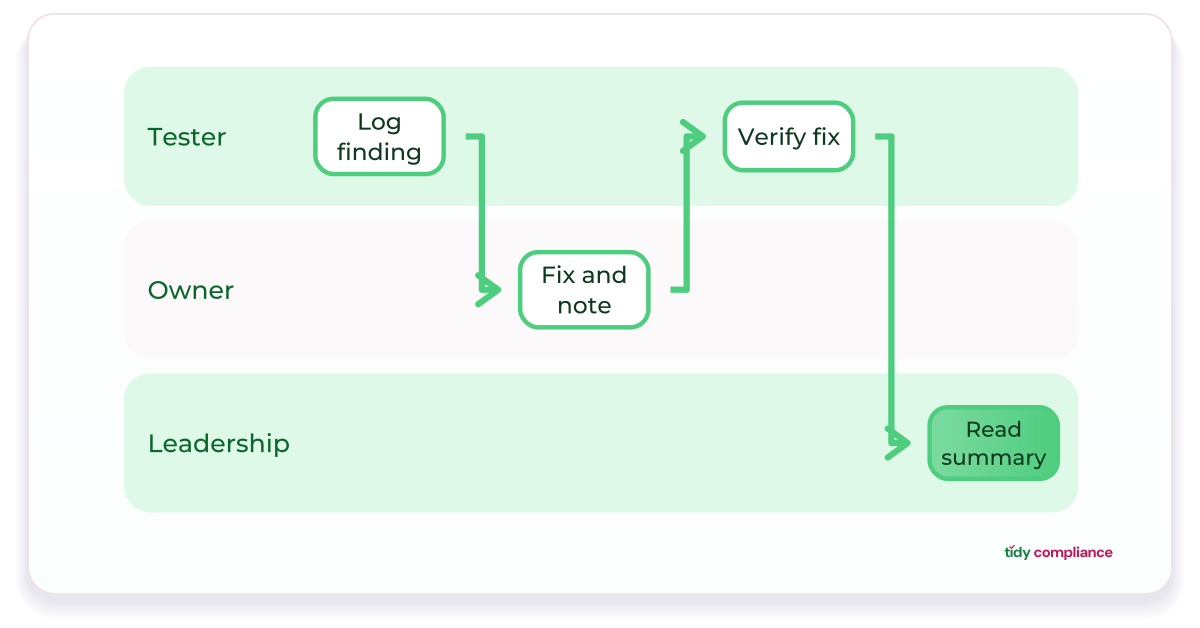
Every program finds problems, and what matters is what happens next. Log each issue with an owner, a due date and a root cause. Close it only when someone has checked the fix. An issue log that shows problems found and closed is a sign of a healthy program, and auditors read it that way.
Report to leadership on a fixed rhythm with a one-page summary: open issues, overdue items, changes in obligations and the next audit dates. Short and regular beats long and rare. Add a safe way for staff to raise concerns, and make sure managers know how to pass them on.
Steps in Practice
- Create one issue log for findings from tests, audits and staff reports.
- Record the cause, owner and due date for every issue.
- Review overdue items weekly with the program lead.
- Verify each fix before you close the issue.
- Send a one-page report to leadership every quarter.
- Feed repeated issues back into policies and training.
Useful Resources
A spreadsheet or a ticketing board with required fields for owner and due date is enough. Link each issue to the obligation it belongs to.
How to Sequence the Eight Points
Run points 1 to 3 in the first month, because they set the boundary for everything else. Points 4 and 5 take the longest to write and roll out, so start them with your highest-rated risks and expand later. Points 6 to 8 then keep the program alive. A realistic plan for a mid-sized company spreads the work over a quarter, and delays usually come from owners with no spare time.
The way these points connect into one system is the subject of my compliance management framework article. If you need to decide how much to invest and in what order, the compliance management strategy guide covers priorities and trade-offs.
| Period | Points | Result you can show |
|---|---|---|
| Weeks 1 to 4 | 1, 2, 3 | Register, owner list and risk ranking |
| Weeks 5 to 10 | 4, 5 | Approved policies and a first training round |
| Weeks 8 to 12 | 6, 7 | Evidence calendar and first control tests |
| Every quarter | 8 | Issue log and a one-page leadership report |
Where Tools and Automation Fit
Tools help with points 6 to 8, where the work repeats. Before you buy anything, run the process by hand for one cycle so you know what you want the tool to do. My ranking of compliance management software compares the main platforms, and the piece on compliance management automation shows which tasks are worth automating first.
Real programs differ in size and shape, so you may like to see how other companies handled the same points. I collected several in compliance management examples, with what worked and what took longer than planned.
How to Decide Whether You Need Help
Work through points 1 and 2 yourself, since you know your business best. Ask for an outside review before you invest in points 4 to 6, because a wrong obligation list or an unclear owner structure causes the most rework. A short review costs little compared with rewriting policies for the wrong scope.
Treat any question about what a law or contract requires as a question for your counsel. A consultant organizes the program and the evidence, and does not replace legal advice.
Questions About Compliance Management Checklists
What Is a Compliance Management Checklist?
It is a short list of the things a working compliance program has to have: a register of obligations, named owners, a risk ranking, written policies, training, evidence, monitoring and a way to fix problems. You use it to check whether each part exists, is current and can be shown to an auditor or a regulator.
How Often Should I Review the Checklist?
I suggest a full pass once a year and a light check every quarter. Review it sooner when something changes, such as a new product, a new state or country, an acquisition or a new regulator guidance document. Put the dates in a calendar and give each review an owner.
Who Should Own the Checklist in a Small Company?
One named person, even if it is a part-time role. In a small business that is often the operations lead, the head of finance or an office manager with support from outside counsel. Shared ownership usually means nobody owns it, so pick one name and write it down.
Is One Checklist Enough for Several Regulations?
The core points stay the same across regulations, which is why one program can serve several. The obligations register is where they differ. Keep one structure and tag each obligation with the regulation or framework it comes from.
What Evidence Do Auditors Usually Ask For?
They usually ask for your policies with approval dates, training records, access and change logs, risk assessments, meeting notes where compliance was discussed and proof that past findings were closed. The exact list depends on the framework and the auditor, so ask for the request list early.
Do I Need Software to Run This Checklist?
No. A shared spreadsheet and a folder structure can run an 8-point program for a small team. Software starts to pay off when you have many obligations, several frameworks or evidence that has to be collected from many systems. Choose it after your process works on paper.
When Should I Bring in a Consultant?
Bring one in when you cannot name your obligations with confidence, when an audit date is close or when the same finding keeps coming back. A short outside review of points 1 to 3 usually saves the most rework. Questions about what the law requires belong with your counsel.
Sources
- U.S. Department of Justice, Evaluation of Corporate Compliance Programs
- ISO 37301, Compliance management systems
Disclaimer: This article is for general information only and isn’t legal, financial or tax advice. Treat figures as estimates from typical work and confirm details with your providers before you act.
Was this guide helpful?
Thanks for your feedback.
Odessa Whitfield
Odessa leads the Tidy editorial team and works with the compliance consultants to turn real client projects into practical guides on regulations, frameworks, policies and audit preparation. Before joining Tidy, she worked in compliance and risk roles, writing and maintaining policy sets for regulated organizations. Every article goes through a consultant who has done the work in practice, and she updates guides when a rule, framework or tool changes. She works remotely from the United States.