Quick Summary
- Each example gave a named person ownership of a duty and produced a dated record.
- Start with one chain, tier or channel, then expand once it works.
- Simple tools such as spreadsheets and shared drives carry early versions.
- The examples are composites, so check each one against your own obligations.
Compliance management programs rarely fail because of one big mistake. They fail through small gaps: a duty with no owner, a policy nobody reads, a vendor nobody reviews. The seven examples below show how organizations closed those gaps in practical ways. I draw them from patterns I see in my compliance management consulting work, and I describe them as composites with details changed, not as named clients or published case studies.
Use them as ideas. Each one shows the situation, the fix and the steps, so you can judge which one fits your own program. Nothing here is legal advice, and your counsel decides what a particular rule requires.
The 7 Examples at a Glance
| Example | Setting | Main fix |
|---|---|---|
| 1. Building a Register After a Contract Surprise | Software company | Export all customer contracts and list clauses that contain duties. |
| 2. Cleaning Up a Policy Library That Nobody Used | Clinic group | Inventory every policy with its date, owner and last review. |
| 3. Putting Vendors Into Risk Tiers | Community bank | List every vendor with the data and systems it touches. |
| 4. Training That Tracks Who Completed What | Multi-site employer | Map roles to the situations each one meets in a normal week. |
| 5. Keeping an Evidence File for Customer Audits | Manufacturer | Create folders by obligation, using the same names as the register. |
| 6. Opening a Safe Channel for Raising Concerns | Hospital system | Describe in plain words who reads reports and what happens next. |
| 7. Adding Independent Testing to the Control Calendar | Regional lender | List high-risk controls and the records each one produces. |
The examples run from small to large and from simple to demanding. Start with the ones that match your biggest gap, and use the compliance management checklist to see which others you might need.
Seven Ways Organizations Fixed Their Compliance Management
Building a Register After a Contract Surprise
A software company with about 120 staff learned from a customer's security addendum that it had agreed to breach notice terms nobody had read. The duty had no owner, no procedure and no test. The sales team had signed it months earlier, and legal had filed it. The first step was a register of obligations, and it took about two weeks of reading contracts, regulations and framework commitments.
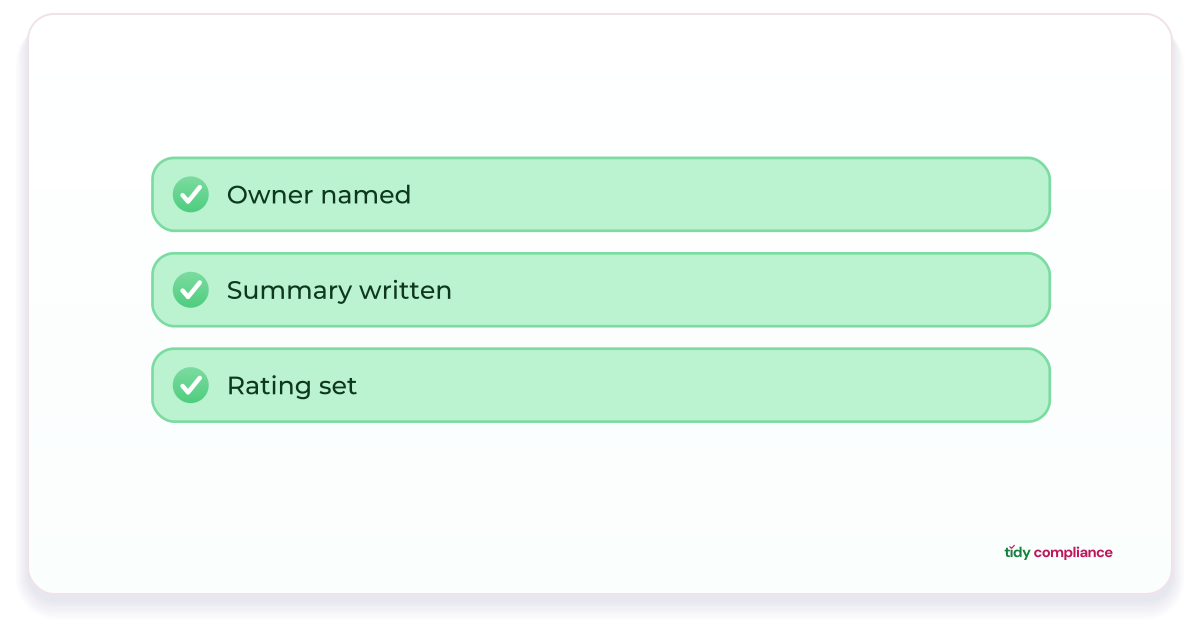
Every duty in the register got an owner, a short summary and a rating. The surprise clause moved to the top of the list, and a one-page procedure and a named backup owner closed it within a month. The company now adds new customer terms to the register before signature. The method is the first part of the compliance management framework I describe elsewhere.
How the register was built
- Export all customer contracts and list clauses that contain duties.
- Add laws and frameworks the company had committed to.
- Write a one-line summary and name an owner for each duty.
- Rate each duty by likelihood and impact of failure.
- Create procedures for the top ten and test one end to end.
- Add a contract review step to the sales process.
Tools for a first register
A shared spreadsheet is enough for the first version, with columns for source, owner, rating and next review. Move to a GRC platform only after the process works by hand.
Cleaning Up a Policy Library That Nobody Used
A group of outpatient clinics had 63 policies, many copied from templates that mentioned systems the clinics did not own. Staff ignored them, and managers could not say which version was current. A review of five sampled policies showed that none matched daily practice, so the group decided to cut the library before adding anything.
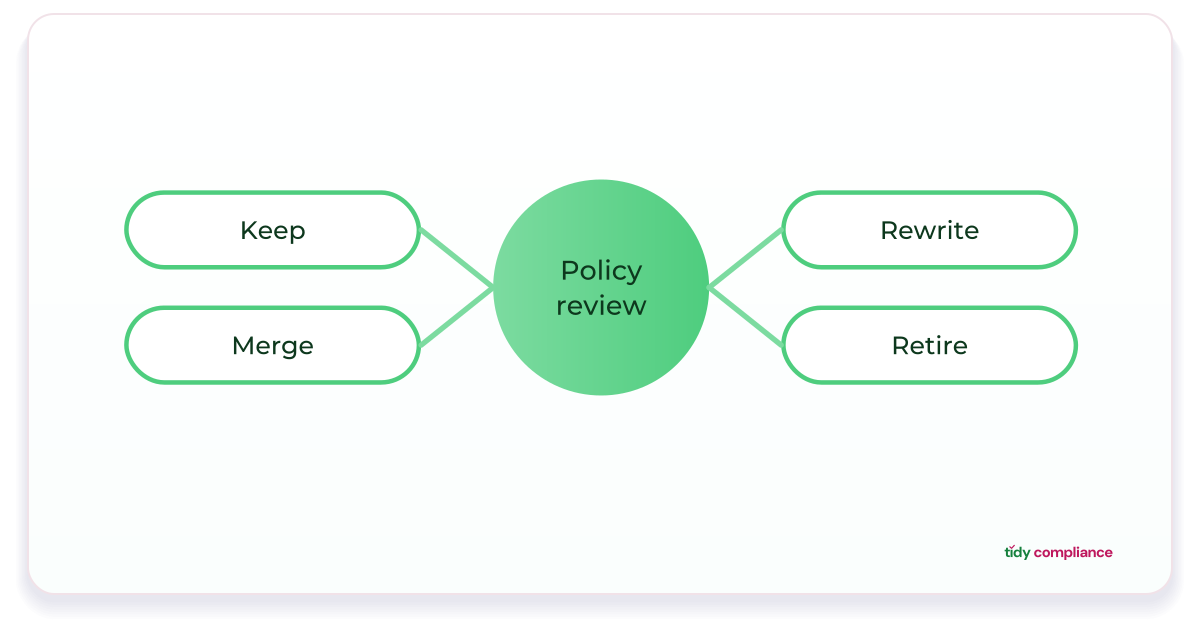
The team sorted policies into keep, merge, rewrite and retire. They ended with 24 policies in a standard layout, each with an approver, a review date and a link to the form staff use. Because the documents were shorter and matched real work, managers started using them in team meetings. The change cost a few weeks of effort and removed a standing finding risk.
Steps in the policy cleanup
- Inventory every policy with its date, owner and last review.
- Sample five policies and compare them with real practice.
- Sort each document into keep, merge, rewrite or retire.
- Rewrite in a standard layout with purpose, rules, owner and review date.
- Link each policy to the form or system staff use.
- Publish one current version in a single shared location.
What supports the cleanup
A document library with version history and approval workflow keeps the single current version visible. A yearly calendar reminder assigns each policy to its owner for review.
Putting Vendors Into Risk Tiers
A community bank had 85 vendors and treated them all the same: a questionnaire at signing and nothing after. The risk was uneven. A payroll processor and a data hosting provider handled sensitive records, and a coffee supplier did not. A short review showed that three of the highest-risk vendors had no review on file in over two years.
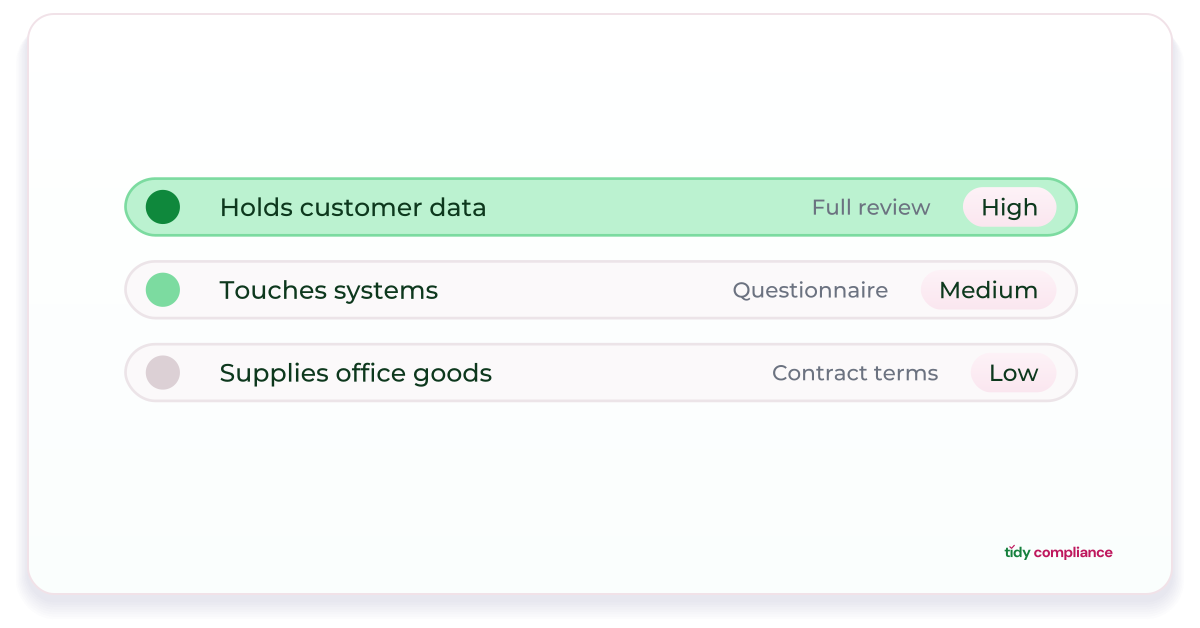
The bank ranked vendors into three tiers by access to sensitive data and importance to operations. High-risk vendors received a deeper review each year, medium vendors a lighter one every two years and low-risk vendors a contract check only. The effort per year went down because the tiers focused attention where it counted. A ranked vendor list also gave leadership a clear view of dependency risk.
How the tiering worked
- List every vendor with the data and systems it touches.
- Score each for data sensitivity and operational importance.
- Place vendors in three tiers and set the review depth for each.
- Collect evidence for the top tier first, starting with the oldest files.
- Record review dates and set renewal reminders.
- Review the tier list each year and after any vendor incident.
Tools for vendor oversight
A spreadsheet with tier, owner and review date works for a first pass. Vendor management modules in GRC platforms add questionnaires and reminders once you have many vendors.
Training That Tracks Who Completed What
An employer with six sites ran an annual compliance training in a single hour for everyone. Attendance was taken on paper, and when a customer asked who had been trained on privacy, the answer took three days to assemble. The content was also generic, so reception staff sat through modules that never applied to them.
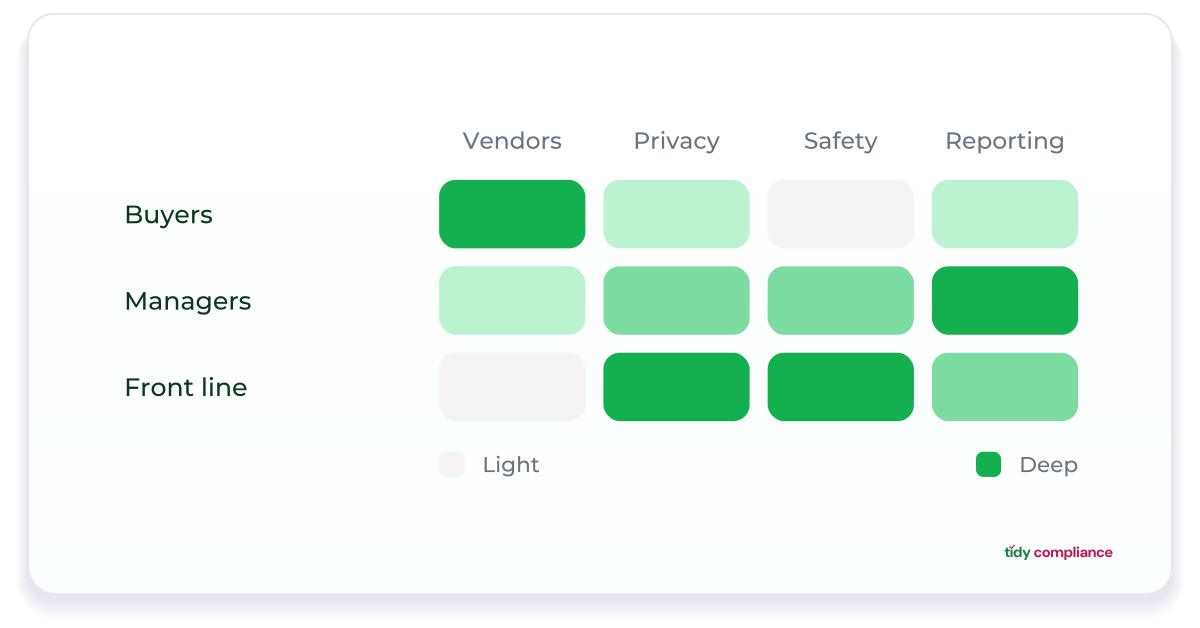
The employer split training into short role-based modules and moved assignment and tracking into a learning tool. New hires received core modules in their first two weeks. Managers saw a completion list for their team. The next customer request took ten minutes, because the learning tool produced a report by person and date. Staff feedback improved as well, since modules were shorter and closer to their work.
How the training was rebuilt
- Map roles to the situations each one meets in a normal week.
- Write short modules for each role with a few quiz questions.
- Assign modules automatically when someone joins or changes role.
- Send reminders and escalate late completions to managers.
- Store completion records by person and date.
- Update modules after policy changes or incidents.
Tools for tracking training
A learning management system or the training module of an HR platform assigns courses and stores records. Pair it with your register so each module traces back to an obligation.
Keeping an Evidence File for Customer Audits
A manufacturer faced three customer audits a year, each asking for similar proof: supplier approvals, training records, corrective actions and test results. Every audit triggered a week of searching through shared drives and email. The proof existed, but nobody could find it fast, and one audit nearly closed with a finding for a missing record that later turned up in a former employee's folder.
The team created one evidence folder organized by obligation, with a naming rule and an owner for each section. Control owners uploaded records as they were produced, and a monthly check looked for gaps. The next audit prep took a day. The folder also helped with questionnaires, because answers could point to a ready record.
How the evidence file works
- Create folders by obligation, using the same names as the register.
- Set a naming rule with date, document type and owner.
- Make control owners responsible for uploading their own records.
- Run a monthly gap check against the control calendar.
- Restrict edit rights and keep a read-only view for auditors.
- Archive old records on a retention schedule you have agreed with counsel.
What keeps the file reliable
A shared drive with permissions and naming rules works for many teams. Evidence modules in compliance platforms can pull records from connected systems automatically.
Opening a Safe Channel for Raising Concerns
A hospital system had a hotline that almost nobody used. Staff did not trust it, managers handled concerns informally and the compliance office heard about problems late. A short survey showed that employees were unsure who would read their report and whether it would affect them. The first fix was to explain the process in plain words.
The system added a second channel through a trained intake team, set response times and published anonymized themes every quarter. Managers learned to pass concerns on within a day. The number of reports rose at first, which the compliance lead presented as a healthy sign, and the share of cases that were closed with a documented fix improved over the year. The HHS OIG general compliance guidance lists effective lines of communication as one of its seven program elements.
How the channel was set up
- Describe in plain words who reads reports and what happens next.
- Offer more than one way to report, including anonymous options.
- Train managers to pass on concerns within one business day.
- Set response times and assign an investigator for each case.
- Close every case with a root cause and a recorded fix.
- Share anonymized themes with staff each quarter.
What the channel needs
A case management tool records reports, assignments and outcomes. Even a simple tracker works if access is restricted and every case has an owner.
Adding Independent Testing to the Control Calendar
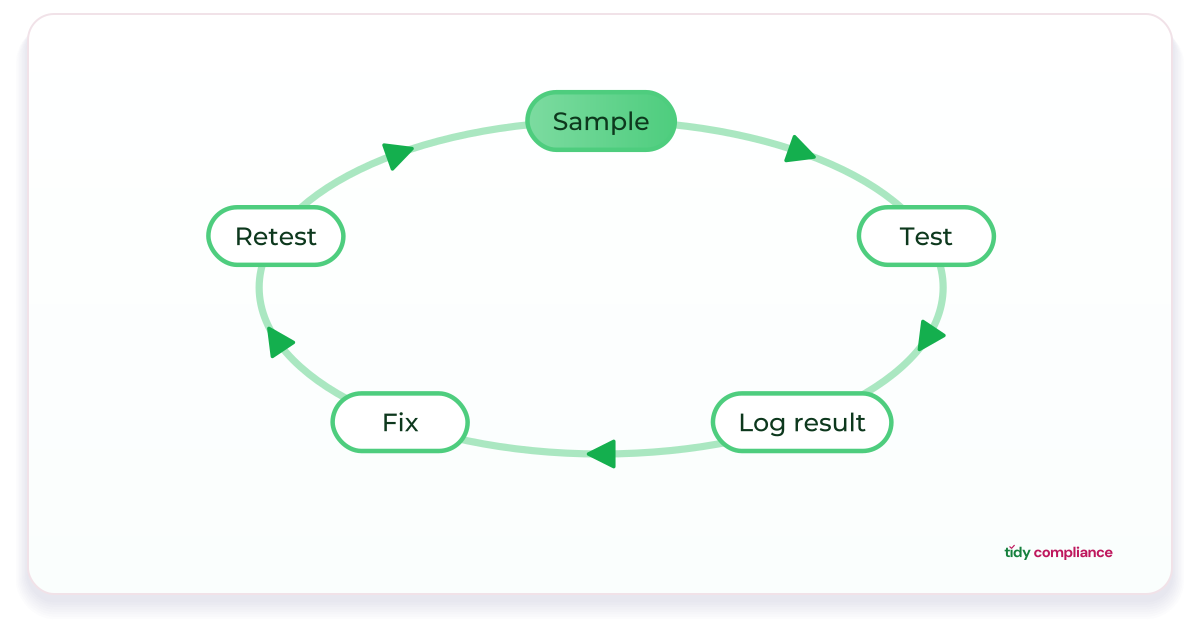
A regional lender had good controls on paper and a habit of marking them complete when the owner said so. An internal review found that two key controls had not run for two quarters. The fix was a monitoring calendar with testers who did not run the controls they checked. For a small team that meant swapping reviews between departments.
Each month, testers sampled records for a set of controls and logged the result in a standard format. Failed checks created issues with owners and dates. After a year, the pattern of results showed where the program was weak and justified the budget for a tool. The approach connects to the playbook in my guide to compliance management strategy, where monitoring forms phase five.
How independent testing was started
- List high-risk controls and the records each one produces.
- Assign testers outside the control's own team.
- Sample a fixed number of records per control each month.
- Log results in one format with sample size and finding.
- Open an issue with owner and date for each failure.
- Report test results and open issues to leadership quarterly.
Tools for control testing
A shared test log and a calendar are enough at first. GRC platforms add test workflows and dashboards when the number of controls grows.
What the Examples Have in Common
Three patterns repeat. Each fix gave a named person ownership of a duty. Each produced a dated record that proved the work. Each started small, with one chain or one tier or one channel, then expanded after it worked. None needed a platform on day one.
That matches the structure in my explanation of the compliance management framework: governance, register, policy, control, training, monitoring and response. If you are weighing tools, the ranking of compliance management software lists options and prices, and the guide to compliance management automation shows how to estimate the hours a tool would save.
How to Choose Which Example to Copy First
Look at your last review, customer questionnaire or internal audit and find the point where answers came slowly or not at all. That is your starting example. Check yourself against these questions:
- Do you know which obligations bind you and who owns each one?
- Can you show who completed which training, by date?
- Do you have a current list of vendors ranked by risk?
- Could you find your evidence for a customer audit within a day?
- Does someone independent test your key controls?
Each no points to one of the examples above. Pick one, set an owner and a date, and finish it before you start the next. If you want a plan that ranks the gaps for you, my compliance management strategy guide shows how.
Sources
HHS OIG: General Compliance Program Guidance, U.S. Department of Justice: Evaluation of Corporate Compliance Programs, ISO 37301: Compliance management systems.
Questions About Compliance Management Examples
What Is an Example of Compliance Management?
A typical example is a register of obligations with named owners, linked to policies, controls, training and evidence. A vendor tiering program and a role-based training tracker are other common examples.
Are These Real Companies?
No. The examples are composites based on patterns in my work, with details changed. They illustrate common situations and fixes and are not published case studies.
Which Example Should a Small Organization Start With?
Most small teams start with the obligations register and a simple evidence folder. Both are cheap, quick and useful for every other part of the program.
How Soon Do Results Show?
Simple fixes such as an owner list or an evidence folder show results within weeks. Vendor tiering, training rebuilds and monitoring calendars take a few months to settle.
Do I Need Software to Copy These Examples?
Not at first. Spreadsheets, shared drives and calendars carry the early versions. Software helps when volume and owner count grow.
How Do I Prove My Compliance Management Works?
Keep dated records for each control, test a sample independently and report results to leadership. Reviewers look for evidence that people followed the rules.
Is This Legal Advice?
No. It is compliance consulting guidance. Your attorney interprets what a specific law requires and advises on reporting and disputes.
Disclaimer: This article is for general information only and isn’t legal, financial or tax advice. Treat figures as estimates from typical work and confirm details with your providers before you act.
Was this guide helpful?
Thanks for your feedback.
Odessa Whitfield
Odessa leads the Tidy editorial team and works with the compliance consultants to turn real client projects into practical guides on regulations, frameworks, policies and audit preparation. Before joining Tidy, she worked in compliance and risk roles, writing and maintaining policy sets for regulated organizations. Every article goes through a consultant who has done the work in practice, and she updates guides when a rule, framework or tool changes. She works remotely from the United States.