Quick Summary
- A framework joins governance, obligations, risks, controls, training and monitoring into one loop.
- Every control should trace back to a listed obligation and an owner.
- Public models such as ISO 37301 and HHS OIG guidance can give you a recognized structure.
- Run one cycle by hand before buying tools, then fix the part that hurts most.
A compliance management framework is the structure that holds your program together: who is responsible, which duties apply, how risks are rated, which controls run, how people learn the rules and how problems get fixed. Without it, compliance becomes a set of separate projects that nobody connects. In my compliance management consulting work I draw the same picture on a whiteboard in the first meeting, because once the pieces are visible, most arguments about priority end quickly.
Below I show the seven parts I use, how they fit, how they compare with public models and how to adapt the structure to your size. Nothing here is legal advice, and your counsel decides what a rule requires of you.
The Seven Parts at a Glance
| Part | Job it does | What it produces |
|---|---|---|
| 1. Governance | Gives the program authority, people and a reporting line | Charter, named lead, committee or sponsor |
| 2. Obligations and risk | Lists what you must do and ranks what could go wrong | Obligations register and risk ratings |
| 3. Policies and procedures | Turns duties into rules and steps people can follow | Approved policy library |
| 4. Controls | Prevents, detects and corrects failures | Control list with owners and frequencies |
| 5. Training and communication | Makes sure each role knows what to do | Role-based training and completion records |
| 6. Monitoring and testing | Checks that controls still work | Test results, internal audit reports |
| 7. Response and improvement | Fixes problems and feeds lessons back | Case log, corrective actions, yearly review |
The parts form a loop. Governance sets direction, obligations and risk decide the focus, policies and controls carry it out, training and monitoring keep it working and response closes the gaps and sends lessons back to the start. If you skip a part, the loop breaks at that point, and the symptom shows later in a different place.
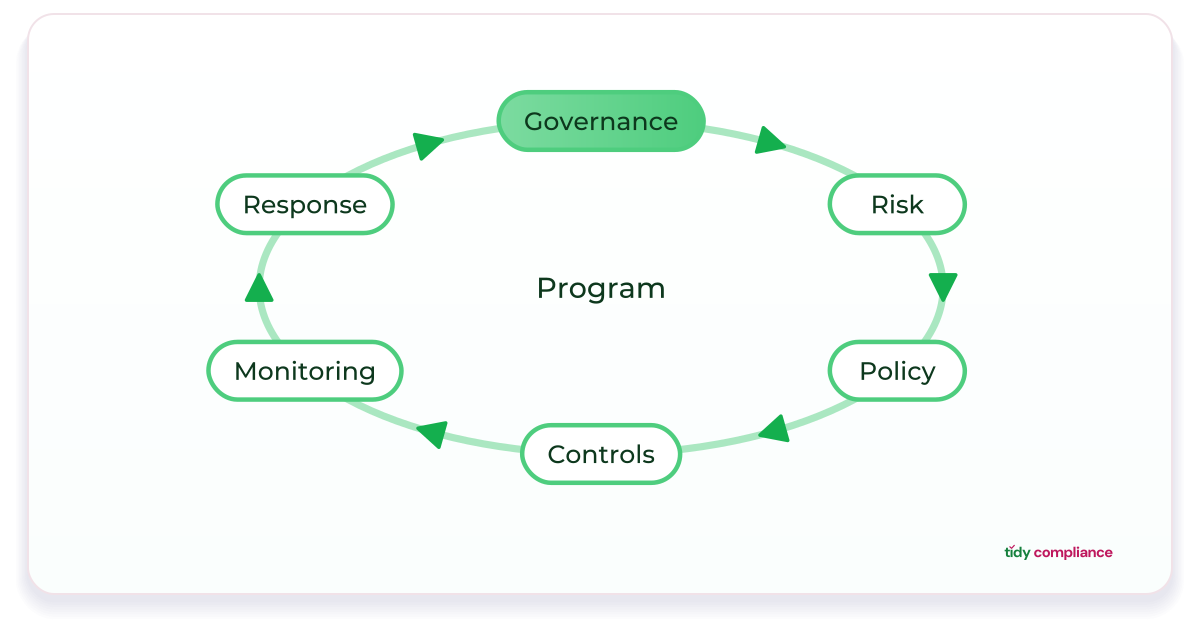
Governance: Who Decides and Who Answers
Governance is the part most often left vague. Name a compliance lead, give that person a direct line to leadership and write down what the role can decide. Add a sponsor from the top team who removes blocks and signs off on priorities. In small organizations the lead may hold another job too, so protect the hours in writing.
The U.S. Department of Justice asks prosecutors three questions about a program: whether it is well designed, whether it is applied in good faith with adequate resources and authority, and whether it works in practice. The Evaluation of Corporate Compliance Programs document, updated in September 2024, is written for prosecutors but gives a clear checklist for any leadership team.
Obligations and Risk: What You Must Do and What Could Go Wrong
List every law, standard and contract duty that applies to you, with an owner and a short summary. Then rate each one by the likelihood and impact of failure. The register is the backbone of the framework, since every policy, control and training module should trace back to a line in it.
Keep ratings simple. Four levels are enough, and the owner of each area should agree with the score. The method for a first pass is in my guide to a risk and compliance assessment, and the checklist in the compliance management checklist shows which records to keep.
Policies, Controls and Training: Turning Duties Into Daily Work
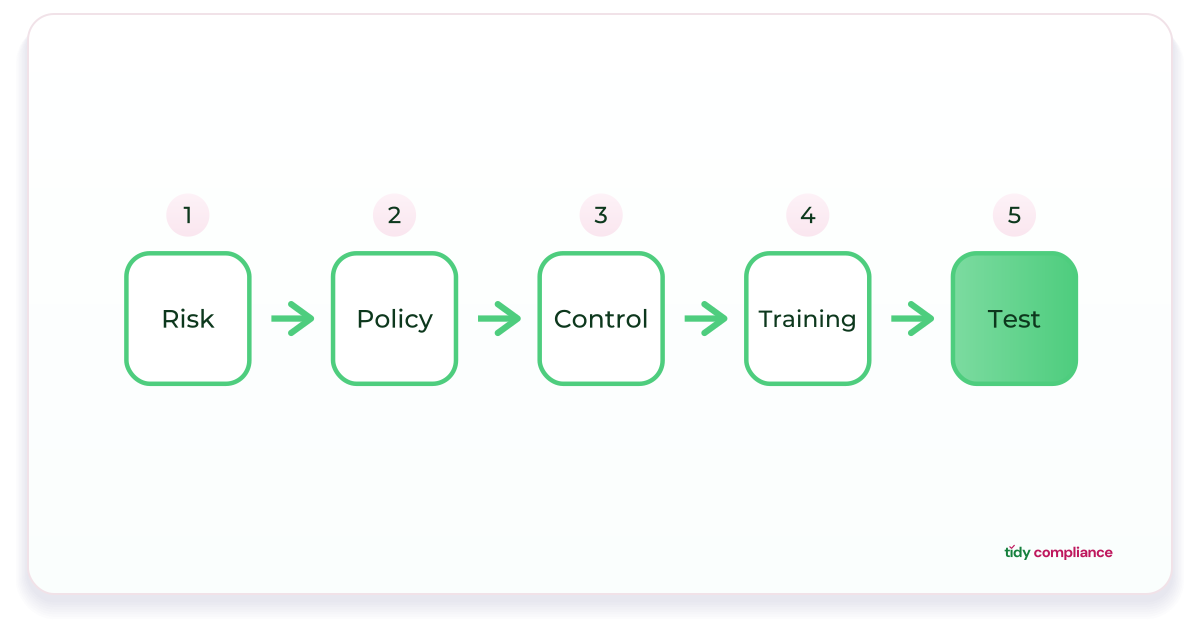
Policies state the expectation, procedures show the steps and controls make sure the steps happen. Training teaches the people who carry them out. I treat the three as one chain, because a gap anywhere shows up as a finding. A strong policy without a control relies on memory. A control without training relies on luck.
For each high-rated risk, write down the policy that covers it, the control that checks it, the owner who runs the control and the training module that teaches it. A one-page table per area works well. Update it whenever any of the four changes.
| Layer | Typical example | Common failure |
|---|---|---|
| Policy | Vendors with access to sensitive data must be reviewed before onboarding | Written once, never updated |
| Procedure | Procurement sends a vendor questionnaire and logs the reply | Steps differ by department |
| Control | Quarterly check that every active vendor has a review on file | Check skipped when the owner is busy |
| Training | Short module for buyers on when to ask for a review | Completion not recorded |
Monitoring, Response and Improvement
Monitoring asks whether controls are still working. Put tests on a calendar, keep testers independent of control owners and report results in the same format each time. The point is a trend: after a year, you can see which areas generate findings and which stay quiet.
Response covers what happens when something goes wrong. Provide a way to raise concerns, assign an investigator, record the outcome and fix the cause. Improvement closes the loop: once a year, review the whole framework, retire what does not matter and add what changed in your business or in the rules you follow.
How the Framework Compares With Public Models
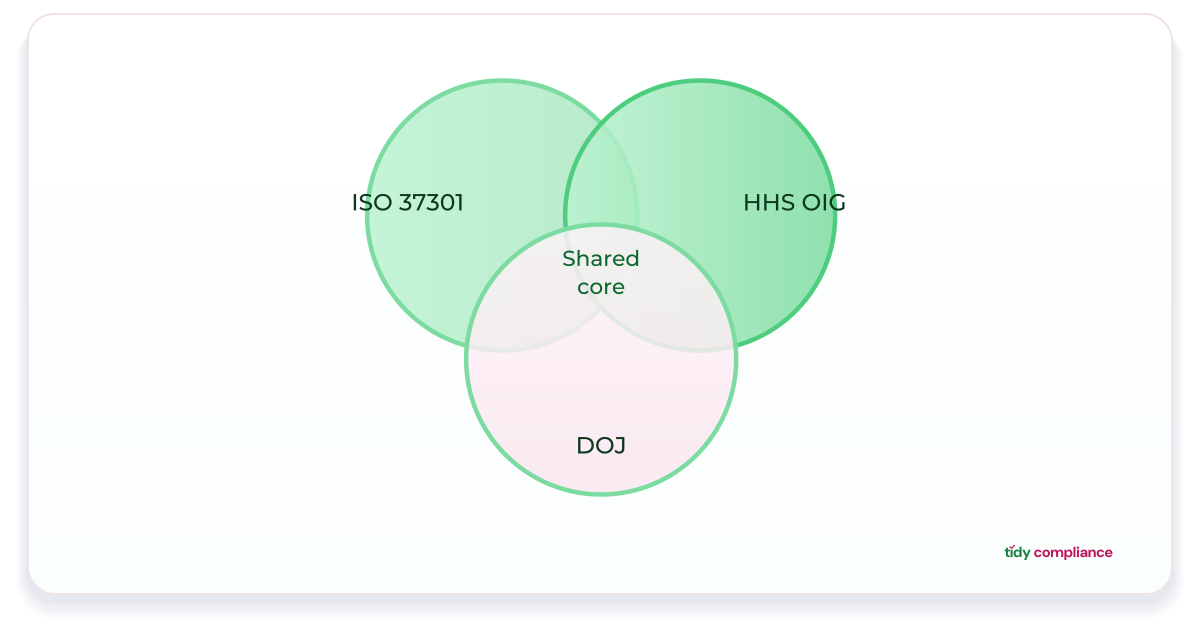
You do not need to invent a structure from scratch. Several public models cover the same ground, and borrowing from them makes your program easier to explain to reviewers.
| Model | What it is | How it maps to the seven parts |
|---|---|---|
| ISO 37301 | An international standard for compliance management systems, first published in 2021 | Covers governance, planning, support, operation, evaluation and improvement; follows the same loop |
| HHS OIG General Compliance Program Guidance | Guidance for health care organizations, listing seven elements | Policies, leadership, training, communication, enforcement, risk and monitoring, and response |
| DOJ Evaluation of Corporate Compliance Programs | Questions prosecutors use to judge a program | Tests governance, resources and whether the program works in practice |
The ISO 37301 page describes the standard as requirements with guidance for use in a compliance management system. The HHS OIG guidance lists written policies and procedures, compliance leadership and oversight, training and education, effective lines of communication, enforcing standards, risk assessment, auditing and monitoring, and response to detected offenses. Pick the model that your sector's reviewers already know and map your parts to it.
Where Frameworks Break in Practice
Frameworks rarely fail at the design stage. They fail in the handoffs. The register is built by one person who then leaves, and nobody updates it. A policy is approved but never reaches the team that needs it. A control is tested by the person who runs it, so it always passes. Training is assigned in a system nobody opens.
Three habits prevent most of these. First, give every part a backup owner, so a vacation or departure does not stop the loop. Second, set a recurring calendar entry for each part, with a named person and a short deliverable, such as an updated register or a signed test sheet. Third, report on the framework itself once a quarter: which parts ran, which were late and why.
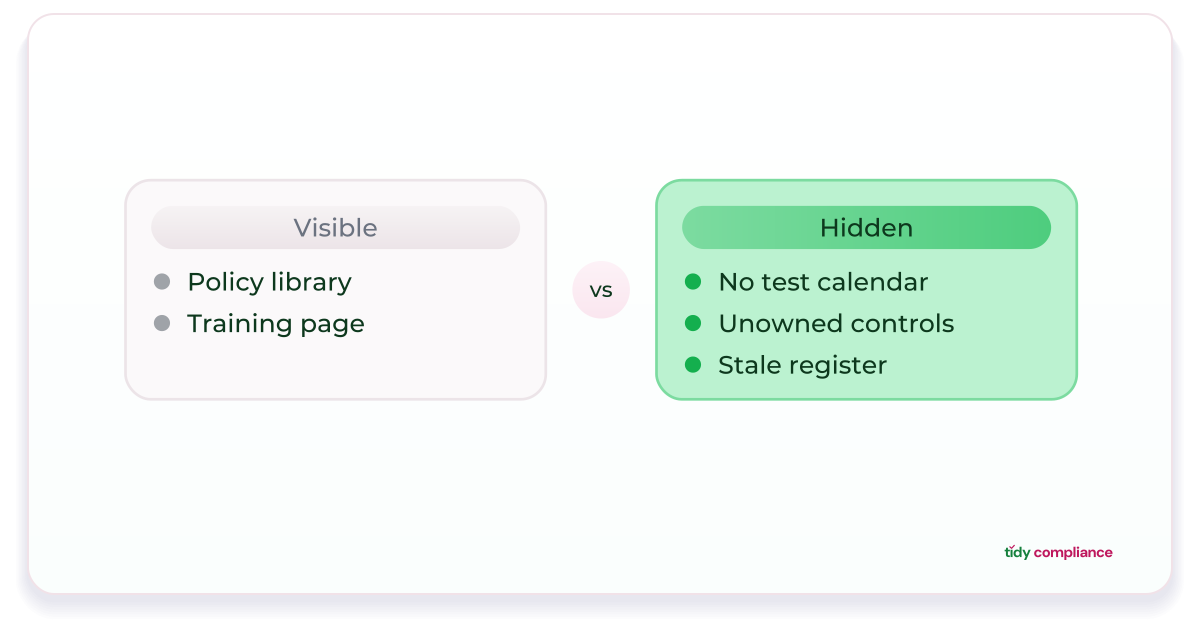
Picture a regional lender with a solid policy library and no monitoring calendar. Everything looks fine until a customer asks for proof that vendor reviews happen. The policy says yearly, the records show two reviews in three years. The framework had a policy and a training module, yet the monitoring part was empty, so nobody noticed the control had stopped. Adding one calendar entry and one owner closes that gap.
Adapting the Framework to Your Size
A ten-person firm and a hospital network need the same seven parts and very different amounts of paper. A small team can hold the register in a spreadsheet, run one risk workshop a year, keep ten short policies and train in a single hour per quarter. A larger organization needs named owners per business unit, a committee that meets on a calendar and tooling to share evidence.
Between those two ends sits the mid-sized organization, which usually needs the most care. It has enough business units that no single person sees everything, and not enough staff for a dedicated team per part. Here, a small committee that meets monthly for an hour, with one owner for each of the seven parts, keeps the loop turning. Give each owner a one-page checklist of their yearly tasks, so the work does not depend on memory.
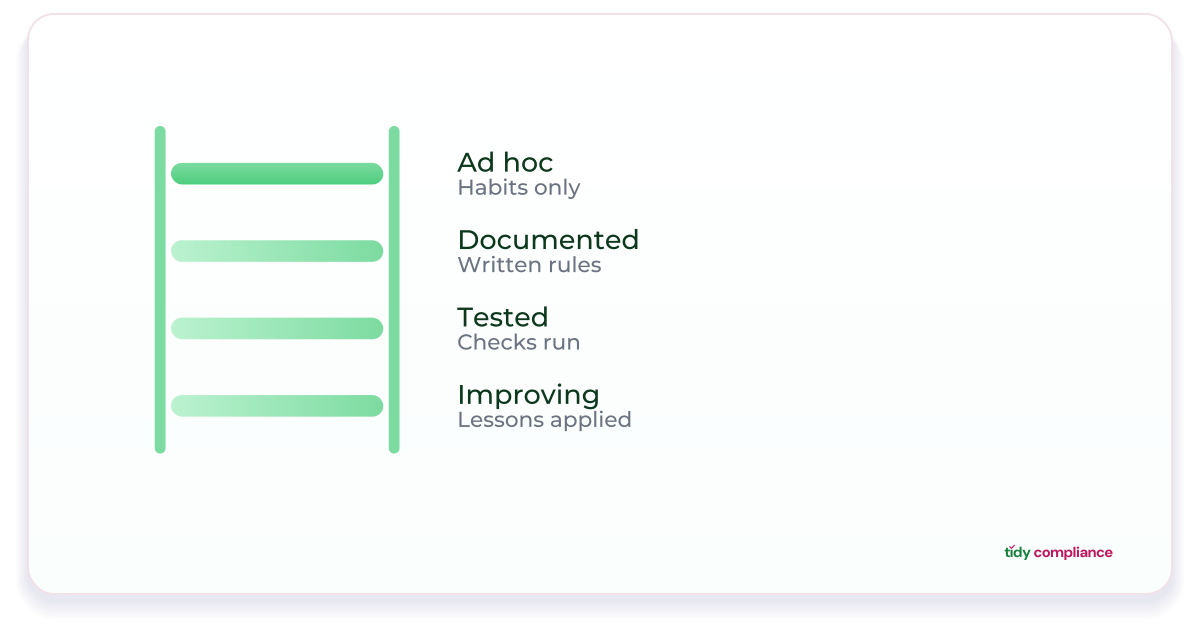
Resist the urge to buy tooling first. Run one cycle by hand, see what hurts, then pick a platform that fixes that pain. My comparison of compliance management software lists options and what each costs. If you want to remove the repetitive parts, read about compliance management automation.
Putting the Framework in Place
Build in the order of the loop but start small. In the first month, name the lead and sponsor and draft the obligations register. In the second and third, rate risks and write or fix the policies that cover the top risks. In months four to six, add controls, training and a first monitoring cycle. After that, run the yearly review. For how to rank priorities and sequence the work in more detail, see my compliance management strategy guide, and for concrete cases read the compliance management examples post.
How to Know the Framework Is Working
A working framework is visible in small signs. Check whether these are true for your organization:
- Every obligation has a named owner and a rating
- New rules and contracts reach the register within weeks
- Controls run on schedule and leave dated records
- Training completion is tracked by person
- Leadership sees a short report every quarter
- Findings lead to fixes that are verified
If you can answer yes to most of these, the framework is doing its job. If not, pick the weakest part and fix that one first. An outside review can speed this up, because a fresh reader sees gaps that insiders have learned to ignore.
Sources
ISO 37301: Compliance management systems, HHS OIG: General Compliance Program Guidance, U.S. Department of Justice: Evaluation of Corporate Compliance Programs.
Questions About Compliance Management Frameworks
What Is a Compliance Management Framework?
It is the structure that connects governance, obligations, risk ratings, policies, controls, training, monitoring and response into one program. It tells you who is responsible, what must be done, how you check it and how you fix problems.
What Are the Main Components of a Compliance Management Framework?
I use seven: governance, obligations and risk, policies and procedures, controls, training and communication, monitoring and testing, and response and improvement. Public models such as ISO 37301 and the HHS OIG guidance cover the same ground with different labels.
Is ISO 37301 Required?
No. It is a voluntary international standard for compliance management systems. Some organizations use it as a structure or seek certification, while others borrow its logic without certifying. Check whether any customer or regulator expects it.
How Is a Compliance Framework Different from a Policy?
A policy is one document that states an expectation. A framework is the whole system around it, including owners, risk ratings, controls, training and monitoring. A policy without a framework often goes unread and unenforced.
How Long Does It Take to Build a Framework?
A basic version with a register, ratings, key policies and a first set of controls usually takes three to six months, depending on size and starting point. A yearly review then keeps it current.
Do Small Organizations Need a Framework?
Yes, in a lighter form. The same seven parts apply, with fewer documents and simpler tools. A spreadsheet register and a shared evidence folder carry a small program well.
Is This Legal Advice?
No. It is compliance consulting guidance. Your attorney interprets what a particular law requires and advises on reporting and disputes.
Disclaimer: This article is for general information only and isn’t legal, financial or tax advice. Treat figures as estimates from typical work and confirm details with your providers before you act.
Was this guide helpful?
Thanks for your feedback.
Odessa Whitfield
Odessa leads the Tidy editorial team and works with the compliance consultants to turn real client projects into practical guides on regulations, frameworks, policies and audit preparation. Before joining Tidy, she worked in compliance and risk roles, writing and maintaining policy sets for regulated organizations. Every article goes through a consultant who has done the work in practice, and she updates guides when a rule, framework or tool changes. She works remotely from the United States.