Quick Summary
- Rank obligations by likelihood, impact and exposure before you write policies.
- Build a full chain of policy, control, owner and training for the top risks first.
- Plan 12 months with owners and dates, and expect approvals to take longer than writing.
- Report five to eight indicators quarterly on one page and refresh the plan every year.
A compliance management strategy answers three questions before any policy gets written: which obligations matter most, how much effort each deserves and in what order you will do the work. Without those answers, teams spread effort evenly, which means the riskiest duties get the same attention as the most trivial. I start every compliance management consulting engagement with a one-page strategy, because it makes later decisions about budget, tools and people far easier.
Below is the playbook I use, in six phases, with a table you can copy and a worked prioritization example. It is compliance consulting guidance, not legal advice, so your counsel decides what a particular rule demands.
The Six Phases at a Glance
| Phase | Main question | Output |
|---|---|---|
| 1. Set direction | What does leadership want from the program, and what risk will it accept? | One-page statement of goals and risk appetite |
| 2. Map and rank | Which obligations apply and which carry the most risk? | Ranked obligations register |
| 3. Build the minimum program | What is the smallest set of policies and controls that covers the top risks? | Core policies, controls and owners |
| 4. Resource and sequence | Who does what, in which order, with what budget? | 12-month plan with owners and dates |
| 5. Measure and report | How will we know the program works? | Short set of indicators and a quarterly report |
| 6. Review and adjust | What changed, and what should change in the plan? | Yearly strategy refresh |
The phases run in order the first time and then repeat each year. Teams in a hurry skip phase 1 and pay for it later, when two leaders discover they wanted different things. Fifteen minutes with the sponsor at the start saves weeks of rework.
Phase 1: Set Direction and Risk Appetite
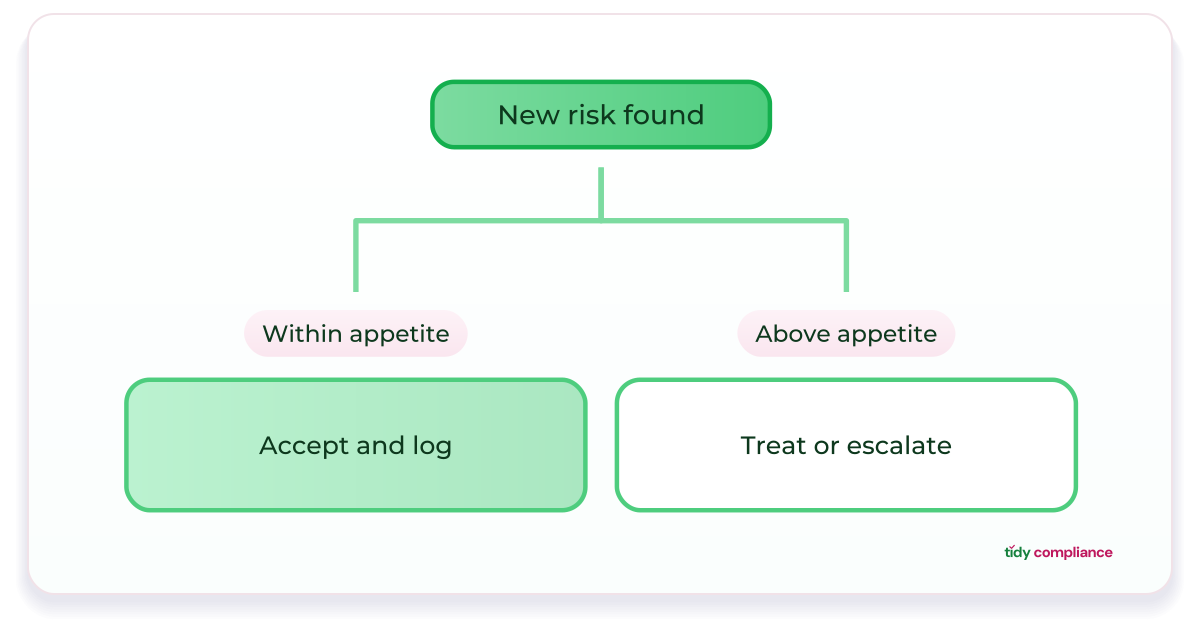
Ask your sponsor what a good result looks like in plain terms. Pass a customer security review, avoid a regulator finding, enter a new market or reduce time spent on audits are all fair answers. Write down two or three, then agree on risk appetite: which kinds of failure are unacceptable and which are tolerable for now.
Risk appetite sounds abstract until you give examples. A privacy breach involving customer records may be unacceptable, while a late internal training completion may be tolerable for a month. Those statements guide every later ranking, and they give you something to point at when a manager asks why a project was postponed.
Phase 2: Map Obligations and Rank Them
List the laws, regulations, standards and contract terms that bind you, and give each an owner. Then rank them. A simple method multiplies three scores from 1 to 5: how likely a failure is, how severe the impact would be and how exposed you are, meaning how many customers, transactions or records the duty touches.
| Obligation (illustrative) | Likelihood | Impact | Exposure | Score | Priority |
|---|---|---|---|---|---|
| Customer data handling duty in major contracts | 4 | 5 | 5 | 100 | 1 |
| Vendor oversight clauses | 4 | 4 | 3 | 48 | 2 |
| Records retention schedule | 3 | 3 | 3 | 27 | 3 |
| Internal expense policy | 2 | 2 | 2 | 8 | 4 |
The numbers are illustrative. The point is that a duty with a score of 100 gets attention before one with a score of 8, even if the second one is easier to fix. Review the ranking with the owners, since they will spot exposure you cannot see from a spreadsheet. The method for gathering the inputs is in my guide to a risk and compliance assessment.
Phase 3: Build the Minimum Program That Covers the Top Risks
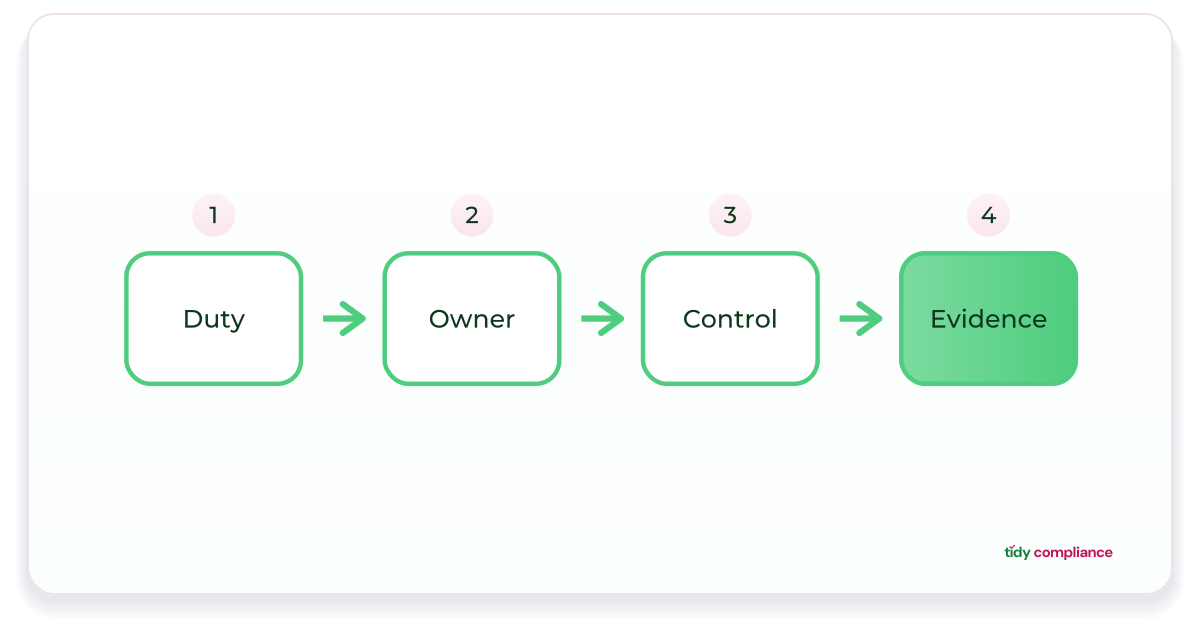
Start with the smallest set of documents and controls that addresses the highest-ranked items. For each, write one policy page, one procedure, one control with an owner and frequency, and one short training item. That is a complete chain for a single duty, and it is far more useful than ten half-built policies.
Then repeat down the list. Each new duty reuses the same template, so the second goes faster than the first. Keep a standard layout: purpose, scope, rules, responsibilities, exceptions, review date. The seven-part structure in my explanation of the compliance management framework gives you the checklist for each chain.
Phase 4: Resource and Sequence the Work
Turn the ranked list into a 12-month plan. Quarter one covers the register, the top-risk chains and governance. Quarter two adds vendor oversight and training. Quarter three starts monitoring and the first internal test. Quarter four reviews results and sets next year's plan. Put an owner and a date on each line.
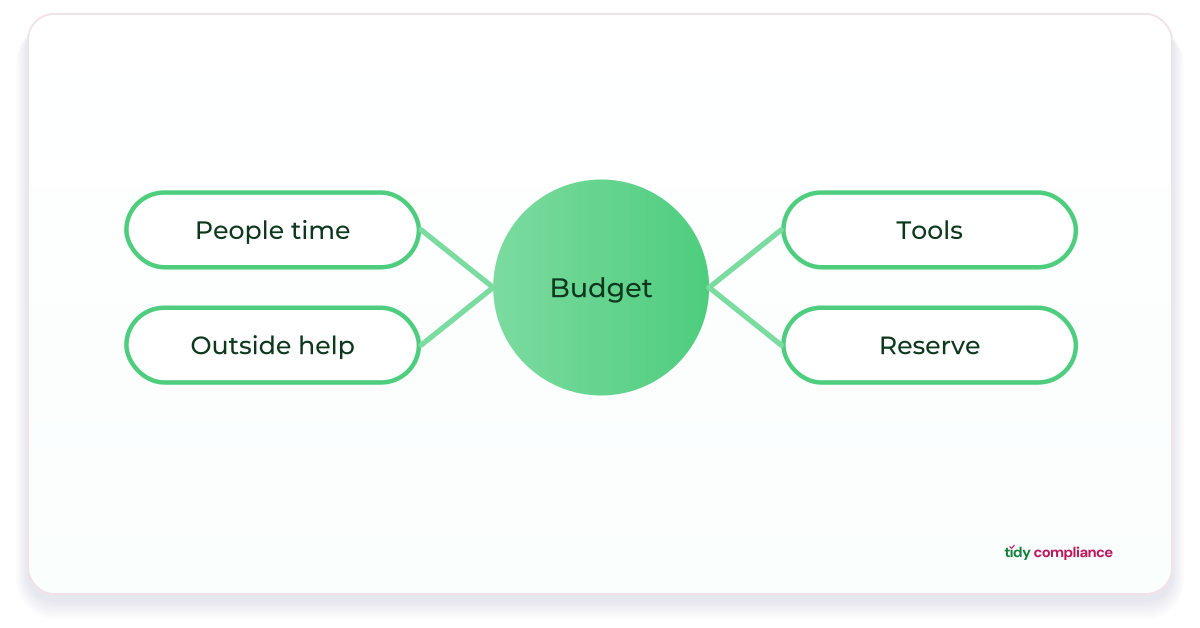
Budget for three things: people time, outside help and tools. Most teams underestimate people time, because owners must review documents and sit in interviews on top of daily work. Plan for delays in approvals, which usually take longer than writing. Tools come last. My comparison of compliance management software covers what is on the market once your process is clear.
| Quarter | Focus | Example deliverables |
|---|---|---|
| Q1 | Governance, register, top-risk chains | Charter, ranked register, first five chains |
| Q2 | Vendors and training | Vendor tiers, role-based training, completion records |
| Q3 | Monitoring and testing | Test calendar, first internal test, issue log |
| Q4 | Review and next year | Leadership report, refreshed ratings, 12-month plan |
Deciding What to Automate and What to Keep Human
Automation belongs in a strategy, because it changes your staffing plan. Reminders, evidence collection from systems, access report pulls and training assignments are good candidates. Judgment calls, such as accepting a risk, interpreting a gray area or deciding whether an incident is reportable, stay with people and counsel. I list practical options in my guide to compliance management automation. Decide early which tasks you will automate, so you do not buy a tool and then discover that nobody owns the findings.
Who Does What in the Playbook
Strategies stall when roles are fuzzy. Agree early who leads each phase, who contributes and who approves. The table below is a starting point that you can adjust to your structure.
| Role | Main duties in the strategy | Time to expect |
|---|---|---|
| Executive sponsor | Sets goals and risk appetite, approves the plan, removes blockers | A few hours per quarter |
| Compliance lead | Drafts the strategy, runs the register, reports progress | Several hours every week, more at launch |
| Business owners | Own obligations in their area, run controls, supply evidence | A few hours per month |
| Counsel | Interprets rules, advises on reporting and disputes | As needed, planned into key decisions |
| Outside consultant | Challenges ranking, builds documents, trains staff | Project based, then light support |
Time estimates vary with size, so treat them as a prompt for the conversation and not a promise. The useful step is naming a person against each row. In my experience, the first thing to slip when roles are unclear is the monitoring phase, because everyone assumes someone else is testing.
Strategy Mistakes That Cost the Most
Three mistakes recur. The first is copying a peer's program. Another organization's ranking reflects its customers, its regulators and its history, and your top risks may look different. Use peers for ideas and your own register for priority.
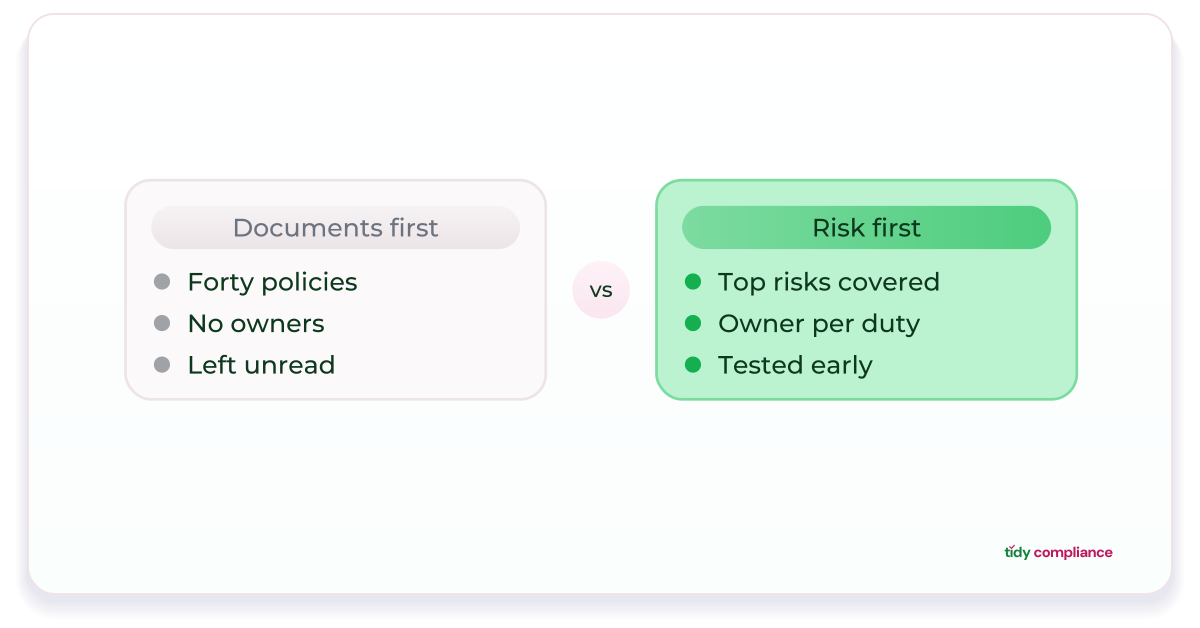
The second is front-loading documents. Teams write forty policies in the first quarter, then discover that nobody follows them and no control checks them. Fewer documents with working controls beat a large library with none. The third is ignoring change. A strategy built once and left on a shelf will drift, since rules, contracts and products keep moving. The yearly review and the quarterly report are the cheapest protection against that drift.
A small budgeting habit helps as well. Reserve a share of your annual effort, I suggest around a fifth, for unplanned work such as a new rule, a customer request or an incident. Programs with no reserve end up cutting planned work in the middle of the year, which usually hits monitoring first.
Phase 5: Measure and Report
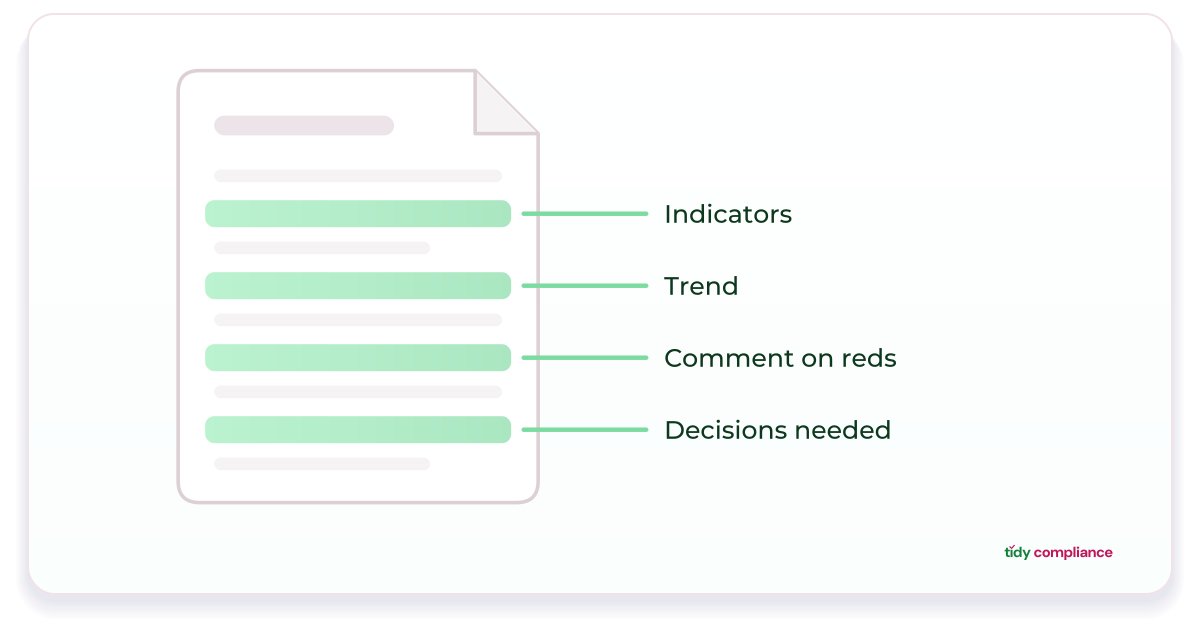
Pick a short set of indicators that tell you whether the program works. Five to eight is enough. Useful ones include percentage of controls tested on schedule, number of overdue actions, training completion, vendor reviews current, time to close issues and number of repeat findings. Avoid vanity numbers such as documents written.
Report them quarterly on one page, with a short comment on anything red. Include the items you are worried about, since a report with only green items teaches leaders to stop reading. If an indicator never changes, replace it.
Phase 6: Review and Adjust Each Year
Once a year, take half a day to review the strategy. Look at what changed in the rules, your business and your risks. Rescore the register, retire controls that no longer matter and add the new ones. Compare the plan with what happened and ask why gaps arose. The goal is a lighter second year, since you only change what moved.
A good test is the story you could tell an outsider. If you can explain in five minutes what your top risks are, what you did about them and what you will do next, the strategy is working. For concrete cases of programs at different sizes, read my compliance management examples, and use the compliance management checklist to confirm that nothing was left out.
How to Pressure-Test Your Strategy
Before you present the plan, ask these questions. A weak answer to any of them is a reason to adjust.
- Does each of the top five risks have an owner and a dated action?
- Is the plan realistic for the hours your team actually has?
- Would leadership recognize its own priorities in the one-page statement?
- Can you explain why the lowest items are last?
- Do you know which decisions need your counsel?
If you want a second pair of eyes, a consultant can challenge the ranking and the sequence in a short working session.
Sources
U.S. Department of Justice: Evaluation of Corporate Compliance Programs, ISO 37301: Compliance management systems, NIST SP 800-30 Rev. 1: Guide for Conducting Risk Assessments.
Questions About Compliance Management Strategy
What Is a Compliance Management Strategy?
It is the plan that decides which obligations get attention first, how much effort each deserves, who does the work and in which order. It turns a long list of duties into a ranked, resourced program.
How Do I Prioritize Compliance Obligations?
Score each one for likelihood of failure, impact if it fails and exposure, meaning how many customers, records or transactions it touches. Multiply the scores, sort the list and agree the ranking with the owners.
How Long Should a Compliance Strategy Cover?
Plan 12 months in detail, with a view of two to three years for larger investments. Review it every year and after major changes in rules, products or markets.
Who Should Lead the Strategy?
The compliance lead drafts it, a senior sponsor approves it and business owners commit to their parts. Without a sponsor, the plan rarely survives its first budget discussion.
What Should a Small Team Do First?
Name a lead, list your obligations, rank them and build the policy, control and training chain for the top three. A small, finished program beats a large, unfinished one.
How Do I Measure Whether the Strategy Works?
Track a handful of indicators such as controls tested on schedule, overdue actions, training completion, vendor reviews current and repeat findings. Report them quarterly on one page.
Is This Legal Advice?
No. It is compliance consulting guidance. Your attorney decides what a specific law requires and advises on reporting and disputes.
Disclaimer: This article is for general information only and isn’t legal, financial or tax advice. Treat figures as estimates from typical work and confirm details with your providers before you act.
Was this guide helpful?
Thanks for your feedback.
Odessa Whitfield
Odessa leads the Tidy editorial team and works with the compliance consultants to turn real client projects into practical guides on regulations, frameworks, policies and audit preparation. Before joining Tidy, she worked in compliance and risk roles, writing and maintaining policy sets for regulated organizations. Every article goes through a consultant who has done the work in practice, and she updates guides when a rule, framework or tool changes. She works remotely from the United States.