Quick Summary
- A cybersecurity compliance assessment compares your practices with a framework or contract, scores each area and ranks the gaps.
- It is a planning tool for your own use, and an audit is a check, often for an outside reader.
- Aim for controls that run on a schedule with an owner and records before a first audit.
- A good result includes a ranked gap list and a dated roadmap, not only a score.
A cybersecurity compliance assessment tells you where you stand against a standard before anyone grades you. It compares your real practices with the requirements of a framework or a contract, scores each area and gives you a ranked list of gaps. Nobody outside needs to see the result, which is why people are honest in it.
I run assessments as the first step of cybersecurity compliance consulting projects, and they decide most of what follows: budget, order of work and whether a deadline is realistic. This article explains what an assessment covers, how the scoring works and how to read the result.
What a Cybersecurity Compliance Assessment Covers
An assessment starts with a target: the framework, regulation or customer requirement you must meet. Typical targets are SOC 2, ISO 27001, the HIPAA Security Rule, PCI DSS or the NIST Cybersecurity Framework. The assessor breaks the target into controls and asks, for each one, whether it exists, whether it is written down and whether it runs.
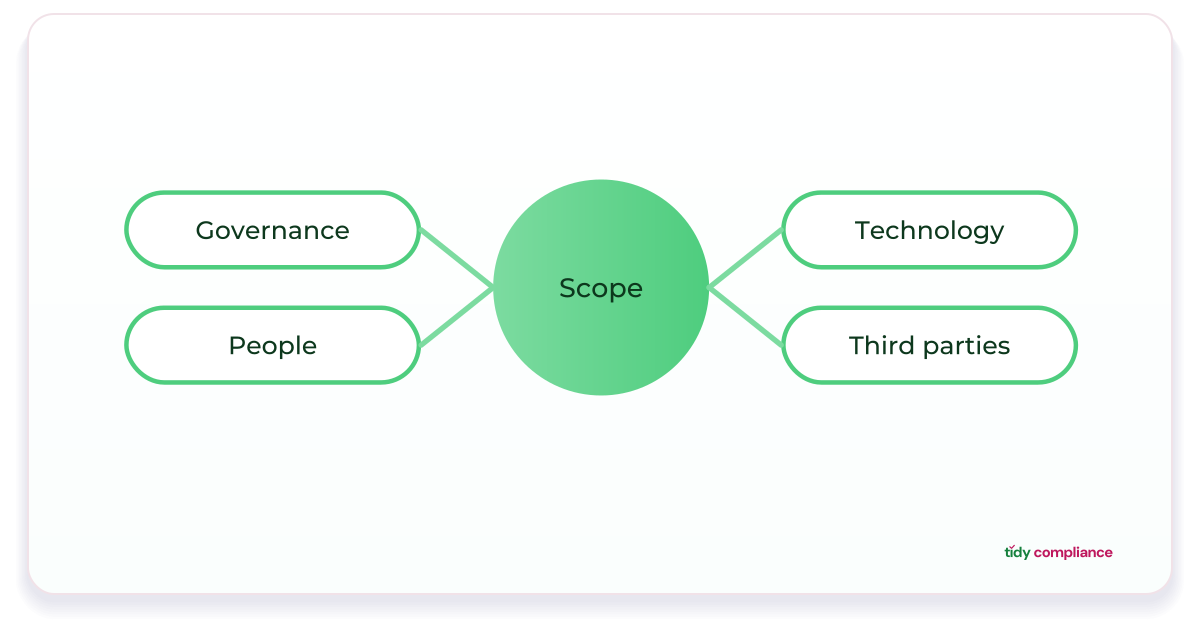
The scope usually spans governance, people, technology and third parties. Governance covers policies, ownership and risk decisions. People covers training and access. Technology covers configuration, patching, encryption and logging. Third parties covers the vendors that hold your data.
Assessment, Audit and Penetration Test Compared
These three terms get mixed up, and buying the wrong one wastes budget. The table shows what each one does and when to use it.
| Activity | Key question | Who sees the result | Best used when |
|---|---|---|---|
| Compliance assessment | Where do we stand against the standard? | Your team and leadership | You are planning, budgeting or choosing a framework |
| Compliance audit | Do our controls meet the standard? | Often an outside party | A customer, regulator or certifier needs proof |
| Penetration test | Can an attacker get in? | Your security team | You want to test technical defenses |
| Risk assessment | Which threats matter most to us? | Leadership and risk owners | You need to decide where to spend money |
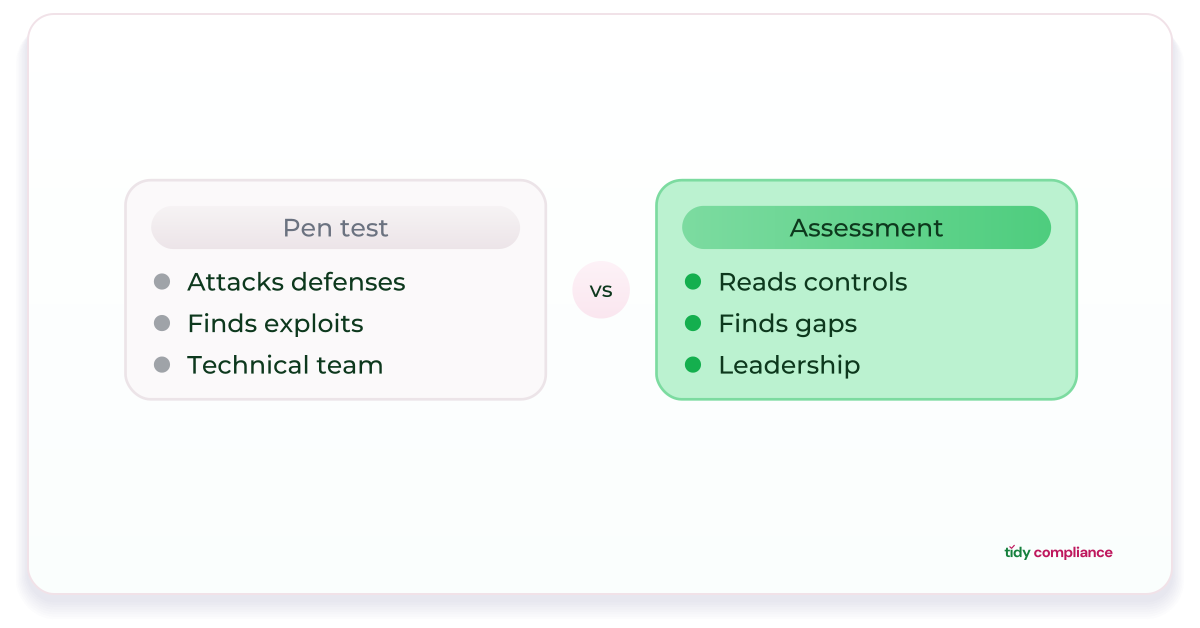
A pen test is a technical test of your defenses, and a compliance assessment asks whether you meet a standard on paper and in practice. Many frameworks expect both over time. If you are ready for the formal step, my guide to the cybersecurity compliance audit shows how the next phase works.
How an Assessment Works, Step by Step
The method is simple, and the quality comes from discipline. I follow the same sequence each time.
Pick the Target and Version
Name the exact framework and version, and write down why it applies, for example a customer contract or a regulatory duty. If several apply, choose the one with the broadest controls as the base and map the others to it, because most share a large overlap.
Interview the People Who Do the Work
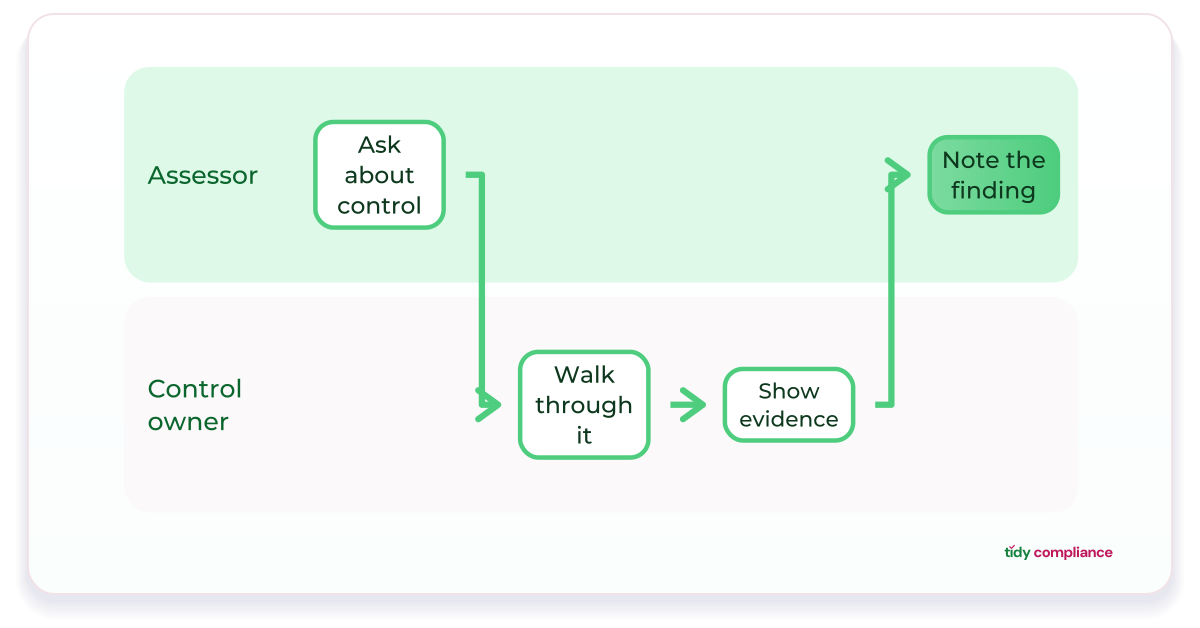
Documents tell you what should happen, and people tell you what does. Talk to the owners of identity, infrastructure, development, HR and vendor management. Ask for a walk-through of one real example, such as how the last new hire got access. Gaps often show up in the walk-through.
Check Evidence for Each Control
For each control, ask for one piece of proof and check its date. A policy proves intent, a log or ticket proves operation. Mark the control as met, partly met or not met, and note what is missing in one line.
Score and Rank
Turn the notes into a score per area and a ranked gap list. Rank by risk first and effort second, so the list shows what to fix this month and what to schedule for later.
Preparing Your Team for the Interviews
People tend to treat an assessment as a test, and they hide problems. Say upfront that the result stays inside the company, and that the goal is a fix list. A short briefing email works: what the assessment covers, how long each interview takes, which documents to bring and who will read the output.
Schedule interviews of 30 to 45 minutes per area, and ask owners to bring one real example for each control, such as the last access request or the last patch cycle. Offer to run the session as a screen share, so the assessor can see the system and not only hear about it. Afterwards, send each owner the notes about their area to confirm, since a wrong note creates a wrong finding.
How Maturity Scoring Works
Many assessments use a maturity scale from zero to four or five. The scale describes how reliably a control runs, not how fancy it is. The table below shows a common version.
| Level | Name | In practice |
|---|---|---|
| 0 | Absent | No control exists |
| 1 | Ad hoc | Some people do it, nothing is written down |
| 2 | Documented | A policy exists, but evidence of it running is patchy |
| 3 | Managed | The control runs on a schedule with an owner and records |
| 4 | Measured | Results are tracked and reviewed by leadership |
For a first SOC 2 or ISO 27001 audit, level 3 on the controls in scope is a sensible target, because auditors look for controls that run on a schedule with records. Level 4 matters later, when you want to show leadership oversight. Do not chase level 4 everywhere. Spend that effort on the controls that protect your most sensitive data.
What You Should Receive at the End
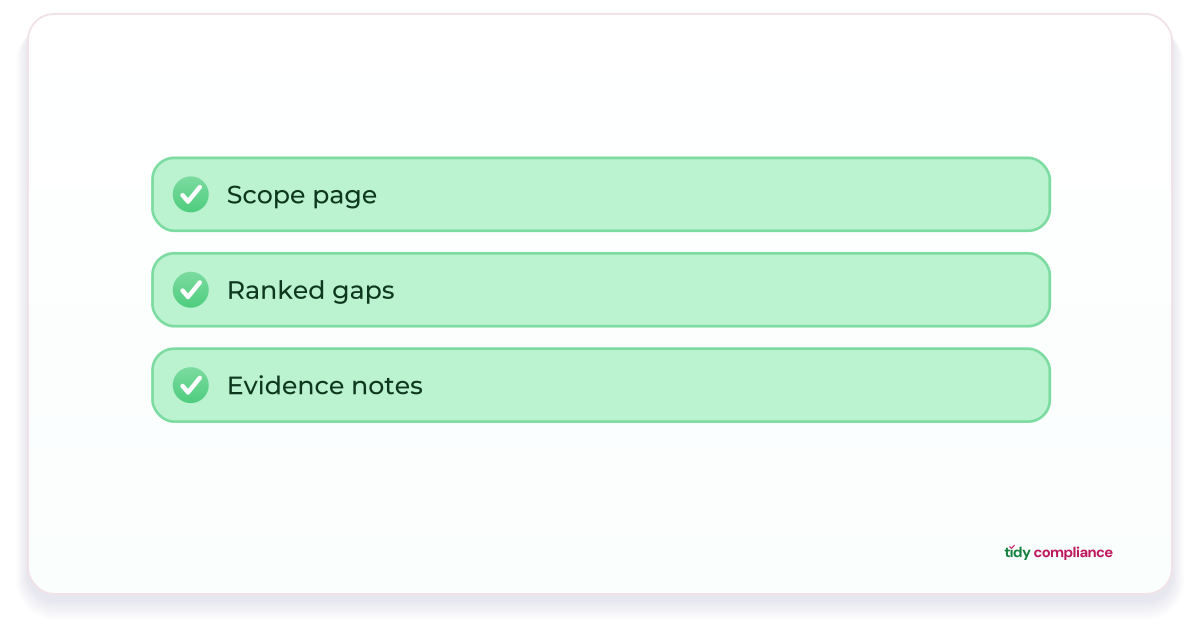
A good assessment ends with documents you can act on, and not a score alone. Expect these five items:
- A scope statement with the framework, version and systems covered
- A control-by-control results sheet with evidence notes
- A ranked gap list with risk rating and effort estimate
- A remediation roadmap with owners and target dates
- A short summary for leadership with the top risks and the budget needed
Ask to see a sample before you hire anyone. If the output is a long narrative with no ranking, you will spend weeks turning it into tasks. For your own use, my cybersecurity compliance checklist is a lighter way to run a first pass when you do not need a full assessment.
Reading the Results Without Panic
Most first assessments list dozens of gaps. That number looks scary, and it matters less than the ranking. In my client work, a small group of gaps, such as access control, missing policies and untested backups, usually accounts for most of the risk, and many of the rest are documentation fixes.
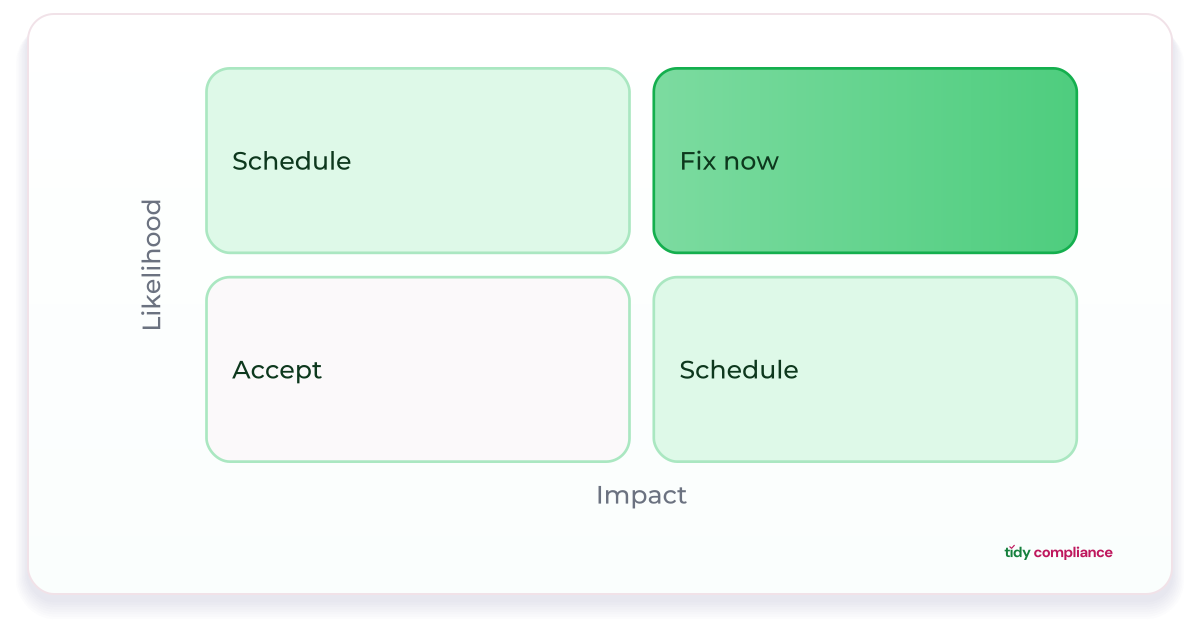
Split the list into three piles: fix now, schedule and accept. Fix now covers high risk and low effort. Schedule covers high risk and high effort, with an owner and date. Accept covers low risk items you document and leave. An accepted risk needs a name next to it and a review date, so it stays a decision and does not turn into an oversight.
A Worked Example: a 40-Person Software Company
Imagine a 40-person software company that a large customer asks to show a SOC 2 report within nine months. The company has multi-factor authentication on email, a cloud provider, a ticketing tool and a handful of policies copied from a template.
The assessment interviews the engineering lead, the IT admin and the head of people. It finds that access reviews have never run, two former contractors still have repository access, backups are never restored, there is no vendor list and training is tracked in a spreadsheet with gaps. Policies exist, but none has an approval date.
Scoring puts access control at level 1, backups at level 2, vendor management at level 0 and policies at level 2. The roadmap starts with a one-week sprint on access and offboarding, followed by a policy approval round, a restore test and a vendor list. With owners named and dates set, the company can book an internal audit in about three months and an outside auditor after that. The numbers here are an illustration, and your own timeline depends on your starting point.
Mistakes That Make an Assessment Less Useful
Three mistakes show up most often. The first is a scope that is fuzzy, so people argue about what is in or out halfway through. The second is scoring from documents alone, which flatters the company because documents describe intent. The third is a result that nobody owns. If the report lands in an inbox and no one is named to run the roadmap, the assessment was a cost and not an investment.
Avoid these by writing the scope first, testing at least a sample for each important control and naming one owner for the roadmap before you close the project. Put the first review on the calendar before the final meeting ends.
Where Software Helps and Where It Does Not
Compliance platforms can run continuous tests, collect evidence and map controls across frameworks, which saves time once you know your gaps. They do not interview your staff or judge whether a policy fits your business. If you want to compare platforms, see my ranking of cybersecurity compliance tools.
How to Choose Between DIY and Outside Help
You can run an assessment yourself if you have a compliance owner, a clear framework and a few days to interview people. Outside help is worth it when you need an independent view, when the result will go to customers or leadership or when you are choosing between frameworks. If you are still choosing, the cybersecurity compliance guide explains how the common ones differ.
- Confirm the framework and version before you start.
- Agree who will see the result and what decisions it supports.
- Ask for a ranked gap list and a roadmap, not a score alone.
- Plan a re-assessment after the first round of fixes.
Questions About Cybersecurity Compliance Assessments
What Is a Cybersecurity Compliance Assessment?
It is a structured review that compares your security practices with a framework, regulation or contract requirement, scores each area and lists the gaps. It gives you a baseline before an audit.
How Long Is the Assessment?
For a small or mid-sized company, a few weeks is common, depending on how many systems, locations and teams are in scope and how quickly owners provide evidence.
How Is an Assessment Different from an Audit?
An assessment is a planning tool for your own use, and an audit checks whether controls meet a standard, often for an outside reader. Run the assessment first, so the audit holds no surprises.
Does the Assessment Tell Me If I Am Compliant?
It tells you how close you are, and where the gaps sit. Formal compliance with a framework such as SOC 2 or ISO 27001 depends on an independent audit or certification, and the final decision belongs to the auditor or regulator.
Who Should Take Part?
The compliance owner, plus the owners of identity, infrastructure, development, HR and vendor management. Leadership should review the result and approve the roadmap.
How Often Should I Repeat It?
Yearly for most companies, and after major changes such as a new platform, an acquisition or a new framework. Some teams re-score the highest-risk areas every quarter.
What Does an Assessment Cost?
The price depends on scope, number of frameworks and how much evidence exists already. You get a range on a discovery call and a fixed quote after scoping, so the number is clear before work starts.
Sources
Disclaimer: This article is for general information only and isn’t legal, financial or tax advice. Treat figures as estimates from typical work and confirm details with your providers before you act.
Was this guide helpful?
Thanks for your feedback.
Odessa Whitfield
Odessa leads the Tidy editorial team and works with the compliance consultants to turn real client projects into practical guides on regulations, frameworks, policies and audit preparation. Before joining Tidy, she worked in compliance and risk roles, writing and maintaining policy sets for regulated organizations. Every article goes through a consultant who has done the work in practice, and she updates guides when a rule, framework or tool changes. She works remotely from the United States.