Quick Summary
- A cybersecurity compliance audit checks whether your controls match a standard, and the internal gap-finding pass is the cheapest and most useful version.
- Fix the scope first, then collect evidence, test samples, rate each gap and turn findings into dated tasks.
- The same findings repeat across companies: stale access, missing owners, untested backups and late training.
- An outside audit firm gives the formal opinion, and an adviser prepares you for it.
A cybersecurity compliance audit is a structured check of whether your security controls match a standard you have committed to, such as SOC 2, ISO 27001, HIPAA or a customer contract. Most people meet it as a deadline: a customer asks for a report, an auditor books a window and the team scrambles. The audits that go well are the ones where the gaps were already found and fixed weeks before the auditor arrived.
I write this from the practical side. In my cybersecurity compliance consulting work, the biggest time saver is a gap-finding pass before the formal audit. Below is how I run one, phase by phase, what usually turns up and how to turn findings into fixes.
Four Kinds of Audit You Might Be Facing
The word audit covers very different events, and the preparation changes with each one. Before you plan anything, find out which one you are dealing with and who will read the result.
| Audit type | Who runs it | What it produces | Typical trigger |
|---|---|---|---|
| Internal audit | Your own team or a hired adviser | Findings and a fix list for your eyes | You want to find gaps early |
| Independent attestation (for example SOC 2) | An outside audit firm | A report you can share with customers | Customers ask for proof of controls |
| Certification audit (for example ISO 27001) | An accredited certification body | A certificate if you pass | A market or contract requires certification |
| Customer or regulator review | The customer, a regulator or their agent | Questions, findings or a formal decision | A contract clause or a regulatory exam |
An internal audit costs the least and teaches the most, because nobody outside sees the findings. That is why I recommend running one before any external audit. If you are unsure which standard applies to you at all, my cybersecurity compliance guide walks through the common ones.
The Five Phases of a Gap-Finding Audit
I split the work into five phases. The table gives you the whole plan on one screen, and the sections after it explain what happens in each phase and where it usually goes wrong.
| Phase | Main question | Output | Typical effort |
|---|---|---|---|
| 1. Scope | What systems, data and people are covered? | Written scope and control list | A few days |
| 2. Evidence | What proof exists for each control? | Evidence folder with owners | One to two weeks |
| 3. Testing | Do the controls work in practice? | Test notes and screenshots | One to two weeks |
| 4. Rating | How serious is each gap? | Ranked findings list | A few days |
| 5. Fixing | Who fixes what, by when? | Remediation plan with dates | Ongoing |
The effort column is a rough guide from my own projects. A twenty-person company with one cloud environment sits at the short end. A larger company with several business units takes longer, mainly because gathering evidence from many owners is slow.
Phase 1: Fix the Scope Before You Look at Anything
Scope is the list of systems, locations, data types and teams the audit covers. Most delays I see start here. A scope that is too wide buries you in controls, and a scope that is too narrow lets an auditor or a customer ask about systems you left out.
Start from the standard and your customers. Write down which systems store or process the data you promised to protect, then add the people who administer them and the vendors that touch them. Keep the scope document to one page, and get the owner of each system to confirm it.
Phase 2: Collect Evidence Where It Already Lives
Evidence is anything that proves a control exists and runs: a policy with an approval date, an access review export, a ticket that shows a patch, a training completion list. Do not create new documents if the proof already sits in a system. Pull screenshots and exports, label them with date and source and store them in one folder structure that follows your control list.
The most common problem is that the evidence is real but scattered. Access reviews live in a spreadsheet, patch records live in a ticketing tool and training lives in an HR system. Name an owner for each control in this phase, because the owner is the person who will answer the auditor later. If you plan to buy software to track this, my ranking of cybersecurity compliance tools compares the main platforms.
Phase 3: Test That Each Control Really Runs
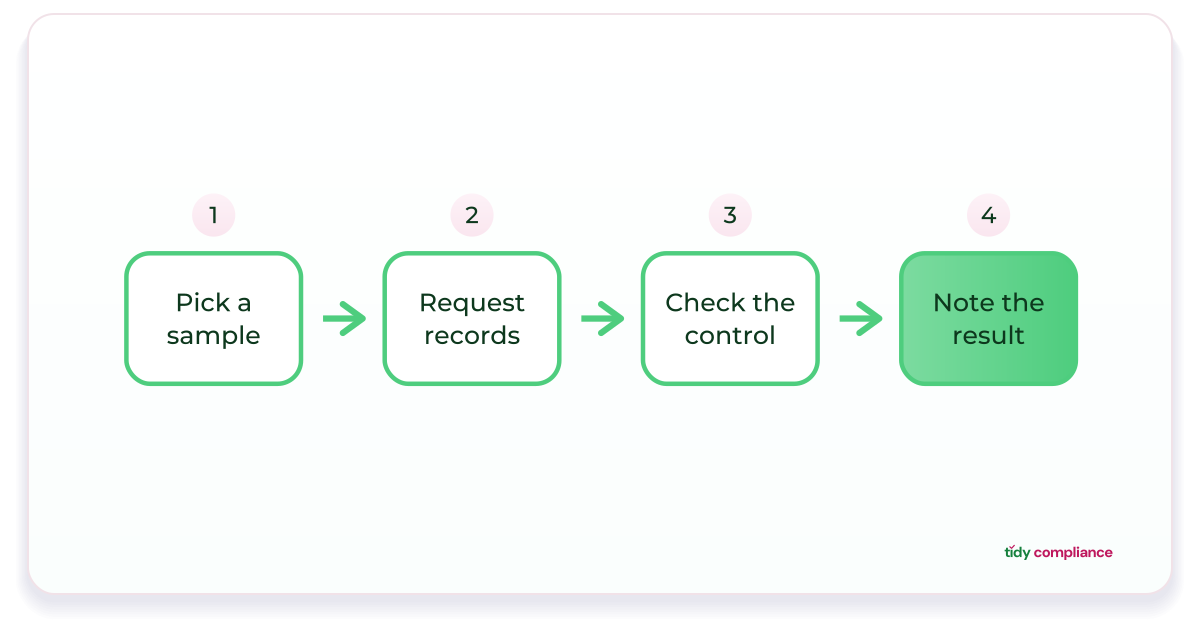
A policy says access is removed within a day of an employee leaving. Testing means picking a sample of recent leavers and checking the actual removal dates. Documents tell you what is supposed to happen, and a sample tells you what does.
Pick samples that are big enough to be meaningful and small enough to finish. For a small company, a sample of five to ten items per control is common. Write down what you checked, what you found and the date, so the result can be repeated. This phase turns up most of the real findings: a shared admin account, a contractor who still has access or a backup nobody has restored.
Phase 4: Rate Every Gap by Risk
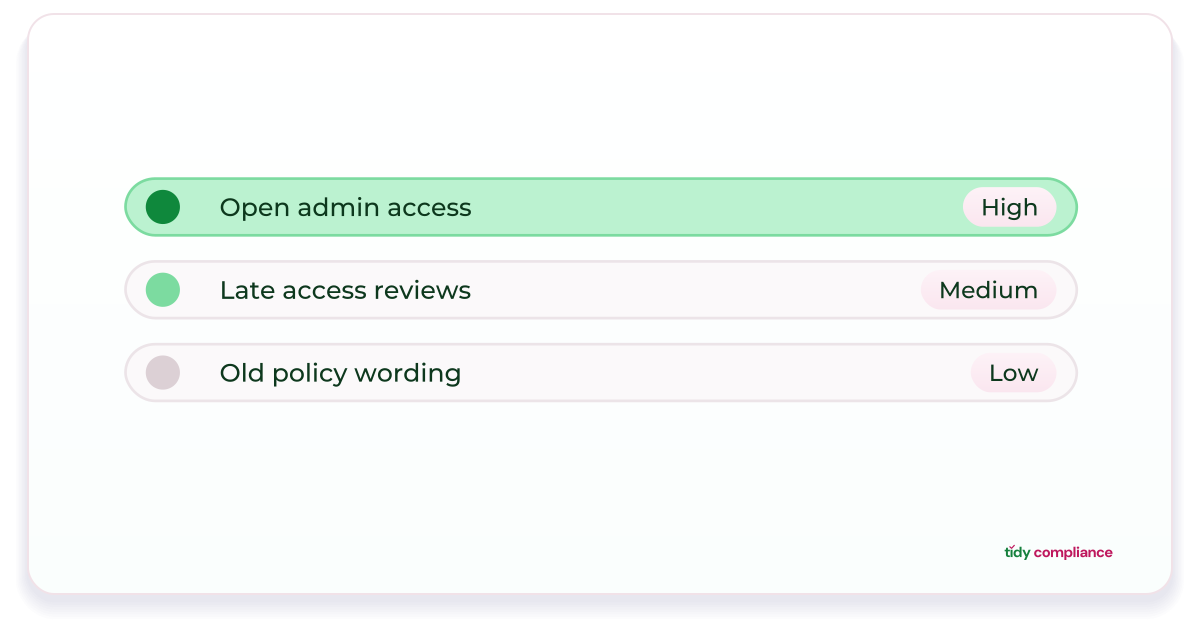
A list of forty findings is not a plan. Give each gap a rating based on how likely it is to cause harm and how much damage it could do, and pair it with the effort to fix it. A simple three-level scale works: high, medium and low.
Group the high-rated findings first and look for quick wins: items that are high risk and cheap to fix, such as turning on multi-factor authentication for every admin. Hold findings for two reviewers: one from security and one from the business, so ratings do not depend on one person’s view.
Phase 5: Turn Findings Into Dated Tasks
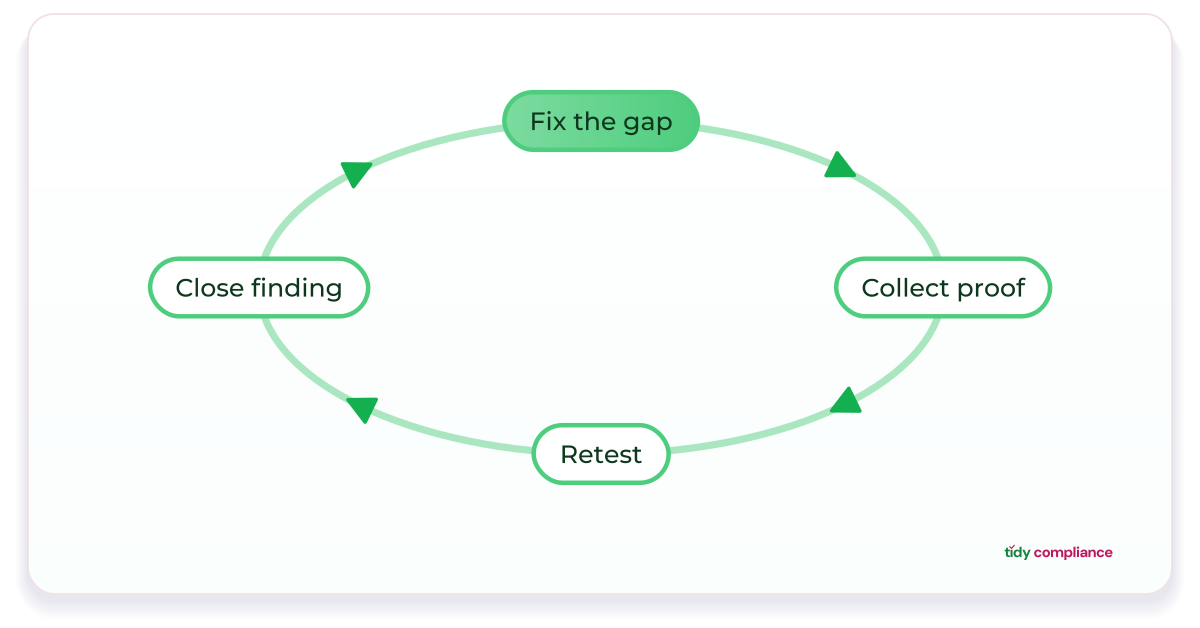
Every finding needs an owner, a fix, a due date and a way to prove it is done. I put these into a remediation plan that the owner of each system signs off. Without owners and dates, findings sit on a list until the next audit rediscovers them.
Plan time for retesting. A fix is closed only when someone checks it. If a fix needs budget or a longer project, record an interim control and a date for the permanent fix, because auditors accept a documented plan more readily than silence.
Findings That Show Up Again and Again
The same gaps appear across very different companies. Knowing them helps you check these first, before the auditor does.
- Access reviews that were planned but never run, or run without a record of the outcome.
- Former employees and contractors who still have active accounts.
- Policies that exist but have no owner, approval date or review date.
- Backups that run but have never been tested with a restore.
- Vendors that handle sensitive data without a security review on file.
- Security awareness training with incomplete completion records.
- Logging turned on but nobody reviewing the alerts.
Writing Findings That Actually Get Fixed
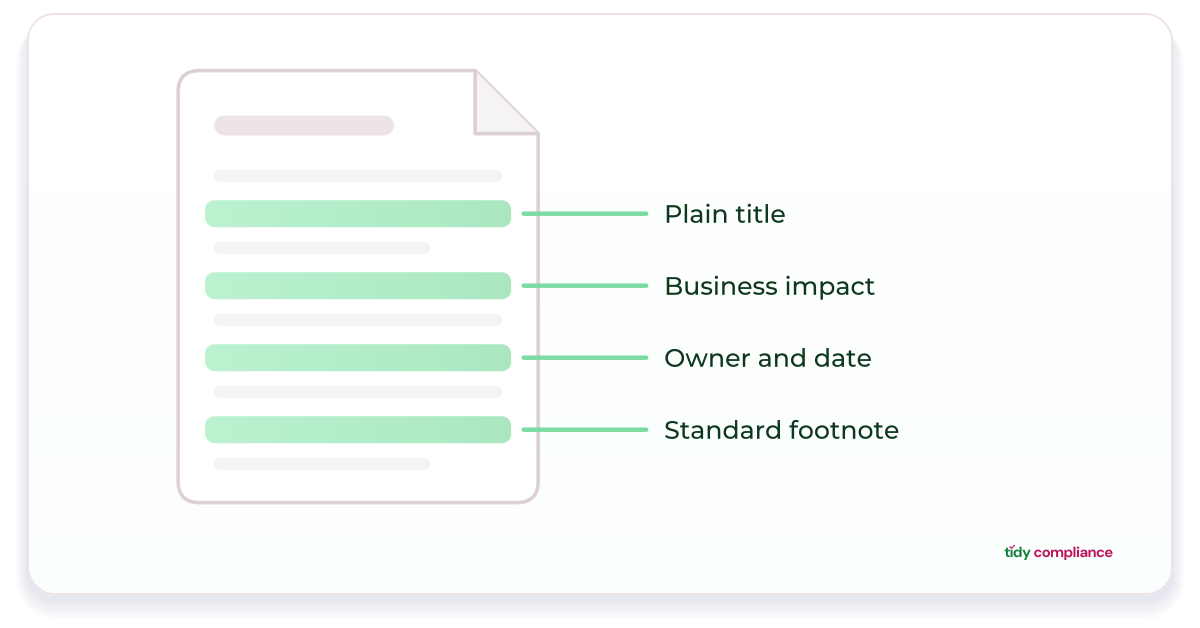
A finding that says access control is weak will not move anyone. A finding that says four former contractors had active accounts for up to ninety days after their contracts ended gives the owner something to fix. Describe what you saw, where, how many cases and why it matters, in two or three sentences.
Add the standard reference only as a footnote. The reader cares about the risk and the fix first. In my experience, owners respond faster when the finding includes a suggested fix and a rough effort estimate, so they can plan it without another meeting.
Report to leadership on a single page: number of findings by rating, the top five risks, what is fixed and what is due next. Boards read trends, so repeat the same layout each quarter.
When to Run It Yourself and When to Bring in Help
A small, technical team with a clear standard can run a gap-finding audit alone, especially with a checklist such as my cybersecurity compliance checklist to guide the first pass. You will save money and learn your own systems well.
Bring in outside help when you lack a compliance owner, when the audit is tied to a large contract or when the first pass turns up more gaps than your team can rank. An outside view also helps because your team stops seeing its own habits. If you want a structured starting point before the audit itself, read about a cybersecurity compliance assessment, which sets the baseline an audit then measures.
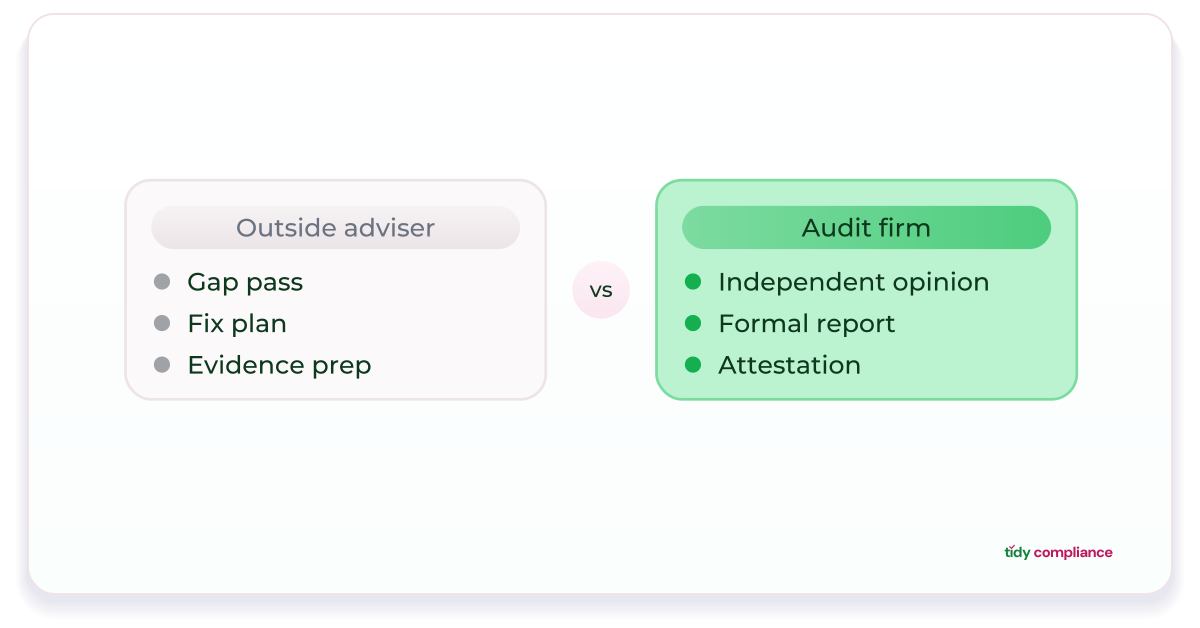
An outside adviser does not replace the independent audit firm that issues a report. The adviser prepares you, and the audit firm gives the formal opinion. Keep those roles separate, and ask any adviser to confirm which standard version your audit will use.
How to Choose Your Audit Approach
Match the approach to the question you need answered. If a customer wants a report, plan an independent attestation and run an internal audit first. If you need to know where you stand, run an internal audit only. If a regulator is involved, confirm the scope with the regulator or your counsel before you start.
- Name the standard and the version your auditor will use.
- Write the scope on one page and get each system owner to confirm it.
- Assign an owner to every control before you collect evidence.
- Test a sample of each control instead of only reading the document.
- Rate findings, assign dates and retest every fix.
If you want a second pair of eyes on your plan, a short call is usually enough to confirm scope and order of work.
Questions About Cybersecurity Compliance Audits
How Long Does a Cybersecurity Compliance Audit Take?
A gap-finding audit for a small company often takes two to four weeks, including evidence collection and testing. Larger organizations take longer because evidence sits with many owners. The formal audit by an outside firm has its own schedule, which you agree with the firm.
What Is the Difference Between an Audit and an Assessment?
An assessment measures where you stand against a standard and gives you a baseline. An audit checks whether controls meet a standard and produces findings, often for an external reader. I use an assessment first to plan, and an audit to confirm.
Who Should Own the Audit Inside My Company?
Pick one accountable person, usually the head of security, IT or compliance, and give them authority to ask system owners for evidence. Control owners answer for their own areas, and leadership reviews the findings.
How Much Evidence Do I Need?
Enough to show each control exists and ran during the audit period. That usually means the policy, a record of it running and a sample of recent instances. Ask your auditor for their sampling expectations early.
What Happens If the Audit Finds Serious Gaps?
You fix them and record the work. Serious findings get an owner and a date, and an interim control if the fix takes time. Depending on the standard, the report may note the exception, so discuss timing with your auditor.
Can I Use Software to Run the Audit?
Software can collect evidence and track tasks, and it saves time on repeat audits. It does not rate risk for you or test whether a control works in practice, so keep a person in charge of both.
How Often Should I Run an Internal Audit?
At least once a year before your external audit, and again after a major change such as a new system, a new office or an acquisition. Some teams test a few controls every quarter so the yearly audit holds no surprises.
Sources
Disclaimer: This article is for general information only and isn’t legal, financial or tax advice. Treat figures as estimates from typical work and confirm details with your providers before you act.
Was this guide helpful?
Thanks for your feedback.
Odessa Whitfield
Odessa leads the Tidy editorial team and works with the compliance consultants to turn real client projects into practical guides on regulations, frameworks, policies and audit preparation. Before joining Tidy, she worked in compliance and risk roles, writing and maintaining policy sets for regulated organizations. Every article goes through a consultant who has done the work in practice, and she updates guides when a rule, framework or tool changes. She works remotely from the United States.