Quick Summary
- Cybersecurity compliance means proving, against a standard, that you protect information, and it rests on requirements, controls and evidence.
- Pick the framework your customers or regulator name, and reuse the shared control set for later ones.
- A program grows in four stages, from decisions and basics to scheduled controls, an audit and a self-running routine.
- Name owners for every control, and buy software only after you know which evidence it must collect.
Cybersecurity compliance means showing that your security practices meet a defined set of requirements, from a law, a framework or a customer contract. It sounds like paperwork, and it is partly that. Mostly it is a habit of deciding what you protect, writing down how, doing it and keeping the proof.
Many people come to me when a customer sends a security questionnaire or asks for a report they do not have. This guide is the one I would hand them: what the pieces are, how they fit and the order I recommend, from zero to a program that runs on its own. Teams that want help with the early steps often start with cybersecurity compliance consulting.
What Cybersecurity Compliance Means in Practice
Security and compliance overlap, and they are not the same thing. Security is the set of protections you use against threats. Compliance is the proof, measured against a standard, that you use them. You can be secure without being compliant, because you lack the paperwork. You can also be compliant and still weak, because the standard sets a floor and does not cover every threat.
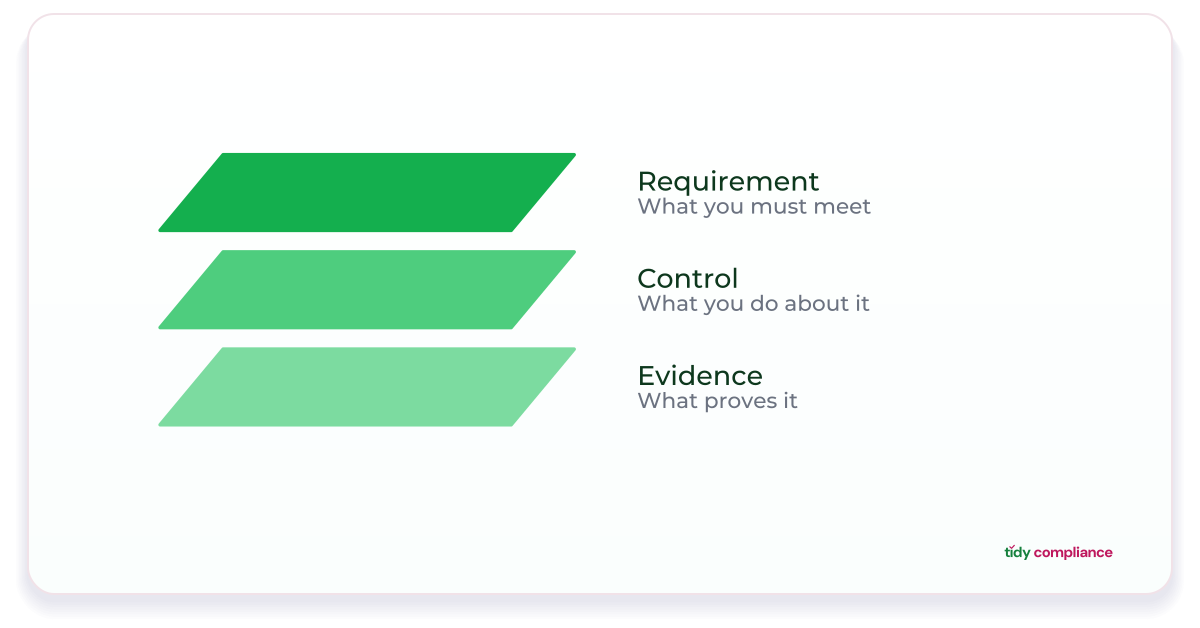
That is why most programs have three layers: the requirement (what you must meet), the control (what you do about it) and the evidence (how you prove it). Every other idea in this guide hangs on those three words.
The Frameworks You Will Hear About
Which framework applies depends on your industry, your customers and your data. The table compares the ones I meet most often, and the sources at the end link to the official pages.
| Framework | Who usually needs it | What it is | Proof you receive |
|---|---|---|---|
| SOC 2 | Software and service companies selling to businesses | Criteria for security, availability, processing integrity, confidentiality and privacy | An auditor’s report |
| ISO/IEC 27001 | Companies selling internationally or to large customers | A management system standard for information security | A certificate from an accredited body |
| HIPAA Security Rule | Healthcare organizations and their business associates | Safeguards for electronic health information | No certificate; you document and can be reviewed |
| PCI DSS | Organizations that handle payment card data | Technical and operational requirements for card data | A report or self-assessment, depending on volume |
| NIST Cybersecurity Framework | Any organization that wants a structure | Six functions: Govern, Identify, Protect, Detect, Respond, Recover | No certificate; it is a framework for self-use |
| CMMC | Contractors working with the US defense sector | Maturity levels for protecting government information | An assessment result, based on level |
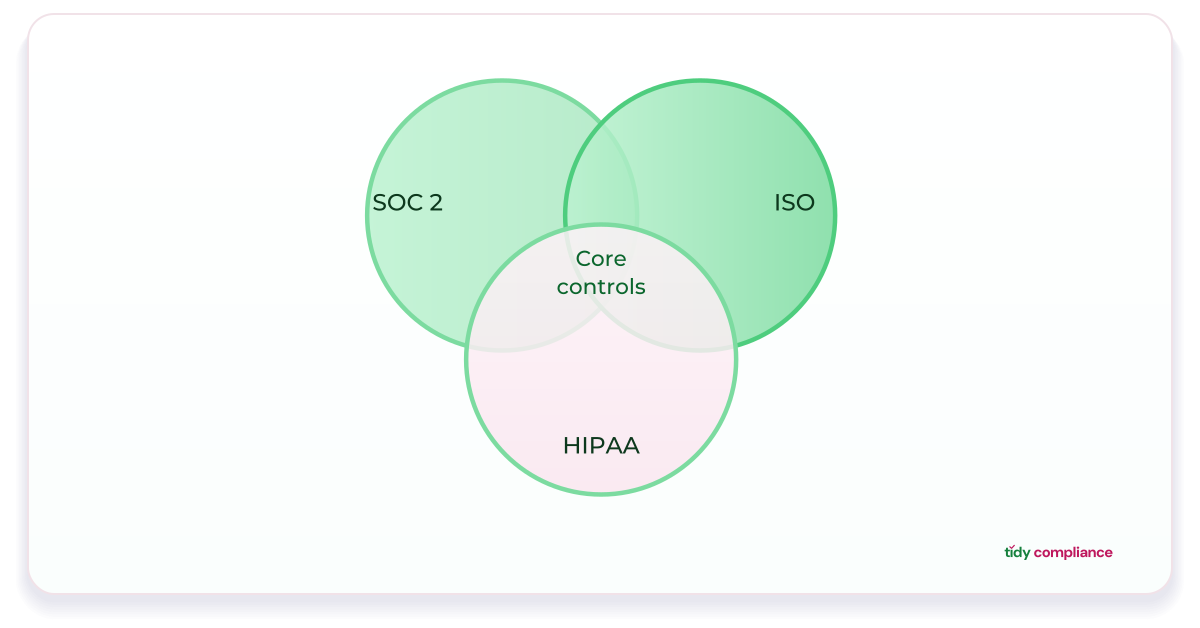
Most of these frameworks share the same core controls: access control, change management, risk management, incident response, vendor management and training. Once you build those, adding a second framework is far cheaper than the first. For tooling that maps one control set to several frameworks, my list of cybersecurity compliance tools compares the main options.
From Zero to Pro: Four Stages of a Program
I think of a compliance program as four stages. You do not need to rush through them. Most companies need stage two or three to win the deals that triggered the work.
Stage Zero: You Have Nothing Written Down
Security happens through habit. Smart people do sensible things, but nothing is documented and ownership is unclear. The only job at this stage is to decide who owns security and which framework a customer or law requires. Do not buy software yet.
Stage One: Baseline and Basics
Run an assessment to find your gaps, then fix the basics: multi-factor authentication, an access list, backups, patching and a short set of policies. A structured start is a cybersecurity compliance assessment, and for a quick first pass the cybersecurity compliance checklist covers the eight checks that matter most.
Stage Two: Controls That Run on a Schedule
Now controls need owners, calendars and records. Access reviews run twice a year, patches follow severity timelines, training is tracked and vendors are reviewed. This is the stage where a compliance platform starts to pay off, because it collects the records you would otherwise chase by hand.
Stage Three: Audit-Ready
You run an internal audit, fix what it finds and then bring in an outside auditor or certification body. The process of finding gaps before the external audit is covered in my guide to the cybersecurity compliance audit. An independent report or certificate is what customers ask for.
Stage Four: A Program That Runs Itself
Controls are measured, leadership reviews results quarterly and new frameworks reuse the same control set. Changes in your business, such as a new product or an acquisition, trigger a review of scope. The work now is maintenance, and it is much lighter than the first year.
Who Does What
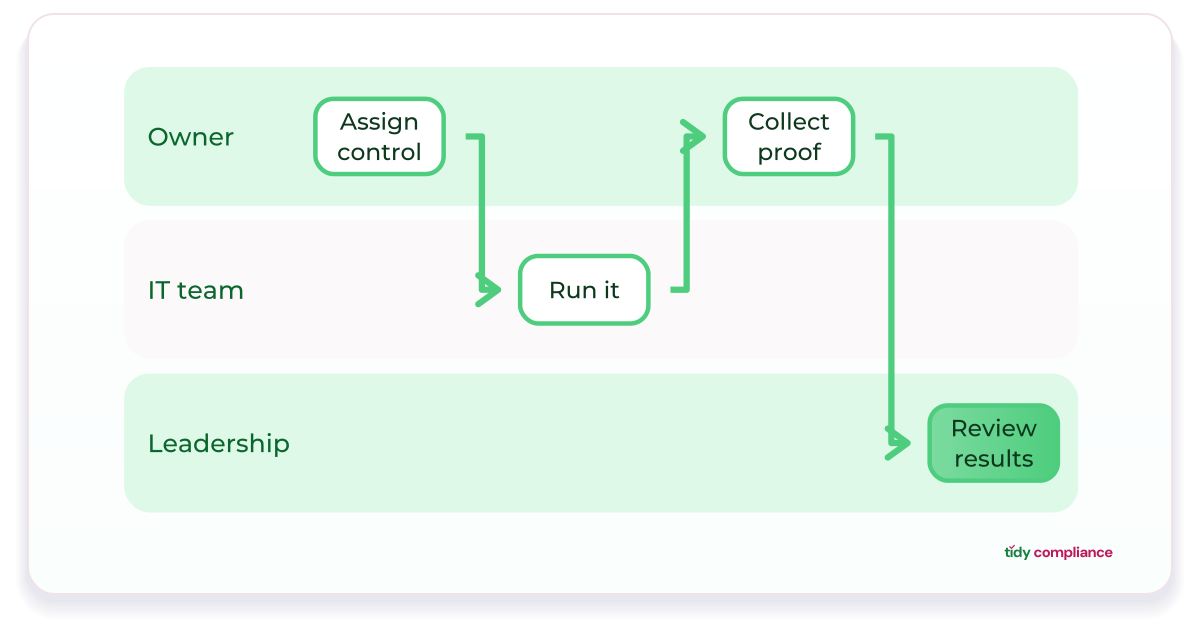
Compliance fails when everyone assumes someone else owns it. Four roles cover most companies, and in a small team one person holds several.
- Executive sponsor: approves budget and risk decisions, and reads the quarterly report.
- Compliance owner: runs the program, tracks tasks and talks to auditors.
- Control owners: run controls in their area, such as IT access or HR onboarding.
- Everyone else: follows the policies and completes training.
Write these roles into your policy set with names, so nobody wonders whom to call when a customer asks a question or an incident happens.
What a First Twelve Months Can Look Like
Timelines vary, so treat this table as a planning sketch and not a promise. It assumes a small company that starts with a few basics in place and has one owner for compliance.
| Months | Focus | Output |
|---|---|---|
| 1 | Decide the framework, owner and scope | Scope statement and named owner |
| 2 to 3 | Assessment and basic fixes | Ranked gap list and first fixes closed |
| 3 to 5 | Policies, training and access reviews | Approved policy set and first review records |
| 5 to 8 | Controls run on a schedule, evidence collected | Evidence folder with dates |
| 8 to 10 | Internal audit and fixes | Internal audit report and closed findings |
| 10 to 12 | External audit or certification | Report or certificate |
If a deadline is shorter, the first three stages compress, and the cost rises because more work happens in parallel. Starting early, even with small steps, spreads the effort and keeps the evidence honest, since auditors want to see that controls ran for a period and not just once.
What It Costs and Where the Time Goes
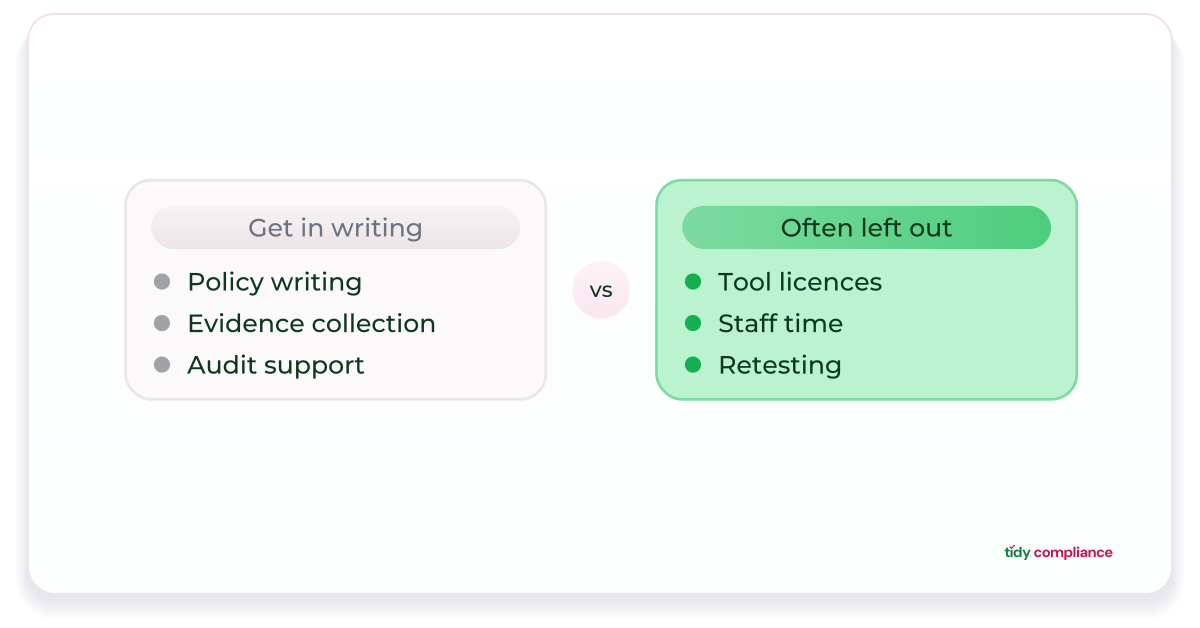
Cost depends on the framework, your size and how much is in place. The main cost buckets are staff time, software, outside advice and the audit fee. Staff time is the largest and the least visible, because control owners spend hours on evidence that nobody tracks as a project cost.
Ask each vendor and adviser for a written scope with what is and is not included, since prices for similar work differ widely. Many compliance software vendors do not publish prices, so plan for a sales call.
Questions to Ask Before You Hire Outside Help
You may not need a consultant, a platform or an audit firm on day one. When you do, a few questions separate a useful partner from an expensive one.
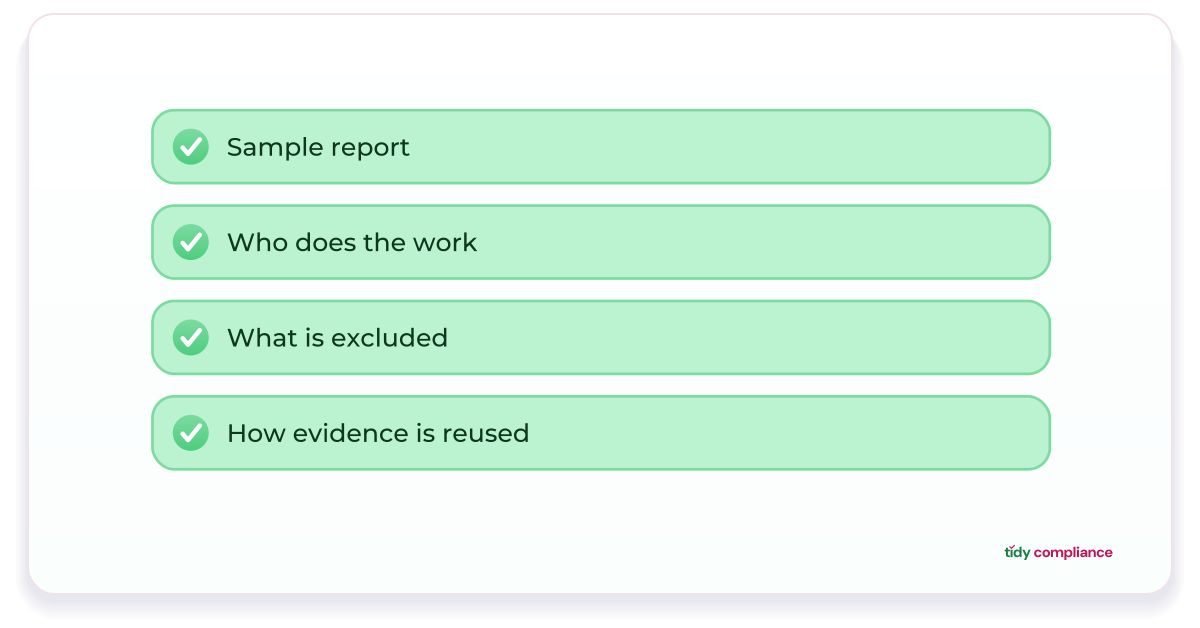
- Which framework and version will you work against, and why does it apply to me?
- What exactly do I receive at the end, and can I see a sample?
- Who on your side does the work, and how much of it will my team have to do?
- How do you charge, and what happens to the price if the scope grows?
- Do you keep any role in the audit itself, and how do you avoid conflicts?
Pay attention to how the answers sound. A good adviser names limits, such as what they cannot decide for you, and says when a legal question belongs with your counsel. A weak one promises a certificate by a fixed date. Only an independent auditor or certification body can issue one, and only after your controls have been checked.
Mistakes That Slow Teams Down
A few patterns repeat, and spotting them early saves months.
| Mistake | In practice | Better approach |
|---|---|---|
| Buying software first | A platform is bought before gaps or scope are known | Run an assessment, then pick tools that fit the gaps |
| Copying templates unchanged | Policies mention tools the company does not use | Edit every policy to match real practice |
| Scope too wide | Every system is in scope, owners are overloaded | Scope to systems that touch the data you promised to protect |
| No owners | Controls are written, nobody runs them | Assign a named owner and a calendar slot to each control |
| Evidence at the last minute | Records are created the week before the audit | Collect evidence as controls run, with dates |
| One-time effort | Everything is fixed once, then forgotten | Set review dates and quarterly check-ins |
Picking Your Starting Point
Begin with the question that triggered the work. If a customer asked for a report, pick the framework they name. If you operate in a regulated industry, start with the rule that applies to you. If you are unsure, use the NIST Cybersecurity Framework as a structure and map to a certifiable framework later.
- Name the framework, the version and the reason it applies.
- Run an assessment or the eight-point checklist to see your gaps.
- Fix the highest-risk basics first and assign owners.
- Add tools once you know what evidence they must collect.
- Run an internal audit before the outside audit.
Questions About Cybersecurity Compliance
What Is Cybersecurity Compliance in Simple Terms?
It is proving, against a standard, that you protect information and systems properly. You decide what rules apply, put controls in place, keep records and, for some frameworks, let an independent party check them.
Which Framework Should I Start With?
Start with the one your customers or your regulator name. If none is required yet, many teams start with SOC 2 for business customers or ISO 27001 for international ones, and use the NIST Cybersecurity Framework as a structure.
How Long Does It Take to Become Compliant?
It depends on your starting point, your size and the framework. Small companies with basic controls in place often need a few months before a first audit, and others need longer. A baseline assessment gives you a realistic timeline.
Do I Need Software to Be Compliant?
No. Software saves time collecting evidence and tracking tasks, especially for repeat audits, but you can run a first program with documents, tickets and a calendar. Buy software when manual tracking becomes the bottleneck.
What Is the Difference Between Compliance and Security?
Security is the protection you use. Compliance is the evidence, measured against a standard, that you use it. You need both, and a good program uses the standard as a floor and adds protections for your own risks.
How Often Do I Need to Renew?
Frameworks differ. SOC 2 reports and ISO certificates are renewed on a cycle set by the auditor or certification body, and some frameworks need ongoing monitoring. Confirm the cycle with your auditor before you plan the calendar.
Can a Small Company Handle This Alone?
Yes, if someone owns it and the scope is small. Many small teams get help for the first assessment and the policy set, then run the program themselves. Outside support helps most where the stakes are high or the time is short.
Sources
- NIST Cybersecurity Framework 2.0
- ISO/IEC 27001 information security standard
- AICPA SOC 2 overview
- HHS HIPAA Security Rule
Disclaimer: This article is for general information only and isn’t legal, financial or tax advice. Treat figures as estimates from typical work and confirm details with your providers before you act.
Was this guide helpful?
Thanks for your feedback.
Odessa Whitfield
Odessa leads the Tidy editorial team and works with the compliance consultants to turn real client projects into practical guides on regulations, frameworks, policies and audit preparation. Before joining Tidy, she worked in compliance and risk roles, writing and maintaining policy sets for regulated organizations. Every article goes through a consultant who has done the work in practice, and she updates guides when a rule, framework or tool changes. She works remotely from the United States.