Quick Summary
- Most GDPR mistakes come from stopping at the cookie banner.
- Test consent in a private window, because a green dashboard can hide early trackers.
- Vendor agreements, a request owner and a breach plan close the gaps customers ask about first.
- Fix the cheap, visible items in days, then build the data map, retention rules and notice.
GDPR mistakes look alike from one company to the next. The same nine show up in nearly every review I run, and most of them come from good intentions: a quick banner, a free tool, a template that looked right. They fail when a customer, an auditor or a data subject asks for proof.
Below are the nine in the order I would fix them, each with a do-this and an avoid-this. If you want help ranking them for your own setup, my GDPR compliance consulting service starts with exactly this list. Nothing here is legal advice, so take interpretation questions to your counsel.
| Mistake | Typical sign | First fix |
|---|---|---|
| 1. Banner as the whole program | Banner live, no record or agreements | Map the data flow |
| 2. Trackers before consent | Ad requests appear after refusing | Gate tags on the consent signal |
| 3. No record of processing | Nobody can list the systems | Build the table with owners |
| 4. Missing vendor agreements | Tools bought by card, nothing signed | Vendor register with links |
| 5. Requests in a general inbox | Answer takes weeks | Named owner and deputy |
| 6. Consent as default basis | Withdrawals break fulfillment | Choose a basis per activity |
| 7. Data kept forever | Ten-year-old leads in the CRM | Retention table and cleanup date |
| 8. No breach plan | Nobody knows who decides | One page and a drill |
| 9. Copied privacy notice | Names vendors you do not use | Rewrite from the data map |
1. Treating the Cookie Banner as the Whole Program
A banner is the part of GDPR that visitors can see, so many companies stop there. Then a customer asks for your record of processing, your vendor agreements or your breach plan, and nothing exists. The banner covers one slice of one rule, which is consent for non-essential cookies.
I see this most with web shops that bought a banner plugin in a hurry. The banner works, the tags still load before consent, and the back office holds ten years of customer data with no retention rule. Treat the banner as step four of a longer list, and use my guide to a GDPR compliance audit to see what sits behind it.
- Do this: map the whole data flow, then place the banner where it belongs.
- Avoid this: buying a banner and calling the project done.
2. Loading Trackers Before the Visitor Chooses
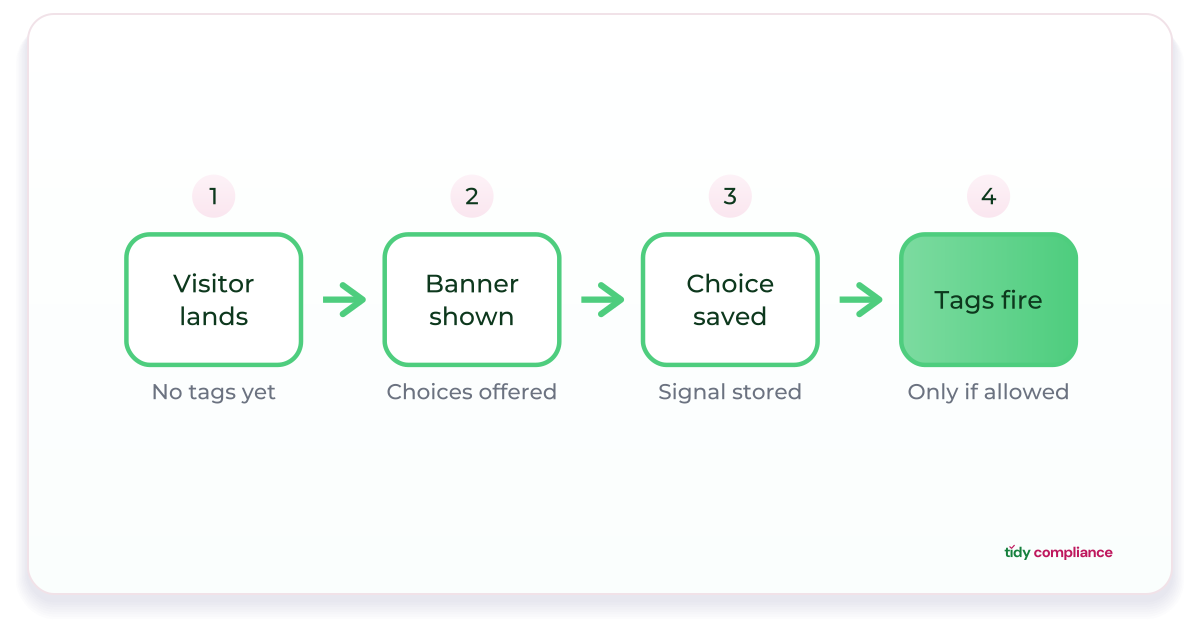
Consent only counts when it comes first. A site that fires analytics and advertising tags on page load, then shows a banner, has already collected the data. The banner then records a choice about something that happened.
The fix is technical. Tags must wait for a signal from the consent tool, and the signal must reach every tag, including the ones a marketing agency added to the tag manager two years ago.
Test it yourself. Open the site in a private window, keep the network panel open, refuse everything and look for requests to analytics and ad domains. If any appear, the setup fails, whatever the banner dashboard says.
- Do this: test in a private window after every site or tag change.
- Avoid this: trusting the dashboard status without checking the network requests.
3. Keeping No Record of Processing Activities
Teams often assume the record is for large companies. The text of Article 30 exempts organizations with fewer than 250 employees, then removes the exemption when processing is not occasional, risks people's rights or involves special categories of data. Regular customer and employee processing is not occasional, so many small companies still need one.
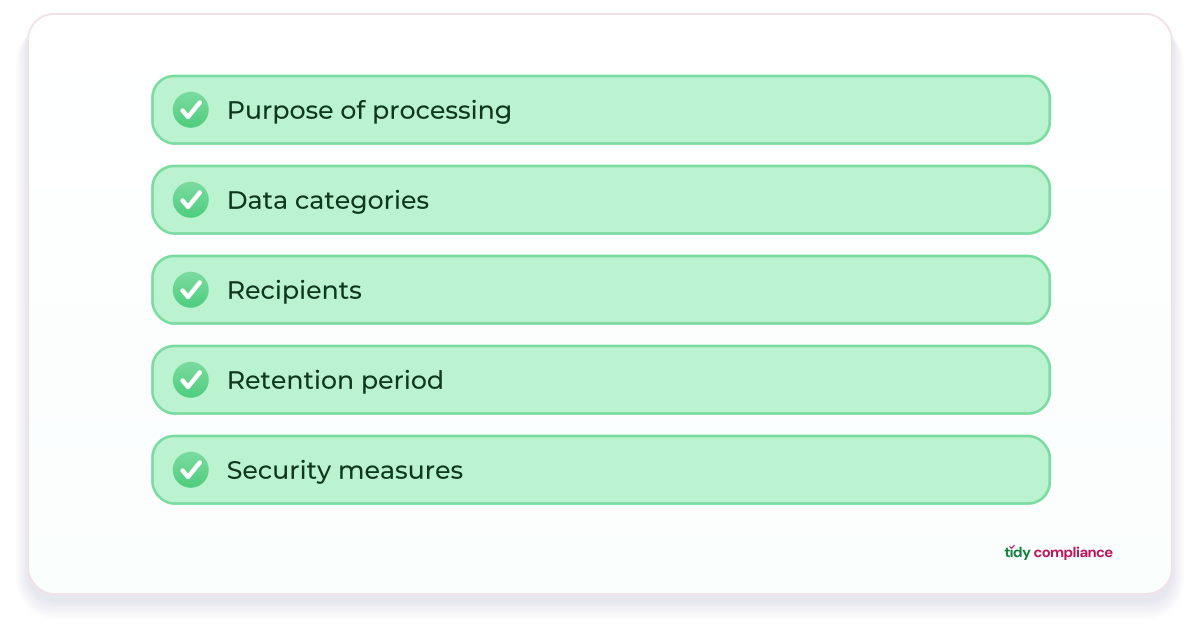
Even when the record is optional for you, you need the same information to write a notice and answer a request. Build it once as a table with system, data, purpose, recipients and retention, and keep one owner for updates. Two hours with the person who runs finance and the person who runs marketing gets most of it.
- Do this: keep the record as a living table with an owner.
- Avoid this: writing it once for a client questionnaire and never updating it.
4. Skipping Agreements With Vendors
Every vendor that processes personal data on your behalf needs a written agreement. Missing agreements are one of the most common gaps I find, because the tools arrive through credit cards and free trials, and nobody sends them to legal.
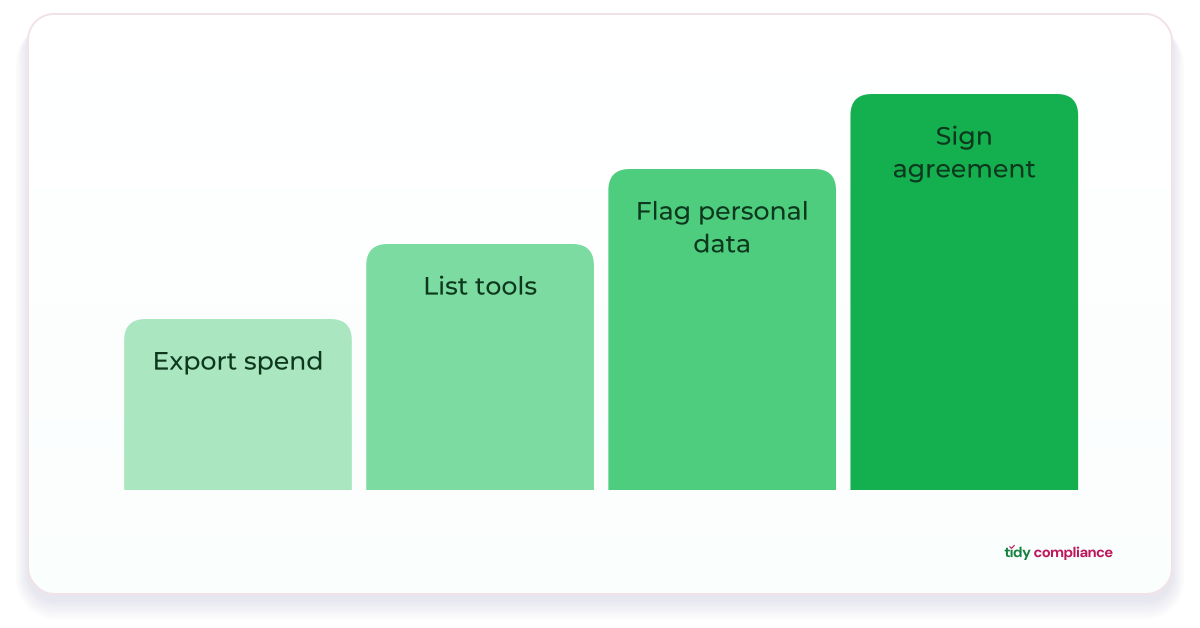
Start from your accounting export. List every tool, mark which ones hold personal data and save the signed agreement for each. Most large vendors offer a standard agreement you can accept online. Also note where each vendor stores data, since transfers outside the EEA need a mechanism you should confirm with your counsel.
- Do this: keep a vendor register with the agreement link and storage region.
- Avoid this: assuming free or small tools are out of scope.
5. Letting Rights Requests Sit in a General Inbox
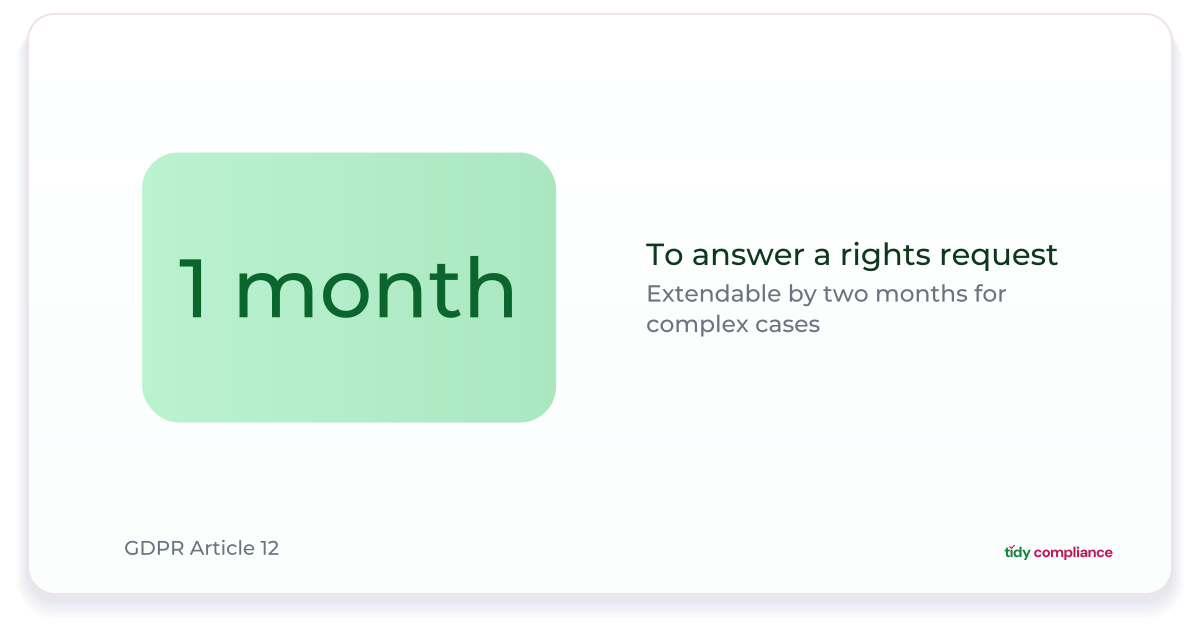
A person who asks for a copy of their data starts a clock of one month, extendable by two months for complex cases, per Article 12. When the request lands in a shared inbox, a week often passes before anyone realizes what it is.
Name an owner and a deputy, create a mailbox for privacy topics and teach support staff to forward requests in the same hour, including ones that arrive by chat or phone. Run one test request each year. The test shows how many systems hold a person's data, and the answer is usually more than the team expects.
- Do this: time one test request from intake to answer.
- Avoid this: relying on staff to recognize a request unaided.
6. Relying on Consent When Another Basis Fits Better
Consent feels safest, so companies ask for it everywhere. It also creates the most work, because it must be freely given, recorded and withdrawable. Using consent for processing that is really needed to deliver a contract, such as shipping an order, can backfire when someone withdraws it and you still must keep the order record.
Choose the basis for each activity on its merits. Contract fits what you need to perform an order, legal obligation fits tax records and consent fits optional marketing. Where you rely on legitimate interests, write a short balancing test. A page per activity is enough, and my cost guide shows why this paperwork is cheap next to rework: see GDPR compliance cost.
- Do this: document the basis for every activity in the data map.
- Avoid this: using consent as a default for everything.
7. Keeping Data Forever
Storage is cheap, so nobody deletes. Years later the CRM holds former customers, dead leads and rejected applicants, and every one of those records adds to what a breach could expose and to what a request must cover.
Set a period per category and make something enforce it. The enforcement can be a quarterly calendar entry with an export, a check and a deletion. Check backups too, because deletion that skips them leaves the data alive. If a system cannot delete at all, record that gap in your findings and plan its replacement.
- Do this: set a retention table and a quarterly deletion date.
- Avoid this: writing a retention policy that no system enforces.
8. Having No Plan for a Breach
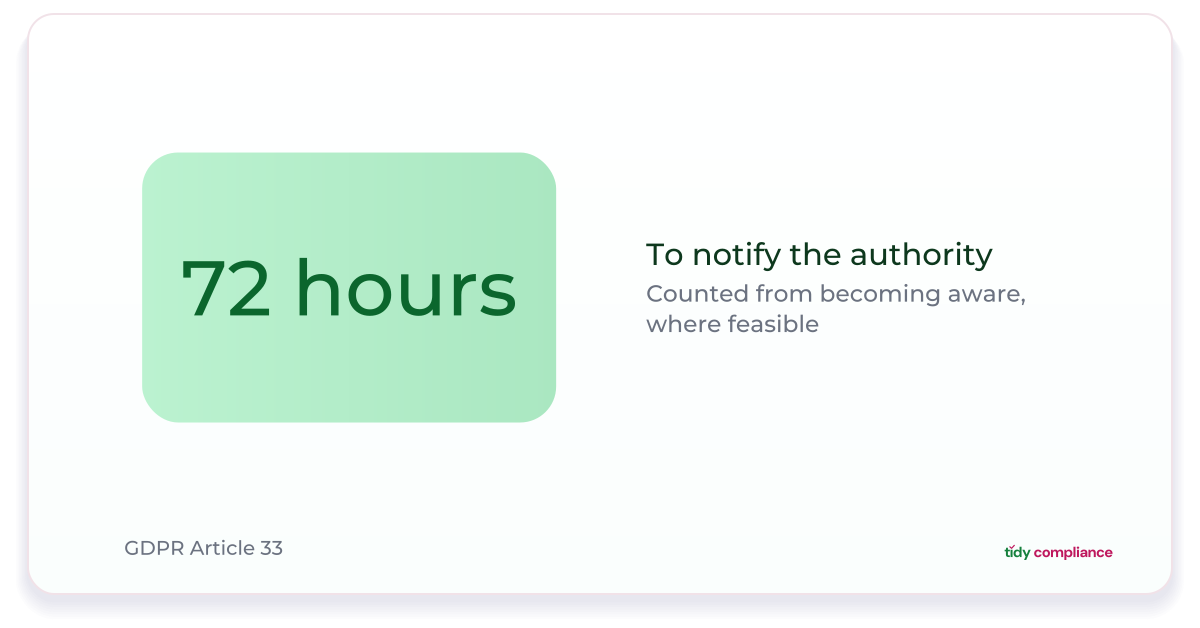
The regulation expects notification to the supervisory authority without undue delay and, where feasible, within 72 hours of becoming aware, unless the breach is unlikely to risk people's rights, per Article 33. Companies that have never rehearsed it lose the first day deciding who is in charge.
Put one page together: who decides, who contacts the authority, who writes to affected people, where the incident log lives and which vendor you call for forensics. Run a half-hour drill with a made-up lost laptop. The first drill usually shows that the decision-maker has no deputy and the log sits in the system that went down.
- Do this: name a deputy for every role in the plan.
- Avoid this: filing the plan in a folder nobody has opened.
9. Copying a Privacy Notice From a Competitor
A copied notice describes someone else's company. It names vendors you do not use, omits ones you do and promises retention periods you do not follow. The mismatch is easy to spot, and it is the first thing a careful customer or regulator compares.
Write the notice from your data map. Name the categories of data you collect, the reasons, the recipients, the retention periods and the way to contact you. Keep it in plain sentences, date it and update it when you change tools. Small teams can find a leaner approach in GDPR compliance for small business.
- Do this: write the notice from your own data map.
- Avoid this: pasting a competitor's text or an unedited generator output.
Why These Mistakes Persist
Three causes explain most of them. Ownership is split, so marketing owns the banner, IT owns the systems and nobody owns the whole picture. Tools arrive faster than review, because a team can start using a new service in an afternoon. And the work is invisible until someone asks, which makes it the first thing to slip when deadlines press.
A single named owner, a vendor register fed by the accounting system and a yearly review fix most of that. Where the program is large, an outside reviewer adds a fresh view and a deadline. The review costs less than the rework that follows a failed customer check, and my notes on cost give ranges.
How to Work Through the List
Start with the cheap, fast fixes: the tag test, the vendor register and the request owner. Those three take days and close the gaps customers ask about first. Move to the data map, retention table and breach drill next. Rewrite the notice last, because it should describe what you now do.
Tools can speed up a few of these steps. My ranking of GDPR compliance tools shows which ones help with consent, requests and policy text. Software never replaces the decisions underneath, so keep the owner list current.
- Run the private-window tag test this week
- Build the vendor register from your accounting export
- Name a request owner and a deputy
- Set a retention table with a quarterly deletion date
- Hold a half-hour breach drill
- Rewrite the privacy notice from your data map
Sources
GDPR Article 12: Transparent information and requests, GDPR Article 30: Records of processing activities, GDPR Article 33: Notification of a breach.
Questions About GDPR Compliance Mistakes
What Is the Most Common GDPR Mistake?
In my reviews it is stopping at the cookie banner. The banner covers one narrow rule, and the records, vendor agreements and breach plan behind it are usually missing.
How Do I Test Whether My Cookie Banner Really Works?
Open the site in a private window with the browser's network panel open, refuse all non-essential cookies and reload. Any request to analytics or advertising domains after refusal means tags fire before consent.
Do Small Companies Need a Record of Processing Activities?
The exemption for organizations under 250 people has limits: it does not apply if processing is not occasional, risks people's rights or includes special categories of data. Most regular business processing falls outside the exemption, so keep one.
How Fast Must I Notify a Breach?
The regulation expects notification to the supervisory authority without undue delay and, where feasible, within 72 hours of becoming aware, unless the breach is unlikely to risk people's rights. Check your authority's current guidance.
Is Consent Always the Safest Lawful Basis?
No. Consent can be withdrawn, which breaks processes you need for a contract or a legal duty. Pick the basis that fits each activity and document the reasoning.
Can I Copy a Privacy Notice from Another Company?
You can read others for ideas, but your notice must describe your own data, vendors and retention. A copied text usually names tools you do not use and misses ones you do.
Which Mistake Should I Fix First?
The ones that are cheap and visible: tag behavior before consent, missing vendor agreements and the owner of rights requests. They take days, and customers and regulators check them first.
Disclaimer: This article is for general information only and isn’t legal, financial or tax advice. Treat figures as estimates from typical work and confirm details with your providers before you act.
Was this guide helpful?
Thanks for your feedback.
Odessa Whitfield
Odessa leads the Tidy editorial team and works with the compliance consultants to turn real client projects into practical guides on regulations, frameworks, policies and audit preparation. Before joining Tidy, she worked in compliance and risk roles, writing and maintaining policy sets for regulated organizations. Every article goes through a consultant who has done the work in practice, and she updates guides when a rule, framework or tool changes. She works remotely from the United States.