Quick Summary
- Start with ownership and a documented risk analysis, because every other practice depends on them.
- Short policies that match daily work beat long manuals that nobody follows.
- Vendors, access rights and training need a calendar, not good intentions.
- Keep evidence as you go. A control you cannot show is a control a reviewer will treat as missing.
Healthcare organizations rarely fail a review because they never heard of the rules. They fail because the written program and the daily work drifted apart. The policy says one thing, the front desk does another and the evidence lives in someone's inbox. In my healthcare compliance consulting work, the same eight habits separate the calm reviews from the painful ones.
Each practice below has a short explanation, a do list and a don't list. The advice is general and is not legal advice, so confirm which requirements apply to you with a qualified adviser.
The Eight Practices at a Glance
| Practice | Core move | Most common failure | Rhythm |
|---|---|---|---|
| 1. Name an owner | One accountable lead with a backup | Everyone shares it, so nobody does it | Review yearly |
| 2. Run a risk analysis | Document threats, scores and actions | A generic report with no actions | Yearly and on change |
| 3. Write short policies | Two pages, owner and review date | Copied templates that do not match practice | Yearly |
| 4. Train by role | Short modules for each job | One slide deck for all staff | At hire and yearly |
| 5. Oversee vendors | One register with reviews by risk | No agreement or review on file | Yearly, deeper for high risk |
| 6. Control access | Least privilege and fast removal | Former staff still have logins | Quarterly |
| 7. Monitor with small checks | Samples, logs and spot tests | Only checking before an audit | Monthly |
| 8. Keep evidence and learn | One folder, incident files, fixes | Proof scattered across inboxes | Continuous |
1. Name an Owner With Real Authority
Programs without an owner decay. Policies age, training slips and a vendor gets added without a review. The owner can be a part-time practice manager in a small clinic or a full-time officer in a group, and the test is the same: this person can ask any department a question, gets an answer and has a direct line to whoever approves budget.
Put the role on one page. State what the person decides, what they escalate and how often they report. Name a backup, because a program stops when its only owner takes leave. The ongoing rhythm for this role is covered in my guide to healthcare compliance management.
- Do this: write a one-page role description, name a backup and set a monthly slot for compliance on the leadership agenda.
- Avoid this: giving the job to someone as an extra duty with no time, no authority and no access to leadership.
2. Run a Documented Risk Analysis
A risk analysis tells you where patient information, billing and vendors expose you most. It is the base for every other decision, because it explains why you spend effort on one control and not another. A useful analysis lists your systems and data flows, the threats to each, a score for likelihood and impact and an action with an owner and a date.
The weak version is a generic questionnaire with a score at the end and no actions. A reviewer asks one question: what did you do about the high-rated items? If the answer is nothing, the document hurts you. Repeat the analysis every year and whenever you add a system, a location or a major vendor.
- Do this: list every place patient data lives, rate each risk, assign an action and track it to closure.
- Avoid this: filing a template report once and calling it done, or leaving high-risk items with no owner.
3. Write Short Policies That Match Daily Work
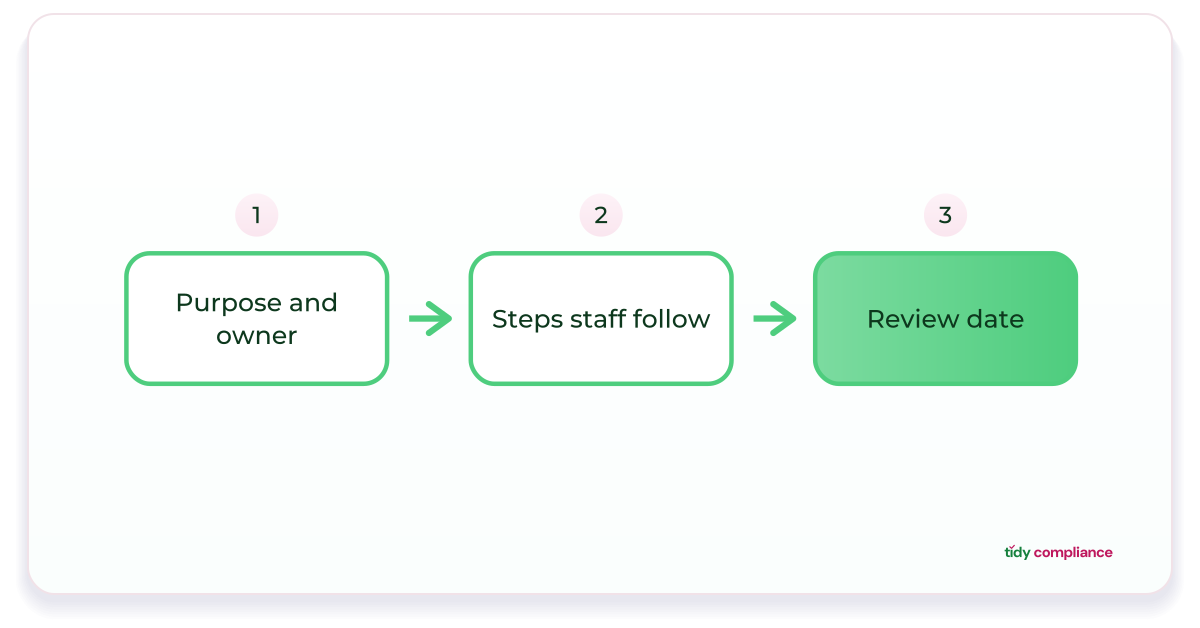
Long policies are rarely followed. I aim for two pages per policy, written for the person who applies it, with a purpose line, the steps, the owner and a review date. Anything longer moves into a procedure or checklist beside the policy.
Template packs are a fine start. The trouble begins when a template promises something your team does not do, such as a monthly access review that has never happened. A policy that describes work you do not perform is worse than no policy, because it proves you knew the standard and missed it. Delete the promises you will not keep, or start doing them.
- Do this: assign each policy an owner, a version number and a review date, and keep every approved version.
- Avoid this: copying a template word for word or letting policies sit untouched for years.
4. Train by Role, Not by Calendar Date
A yearly slide deck for all staff produces a signed attendance sheet and little else. Short modules by job work better. Front desk staff need to verify identity and handle record requests. Clinicians need to share information safely. Billing staff need documentation rules. Managers need to know what to report and when.
Track completion and read the quiz results. When half the staff misses the same question, the lesson or the policy is unclear, and you have a free list of what to fix. Train new hires before they get system access, not three months later.
- Do this: build four or five role-based modules of ten to fifteen minutes and review the results every quarter.
- Avoid this: a single annual session with no test, no records and no link to what people actually do.
5. Oversee Vendors Like Part of Your Staff
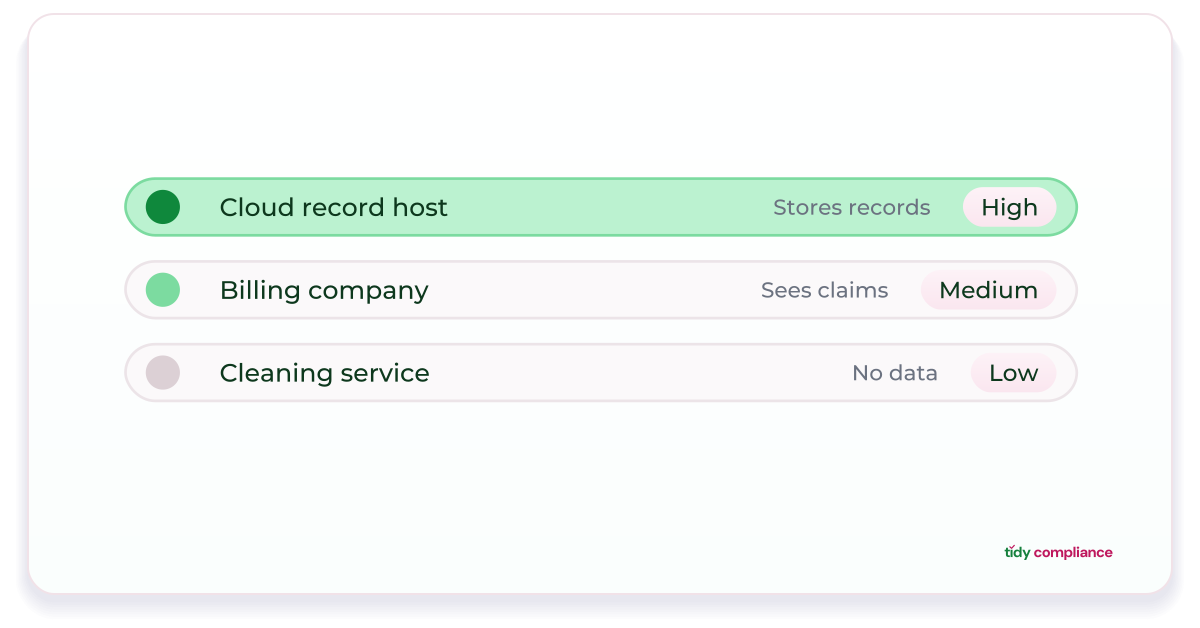
Billing companies, software providers, cloud services and transcription services handle your patients' information, and their mistakes become your problem. Keep one register that shows each vendor, what they handle, the agreement in place, the date of the last review and an owner on your side.
Review by risk. A vendor that stores records needs a deeper look than one that delivers office supplies. Ask for a recent security report or a completed questionnaire, read it and file the answer. When the list grows long, software can take over the tracking, and my comparison of healthcare compliance software shows what to expect.
- Do this: keep a vendor register with agreement dates, review dates and a named internal owner.
- Avoid this: trusting a logo or a badge in place of a review, or letting agreements expire unnoticed.
6. Control Access and Remove It Fast
Most everyday exposure comes from access that nobody reviewed. People change roles, leave the organization or share a login to save time. Give each role the minimum access it needs, use individual logins and remove access on the day someone leaves.
A quarterly access review takes an hour in a small organization. Print the user list for the main system, ask each manager to confirm every name and remove the rest. Keep the signed list. It is cheap, fast evidence that you manage access on purpose.
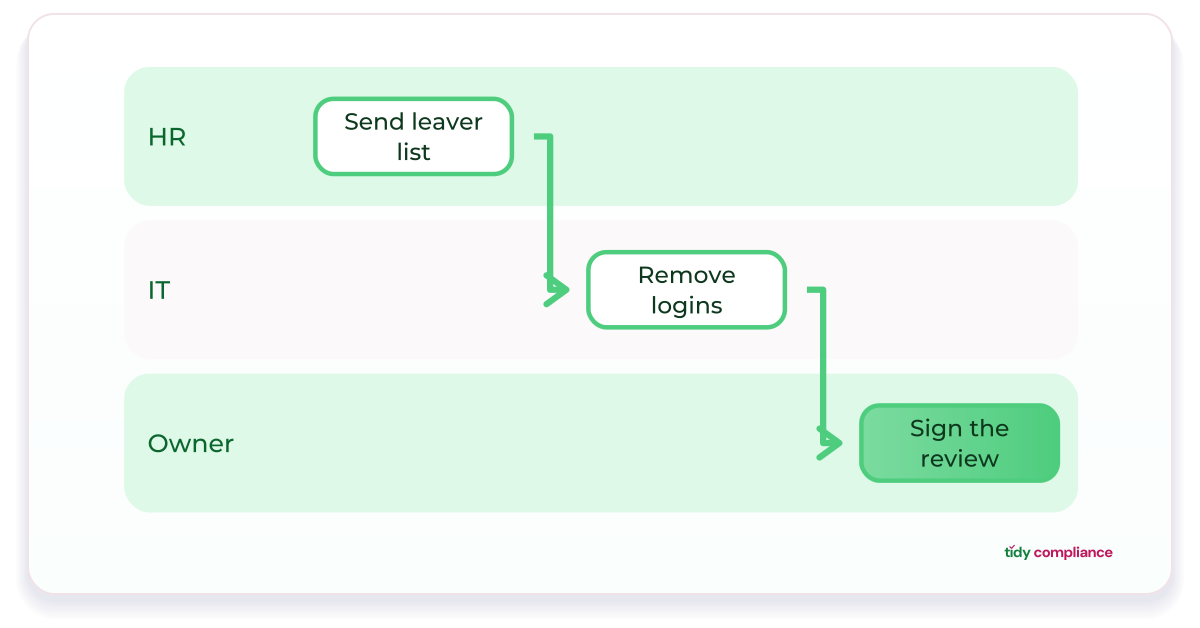
- Do this: link account removal to your HR exit checklist and review user lists each quarter.
- Avoid this: shared logins, standing access for former staff and broad rights granted just in case.
7. Monitor With Small, Repeatable Checks
You do not need a large audit to know how you are doing. Small checks run regularly tell you more. Read ten billing records each month, test five random user accounts, run a test of your incident reporting line and walk through the waiting area to see what is visible on screens and desks. Write down what you checked, what you found and what you changed.
Checks that happen only before an audit prove very little. Checks that happen every month show a reviewer that the program runs on its own. When you want a deeper look, a structured review comes next, and my healthcare compliance audit framework shows how to plan one.
- Do this: schedule a short monthly check with a log and one corrective action per finding.
- Avoid this: an annual panic review that finds forty problems at once and fixes none.
8. Keep Evidence and Learn From Incidents
A control you cannot show is a control a reviewer treats as missing. Keep one evidence folder organized by requirement, with signed policies, training records, risk analyses, vendor files and check logs. File documents when they are created, not the week before a review.
Treat every incident as a source of improvement. Respond by your written procedure, then ask what allowed it and change the process, the training or the system. Record the whole chain in one file. The starting inventory for all of this is in my healthcare compliance checklist. Ask your counsel which events need formal notification, because that is a legal question that depends on the facts.
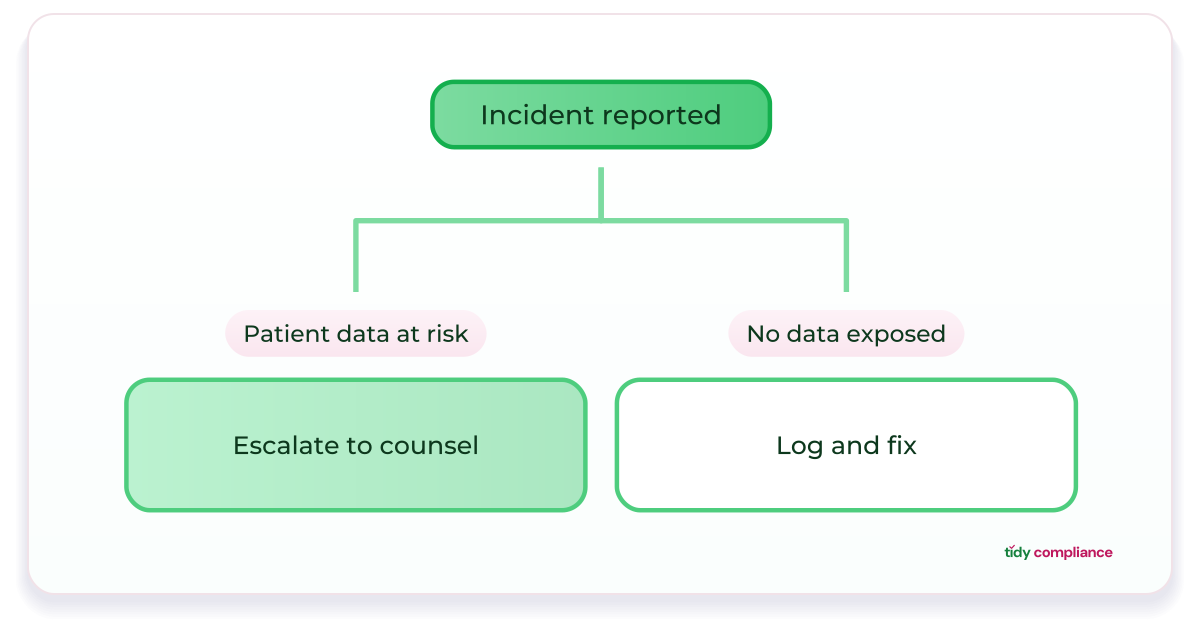
- Do this: use one folder structure for evidence and an incident file that records cause and fix.
- Avoid this: collecting proof in a rush before a review, or blaming the person who reported a mistake.
A Sensible Order for Rolling Them Out
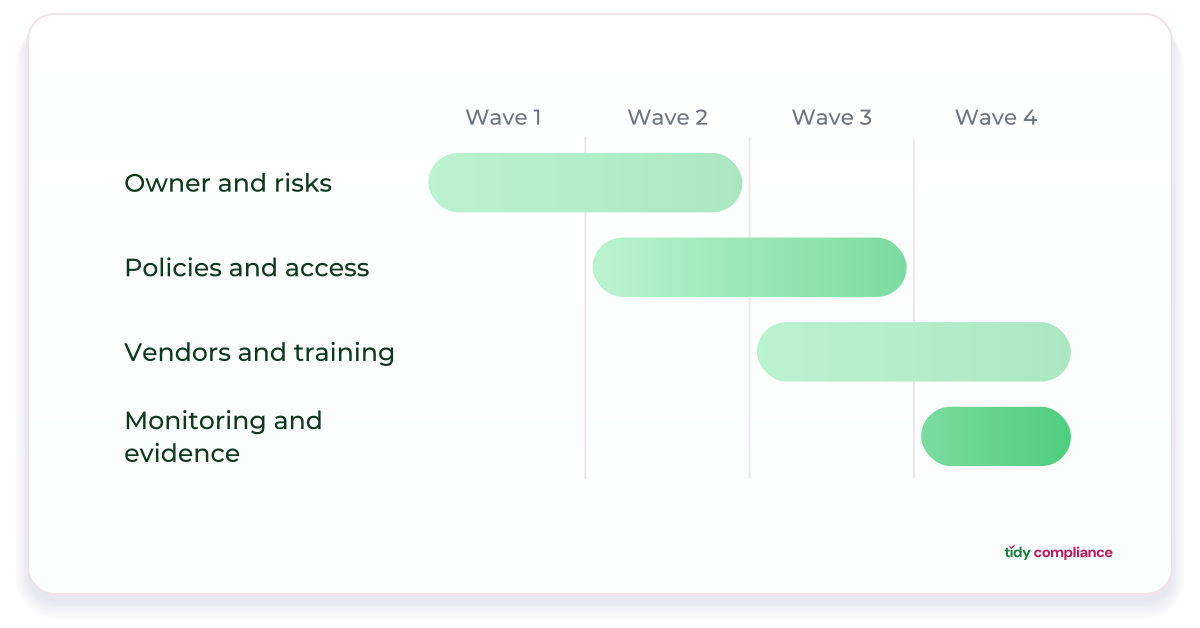
You do not need all eight at once. In my client work, the order that holds up best starts with ownership and the risk analysis, moves to policies and access, adds vendors and training and finishes with monitoring and the evidence routine. Each wave takes four to eight weeks in a small organization.
| Wave | Practices | Outcome you can show |
|---|---|---|
| Wave 1 | Owner and risk analysis | Role description and ranked risk list |
| Wave 2 | Policies and access control | Approved policies and a signed user review |
| Wave 3 | Vendors and training | Vendor register and completion records |
| Wave 4 | Monitoring and evidence | Monthly check logs and an organized folder |
Expect delays. Vendors are slow to return questionnaires and staff are slow to finish training, so build slack into wave three. Small wins show progress, and a ranked list shows leadership why the next wave needs time.
How to Know Whether You Need Outside Help
Plenty of organizations do this alone. Consider support if two or more of these apply:
- Nobody can say who owns compliance today.
- Policies are more than two years old or describe work you no longer do.
- You cannot produce a vendor list with agreements within an hour.
- A review, payer audit or customer questionnaire is coming.
- You added locations, services or systems since the last risk analysis.
Questions About Healthcare Compliance Best Practices
What Are the Most Important Healthcare Compliance Best Practices?
Name one owner, run a documented risk analysis, keep short policies that match daily work, train by role, review vendors and keep evidence in one place. Those six habits cover most of what reviewers ask about, and they make the other practices easier to run.
How Often Should a Healthcare Organization Review Its Compliance Program?
Review the full program at least once a year and whenever something major changes, such as a new service, location, billing company or software system. Small checks, like exclusion screening and access reviews, belong on a monthly or quarterly calendar.
Do Small Practices Need the Same Practices as Large Systems?
The practices are the same and the size of the work is different. A small practice can use a two-page policy, a part-time compliance lead and a shared folder. A health system needs committees, several owners and software for tracking. The logic of owner, risk, policy, training, monitoring and correction stays identical.
How Long Should I Keep Compliance Records?
It depends on the rule. Some federal requirements ask for six years, while state law and payer contracts set their own periods for medical and billing records. Write one retention schedule, have your counsel confirm it and apply it to every document type.
What Is the Difference Between a Compliance Policy and a Procedure?
A policy states the rule and who owns it. A procedure gives the steps a person follows to meet that rule. Keep the policy to a page or two and put the detailed steps in a procedure or checklist next to it, so staff can use the steps without reading the whole policy.
Should I Buy Compliance Software Before I Fix My Processes?
Fix a few processes first. Software works best when it holds a process you already run, such as vendor reviews or training tracking. If you buy first, you often configure a tool around habits that you have not yet decided on. Compare options before you commit.
When Should I Hire a Compliance Consultant?
Hire help when nobody owns compliance, when a review or payer audit is close, when you have grown or changed systems, or when your documents no longer match practice. A consultant gives you a method and a head start. Legal interpretation still belongs with a licensed attorney.
Sources
Disclaimer: This article is for general information only and isn’t legal, financial or tax advice. Treat figures as estimates from typical work and confirm details with your providers before you act.
Was this guide helpful?
Thanks for your feedback.
Odessa Whitfield
Odessa leads the Tidy editorial team and works with the compliance consultants to turn real client projects into practical guides on regulations, frameworks, policies and audit preparation. Before joining Tidy, she worked in compliance and risk roles, writing and maintaining policy sets for regulated organizations. Every article goes through a consultant who has done the work in practice, and she updates guides when a rule, framework or tool changes. She works remotely from the United States.