Quick Summary
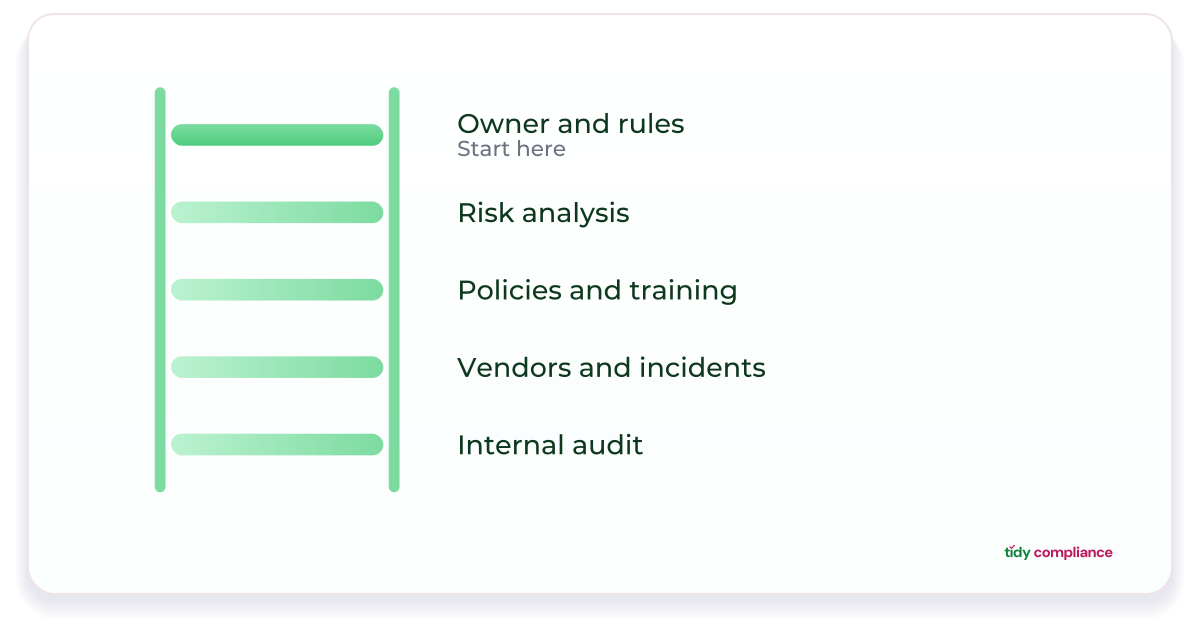
- Ten items form the foundation: owner, rules, risk analysis, policies, training, vendors, screening, incidents, evidence and audit.
- Work through them in order, because the first three decide what the other seven must cover.
- Each item leaves a document you can show, which is what reviewers ask for first.
- Scale the depth to your size, but do not skip an item.
Before you write a single policy, check that the foundation exists. I use the same ten items when I start a project with healthcare compliance consulting clients, and the gaps are usually in the first three. Teams that skip them end up writing policies that do not match their risk.
The list below is general guidance, not legal advice. It is a starting point for any clinic, pharmacy or healthcare service business, and your specific rules may add items.
The Ten Items at a Glance
| Item | What you end up with |
|---|---|
| 1. Name Your Compliance Owner | Authority and a reporting line |
| 2. List the Rules That Apply to You | Applicable rules written down |
| 3. Run a Risk Analysis | Documented risks with owners |
| 4. Write Policies People Can Follow | Policies in force |
| 5. Train Every Role, and Record It | Role-based training records |
| 6. Build a Vendor and Agreement Register | Vendor register and agreements |
| 7. Check Exclusion Lists | Monthly screening logs |
| 8. Set Up Incident Reporting and Response | Incident file per event |
| 9. Document the Evidence as You Go | Evidence organized by requirement |
| 10. Schedule an Internal Audit | Audit with a follow-up log |
The Checklist in Detail
Each item has a short explanation and a set of steps. Tick them off as you go, and save the result in your evidence folder.
Name Your Compliance Owner
Start with a person, not a document. Without a named owner, every later item on this list stalls, because nobody can approve a policy, assign a task or report a problem. In a small practice the owner can be the practice manager with a few hours set aside each week. In a larger organization it is a full-time officer with a deputy.
What to Check
- Write a one-page role description with decision rights and a reporting line.
- Name a backup for leave and turnover.
- Confirm the owner has a direct line to the person who controls budget.
- Tell all staff who the owner is and how to reach them.
The owner is the contact your staff and your consultant use for everything else, and the item I check first in every compliance management review.
List the Rules That Apply to You
Most organizations carry rules they have never written down. Privacy and security of patient information, billing and coding, exclusion screening, state licensing, accreditation standards and payer contract terms all count. List them once, with the service line each one affects.
How to Set It Up
- Write down every service you provide and every location.
- Match each service to the rules and contract terms that govern it.
- Mark which items need a legal opinion and ask your counsel.
- Save the list as the base document for your policies.
This list is also the scope of your gap assessment. If it is wrong, everything built on it is off.
Run a Risk Analysis
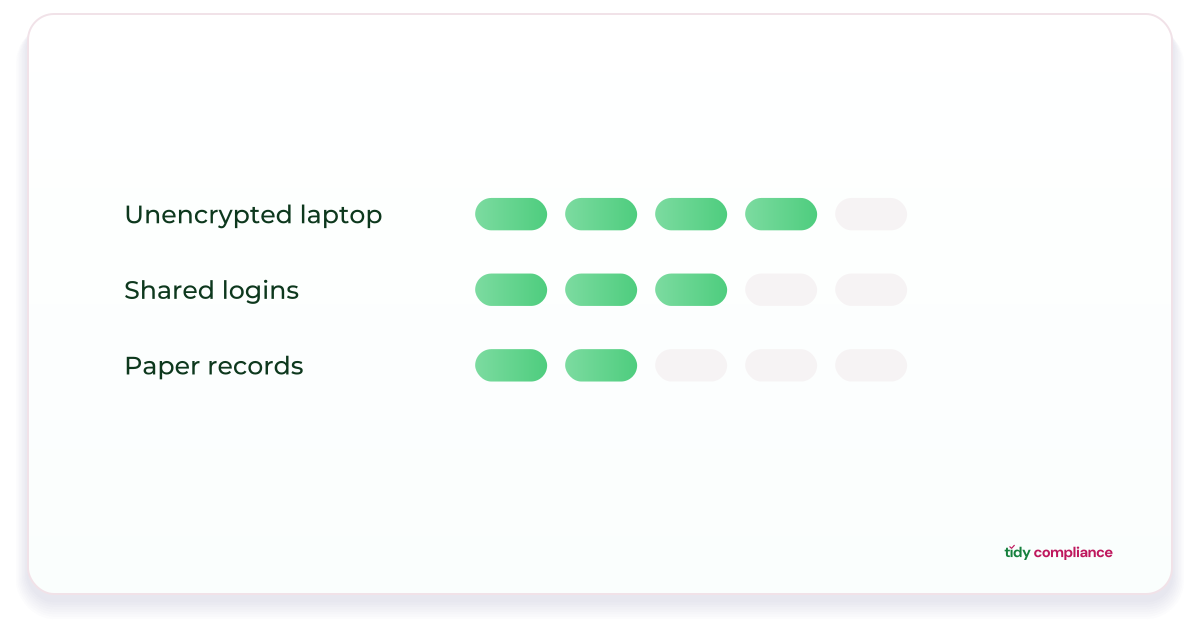
A risk analysis lists what could go wrong with patient information and operations, how likely it is and what you would do about it. It is a core document for privacy and security programs, and many reviewers ask for it first. A single pass can take a small practice a few days of focused work.
Steps to Follow
- Inventory the systems, devices and locations where patient information lives.
- List threats, such as lost devices, misdirected messages and unauthorized access.
- Score each risk by likelihood and impact.
- Assign a treatment, an owner and a date to every high risk.
- Record the date and repeat the analysis each year and after major changes.
Keep the output in a risk register you can sort by score and review monthly.
Write Policies People Can Follow
Short policies get followed, and long ones get filed. Aim for two pages with a clear purpose, the steps, the owner and a review date. Cover the basics first: privacy, security, breach response, record requests, billing, exclusion screening and vendor management.
What to Write
- Use the language of the person who does the job.
- Put the owner and review date at the top.
- Store approved versions in one folder and archive old ones.
- Remove any policy that describes a process you no longer run.
If you need a larger list of habits behind good policies, see these healthcare compliance best practices.
Train Every Role, and Record It
Training works when it matches the job. Front desk staff need different content than clinicians, billing staff or managers. Deliver it at hire and at least yearly, and keep a record of who completed what and when.
What to Include
- Build short modules per role instead of one generic deck.
- Add a quiz and review the missed questions.
- Set a completion deadline for new hires.
- Keep completion records with dates for every person.
When a quiz question is missed by many people, the policy it teaches is probably unclear.
Build a Vendor and Agreement Register
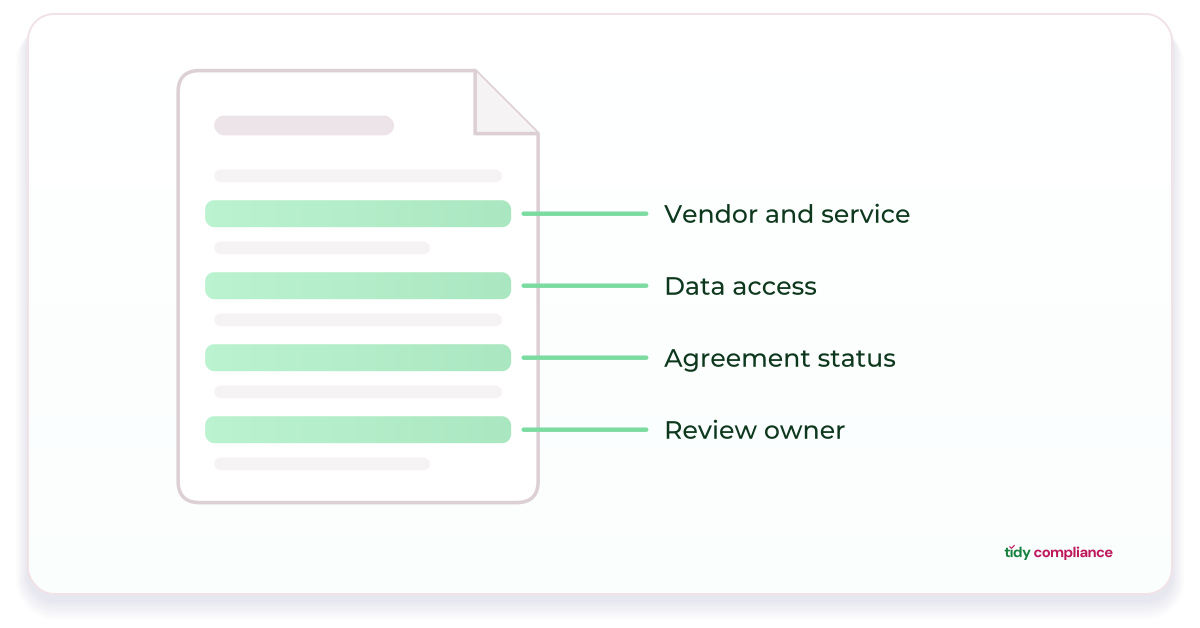
Every vendor that touches patient information or your billing is an extension of your organization. Keep a register with the vendor name, what they handle, the agreement in place, the last review date and your internal owner. Review vendors by risk, deeper for those who store or process records.
What to Record
- List every vendor with access to patient information.
- Confirm each has a signed agreement and check its terms.
- Ask for a recent security report or questionnaire from high-risk vendors.
- Set a review date for each vendor.
A register that exists on day one makes every later review shorter.
Check Exclusion Lists
Employing or contracting with an excluded individual or entity can create serious problems for programs funded by federal health care programs. The OIG publishes the exclusion database, and its complete file is replaced every month. Screening staff and vendors at hire and on a regular schedule is a standard control.
Screening Steps
- Screen all new hires and contractors before they start.
- Re-check current staff and vendors on a monthly schedule.
- Record the date and result of each check.
- Define in writing what happens when a match appears.
Ask your adviser which lists apply to you, including state lists, because they differ by program.
Set Up Incident Reporting and Response
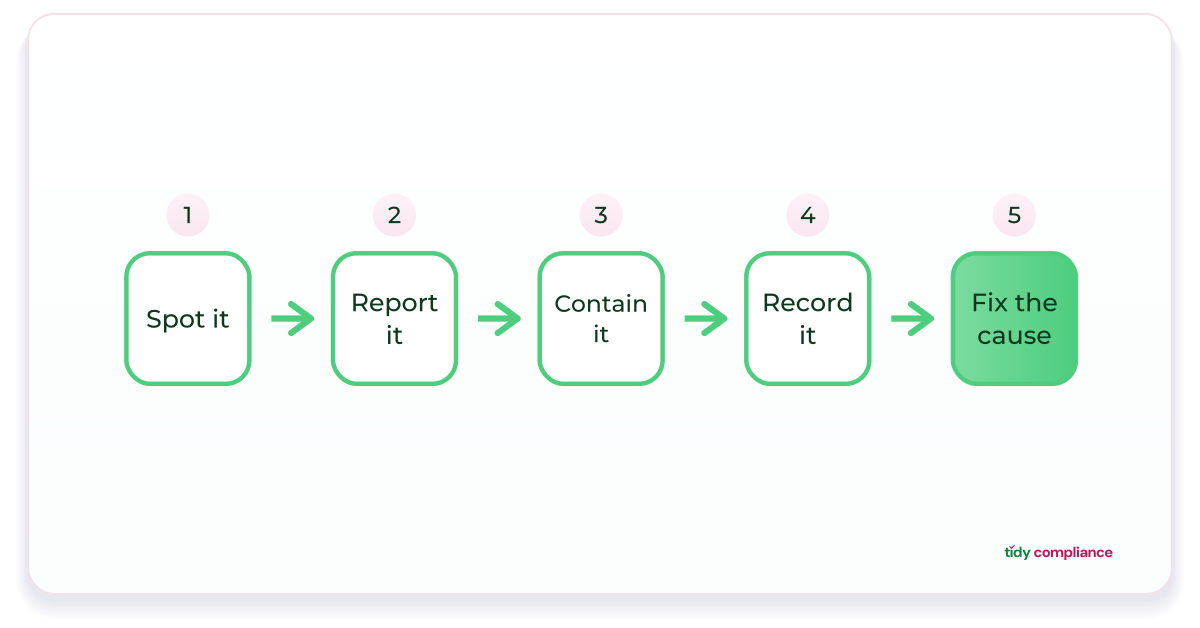
Staff need a clear way to report a problem and a plan for what happens next. A good procedure says who to tell, what to record, who investigates and how the root cause is fixed. Many incidents are small, and the pattern across them is where the real risk shows.
What to Define
- Create a single reporting channel and make it known.
- Define what counts as an incident and give examples.
- Write response steps with names, not only roles.
- Keep one file per incident with cause and fix.
Ask your legal counsel which events require formal notification, since that is a legal determination.
Document the Evidence as You Go
Evidence is the proof that your program exists. Signed policies, training records, risk analyses, vendor reviews, incident files and meeting notes all count. Store them in a folder structure organized by requirement, so an auditor's request becomes a handover.
What to Keep
- Create one folder per requirement or policy area.
- Save the document and the date it was approved.
- Capture screenshots or exports for technical controls.
- Review the folder quarterly for gaps.
Software can help with this once the volume grows, as I show in the ranking of healthcare compliance software.
Schedule an Internal Audit
The last item closes the loop. Plan a review at least once a year, with an independent person, a written scope and a follow-up log. Start small: one area, one quarter, one sample. The first pass teaches you how your records behave and builds the habit.
How to Start
- Pick one high-risk area and a period to review.
- Write the criteria and tests before you look.
- Sample real records and interview staff.
- Rate findings and assign owners and dates.
- Verify that each fix works.
The steps are covered in my healthcare compliance audit framework.
What Reviewers Ask For First
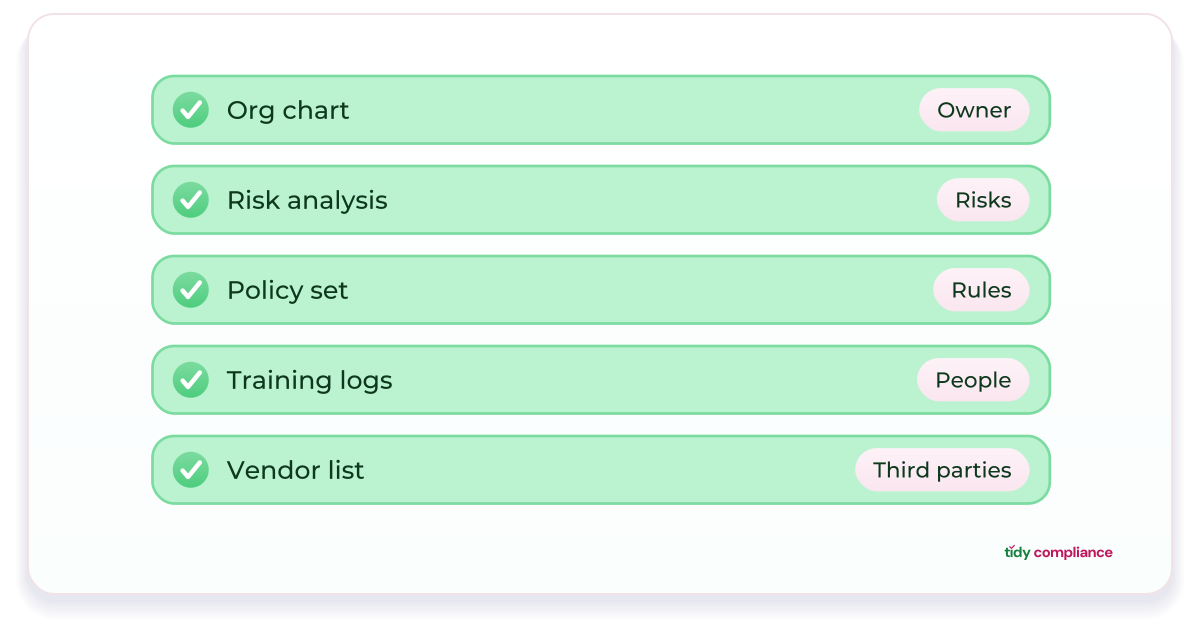
When a reviewer announces a visit, the first request list is surprisingly predictable. It nearly always includes the policies in force, the latest risk analysis, training records, the vendor list with agreements and incident logs. Items 3, 4, 5, 6 and 8 on this list produce exactly those documents.
If time is short, start there, then work backward to the owner and the rule list so the documents have a clear home. Do not backdate anything. Date every document with the day it was actually approved, because a reviewer who finds a backdated policy loses trust in everything else you show.
How to Know You Are Ready to Move On
You are ready for the next phase, writing policies at scale or booking an audit, when you can answer yes to each of these:
- I can name the person who owns compliance and their backup.
- I can hand over the list of applicable rules and the latest risk analysis.
- I can show current policies, training records and a vendor register.
- I can show the exclusion checks and an incident file.
- I know when the next internal audit takes place.
If more than two answers are no, a gap assessment is the fastest way to turn this list into a plan with dates.
Questions About the Healthcare Compliance Checklist
What Should a Healthcare Compliance Program Include?
At minimum: a named owner, a list of the rules that apply to you, a risk analysis, current policies, role-based training, vendor oversight, exclusion screening, incident reporting, organized evidence and a regular internal audit. Larger organizations add a committee and formal reporting to a board.
In What Order Should I Do These Ten Items?
Follow the list from the top. The owner, the rule list and the risk analysis decide what policies, training and vendor reviews you need. If a review is coming within weeks, start with the risk analysis, the vendor register and the evidence folder, since reviewers ask for those first.
How Long Does It Take to Work Through the Checklist?
It depends on your size and starting point. A small practice with some documents can cover the first items in a few weeks. A larger organization with several locations needs longer and usually benefits from a phased plan with owners for each item.
Is This Checklist Enough for a Regulatory Review?
It is a starting point. A review applies the specific rules and standards of the reviewing body, which may require more than this list. Use the checklist to build the foundation, then run a gap assessment against the exact requirements that apply to you.
Do Small Practices Need All Ten Items?
Yes, in a smaller form. A two-page risk analysis and a short vendor list still count. Scale the depth to your size, but do not skip an item, because each one closes a different kind of gap.
Can I Use a Template for Each Item?
Templates are a good starting point, and they must be adapted. A policy that describes a process you do not follow is worse than no policy, because it proves the gap. Edit every template until it matches your practice.
When Should I Ask a Lawyer?
When an item needs a legal interpretation, such as notification duties after an incident, a possible violation or a contract clause. A checklist organizes work, and an attorney gives legal advice.
Sources
Disclaimer: This article is for general information only and isn’t legal, financial or tax advice. Treat figures as estimates from typical work and confirm details with your providers before you act.
Was this guide helpful?
Thanks for your feedback.
Odessa Whitfield
Odessa leads the Tidy editorial team and works with the compliance consultants to turn real client projects into practical guides on regulations, frameworks, policies and audit preparation. Before joining Tidy, she worked in compliance and risk roles, writing and maintaining policy sets for regulated organizations. Every article goes through a consultant who has done the work in practice, and she updates guides when a rule, framework or tool changes. She works remotely from the United States.