Quick Summary
- Compliance management is a recurring cycle of ownership, policies, training, monitoring and correction, not a one-time project.
- One named owner and a monthly meeting do more for a small practice than a thick binder.
- A yearly calendar turns vague duties into dated tasks that someone is accountable for.
- A one-page report to leadership keeps the program funded and visible.
Most healthcare organizations I meet have policies. Far fewer have a program that keeps those policies alive. The documents were written for a review three years ago, the person who wrote them left and nobody knows who approves a new vendor. This is where healthcare compliance consulting usually starts, and where good management saves the most trouble.
Below is the structure I use to help clients run compliance well: an owner, a rhythm, a way to watch the risks and a way to report. The advice is general and is not legal advice. Check your own obligations with a qualified adviser.
The Shape of a Working Program
The HHS Office of Inspector General published general compliance program guidance in November 2023 that describes seven elements of an effective program. Reading it is worth an afternoon. The elements cover written policies and procedures, compliance leadership and oversight, training and education, open lines of communication, enforcing standards, risk assessment with auditing and monitoring, and responding to problems with corrective action.
I translate those elements into five operating habits, so a busy manager can see what to do on Monday. The table shows how they connect.
| Operating habit | What you do | How often | Evidence it leaves |
|---|---|---|---|
| Own it | Name a lead, give them authority and a reporting line | Set once, review yearly | Role description and org chart |
| Write it | Keep policies short, current and assigned to owners | Annual review, update on change | Dated policy versions |
| Train it | Onboard new staff and refresh by role | At hire and yearly | Completion records |
| Watch it | Check vendors, access, billing samples and exclusions | Monthly and quarterly | Check logs and findings |
| Fix it | Investigate incidents and close root causes | As they happen | Incident file with actions |
Give Compliance an Owner With Real Authority
Programs without an owner decay. In a 12-person practice the owner might be the practice manager at four hours a week. In a hospital group it is a full-time officer with a team. What matters is the same in both: the person can ask any department a question and gets an answer, and has a direct line to the person who can say yes to a budget.
Write the role down in one page. Say what the person decides, what they escalate and how often they report. I also ask clients to name a backup, because the program stops when the owner is on leave. If you want to see what a good starting inventory looks like, the healthcare compliance checklist lists the items an owner takes on first.
Run the Year on a Calendar
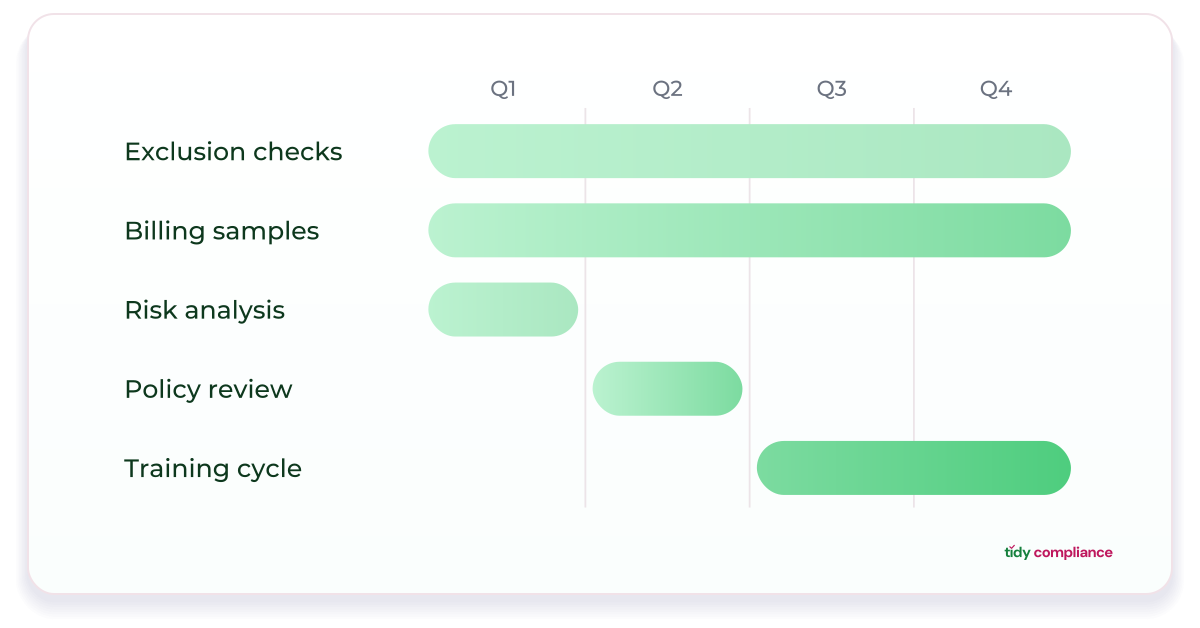
A calendar is the cheapest management tool there is. Put every recurring duty on it with a date and a name: the annual risk analysis, policy reviews, training refreshers, vendor reviews, mock audits and the leadership report. When a duty has no date, it slips quietly until a review finds it.
| Rhythm | Typical tasks |
|---|---|
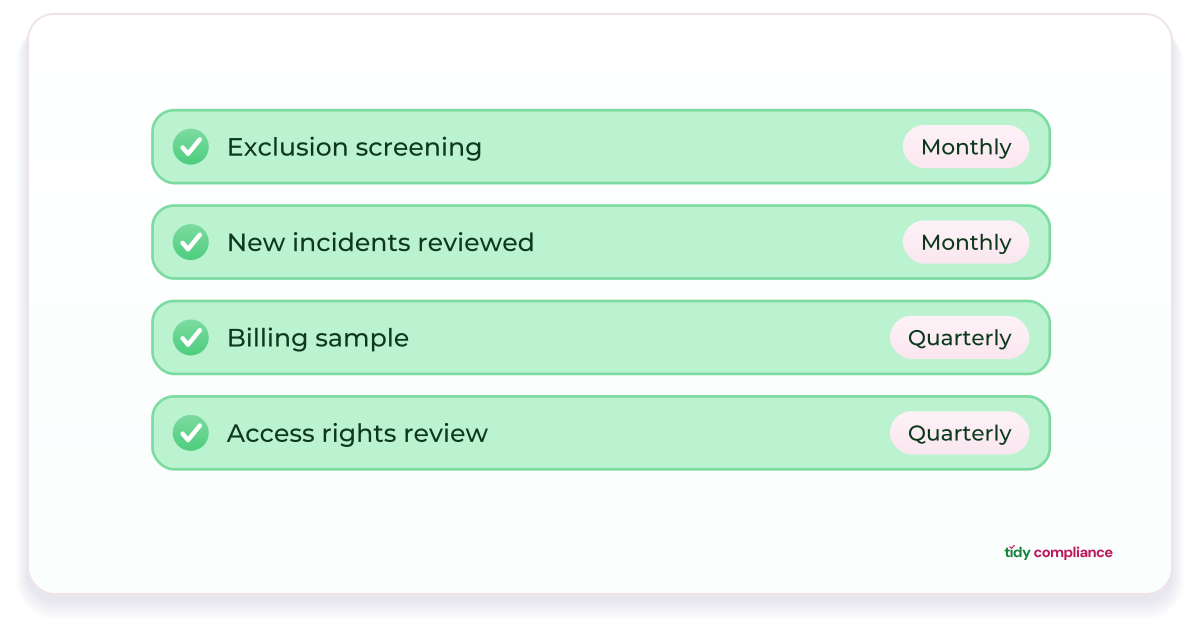
| Monthly | Check exclusion lists for staff and vendors, review new incidents, update the open-items list, short compliance meeting |
| Quarterly | Sample billing and documentation, review access rights, report to leadership, review vendor changes |
| Yearly | Risk analysis, policy review, training cycle, vendor re-assessment, mock audit |
| On change | New service, system, location or vendor: update policies, risk analysis and training before go-live |
The federal exclusion database is a good example of a calendar item. The OIG replaces its complete exclusion file every month, so a monthly check of staff and vendors against the current list is easy to schedule and easy to prove. Confirm the checking duties that apply to you with your adviser.
Keep Policies Short and Alive
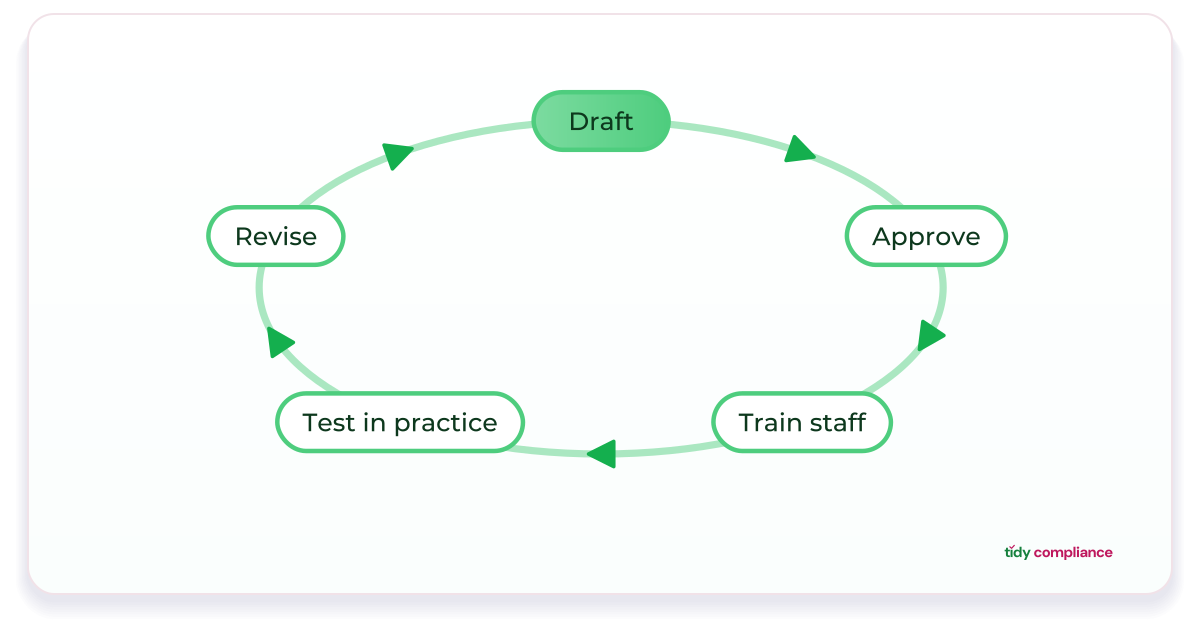
Long policies are rarely followed. I aim for two pages per policy, written for the person who follows it, with a one-line purpose, the steps, the owner and the review date. When a policy needs more detail, put it in a procedure or a checklist that sits next to it.
Version control matters more than people expect. When a reviewer asks for the policy in force on a given date, you should be able to hand it over in minutes. Store every approved version, archive the old ones and record who approved each change. For a deeper list of habits that keep this clean, see my article on healthcare compliance best practices.
Manage Vendors Like Part of Your Own Staff
Billing companies, software providers, cloud services and transcription services all handle your patients' information, and their mistakes become your problem. Keep one register with every vendor, what they handle, the agreement in place, the date of the last review and an owner on your side.
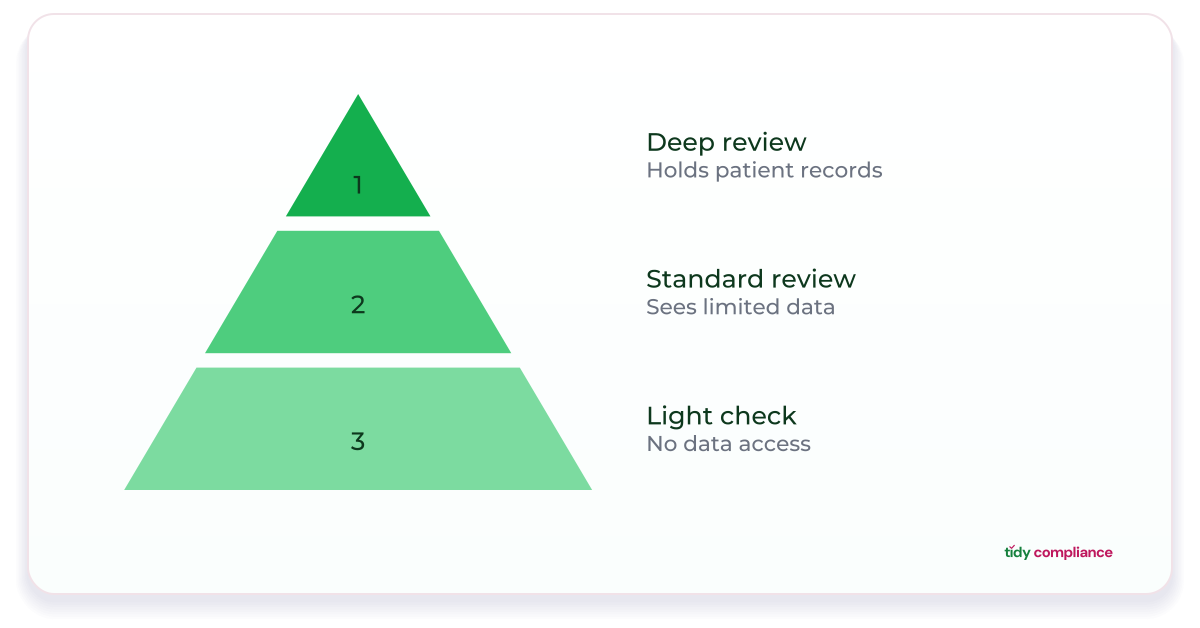
Review by risk. A vendor that stores records needs a deeper review than a vendor that delivers office supplies. Ask for a recent security report or completed questionnaire and read it, and keep the answer. If you manage many vendors, software can take over the tracking, and my ranking of healthcare compliance software compares options for that job.
Train by Role, Not by Calendar
A yearly all-staff slide deck produces a signed attendance sheet and little else. Short modules by role work better: front desk staff learn how to verify identity and handle record requests, clinicians learn how to share information safely, billing staff learn documentation rules and managers learn how to report and escalate.
Track completion, and review the quiz results. When a question is missed by half the staff, the lesson is unclear or the policy is. Either way, you have a free list of what to fix.
Monitor With Small, Repeatable Checks
You do not need a huge audit to know how you are doing. Small checks run regularly tell you more: ten billing records read each month, access rights for five random users, a test of the incident reporting line, a walk through the waiting area to see what is on screens and desks. Keep a simple log of what you checked, what you found and what you did about it.
When you want a deeper look, a structured review is the next step. My healthcare compliance audit framework shows how to plan one.
Budget the Program Like Any Other Operating Cost
Compliance gets funded when its cost and its payoff are visible. List the lines once: owner time, training content, tools, vendor reviews, outside advice and the annual audit. Then list what a failure costs: staff time during a review, repayment, rework and lost trust with patients and payers.
You do not need precise numbers to start. A rough yearly figure per line, reviewed each budget cycle, is enough to avoid the most common problem, which is a program that depends on goodwill. When the budget line exists, the owner can plan the calendar with confidence.
| Budget line | What it pays for | Who decides |
|---|---|---|
| Owner time | Hours of the compliance lead and backup | Practice owner or administrator |
| Training | Content, platform and staff time | Compliance owner with HR |
| Tools | Policy, vendor and evidence tracking | Compliance owner with IT |
| Outside help | Audits, gap assessments and legal advice | Leadership |
Report in One Page
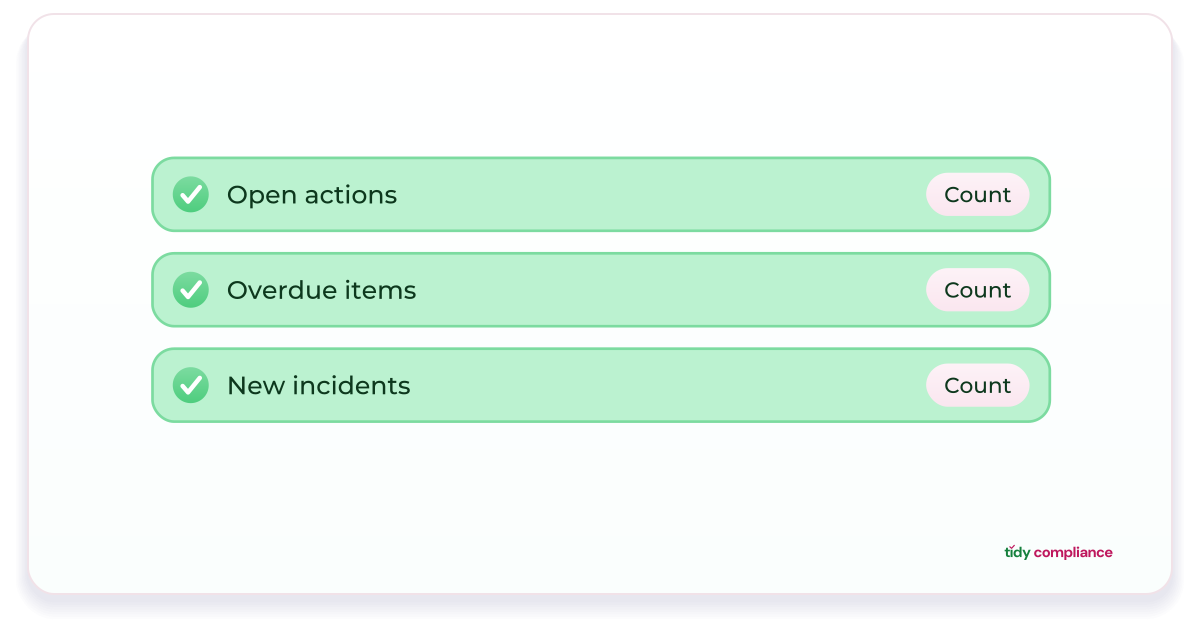
Leadership attention is the scarcest resource in the program. A one-page report keeps it. I use the same five blocks every time: open gaps by risk level, overdue items, incidents and what caused them, vendor reviews due and the status of any external review. Add one sentence on what you need from leadership.
Do not hide bad news. A report that shows a rising count of overdue items prompts a budget conversation early, when it is cheap. A report that only shows green lights loses credibility the first time something goes wrong.
Handle Incidents as a Source of Improvement
Every incident, from a misdirected fax to a lost laptop, has two outputs: the immediate response and the lasting fix. Handle the response by your written procedure. Then ask what let it happen and change the process, the training or the system accordingly.
Record the whole chain in one file: what happened, who was told, what was done, the cause and the change you made. If a review later asks about a particular incident, the file tells the story. Ask your counsel which events need formal notifications, because that is a legal question and the answer depends on the facts.
The Part No Tool Can Do: Culture
Programs live or die on whether staff report problems. If the first person who admits a mistake gets blamed, reports stop and risk goes underground. I advise leaders to say out loud that an honest report is welcome, and then to prove it the first time someone comes forward.
Small signals matter. Thank the person, fix the cause and share the lesson without names. Over a year, this turns reporting from a risk into a habit, and gives your owner the early warning that no software can supply.
How to Decide Whether You Need Outside Help
You can run a lot of this yourself. Consider outside support if you recognize two or more of these signs:
- Nobody can say who owns compliance today.
- Policies are more than two years old or no longer match practice.
- You cannot produce a vendor list with agreements in under an hour.
- A review, payer audit or customer questionnaire is coming.
- You have grown, added locations or changed systems since the last risk analysis.
Questions About Healthcare Compliance Management
What Is Healthcare Compliance Management?
It is the ongoing work of keeping your organization in line with the rules that apply to it: assigning ownership, writing and updating policies, training staff, monitoring activity, investigating problems and fixing causes. It is a continuous program, not a project that ends when a binder is finished.
Who Should Own Compliance in a Small Practice?
One named person, even if the role is part-time. The person needs authority to ask questions across the practice and a direct line to the owner or board. Splitting the role among several people with no lead is the most common reason small programs drift.
Do I Need a Compliance Committee?
Larger organizations usually benefit from one, because it brings clinical, billing, IT and HR views together. A small practice can replace it with a short monthly meeting of the compliance lead and two or three department heads. The point is a regular place where issues get decided and recorded.
How Often Should I Review Policies?
At least once a year, and whenever your services, systems, vendors or the applicable rules change. Put the review date in the policy header and name the owner, so an overdue review is visible.
What Should I Report to Leadership?
A short, regular report with open gaps by risk level, overdue training, vendor reviews due, incidents and their causes and the status of any audit or payer review. Keep it to one page so people read it.
Is Software Required to Manage Compliance?
No, a small organization can run a program with shared folders and a tracker. Software helps once you have many policies, vendors or locations, or when evidence collection takes more time than the checks themselves. Compare options before buying.
When Should I Involve a Lawyer?
When you need an interpretation of a rule, face a possible violation, receive a government or payer letter, or consider a self-disclosure. A compliance program organizes the work. A licensed attorney gives legal advice.
Sources
Disclaimer: This article is for general information only and isn’t legal, financial or tax advice. Treat figures as estimates from typical work and confirm details with your providers before you act.
Was this guide helpful?
Thanks for your feedback.
Odessa Whitfield
Odessa leads the Tidy editorial team and works with the compliance consultants to turn real client projects into practical guides on regulations, frameworks, policies and audit preparation. Before joining Tidy, she worked in compliance and risk roles, writing and maintaining policy sets for regulated organizations. Every article goes through a consultant who has done the work in practice, and she updates guides when a rule, framework or tool changes. She works remotely from the United States.