Quick Summary
- Guided tools such as MedTrainer and Compliancy Group fit practices that need templates, training and agreements in one place.
- Automation platforms such as Vanta, Drata and Secureframe fit healthcare technology companies with cloud systems to monitor.
- Censinet is the specialist for vendor risk when you manage many third parties.
- Most vendors do not publish prices, so request written quotes that list users, modules and exclusions.
The Best Healthcare Compliance Software at a Glance
| Tool | Type | Best for |
|---|---|---|
| 1. MedTrainer | Training, credentialing and compliance platform | Healthcare groups that want training, policies and credentialing in one system |
| 2. Compliancy Group | HIPAA compliance software with advisory support | Small practices and business associates that want guided HIPAA compliance |
| 3. Vanta | Compliance automation platform | Healthcare technology companies that need continuous evidence collection |
| 4. Drata | Compliance automation platform | Growing technology and health companies with several frameworks to maintain |
| 5. Secureframe | Compliance automation platform | Teams that want automation plus guided onboarding for security and privacy frameworks |
| 6. Thoropass | Compliance platform with audit services | Companies that want the platform and the audit from one provider |
| 7. Hyperproof | Compliance operations platform | Organizations that run several frameworks and want one control library |
| 8. Censinet RiskOps | Healthcare third-party risk platform | Provider organizations that manage many vendors and products |
| 9. LogicGate | Governance, risk and compliance platform | Larger organizations that need configurable risk and compliance workflows |
| 10. NAVEX One | Integrated risk and compliance platform | Large organizations that want policy management, training and reporting lines from one vendor |
| 11. Sprinto | Compliance automation platform | Small and mid-sized technology companies adding HIPAA to an existing program |
The 11 Best Healthcare Compliance Software Tools, Ranked
I start with tools that suit healthcare providers directly and move toward platforms built for technology companies and large enterprises, so you can stop when you find your fit. Software is only one part of the result. In the healthcare compliance consulting work I see, the owner, the policies and the habits behind the tool decide whether it pays off.
MedTrainer
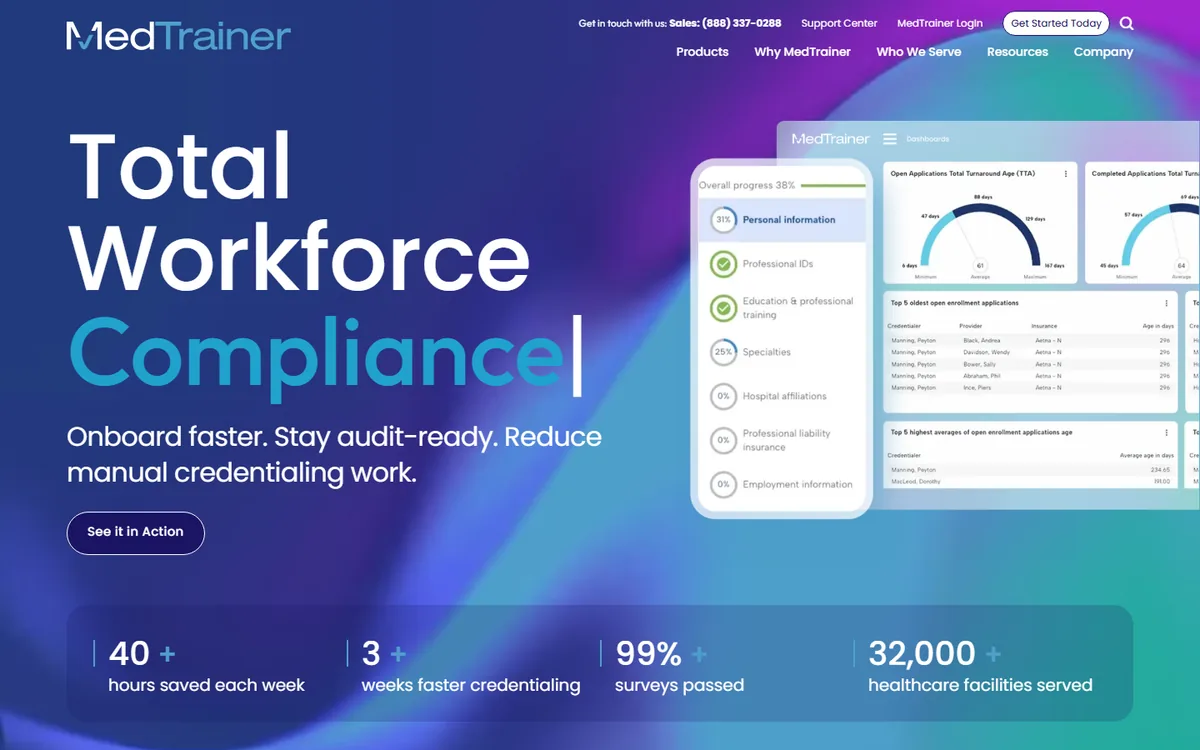
A Broad Healthcare Platform That Pairs Staff Training With Policy and Credentialing Work
MedTrainer combines learning management, provider credentialing and compliance tools built for healthcare organizations.
MedTrainer is the platform I look at first when a client wants training and documentation under one roof. Its three product lines cover learning (courses, onboarding paths, tracking and reporting), credentialing (exclusion monitoring, privileges, provider enrollment) and compliance (document and policy management, incident reporting, contract management and accreditation). For a multi-site group, one system replaces several spreadsheets and email chains.
What I like most is that the training library is built around healthcare roles, so you are not adapting generic content. The trade-off is breadth. If you only need a single function, such as policy storage, you will pay for modules you do not use, and the setup effort grows with the number of modules you switch on. Plan an implementation owner and a rollout by department, as in my healthcare compliance management routine.
What I Like About MedTrainer
- Training, credentialing and policy tools sit in one platform
- Content is written for healthcare roles
- Exclusion monitoring is part of the credentialing line
What I Don’t Like About MedTrainer
- Pricing is quote-based, so you cannot compare costs before a call
- Breadth means a longer setup than a single-purpose tool
MedTrainer Pricing
MedTrainer does not publish prices. It sells three plan tiers, Select, Premier and Signature, and quotes depend on the number of licensed users, the modules you need and the industry content. The vendor states that quotes take 24 to 48 hours.
MedTrainer Reviews
- G2: 4.4 out of 5 star rating (from 95 user reviews)
Compliancy Group
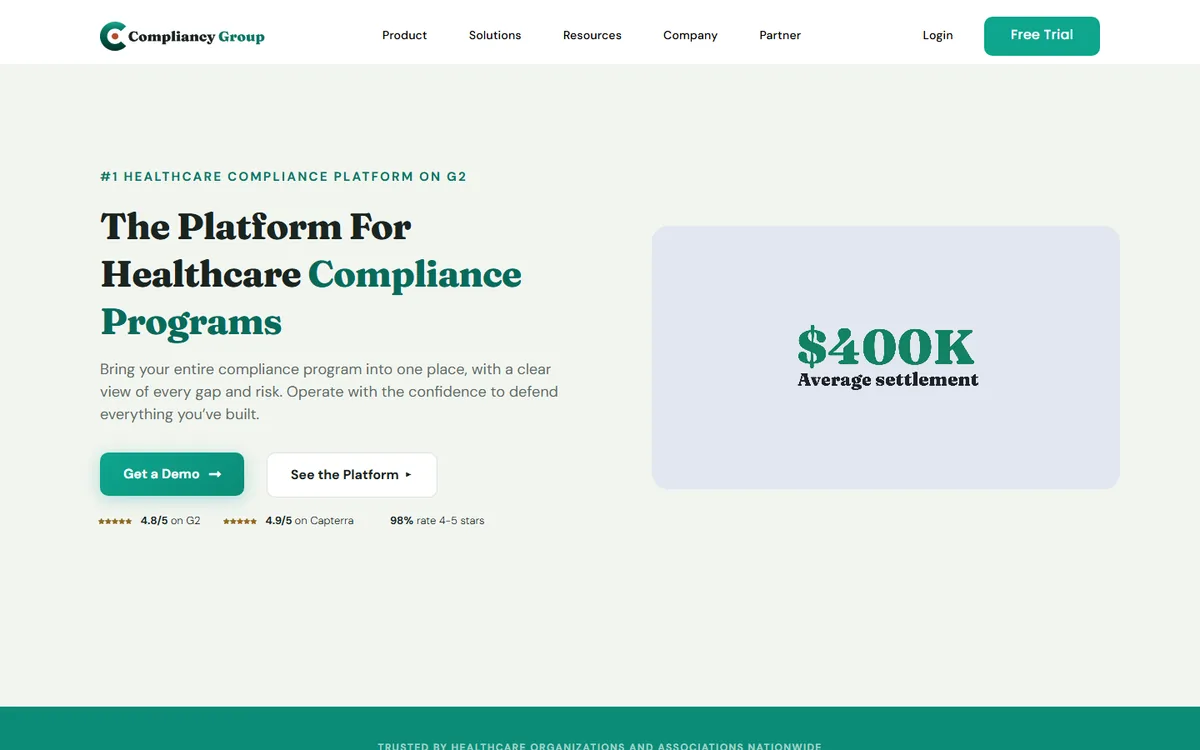
Guided HIPAA Compliance Software for Practices That Want Templates and Tracking in One Place
Compliancy Group sells The Guard, a platform that walks you through audits, policies, training and vendor agreements.
Compliancy Group is built around a simple idea: give a small organization the pieces of a HIPAA program in one place. The Guard includes security, administrative, technical, physical, privacy and device audits, policy and procedure templates, annual training with completion reports, storage for signed business associate agreements and tools for vendor due diligence. It also lists an exclusion list checker covering 55 lists, an AI compliance assistant called CORA and an Audit Manager+ tool.
I see it work best for practices that do not have a compliance team and need structure more than customization. The risk is the usual one with templates: if nobody adapts them, you end up with documents that do not match daily practice. Use the audits to find gaps, then edit each policy until it describes how you really work. The healthcare compliance checklist is a useful companion for that edit.
What I Like About Compliancy Group
- Audits, policies, training and agreements live in one tool
- Exclusion list checker covers 55 lists
- Aimed at small practices and business associates
What I Don’t Like About Compliancy Group
- Price available on request on the product page
- Template content needs real editing to fit your operations
Compliancy Group Pricing
Compliancy Group links to a pricing page from its product page but does not show price amounts there. The vendor describes The Guard as cost-effective, so ask for a quote that lists what is included.
Compliancy Group Reviews
I could not read a current G2 or Capterra rating for this product when I wrote this article, so I have left it out. Check the vendor’s review profiles before you decide.
Vanta
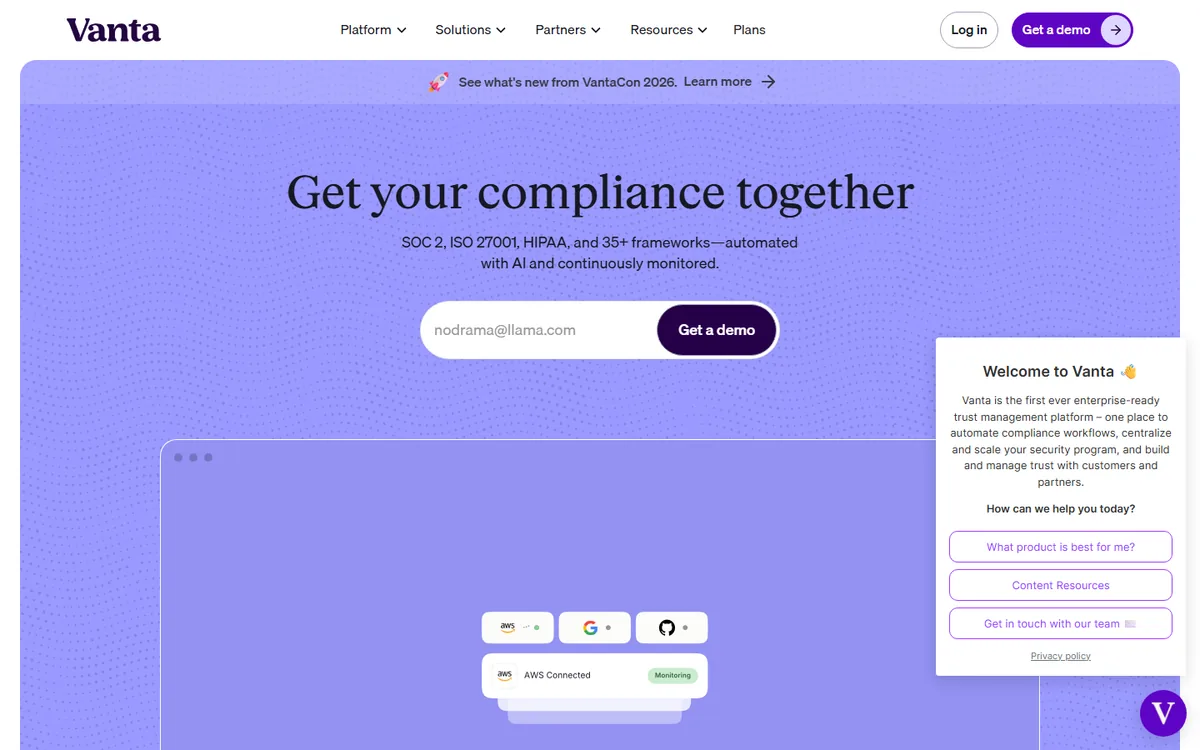
Continuous Evidence Collection for Healthcare Technology Companies That Answer Security Questionnaires
Vanta automates evidence collection across your cloud and business tools and maps it to frameworks including HIPAA.
Vanta connects to your cloud, identity, device and ticketing systems and checks controls continuously, then maps the results to frameworks. Its healthcare page describes automation for HIPAA and HITRUST. For a health technology company that sells to providers, it shortens the time you spend answering security questionnaires and building audit evidence.
It is less natural for a clinic or a practice without a technical stack, since much of its value comes from integrations with cloud and software tools. Expect a real implementation, because policies, access reviews and vendor lists still need owners. The platform records the work, and your team still does it. Compare how the evidence feeds an audit in my healthcare compliance audit framework.
What I Like About Vanta
- Continuous control checks across many integrations
- Healthcare and HIPAA content alongside other frameworks
- Large user base with many reviews
What I Don’t Like About Vanta
- Built for technical environments, so less natural for small clinics
- Pricing is quote-based and G2 reviewers rate the perceived cost at the highest tier
Vanta Pricing
Vanta lists four plans, Essentials, Plus, Professional and Enterprise, but publishes no prices and asks you to request a demo for a personalized quote. Confirm which plan includes HIPAA support before you sign.
Vanta Reviews
- G2: 4.5 out of 5 star rating (from 2,916 user reviews)
Drata
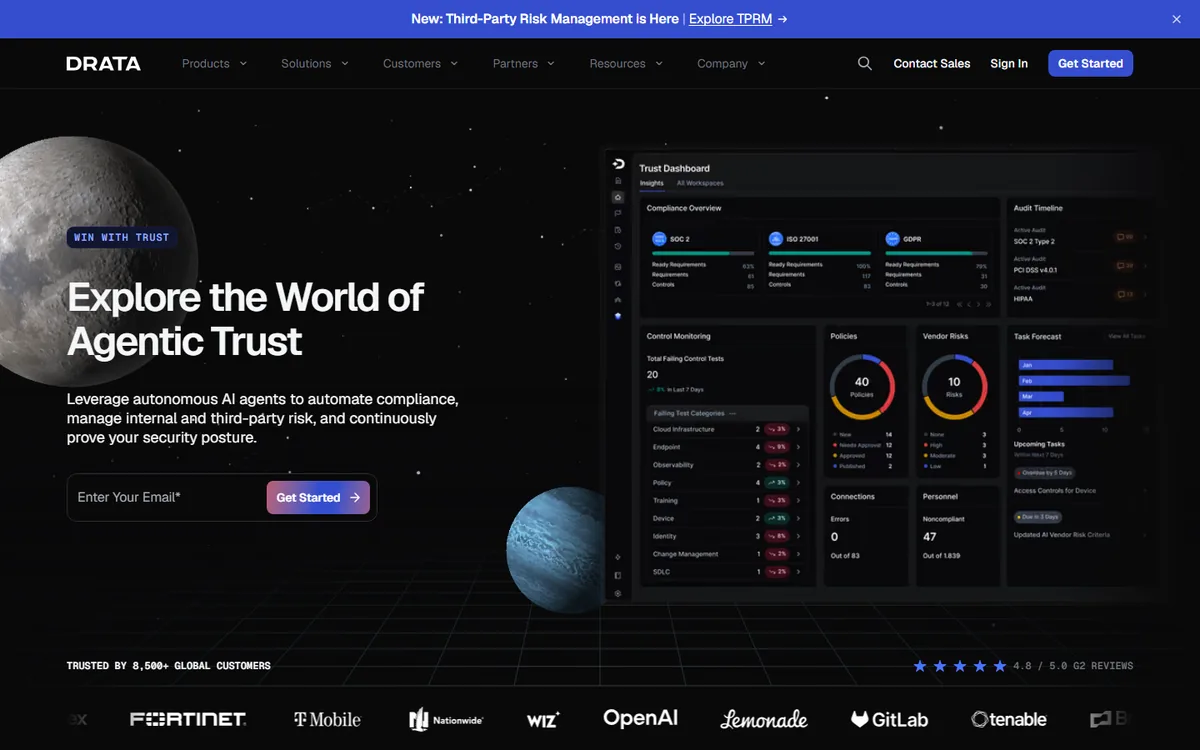
A Well-Reviewed Automation Platform for Teams Managing More Than One Framework
Drata automates control monitoring and evidence collection and supports a library of security and privacy frameworks.
Drata sits in the same category as Vanta: it connects to your systems, monitors controls and keeps an evidence trail for audits. It earns strong reviews on G2, and its audience is mostly technology companies that must prove security to customers. Healthcare technology vendors use that kind of platform to cover HIPAA alongside other frameworks without duplicating work.
The practical question is fit. A platform helps when you already know your policies and need to run them at scale. If you are still writing the basics, a consultant or a simpler tool may serve you better first. Treat the platform as the engine and the program as the driver, and check how it handles vendor tracking, which I cover in the healthcare compliance best practices list.
What I Like About Drata
- High G2 rating across more than 1,300 reviews
- Reuses one set of controls across frameworks
- Strong fit for technology teams
What I Don’t Like About Drata
- Perceived cost sits at the top of G2's scale
- Less suited to organizations without cloud systems to connect
Drata Pricing
Drata does not list prices on its G2 profile, and reviewers rate the perceived cost at the highest tier. Expect to request a quote, and compare it with the number of frameworks and integrations you actually need.
Drata Reviews
- G2: 4.7 out of 5 star rating (from 1,399 user reviews)
Secureframe
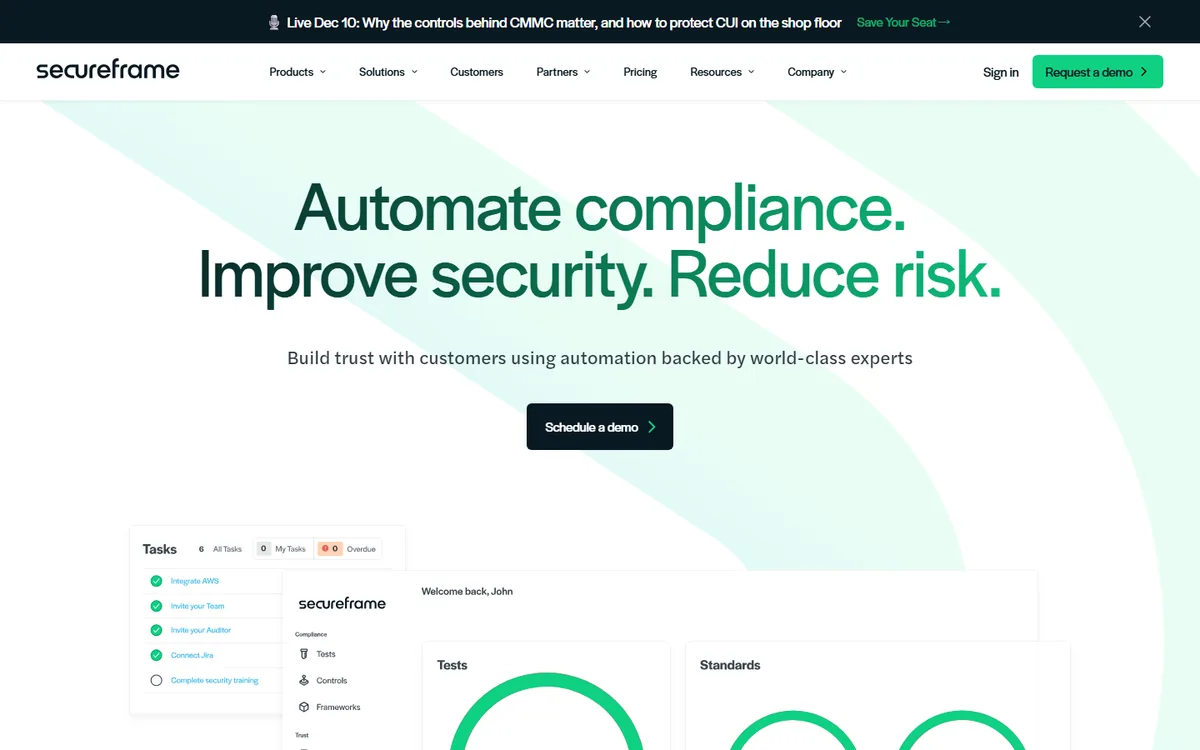
Automation With Guided Onboarding for Teams Preparing for a First Audit
Secureframe automates evidence collection and tracks controls across security and privacy frameworks.
Secureframe is another platform in the automation group, and its G2 reviewers rate it highly. It connects to the systems where evidence lives, tracks control status and helps you prepare for audits. Reviewers on G2 report an average implementation time of about two months, which matches what I tell clients to plan for.
For a first audit the main benefit is structure. You see which controls are failing, who owns them and what evidence is missing. The limit is the same as for the other platforms: it records your compliance and does not create it. Pair it with someone who can write policies and run training, or you will see a dashboard full of red items without a plan.
What I Like About Secureframe
- Strong G2 rating from more than 800 reviews
- Clear view of failing controls and evidence gaps
- Reviewers report a typical two-month implementation
What I Don’t Like About Secureframe
- Perceived cost is at the top of G2's scale
- Does not write policies or run training for you
Secureframe Pricing
Secureframe does not show prices on its G2 profile. Reviewers there report an average discount of about 12 percent off list price, so negotiate and ask what is included at each tier.
Secureframe Reviews
- G2: 4.7 out of 5 star rating (from 845 user reviews)
Thoropass
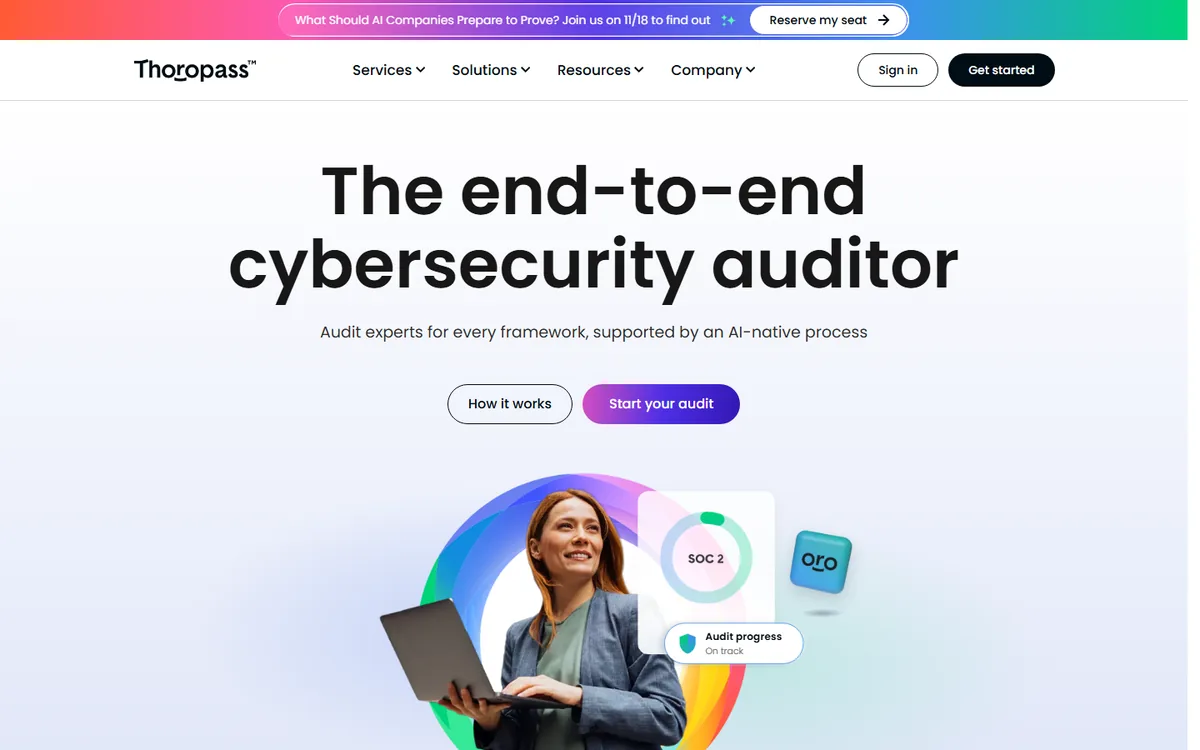
Software Plus Audit in One Contract, With Published Starting Prices for HIPAA Audits
Thoropass combines a compliance platform with audit services, and it publishes starting prices for its audit offers.
Thoropass differs from the pure software tools because it also performs audits. A company can collect evidence in the platform and receive the audit from the same provider. The G2 profile lists a HIPAA Security and Breach Notification Rule audit starting at $8,000 per year, as provided by Thoropass, next to SOC 2 audits starting at $11,500 per year.
The single-provider model reduces handoffs, which matters when a deadline is close. Ask how independence is handled for the audit work and compare the audit scope with what your customers expect. Prices that start low can rise with scope, so ask for a written scope and a quote for the full set of services you need.
What I Like About Thoropass
- Platform and audit from one provider
- Published starting prices for HIPAA and SOC 2 audits
- Strong G2 rating from nearly 600 reviews
What I Don’t Like About Thoropass
- Starting prices rise with scope
- Mostly aimed at technology companies
Thoropass Pricing
According to Thoropass's G2 profile, a HIPAA Security and Breach Notification Rule audit starts at $8,000 per year, and SOC 2 Type 1 and Type 2 audits start at $11,500 per year. Treat these as starting points and confirm scope and total cost with the vendor.
Thoropass Reviews
- G2: 4.7 out of 5 star rating (from 587 user reviews)
Hyperproof
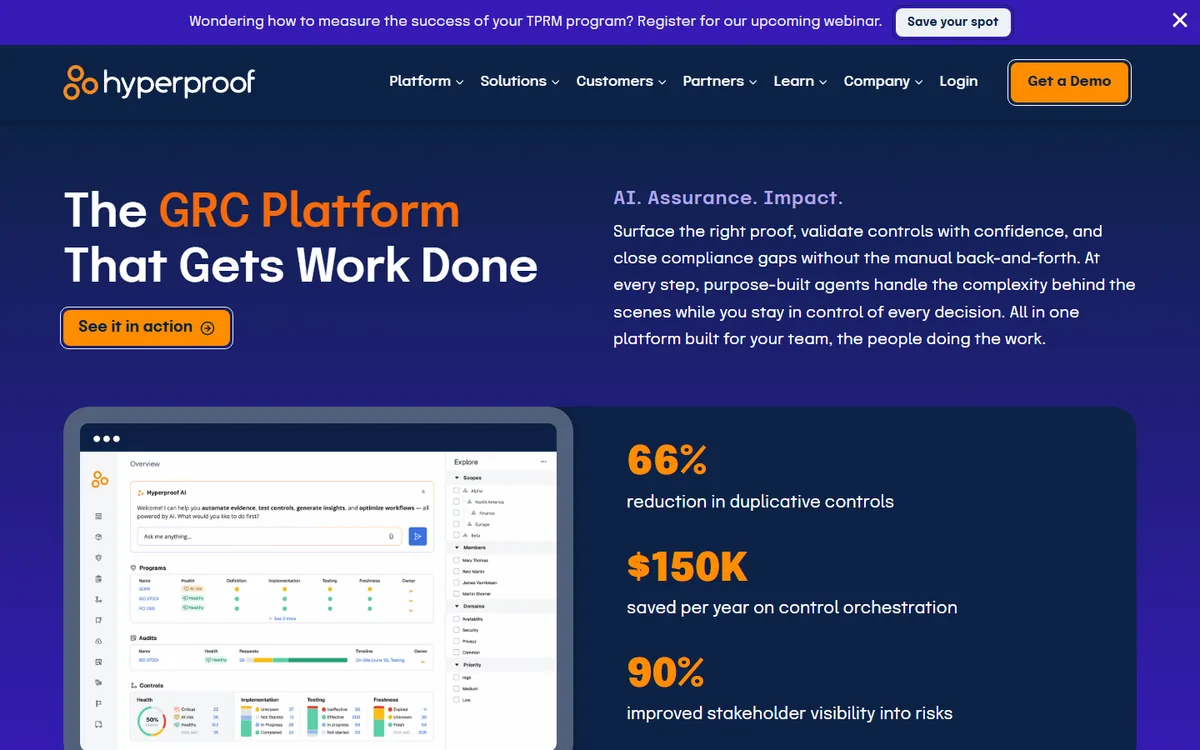
A Control Library for Organizations That Run Many Frameworks and Need One Source of Truth
Hyperproof manages controls, evidence and risk in one place and maps them to multiple frameworks.
Hyperproof treats compliance as an operations problem: one library of controls, mapped to many frameworks, with evidence, tasks and risk in the same place. That suits a company that carries HIPAA, a security framework and customer contract requirements at once, and wants to test a control once and use the result several times.
Its G2 profile lists a Basic plan at $12,000 per year, usage-based, as provided by the vendor, which is one of the few concrete prices in this category. A mature program gets the most from it. A team starting from zero will need to build the control library and the habits first, so I would pair it with a gap assessment.
What I Like About Hyperproof
- One control library mapped to several frameworks
- Published starting price on G2
- Evidence, tasks and risk in one view
What I Don’t Like About Hyperproof
- Rewards teams that already have a defined program
- Smaller review base than the largest platforms
Hyperproof Pricing
Hyperproof's G2 profile lists a Basic plan at $12,000 per year, usage-based, provided by the vendor. Higher plans and add-ons are quoted, so ask what the Basic plan leaves out.
Hyperproof Reviews
- G2: 4.5 out of 5 star rating (from 229 user reviews)
Censinet RiskOps

Healthcare-Specific Vendor Risk Management Backed by a Large Network of Vendors and Products
Censinet RiskOps manages third-party and supply chain risk for healthcare organizations with standardized assessments and monitoring.
Censinet is the specialist on this list. Its platform standardizes vendor assessments, automates workflows, monitors vendors continuously and maps vendors to the clinical and business functions they support. The vendor describes a collaborative risk network of healthcare delivery organizations and more than 40,000 vendors and products.
That network is the point. If a vendor has already answered a standard assessment, you can often reuse it instead of sending your own questionnaire. The scope is narrower than the broad platforms, since it focuses on vendor and supply chain risk. Healthcare providers with many vendors get the most value, and a small practice with ten vendors does not need it.
What I Like About Censinet RiskOps
- Built specifically for healthcare third-party risk
- Large network of vendors and products reduces repeated questionnaires
- Maps vendors to clinical and business functions
What I Don’t Like About Censinet RiskOps
- Covers vendor risk, not the full compliance program
- Price available on request
Censinet RiskOps Pricing
Censinet does not publish pricing. You need to request a demo or contact the company for a quote.
Censinet RiskOps Reviews
I could not read a current G2 or Capterra rating for this product when I wrote this article, so I have left it out. Check the vendor’s review profiles before you decide.
LogicGate
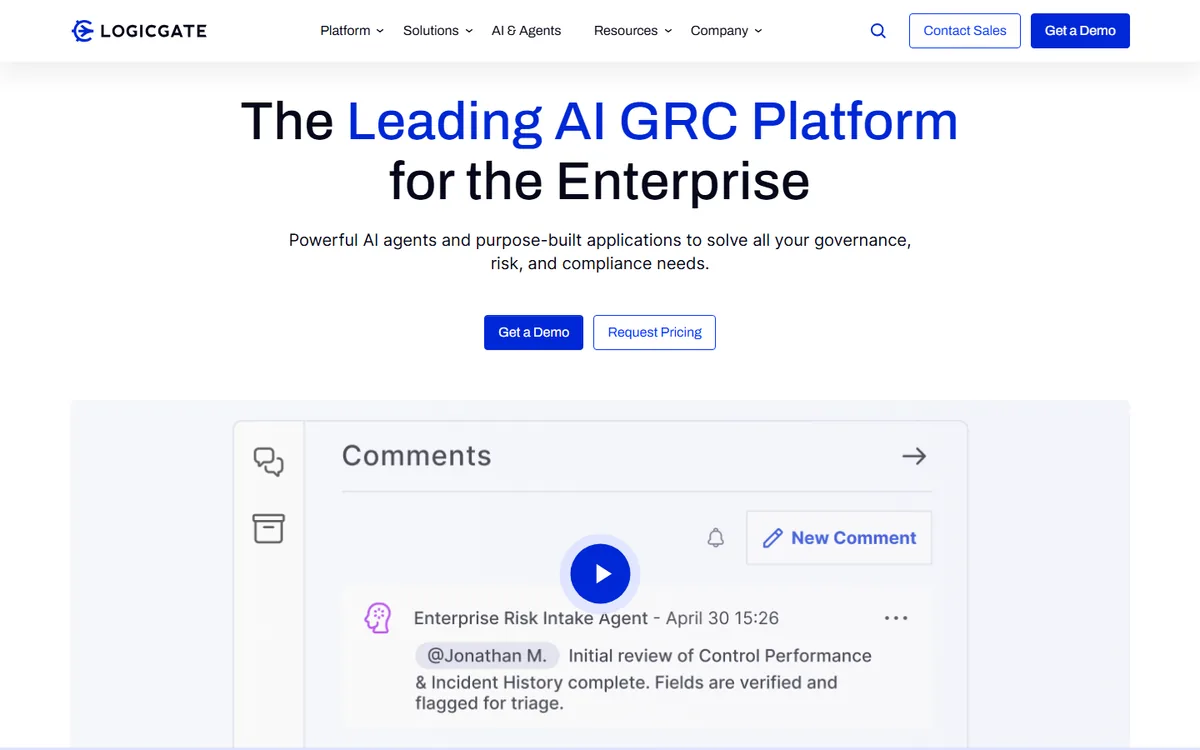
A Configurable Risk and Compliance Workflow Platform for Larger Organizations With In-House Process Owners
LogicGate offers configurable workflows for risk, compliance and audit across the enterprise.
LogicGate is a governance, risk and compliance platform known for configurable workflows. Instead of fixed modules, you design the processes for risk registers, issue tracking, audits and policy reviews. For a health system with an internal risk team, that flexibility is attractive.
The cost of flexibility is time. G2 reviewers report an average implementation of about four months and rate the perceived cost at the highest tier, so this is not a quick fix for a small clinic. Choose it when you have process owners who can design workflows and a project budget to match.
What I Like About LogicGate
- Highly configurable workflows
- Strong G2 rating from more than 200 reviews
- Suits enterprise risk, audit and compliance together
What I Don’t Like About LogicGate
- Reviewers report about four months to implement
- Perceived cost is at the top of G2's scale
LogicGate Pricing
LogicGate does not list prices on its G2 profile. Reviewers there report an average discount of about 17 percent, so expect a custom quote and negotiate.
LogicGate Reviews
- G2: 4.6 out of 5 star rating (from 214 user reviews)
NAVEX One
A Long-Established Suite for Large Organizations That Value Policy, Training and Reporting Together
NAVEX One brings together policy management, training, risk and incident reporting in a single suite.
NAVEX is a long-standing name in ethics and compliance, and NAVEX One is its integrated platform. It targets organizations that want policy management, training, third-party risk and reporting channels from one supplier. Large employers and health systems with established compliance functions are its core audience.
Its G2 rating is the lowest on this list, at 3.8 from 87 reviews, and reviewers report an average implementation of about four months and a return on investment of about 21 months. Read those numbers as a warning about scale: it is a heavy suite and rewards organizations that commit to it. Request a reference customer of your size before you sign.
What I Like About NAVEX One
- Broad suite covers policy, training and reporting
- Established vendor in ethics and compliance
- Fits large organizations with dedicated compliance teams
What I Don’t Like About NAVEX One
- Lowest G2 rating among the platforms reviewed here
- Reviewers report long implementation and return on investment periods
NAVEX One Pricing
NAVEX does not list prices on its G2 profile. Reviewers there report an average discount of about 10 percent, so expect a custom quote that depends on modules and headcount.
NAVEX One Reviews
- G2: 3.8 out of 5 star rating (from 87 user reviews)
Sprinto
A Lean Automation Platform for Smaller Teams That Need HIPAA Alongside Other Frameworks
Sprinto automates control checks and evidence for a long list of frameworks, with HIPAA among the supported ones.
Sprinto is a compliance automation platform aimed at smaller technology teams. Its site describes 25 or more frameworks automated out of the box and more than 200 frameworks digitized, and it supports HIPAA, with a dedicated page for healthcare companies. The vendor does not say which of the frameworks are in the automated group, so ask for HIPAA to be named in your plan.
For a small company that sells software to healthcare customers, a lean platform may be enough, and its entry plans are priced for teams of that size. The same limits apply as with the larger tools: you still need owners, written policies and trained staff. Use it to keep evidence current and to shorten audit preparation.
What I Like About Sprinto
- Supports HIPAA with a healthcare page
- Large framework library
- Targets smaller teams
What I Don’t Like About Sprinto
- Pricing is quote-based
- Not built for clinics without a technical stack
Sprinto Pricing
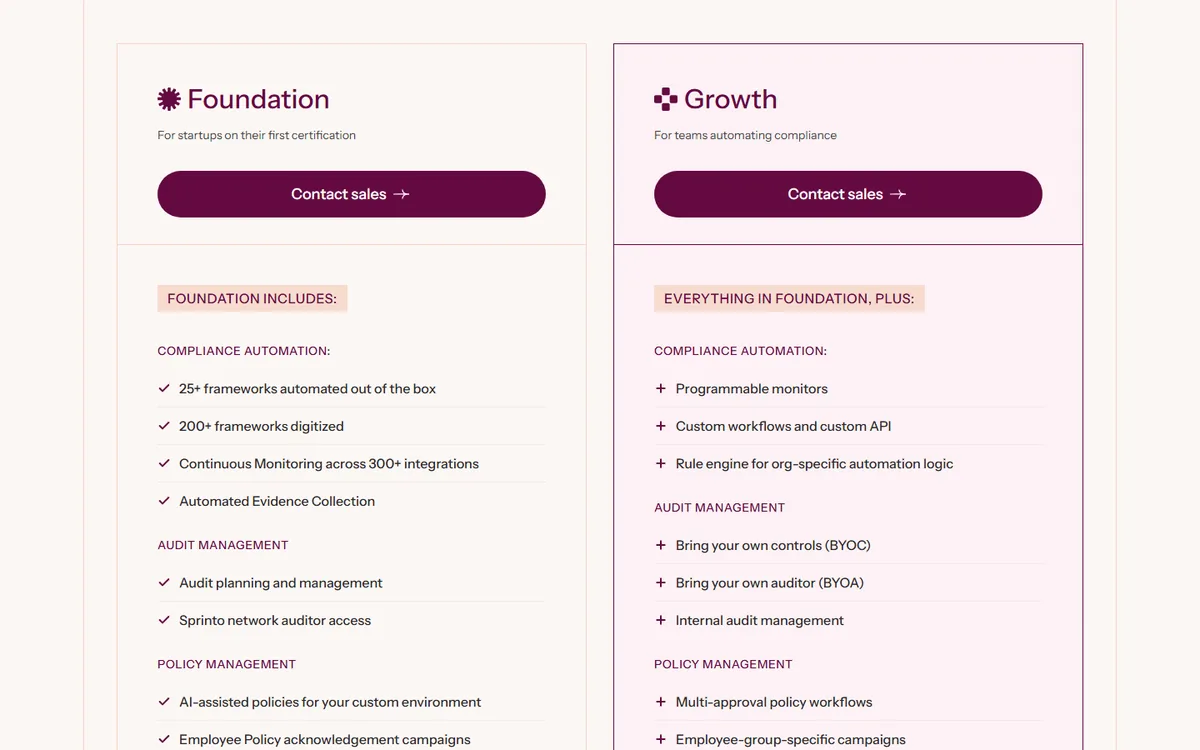
Sprinto lists Foundation, Growth and Platform plans, all sold through its sales team with contact buttons and a plan finder. No prices are published.
Sprinto Reviews
I could not read a current G2 or Capterra rating for this product when I wrote this article, so I have left it out. Check the vendor’s review profiles before you decide.
What to Budget Beyond the License
The license fee is the visible part of the cost. Before you pick a plan, list the other lines so the comparison is fair.
| Cost line | What to ask the vendor |
|---|---|
| Implementation | How many weeks, who does the work and what is the fee? |
| Users and modules | Which modules and how many users does the quote include? |
| Integrations | Which of my systems connect, and which cost extra? |
| Training content | Is the course library included or sold per course? |
| Renewal | How much can the price rise at renewal? |
| Your own time | How many hours per week does an owner need to run it? |
Most of these lines have little to do with features, and many buyers learn about them after signing. If you are still planning the program itself, my healthcare compliance checklist shows what the software has to support.
How to Choose the Right Healthcare Compliance Software
Fit with your operation decides more than any feature list. Before you compare vendors, answer four questions:
- Which gap hurts most today: training, policies, vendors, evidence or audit follow-up?
- Do you run cloud systems the tool can connect to, or mostly paper and a few desktop programs?
- Who will own the tool, and how many hours per week can they give it?
- Which framework or review is coming, and what evidence will it ask for?
If you run a practice and need structure, start with MedTrainer or Compliancy Group. If you are a technology company answering customer questionnaires, look at Vanta, Drata, Secureframe or Thoropass. If your vendor list is long, consider Censinet, and if you need configurable enterprise workflows, LogicGate or NAVEX One. Ask each shortlisted vendor to show how its tool handles your next review, the way I describe in my healthcare compliance audit framework. Whatever you choose, pair it with the habits in healthcare compliance best practices and the ownership routine in healthcare compliance management.
Questions About Choosing Healthcare Compliance Software
What Is the Best Healthcare Compliance Software?
There is no single best product. MedTrainer and Compliancy Group fit practices that want training, policies and agreements managed in one place, platforms such as Vanta, Drata and Secureframe fit technology companies with cloud systems, and Censinet fits provider organizations with many vendors. Match the tool to your size and your biggest gap.
Do I Need Software for Healthcare Compliance?
Not always. A small practice can run a program with shared folders and a tracker. Software starts to pay off when you manage many policies, vendors, staff or locations, or when collecting evidence takes more time than the checks themselves.
How Much Does Healthcare Compliance Software Cost?
Most vendors in this ranking do not publish prices. The published starting points I found were $8,000 per year for a HIPAA audit at Thoropass and $12,000 per year for the Basic plan at Hyperproof, both listed on G2 by the vendors. Request quotes that state users, modules and what is excluded.
Can Software Make Me Compliant by Itself?
No. Software records and monitors your compliance, and your team still writes policies, trains staff, reviews vendors and fixes gaps. A platform without an owner becomes a list of red items. Pair it with a program owner and a plan.
How Long Does Implementation Take?
G2 reviewers report about two months for Vanta, Drata and Secureframe and about four months for LogicGate and NAVEX One. Your time depends on the number of integrations, policies and users, so ask the vendor for a plan with dates.
Which Tool Is Best for a Small Clinic?
A guided tool with templates and training, such as Compliancy Group or MedTrainer, is usually a better fit than a technical automation platform. Start with the gaps you have and ask each vendor to show how its tool handles them.
Is This Ranking Legal or Compliance Advice?
No. It is general information about software. Ratings, prices and features change, so confirm them with each vendor, and ask a qualified adviser what your own obligations are.
Please note: pricing, plans and ratings change often. They were accurate at our last review; please verify them on the vendor sites before you buy. None of this is legal or financial advice.
Was this guide helpful?
Thanks for your feedback.
Odessa Whitfield
Odessa leads the Tidy editorial team and works with the compliance consultants to turn real client projects into practical guides on regulations, frameworks, policies and audit preparation. Before joining Tidy, she worked in compliance and risk roles, writing and maintaining policy sets for regulated organizations. Every article goes through a consultant who has done the work in practice, and she updates guides when a rule, framework or tool changes. She works remotely from the United States.