Quick Summary
- Think of cost in five parts: assessment, remediation, policies, training and tools.
- Year one is the heavy year, and later years are usually well under half of it.
- Remediation is the part most quotes leave vague, so ask about it first.
- Published software prices range from $99 a month to $7,000 a year, and many vendors publish nothing.
Nobody publishes a standard price for HIPAA compliance, because the work depends on your size, your systems and how much documentation you already have. When someone asks me what it costs, I split the answer into five parts: assessment, remediation, policies, training and ongoing upkeep. A good HIPAA compliance consulting quote shows each of them.
Below you get the cost formula I use, a worked example for a mid-sized practice, the published prices I could verify for software and the factors that push a budget up or down.
The Cost Formula I Use
Total first-year cost is the sum of five items. Subtract anything you can reuse from earlier work, then add a buffer for fixes that surface during the assessment.
First-year cost = assessment + remediation + policies + training + tools, plus a 15 to 20% buffer for findings.
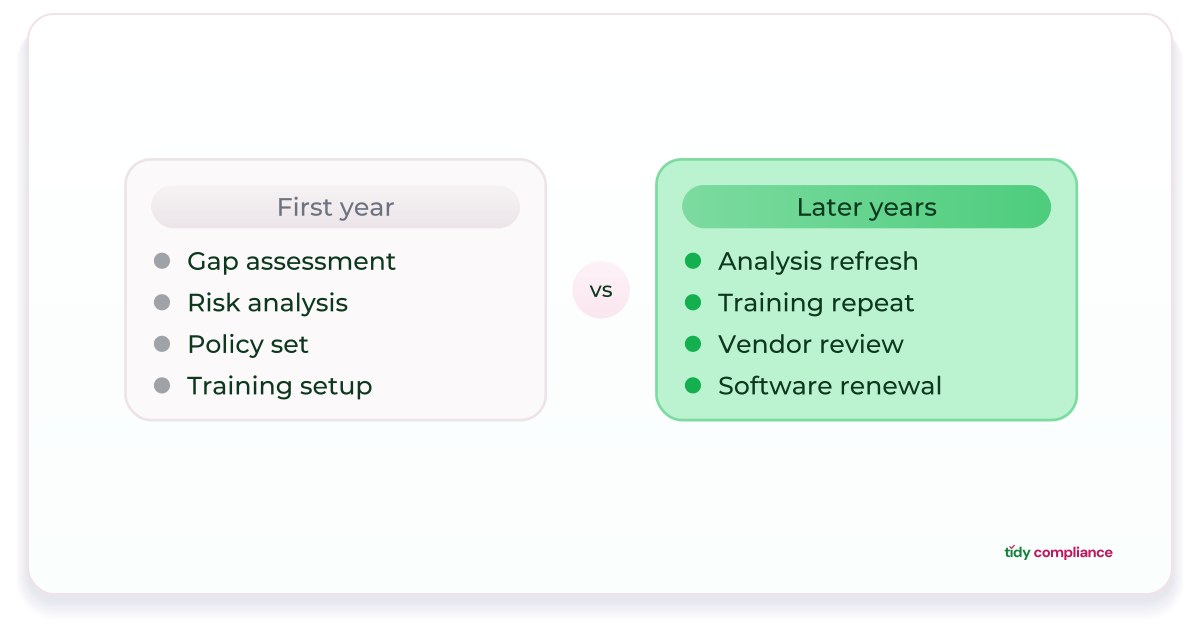
After the first year the formula shrinks. You keep the yearly risk analysis refresh, training, tool subscriptions and a small allowance for changes. In the projects I see, year two usually costs well under half of year one, unless the organization grows or changes systems.
What Each Part Typically Costs
These ranges reflect projects of small to mid-sized healthcare organizations that I see. They are not quotes. Larger groups with many sites move up the scale, and organizations with strong existing documentation move down.
| Cost item | Typical range | What drives it |
|---|---|---|
| Gap assessment | $2,500 to $9,000 | Number of sites, systems and staff |
| Security risk analysis | $3,000 to $15,000 | Number of systems, devices and data flows |
| Policies and procedures | $2,000 to $8,000 | How much you already have and how many roles |
| Training program | $500 to $6,000 | Staff count, role tracks and platform |
| Remediation work | Varies widely | Encryption, access cleanup, vendor changes |
| Software | $1,000 to $10,000 a year | Employees, modules and vendor |
| Ongoing upkeep | $3,000 to $12,000 a year | Annual refresh, audits and changes |
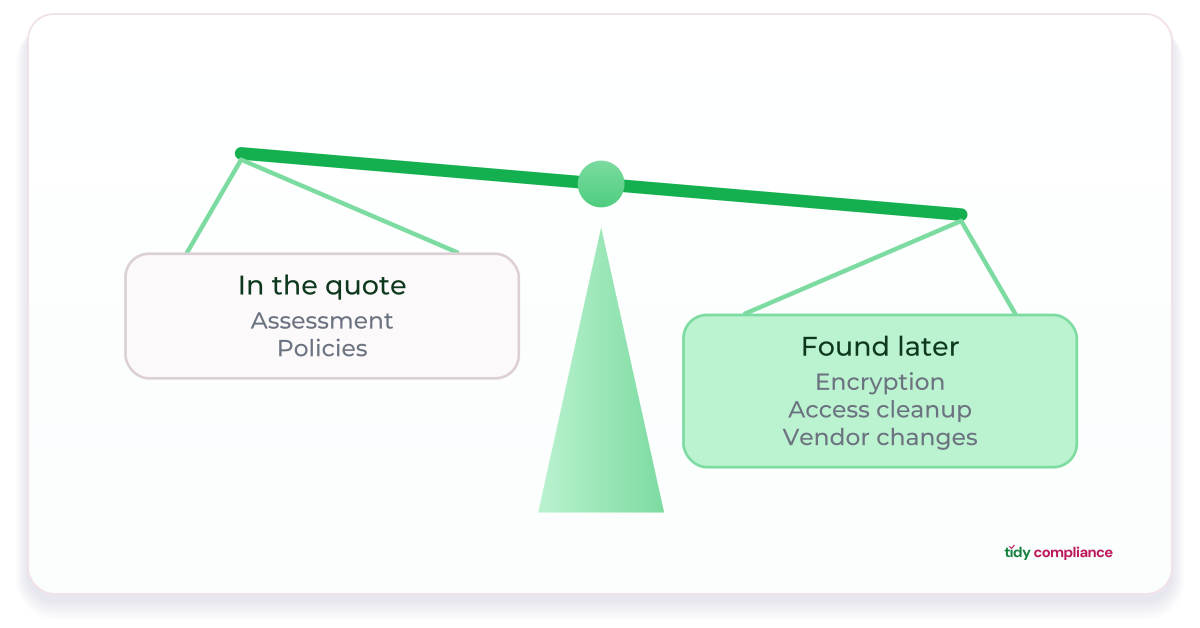
Remediation is the line that surprises people. The assessment may find that laptops are not encrypted or that old accounts are still active. Those fixes cost IT time and sometimes hardware, which a consulting quote does not include unless it says so.
A Worked Example: 25-Person Practice
Here is how the formula plays out for an illustrative practice with 25 staff, one location, an EHR, cloud email and four vendors. The numbers are mid-range assumptions, not a client result.
| Item | Assumption | Amount |
|---|---|---|
| Gap assessment | One site, short interviews | $3,500 |
| Risk analysis | One EHR, email, devices | $5,000 |
| Policies | Edit and complete a set | $3,000 |
| Training | 25 staff, role-based | $1,200 |
| Software | Compliance platform, annual | $3,000 |
| Remediation | Encryption, access cleanup | $2,500 |
| Buffer | About 15% | $2,800 |
| First-year total | $21,000 |
In year two, the practice refreshes the risk analysis, repeats training, renews software and reviews policies. That is roughly $9,000 to $10,000 in this example. Your numbers will differ, but the shape holds: a heavy first year and a lighter routine afterward.
What HIPAA Software Costs
Software sits in two groups. HIPAA-specific tools are built for small and mid-sized healthcare organizations. Broader compliance automation platforms are built for companies that also need SOC 2 or ISO 27001. Prices are published for only some of them.
| Tool | Published price | Source note |
|---|---|---|
| Compliancy Group | Foundation $99 a month, Growth $249, Advanced $449, billed annually, plus a per-employee fee | Listed by Expert Insights |
| Accountable HQ | From $169 a month for the Basic HIPAA plan, billed annually, covering 15 employees | Listed by Expert Insights |
| Secureframe | From $7,000 a year for one framework | Listed by Expert Insights |
| Medcurity | Self-service risk assessment from $499 a year | Medcurity pricing page |
| Vanta, Drata, Thoropass | Quote required | No price published |
Check prices on each vendor page before you budget, because plans change. My full ranking of HIPAA compliance software compares features and review scores, and says where a price is not published.
Six Factors That Move Your Budget
Every quote I review is shaped by the same six things. Know where you stand on each, and you can predict which end of the range you will land on.
- Size: more staff and sites mean more interviews, training and records.
- Systems: each system that holds patient data adds to the risk analysis.
- Starting point: existing policies and a recent analysis lower the work.
- Vendors: many business associates mean more agreements and reviews.
- Risk profile: telehealth, mobile devices and research data add scope.
- Support model: a one-time project costs less upfront than a retainer.
Project, Retainer or Hourly: Which Pricing Model Fits
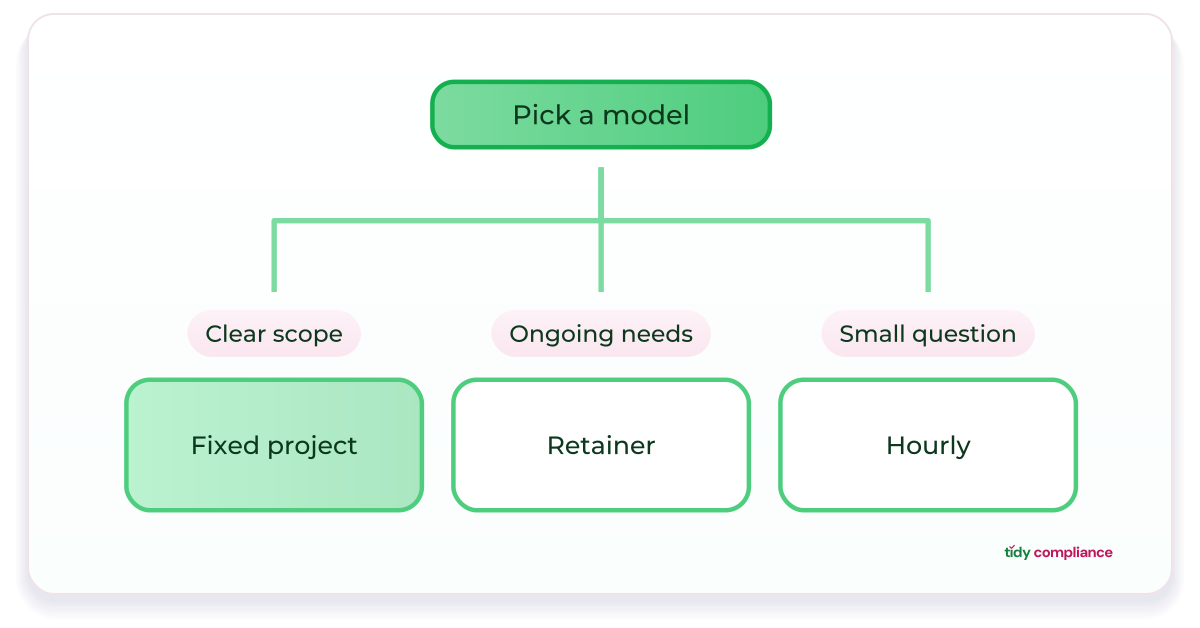
Consultants charge in three ways, and each one suits a different situation. A fixed-price project works when the scope is clear, such as an assessment and a policy set. A retainer suits organizations that want a standing contact for questions, vendor reviews and yearly updates. Hourly work is useful for small, specific tasks, but it is hard to budget when the scope is unclear.
I usually advise a fixed price for the first year and a small retainer afterward. The first year has defined deliverables, and the second year is about keeping them current. A retainer with a set number of hours also keeps the program from drifting, because someone is responsible for the calendar. Ask what happens when the hours run out, and whether unused hours carry over.
| Model | Best for | Watch for |
|---|---|---|
| Fixed-price project | Assessment, risk analysis, policy set | Scope creep charged as extras |
| Monthly retainer | Ongoing upkeep, vendor reviews, questions | Hours that expire unused |
| Hourly | Small tasks and second opinions | Open-ended totals |
What Different Organizations Usually Spend
Cost grows with complexity more than with headcount. A ten-person therapy practice with one cloud EHR is a small project. A 60-person specialty group with three sites, imaging systems and a patient portal is a mid-sized one. A software company that hosts patient data for clients carries the heaviest load, because its customers will test its controls.
- Solo and small practices: often focus on a lean risk analysis, a core policy set and training, with software for tracking.
- Multi-site groups: add site visits, device inventories and a vendor program, which raises assessment and remediation lines.
- Business associates and software vendors: add technical testing, customer questionnaires and evidence for contracts.
Whichever type you are, ask for a quote that lists the same five parts. It is the fastest way to see where one offer includes work that another leaves out.
Costs Nobody Puts in the Quote
Staff time is the biggest hidden cost. Interviews, document reviews, training sessions and access cleanup take hours from people who already have full days. A small practice should expect the office manager or clinic lead to spend several hours a week during the assessment phase. Plan for that, and arrange coverage, or the project drags and the price creeps up.
The second hidden cost is IT work. If your risk analysis finds unsupported operating systems, shared logins or unencrypted backups, someone has to fix them, and that may be an outside IT provider billing separately. Ask your IT provider for a rough estimate early, so the remediation line has a number before you commit.
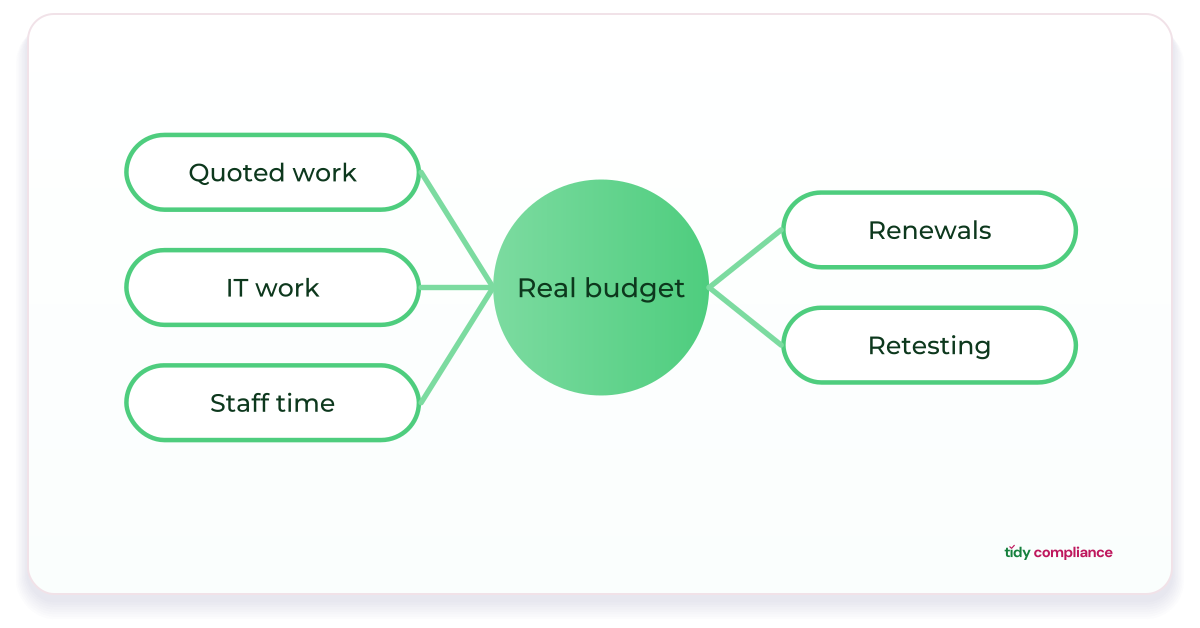
The third is renewal. Software subscriptions, training platforms and agreements with vendors all renew, and prices can change at renewal. Put the dates in one calendar and review each tool yearly. Dropping a tool you no longer use is the easiest saving in the whole program.
What Non-Compliance Can Cost
HHS enforces the rules through investigations and civil money penalties that are tiered by the level of culpability and adjusted for inflation each year, so check HHS enforcement results for current figures and real cases. The penalty is only part of the bill. Resolution agreements usually require a corrective action plan, outside monitoring and years of reporting.
Breach response has its own costs: forensic work, notification letters, credit monitoring, call center support and lost patients. A small incident can cost more than a year of a decent program. That is why I treat compliance spend as risk reduction and not as a fee. See the failures that start most incidents in HIPAA compliance risks.
Ways to Spend Less Without Cutting Corners
You can lower the bill without weakening the program if you pick the right places. Use the checklist in my HIPAA compliance checklist to do the inventory yourself, which saves consulting hours. Reuse policies you already have after a proper review. Pick one platform and use it fully, and avoid paying for modules you will not touch.
Small organizations in particular can start with a right-sized scope. The approach is in HIPAA compliance for small business. Spend where the risk is, and the rest follows. A practical test: for every line in a quote, ask what you would hold in your hands at the end and who would use it. Anything without a clear answer is a candidate to cut or to reduce, and the answers also help you explain the budget to partners, owners or a board who will want to know why the number is what it is. The routine in HIPAA compliance best practices then keeps year two lean.
How to Compare Quotes
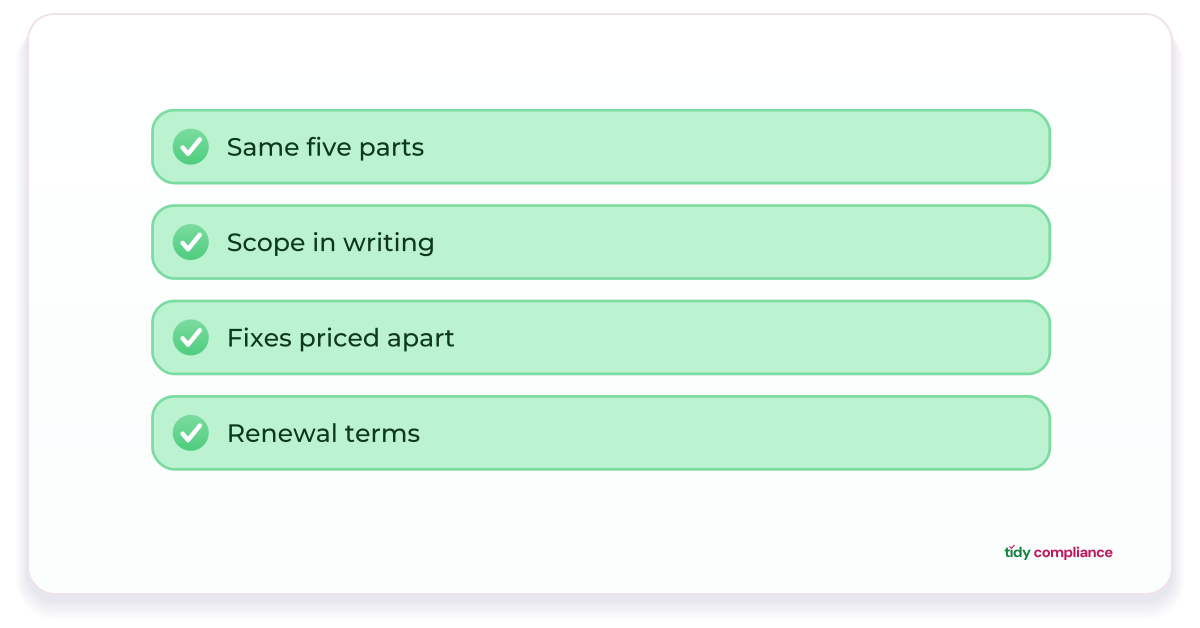
Ask each provider to list deliverables, hours, who does the work and what is excluded. Compare the same five parts side by side, and look hard at remediation and upkeep, which are the lines most often left vague.
- Named deliverables, such as a dated risk analysis and a gap report
- A fixed price or a clear cap for each phase
- A plan for year two, with its own price
- No promise that you will pass an audit, since nobody controls that
Sources
Expert Insights: Best HIPAA Compliance Solutions, Medcurity pricing, HHS: Resolution Agreements.
Questions About HIPAA Compliance Costs
How Much Does HIPAA Compliance Cost for a Small Practice?
A first year often lands in the low to mid five figures for assessment, risk analysis, policies, training, software and fixes, and then drops in later years. Your number depends on staff count, systems and your starting documents. A consultant can give a range after a short call.
Is HIPAA Compliance a One-Time Cost?
No. The first year has the most work, but you must keep reviewing the risk analysis, updating policies, training staff and managing vendors. Plan for a yearly budget in addition to the first-year project.
Does HIPAA Compliance Software Replace a Consultant?
Software helps with training, policy storage, tracking and reminders. It does not do an honest risk analysis for your environment or fix your systems. Most small teams combine a tool with a few consulting hours.
What Does a HIPAA Risk Analysis Cost?
In the projects I see, a risk analysis for a small or mid-sized organization costs from a few thousand dollars to the low five figures, depending on systems and sites. Self-service tools start lower, with Medcurity listing a small practice assessment from $499 a year.
What Is the Most Expensive Part of Compliance?
Remediation. Encrypting devices, replacing unsupported systems and cleaning up access can cost more than the assessment itself, which is why you should ask about it before you sign.
How Much Are HIPAA Fines?
Penalties are tiered by culpability and adjusted yearly for inflation. Check current amounts and real cases on the HHS enforcement pages, and remember that corrective action plans and breach response add costs beyond the fine.
Can Insurance Cover HIPAA Costs?
Cyber insurance may cover some breach response costs, but policies differ and often require basic controls to be in place. Ask your broker what is covered and which safeguards the insurer expects.
Disclaimer: This article is for general information only and isn’t legal, financial or tax advice. Treat figures as estimates from typical work and confirm details with your providers before you act.
Was this guide helpful?
Thanks for your feedback.
Odessa Whitfield
Odessa leads the Tidy editorial team and works with the compliance consultants to turn real client projects into practical guides on regulations, frameworks, policies and audit preparation. Before joining Tidy, she worked in compliance and risk roles, writing and maintaining policy sets for regulated organizations. Every article goes through a consultant who has done the work in practice, and she updates guides when a rule, framework or tool changes. She works remotely from the United States.