Quick Summary
- An assessment finds and ranks gaps before an audit, and it ends in an action plan, not a certificate.
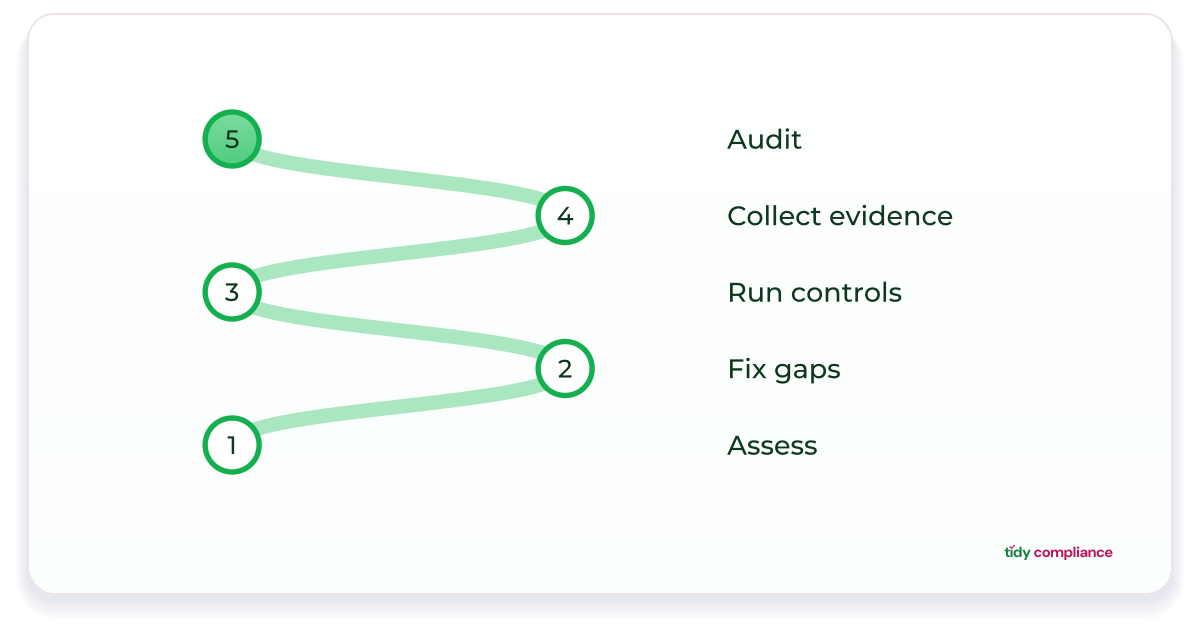
- Four phases do the work: scope, collect evidence, rate each control and rank the gaps.
- Rate design and operation separately, and plan for the evidence period your audit needs.
- Run the first pass yourself if you can, and bring in an outside view for rating and ranking.
An IT compliance assessment answers one question: how ready are you for the requirements you face, and what stands between you and ready? It is not an audit, and nobody issues a pass or fail. It is a structured look at your controls, your documents and your habits, ending in a ranked list of gaps you can act on.
I run these as part of IT compliance consulting work, usually before a first SOC 2 report, an ISO 27001 certification or a large customer review. The method below is the one I use. You can run a light version yourself, and I point out where an outside view adds the most.
What an Assessment Is and Is Not
An assessment compares what you do with what a standard or a contract asks for. It checks design (is the control described and sensible?) and operation (does it run, and is there proof?). It does not collect formal audit evidence over a period, and it does not replace a certification body or a CPA firm.
That difference matters for timing. You run an assessment first, to find and fix gaps cheaply. An IT compliance audit comes later, once you can show controls working over time. Skipping the first step is the most common reason a first audit goes badly.
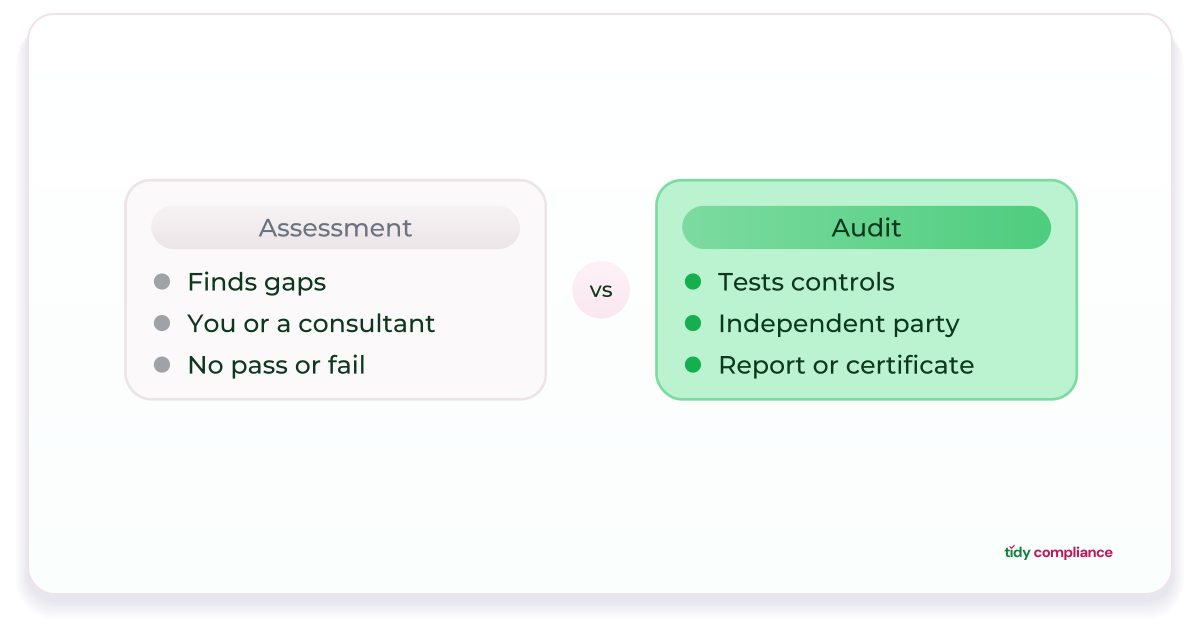
| IT compliance assessment | IT compliance audit | |
|---|---|---|
| Purpose | Find gaps and rank them so you can fix them | Give an independent opinion on your controls |
| Who does it | You, a consultant or both | An independent auditor or certification body |
| Output | Gap list, readiness score, action plan | Report or certificate |
| Timing | Before the audit, and yearly after | After gaps are closed and evidence exists |
| Tone | Collaborative and fast | Formal and evidence-driven |
The Four Phases of an Assessment
A useful assessment has four phases. Small organizations can finish them in two to three weeks, and larger ones take longer because evidence sits with more teams.
| Phase | What happens | What you end up with |
|---|---|---|
| 1. Scope | Choose the systems, locations, frameworks and data in play | A written scope and a list of owners |
| 2. Collect | Gather policies, configurations, tickets and interview answers | An evidence set for each control |
| 3. Rate | Compare each control to the requirement and rate design and operation | A gap list with a readiness score |
| 4. Plan | Rank gaps by risk and effort and assign owners and dates | A corrective action plan |
Phase 1: Set the Scope
Decide what is in. For a SOC 2 readiness review, that is the product and the supporting systems. For ISO 27001, it is the scope statement of your management system. For a customer review, it is the services they use.
Write the scope down in half a page, name the frameworks, list the systems and name an owner for each. A vague scope is the top reason assessments run over time, because every new system found halfway through restarts the work.
Phase 2: Collect Evidence and Interview Owners
Collect what exists: policies, configuration exports, access lists, change tickets, scan reports and training records. Then talk to the owners. A thirty-minute conversation with a system administrator finds more than a week of reading documents.
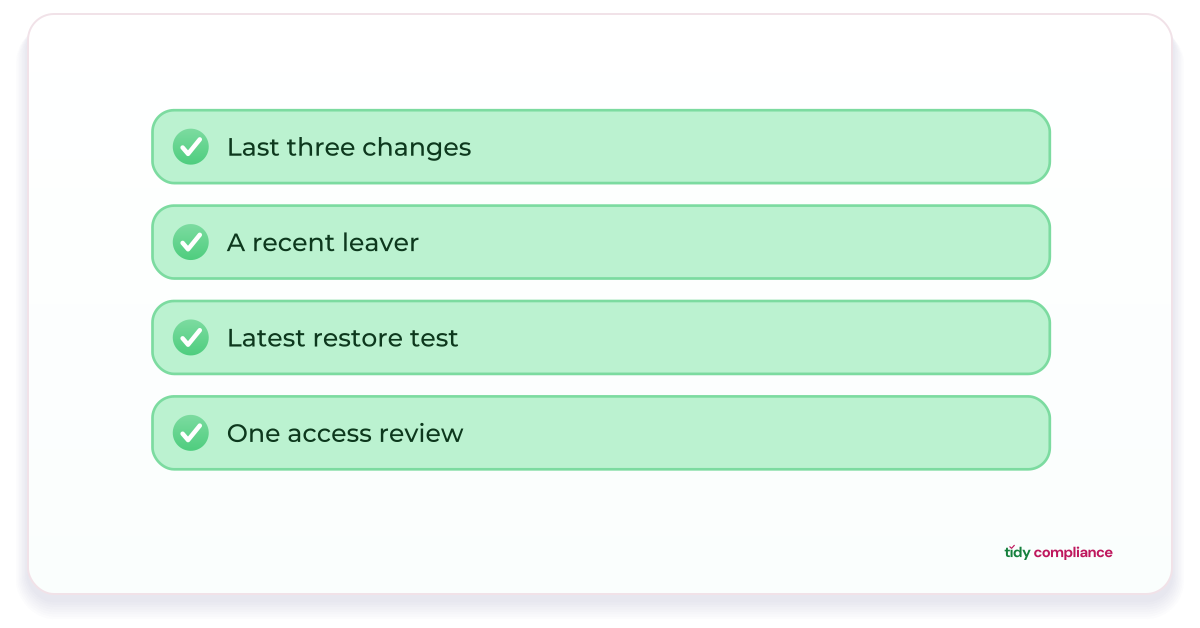
Ask for examples, not descriptions. "Show me the last three changes to this system" and "show me the last person who left" produce real evidence, and the gaps between the answer and the policy become obvious.
Phase 3: Rate Each Control
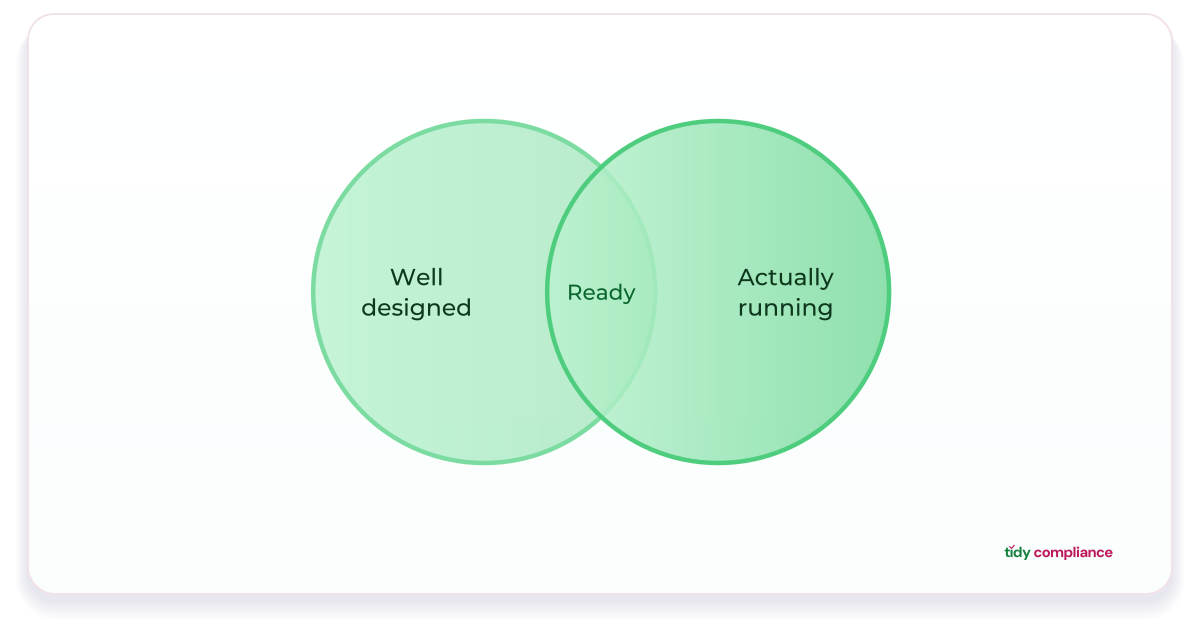
Rate every control on two questions. Is it designed well, meaning it covers the requirement? And does it operate, meaning there is proof it ran as described? A simple four-level scale works: not in place, partly in place, in place and in place with evidence.
A control can be well designed and not operating, such as a quarterly access review that has not been done since spring. It can also operate without being designed, such as a habit that one engineer keeps but nobody has written down. Both are gaps, and they need different fixes.
| Rating | Meaning | Typical fix |
|---|---|---|
| Not in place | No control exists for the requirement | Design and implement |
| Partly in place | A control exists but covers only part of the scope | Extend to the full scope |
| In place | Designed and used, but with little proof | Document and capture evidence |
| In place with evidence | Designed, operating and proven with dated records | Maintain and review yearly |
Phase 4: Rank and Plan
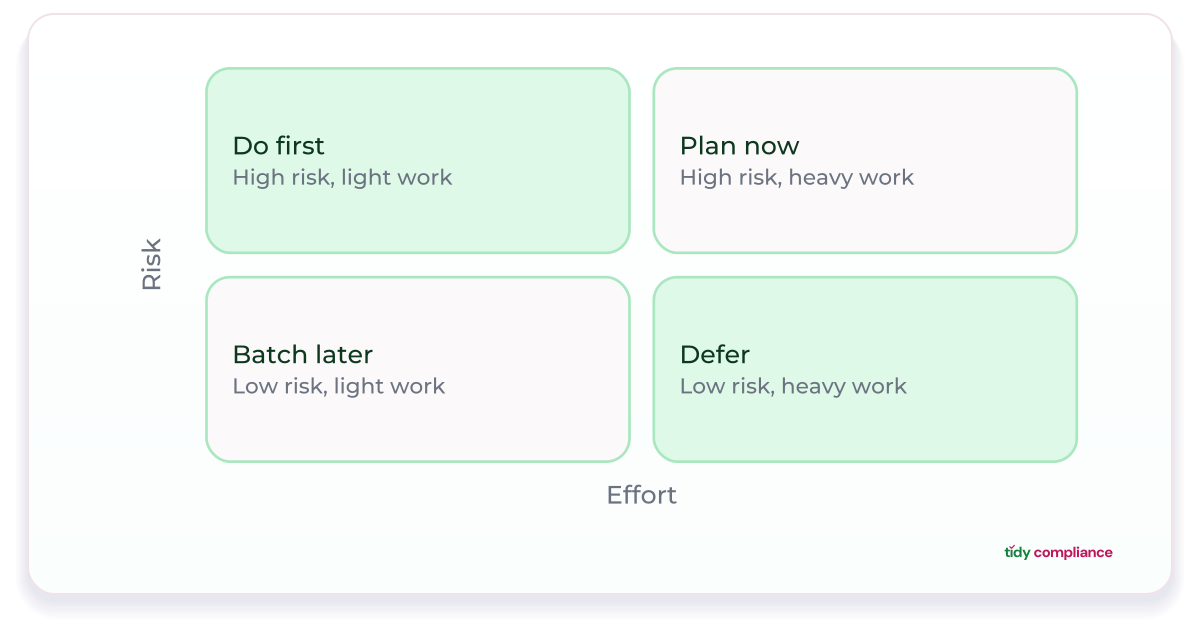
Rank gaps by the risk they carry and the effort they need. High risk and low effort go first. High risk and high effort need a project with an owner and a budget. Low risk and high effort can wait, as long as someone records the decision.
Give each gap an owner, a date and a definition of done. A plan with no owners is a wish list. Review progress every two weeks, and track the share of controls rated "in place with evidence", which is the number leadership understands.
How to Evaluate Readiness
Readiness is a judgment, and a score helps you make it consistently. A plain model: give each control a value from zero to three using the table above, add them up per domain and divide by the maximum. A domain below 50 percent needs real work. A domain above 80 percent is usually ready for an audit if the evidence covers enough time.
Time is the part people forget. Many frameworks that report on operating effectiveness, such as a SOC 2 Type 2 report, look at controls over a period. A control you started last week is designed, but it has no history. Plan for the evidence period when you set your audit date.
| Domain | Questions to ask | Common weak spot |
|---|---|---|
| Governance | Is there an owner, a risk register and a review rhythm? | Policies without owners |
| Access | Do roles, reviews and leaver steps work? | Stale accounts and shared logins |
| Operations | Are changes, patching and backups controlled? | Exceptions that never expire |
| Monitoring | Are events logged, reviewed and acted on? | Logs collected, never read |
| Third parties | Are vendors ranked and reviewed? | A register with no review dates |
| People | Is training tracked and role-based? | One generic course for everyone |
Choosing the Framework to Assess Against
Start with what customers and regulators ask for. SOC 2 is common for software and service providers in the US. ISO 27001 is common for international customers. PCI DSS applies when you handle card data, and the HIPAA Security Rule applies to covered entities and their business associates. The NIST Cybersecurity Framework is a flexible base when nothing is mandated.
Do not assess against five frameworks at once. Pick the one with the most pressure, map the rest to it and check where they differ. Most overlap in access, change, logging, vendor and incident controls is large, and a good map saves weeks. My IT compliance guide explains how these frameworks relate.
What You Can Do Yourself and Where Help Pays Off
You can run phases one and two on your own, especially the scope and the evidence collection. Use the ten points in my IT compliance checklist as a quick first pass. Rating and ranking are where an outside view helps, because insiders tend to rate their own controls kindly.
Tooling can help with evidence collection and tracking, but it does not rate controls for you. If you are comparing platforms, read my ranking of IT compliance software before you buy, and decide your scope first.
After the Assessment
The assessment ends with a plan, and the plan only works with a rhythm. Hold a short review every two weeks, close the quick items first and keep a log of decisions. Repeat the assessment once a year, or when you add a major system or enter a new market.
The habits that keep scores high are the same ones I describe in IT compliance best practices: one owner per control, evidence saved as you go and a calendar for recurring checks.
Pitfalls That Skew the Results
Three habits make assessments look better than they are. The first is rating a control by its policy and not by its proof. The second is letting the owner of a control rate it, which rewards optimism. The third is stopping at the first sample that looks fine. Fix them by asking for dated evidence, having someone else review the rating and checking at least three samples per control.
Another trap is scope creep in the other direction. A team that shrinks the scope to make the score look good will meet the full scope when a customer asks. Decide the scope based on what the business sells and what customers rely on, then keep it fixed for the whole assessment.
One last point on timing: schedule the assessment so that fixes have room before any audit date. Teams that finish the assessment six weeks before the auditor arrives usually discover that remediation takes three months, and then they have to move the audit.
How to Choose Your Assessment Approach
Pick the approach that fits your timeline and your pressure. A self-assessment suits a team with some experience and no hard date. A consultant-led assessment suits a team with a customer deadline, a first audit or little time. A hybrid, where you collect and a consultant rates, is the most common choice.
- Write the scope and name the framework before you collect anything.
- Collect three samples per control and interview the owners.
- Rate design and operation separately, and rank gaps by risk and effort.
- Set an audit date that leaves room for an evidence period.
Questions About IT Compliance Assessments
What Is an IT Compliance Assessment?
It is a structured review that compares your controls and documents with the requirements of a framework or contract. It ends with a ranked list of gaps and an action plan, and it does not produce a certificate.
What Is the Difference Between an Assessment and an Audit?
An assessment helps you find and fix gaps, and you or a consultant can run it. An audit is an independent review that ends in an opinion, a report or a certificate. You run the assessment first.
How Long Does an IT Compliance Assessment Take?
A small organization can finish in two to three weeks. Larger environments with several frameworks and many system owners usually take six to eight weeks, mostly because evidence collection takes time.
How Do I Measure Readiness?
Rate each control on design and operation, convert the ratings into a score per domain and track the share of controls with dated evidence. Also check that the evidence covers enough time for the report you want.
Can I Run an Assessment Myself?
Yes, for scope and evidence collection. Rating is harder to do objectively, so many teams ask an outside reviewer to rate and rank. A hybrid approach keeps cost down and quality up.
Which Framework Should I Assess Against First?
Pick the one your customers or regulators ask for most often. Map the others to it later. Assessing against several at once multiplies work and blurs priorities.
How Often Should I Repeat an Assessment?
Once a year is typical, and again after a major change such as a new platform, an acquisition or a new market. Many teams also run a short quarterly check on their riskiest domains.
Sources
Disclaimer: This article is general compliance information and not legal advice. Requirements depend on your location, industry and facts, so confirm what applies to you with qualified counsel or the issuing authority.
Was this guide helpful?
Thanks for your feedback.
Odessa Whitfield
Odessa leads the Tidy editorial team and works with the compliance consultants to turn real client projects into practical guides on regulations, frameworks, policies and audit preparation. Before joining Tidy, she worked in compliance and risk roles, writing and maintaining policy sets for regulated organizations. Every article goes through a consultant who has done the work in practice, and she updates guides when a rule, framework or tool changes. She works remotely from the United States.