Quick Summary
- An IT compliance audit moves through four parts: scope, method, findings and closure.
- Scope is the key decision, and shared services such as identity are the usual blind spot.
- Inspect a sample of dated records from the system itself instead of relying on interviews.
- Rate every finding, assign an owner and retest before you close it.
An IT compliance audit tests whether the controls you claim are the controls you run. Auditors do not read your policy and take your word for it. They ask for a sample: ten recent new hires and their access approvals, five production changes and their tickets, the last backup restore test. If the proof exists, you pass that check. If it does not, you get a finding.
This article gives you a framework for the whole cycle: how to set the scope, which method to use, how to write and rate findings and how to close them. It applies whether you face SOC 2, ISO 27001, a customer review or an internal audit. If you want a partner for the cycle, my IT compliance consulting work follows the same framework, and independent audits and legal opinions stay with the right professionals.
The Four-Part Audit Framework
Every audit I run or prepare clients for moves through four parts: scope, method, findings and closure. Each part has a clear output, so you always know whether you are done with it.
| Part | Key question | Output |
|---|---|---|
| Scope | What is in and out of the audit? | A written scope statement with systems, sites and period |
| Method | How will each control be tested? | A test plan with sample sizes and evidence types |
| Findings | What failed, and how bad is it? | Rated findings with evidence and owners |
| Closure | How and when is each gap fixed? | A remediation tracker with dates and retest results |
Scope: Draw the Boundary First
Scope is the most important decision in the audit, and the one teams rush. A narrow scope shortens the work but may not satisfy the customer who asked for the audit. A wide scope drags in every system and every team.
Start from the question the audit must answer. If a buyer wants a SOC 2 report on your product, scope covers the production systems, the people who can change them and the supporting tools such as identity, ticketing and monitoring. If you chase ISO 27001, the scope statement defines which parts of the organization the management system covers, and the certification body reads it closely.
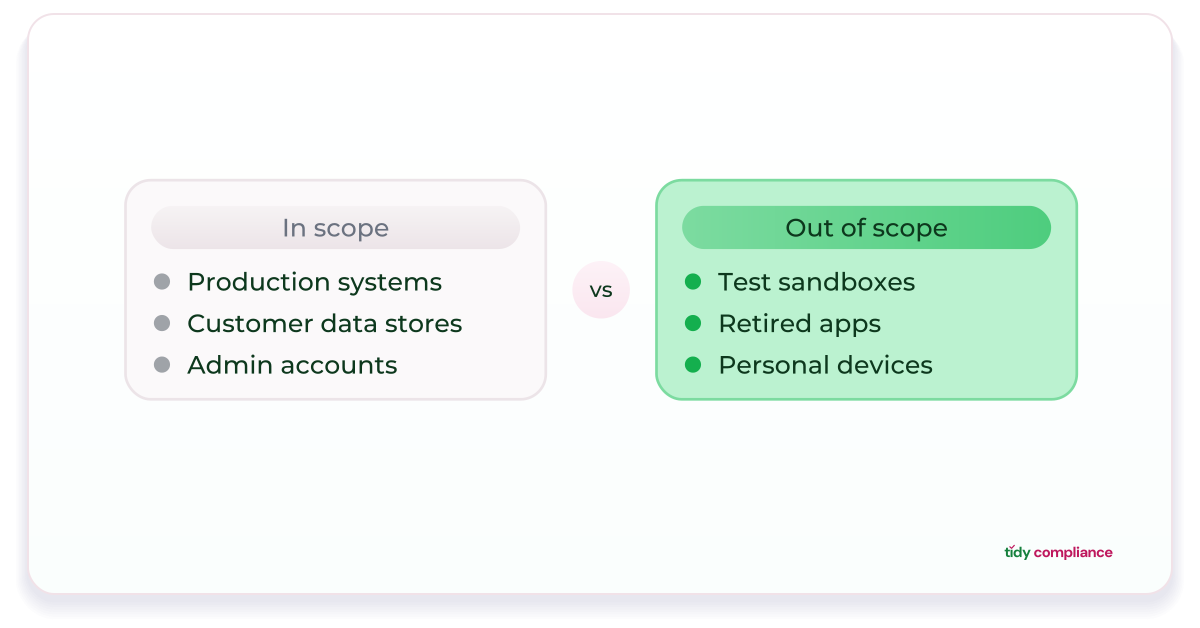
Write the scope as a short document: the systems and data in scope, the locations and teams, the audit period and the exclusions with a reason for each. Exclusions need a reason because auditors ask for one. In my client work, the most common scope mistake is leaving out a shared service, such as the identity provider, that every in-scope system depends on.
Method: Decide How Each Control Gets Tested
A control is tested in one of four ways: you ask someone, you observe it, you inspect a record or you re-perform it. Asking is the weakest evidence and re-performing is the strongest. Most audit tests combine inspection of a sample with one observation.
| Test type | Example | Strength |
|---|---|---|
| Inquiry | Ask the IT lead how access is removed on exit | Weakest, used to understand the process |
| Observation | Watch an engineer run a backup restore | Good for processes done live |
| Inspection | Open ten leaver tickets and compare dates | Core of most tests |
| Re-performance | Rerun a vulnerability scan and compare results | Strongest, used on key controls |
Choose sample sizes before you pull evidence, so you do not select only the clean examples. For a control that runs daily, a larger sample over the audit period tells more than a few. For one that runs yearly, you test the single instance carefully. Your external auditor sets its own sample sizes, so ask for their approach early.
Group controls into the areas auditors always visit: access management, change management, logging and monitoring, backups and recovery, vulnerability and patch management, vendor management, incident response, endpoint security and policy and training records. The framework you follow decides the wording, but those areas appear in almost every one, and the NIST Cybersecurity Framework offers one public way to organize them.
Evidence: What Auditors Actually Accept
Good evidence has four traits. It is dated, it is complete for the period, it comes from the system itself and it shows who did what. A screenshot of a setting is thin evidence on its own, because it shows one moment. An export of the setting history, or a log of approvals, is better.
Automation tools help here, which is why my ranking of IT compliance software exists. They pull access lists, device status and ticket history on a schedule. The tool still needs correct settings behind it, so a green dashboard shows only that the check ran.
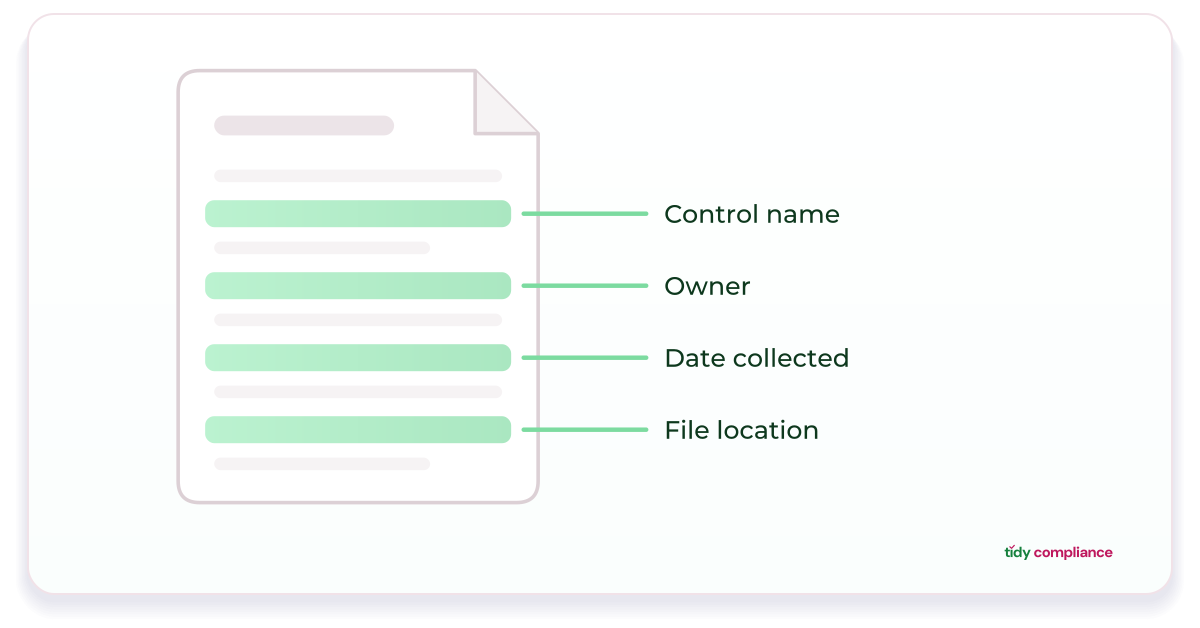
Keep evidence in one folder per control with a short index: control name, owner, what the evidence shows and the date pulled. A tidy folder saves hours in the audit week and makes a repeat audit far cheaper.
Findings: Write Them So Someone Can Fix Them
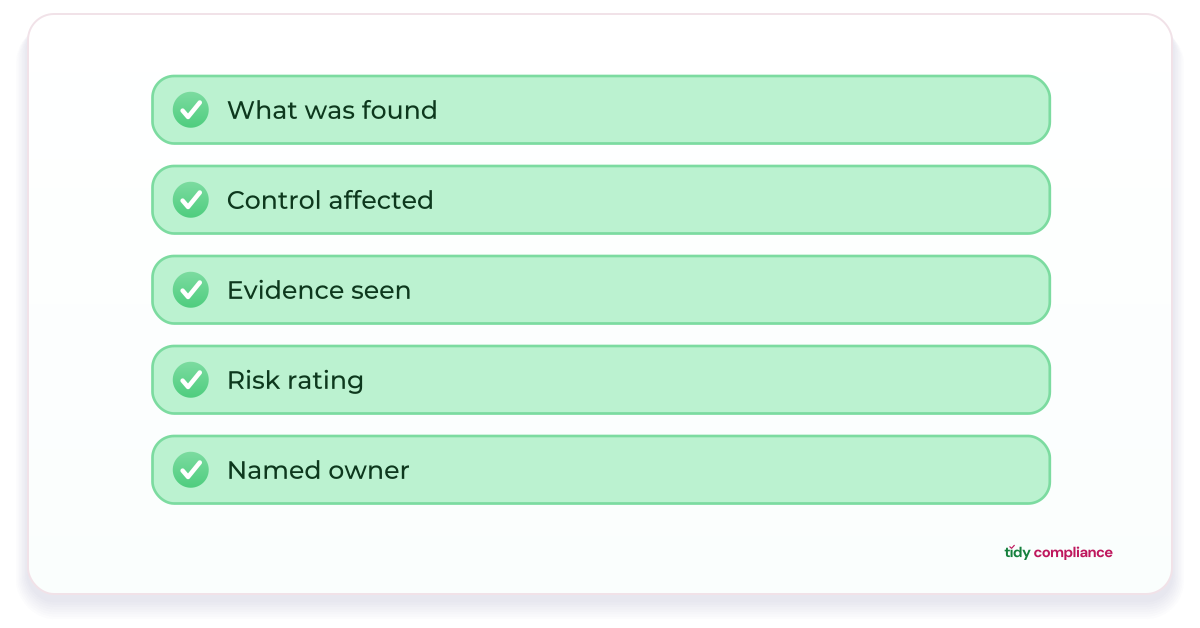
A good finding has five parts: the control, the condition you found, the evidence, the risk and the owner. "Access reviews are weak" is not a finding. "The quarterly access review for the billing system was not performed in Q2 and Q3; the last signed review is dated January" is.
Rate each finding so the list can be ranked. I use three levels. High means a control failed in a way that exposes data or fails a requirement. Medium means a control exists but is incomplete or late. Low means the practice is fine and the documentation is thin.
| Rating | What it means | Typical example | Fix window I suggest |
|---|---|---|---|
| High | Control failed or missing, with real exposure | No offboarding record for four leavers with live access | Days |
| Medium | Control exists but late or incomplete | Quarterly access review done twice in a year | Weeks |
| Low | Practice works, evidence is thin | Backup tests done but not logged | Next cycle |
Keep language neutral and factual. Findings describe controls and records. They do not describe people. A neutral tone also keeps the review useful, because owners stop defending and start fixing.
Closure: Track Every Gap to Retest
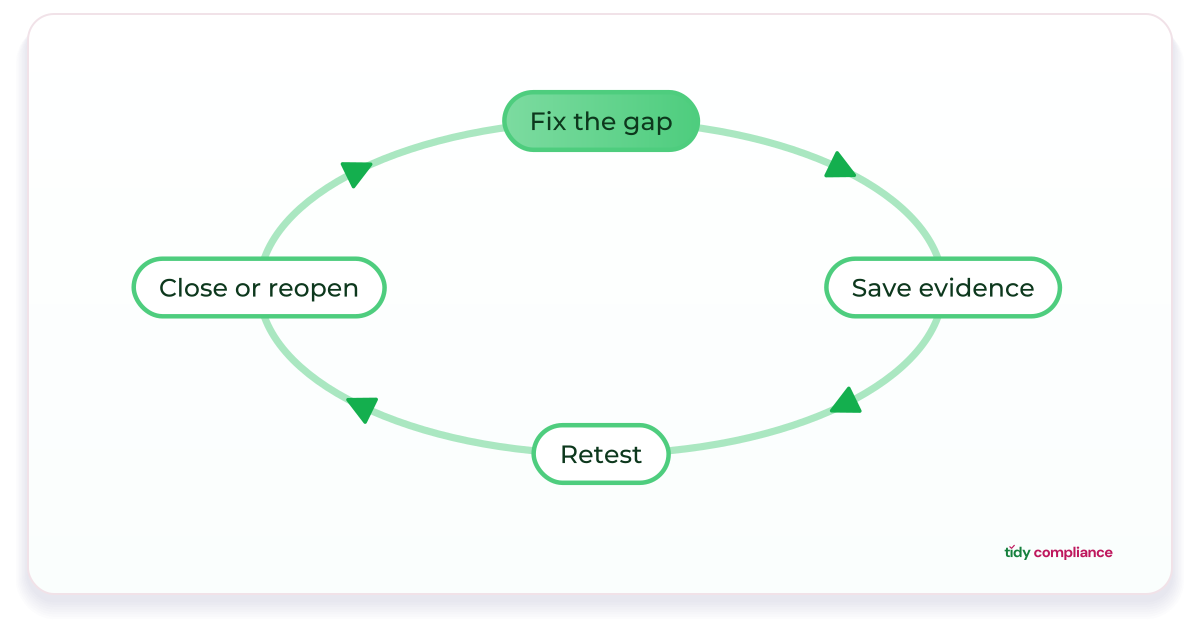
A finding is closed when the fix is in place and a retest passes. Record the owner, the due date, what changed and the retest evidence. Close high findings first, then group medium ones by system, so one engineer fixes related gaps in one sitting.
Some fixes take a quarter, such as replacing an unsupported system. Write a time-bound exception for those, with the compensating controls you run meanwhile and who accepted the risk. Auditors treat a documented, approved exception far better than a silent gap.
Internal Audit, Customer Audit or External Certification
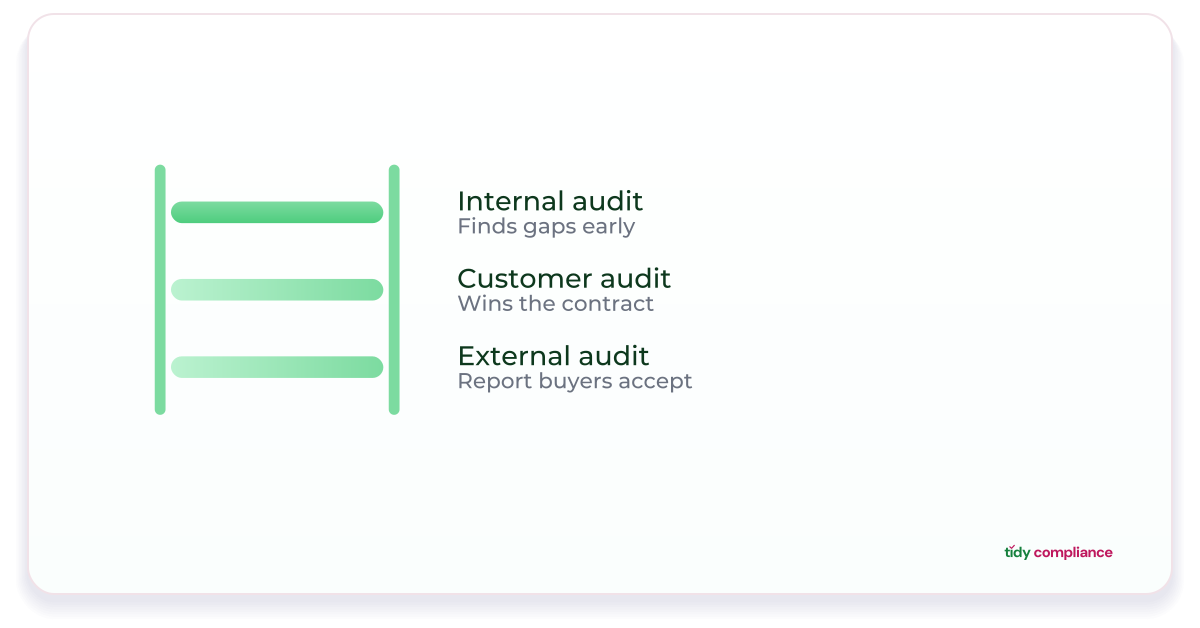
The framework is the same, and the stakes differ. An internal audit is your own rehearsal and the cheapest place to find gaps. A customer audit is a buyer reviewing your controls, often through a questionnaire and a call. An external audit, such as a SOC 2 report or an ISO 27001 certification, is done by an independent firm that must stay independent of the people who prepared you.
| Audit type | Who runs it | Best use |
|---|---|---|
| Internal | Your team or a consultant | Find gaps early and train owners |
| Customer | The buyer's security team | Win or keep a contract |
| External | An independent audit firm | A report or certificate buyers accept |
Run an internal audit before every external one. The internal audit costs a fraction of an external failure, and my IT compliance assessment guide shows how to judge readiness before you book an auditor. A step-by-step list for the pre-audit check is in my IT compliance checklist.
Keeping the Audit Cycle Light
Treat the audit as the visible part of a yearly rhythm. Review access every quarter, test backups twice a year, review vendors every year and refresh policies on a calendar. When these routines run all year, the audit week becomes a collection exercise and not a scramble.
Teams that struggle usually have the same cause: controls belong to everyone and therefore to no one. Name an owner for each control and a deputy, and review the list when people change roles. My notes in IT compliance best practices go into the habits that keep programs steady, and the IT compliance guide covers the basics if you are new to the field.
A Sample Eight-Week Internal Audit
Here is a schedule I use as a starting point for a company with one product, a small engineering team and about twenty in-scope systems. Treat it as a pattern and not a promise, because your own timeline depends on how fast owners respond and how much evidence already exists.
| Weeks | Work | Who is involved |
|---|---|---|
| 1 | Scope statement, control list and owners | Audit lead, IT lead, security owner |
| 2 | Test plan and sample sizes | Audit lead, control owners |
| 3 to 5 | Evidence collection and testing | Control owners, engineers |
| 6 | Findings drafted, rated and reviewed with owners | Audit lead, control owners |
| 7 | Fixes for high findings and retests | Engineers, IT lead |
| 8 | Final report and remediation tracker | Audit lead, leadership |
Most delays come from week three, when owners discover that the evidence they planned to pull does not exist in the form an auditor wants. Pulling a few samples in week one, before the plan is final, shows that problem early. A short meeting each Friday with owners keeps testing moving, and a shared tracker shows everyone what is outstanding.
At the end, brief leadership in plain language: how many findings, how many high, what the fixes cost and when the external audit can start. Decision-makers rarely need the detail. They need the list of what blocks the report and the date it clears.
How to Prepare for Your Next Audit
Work in this order: write the scope, pick the controls and tests, collect evidence into a folder, run an internal pass and fix high findings before the real audit. Bring in an outside reviewer if no one on your team has run an audit before, mainly for fresh eyes and honest ratings.
- Written scope with exclusions and reasons
- Test plan with sample sizes agreed in advance
- Evidence folder with an index per control
- Internal pass with rated findings
- Remediation tracker with owners and dates
- Retest evidence for every high finding
Sources
Questions About IT Compliance Audits
What Does an IT Compliance Audit Cover?
It covers whether your controls match the framework or contract you are measured against. Typical areas are access, change management, logging, backups, vulnerability management, vendors, incident response and policies and training records.
How Long Does an IT Compliance Audit Take?
An internal audit for a small company can take a few weeks. An external audit adds fieldwork and report time, and for a period-based report such as SOC 2 Type II the audit period itself runs for months. Ask your auditor for a timeline in writing.
What Is the Difference Between an Audit and an Assessment?
An assessment judges readiness against a framework and lists gaps. An audit tests whether controls work and produces a formal opinion or report when done by an independent firm. Many teams run an assessment first.
Who Should Run the Audit?
Run an internal audit with your own staff or a consultant. For SOC 2 reports and ISO 27001 certificates, an independent audit firm or certification body must do the assessment, so your consultant prepares you and does not audit you.
What Evidence Do Auditors Want?
Dated records from the system itself that cover the whole period: access approvals, change tickets, logs, test results and training records. Auditors usually test a sample, so keep the evidence complete.
How Do I Handle Findings I Cannot Fix Quickly?
Document an exception with an owner, a due date and the compensating controls you run meanwhile. Get the risk accepted in writing by the right person, and retest when the fix lands.
How Often Should I Audit My IT Controls?
Run a full internal audit once a year, review key controls every quarter and run a short check after major changes such as a new system or a new vendor.
Disclaimer: This article is for general information only and isn’t legal, financial or tax advice. Treat figures as estimates from typical work and confirm details with your providers before you act.
Was this guide helpful?
Thanks for your feedback.
Odessa Whitfield
Odessa leads the Tidy editorial team and works with the compliance consultants to turn real client projects into practical guides on regulations, frameworks, policies and audit preparation. Before joining Tidy, she worked in compliance and risk roles, writing and maintaining policy sets for regulated organizations. Every article goes through a consultant who has done the work in practice, and she updates guides when a rule, framework or tool changes. She works remotely from the United States.