Quick Summary
- Nine checks cover standards, hazards, programs, chemicals, machines, falls, emergencies, training and records.
- Walk the site and look for real proof, and mark a point open if you cannot show it in ten minutes.
- Fix visible hazards first, then missing programs and training, then recordkeeping routines.
- The checklist organizes your review and does not replace OSHA guidance or advice from your counsel.
Most OSHA problems at small and mid-sized workplaces are not exotic. A chemical without a label, a machine with a missing guard, a training record that stops two years ago. A short checklist finds these in an afternoon, before an inspector or an injury does.
This one has nine points that cover the topics I check first at the start of every OSHA compliance consulting project. It is a compliance aid, and it does not tell you which standards apply to your work or interpret them for you. Your counsel and OSHA's own materials do that.
How to Use This Checklist
Walk the site with a supervisor who knows the work. For each point, find the actual proof: a document, a log, a label on a container. If you cannot show it in ten minutes, mark the point open. Open items go on a list with an owner and a date.
Do not run it from your desk. Programs and logs tell you what should happen, and the floor tells you what does. The gap between the two is where most findings come from.
| Check | What to verify | Where the proof lives |
|---|---|---|
| 1. Applicable standards | You know whether general industry, construction or other standards apply to each task | Standards list, site map |
| 2. Hazard assessment | Hazards are walked, written down and rated | Walkthrough notes, hazard register |
| 3. Written programs | Required programs exist, fit your work and are current | Program documents with dates |
| 4. Hazard communication | Chemicals are listed, labeled and have safety data sheets at hand | Chemical inventory, SDS binder or system |
| 5. Machine safety and lockout/tagout | Guards are in place and energy control steps are written and used | Procedures, inspection records |
| 6. Falls, ladders and walking surfaces | Edges, ladders, floors and stairs are safe and checked | Inspection checklists, photos |
| 7. Emergency planning | Exits, alarms, extinguishers and first aid are ready and practiced | Emergency plan, drill records |
| 8. Training | Workers are trained on the hazards of their tasks, with proof | Sign-in sheets, training matrix |
| 9. Injury and illness records | Incidents are logged, summarized and reported on time | Logs, summaries, report copies |
The Nine Checks in Detail
Each check says why it matters, how it usually goes wrong and what to look for.
1. Applicable Standards
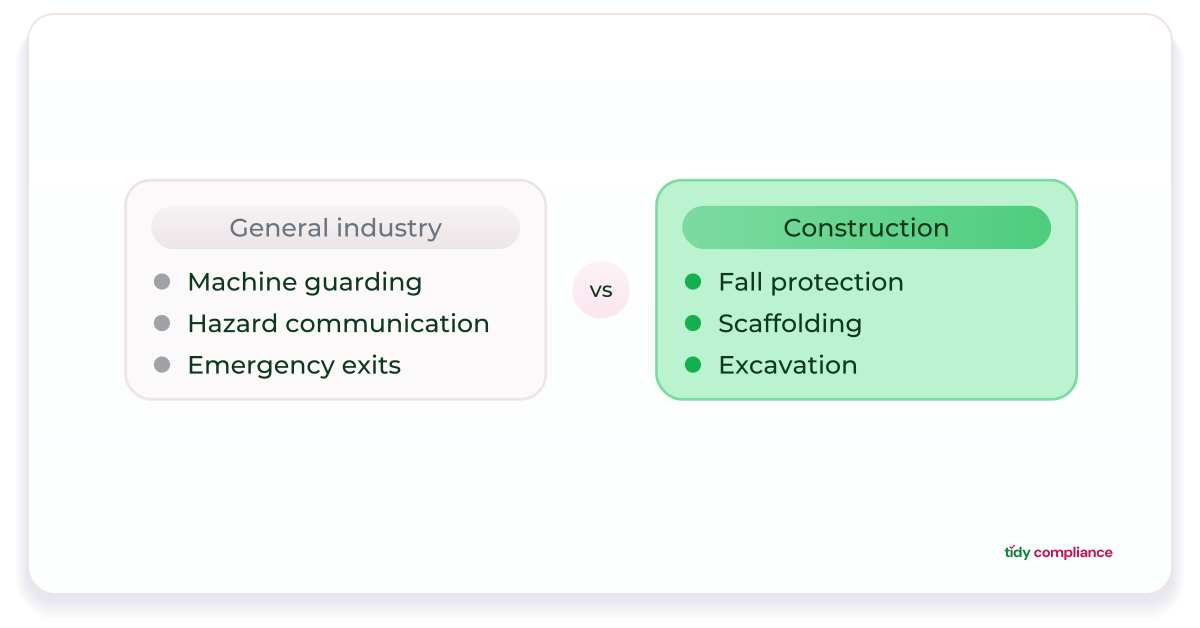
OSHA groups its rules by type of work. Construction has its own set, general industry covers most other workplaces, and some activities such as confined spaces or respiratory protection bring specific requirements. Start by listing what your people do, then match tasks to the standards that cover them.
The common mistake is assuming one set fits every site. A company with an office, a warehouse and a delivery fleet has three different pictures. If a task is unclear, ask OSHA or your counsel, and write down the answer.
- Tasks are listed for each site
- Each task is matched to the standards that apply
- Questions are logged with the answer and date
2. Hazard Assessment
A hazard assessment is a walk with a notepad. Look at tasks, equipment, materials and conditions, and write down what could hurt someone. Include noise, heat, vehicles, manual handling and chemicals.
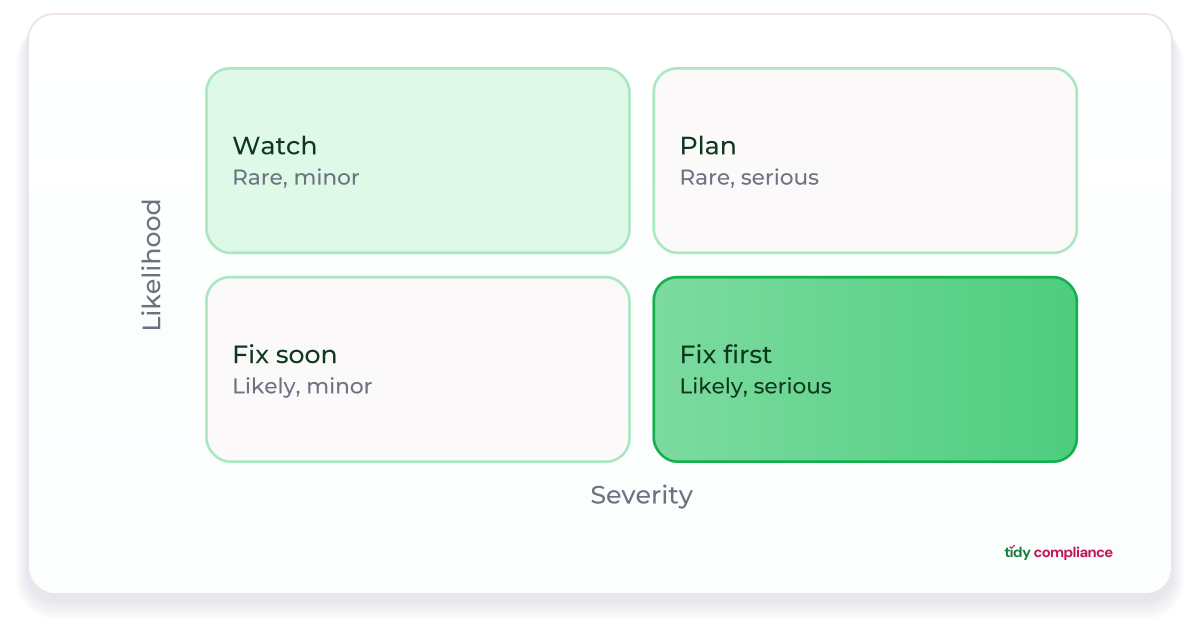
Rate each hazard by how likely harm is and how bad it could be, and decide on a control. Repeat when something changes: a new machine, a new product, a new site. A register with dates shows an inspector that you look.
- A written hazard register exists for each site
- Each hazard has a rating, a control and an owner
- The register was reviewed in the last twelve months
3. Written Programs
Several standards expect written programs, including hazard communication, lockout/tagout, respiratory protection and emergency action plans, depending on your work. Check that each required program exists, names a responsible person and describes your equipment and tasks.
A template with someone else's company name in a footer is the classic finding. Read the program next to the machine it describes and see whether the steps match.
- Every program that applies to your work exists
- Programs name owners, tasks and equipment
- Review dates are recent
4. Hazard Communication
If workers use or are exposed to hazardous chemicals, they need to know what they are. That means a chemical list, labels on containers, safety data sheets that workers can reach during a shift and training on how to read them.
Walk the storage area and read ten labels. Look for unlabeled spray bottles and decanted containers, which are the usual gaps. Compare the chemical list with what is actually on the shelves, because new products sneak in.
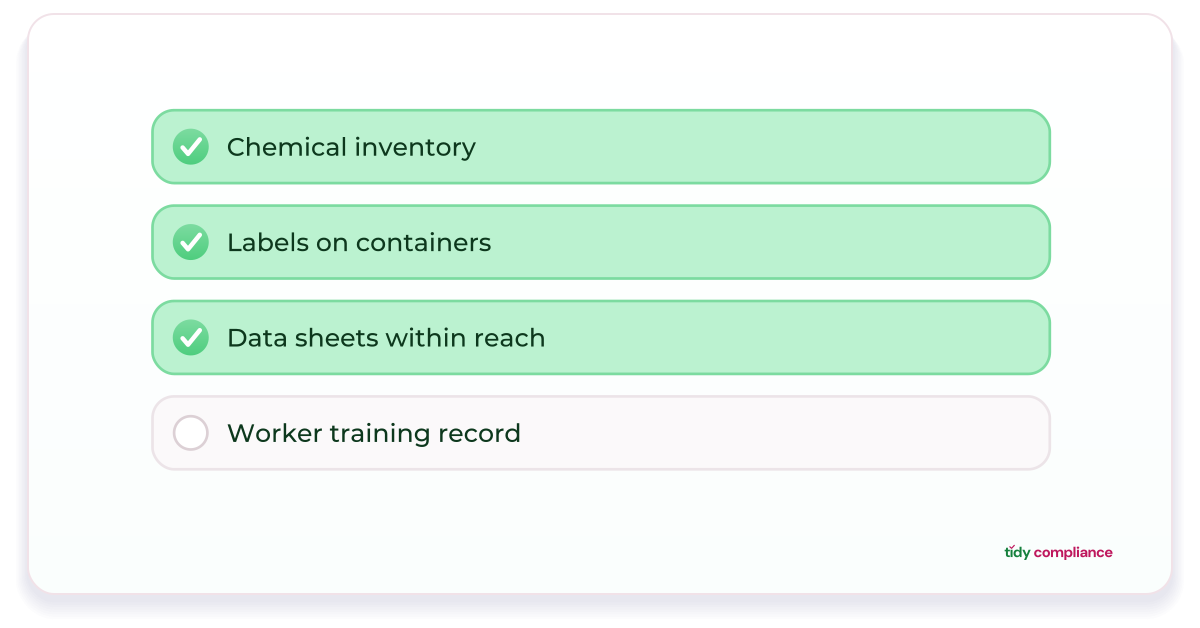
- A current chemical inventory exists
- Containers are labeled, including secondary ones
- Safety data sheets are accessible on every shift
5. Machine Safety and Lockout/Tagout
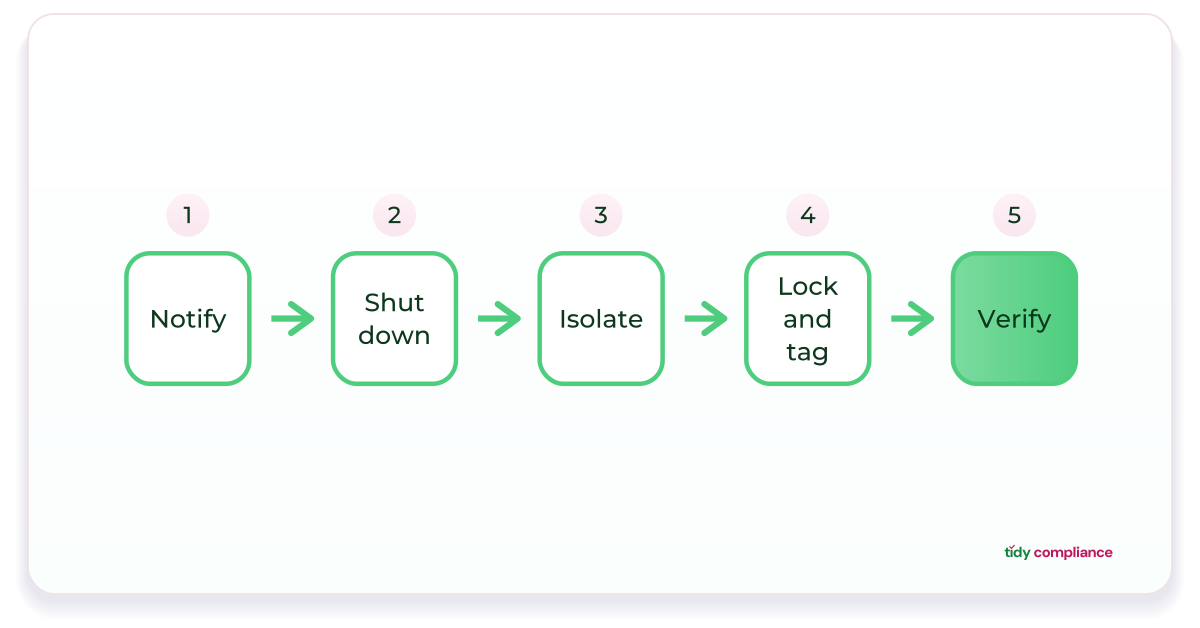
Look for missing guards, bypassed interlocks and exposed moving parts. For servicing equipment, check that energy sources are shut off and locked, with written steps for each machine type.
Ask a mechanic to show you the steps on one machine and compare it with the written procedure. Workers who service machines should be trained, and supervisors should know when the procedure applies.
- Guards are in place and interlocks are not bypassed
- Written lockout/tagout steps exist for each machine type
- Authorized workers can show the procedure
6. Falls, Ladders and Walking Surfaces
Falls are among the most frequently cited problem areas in OSHA's published lists. Look at floor openings, edges, stairs, ladders and platforms, and keep floors clear and dry. Check ladders for damage and see that people use them correctly.
For work at height, check what protection is used and whether people have been trained on it. Housekeeping belongs here too: cords, boxes and spills in walkways cause plenty of injuries.
- Ladders are inspected and in good condition
- Edges, openings and platforms have protection where required
- Walkways are clear and spills are cleaned promptly
7. Emergency Planning
Walk the exit routes. Doors should open, aisles should be clear and signs should be visible. Check fire extinguishers for charge and inspection dates, and see that first aid supplies are stocked and a trained person is available.
Hold a drill at least once a year and write down what went wrong. A drill where everyone already knew the plan teaches little, so change the scenario.
- Exits are unlocked, marked and clear
- Extinguishers and first aid supplies are current
- A drill was held and documented in the last twelve months
8. Training
Workers should be trained on the hazards of their own tasks, in a language and at a level they understand. Keep a training matrix that shows who needs what, when it was done and when it expires.
Ask two workers a simple question from a recent session. Their answers tell you more than the sign-in sheet.
- A training matrix covers each role and task
- Sign-in sheets or records exist for each session
- New hires are trained before they start the task
9. Injury and Illness Records
Many employers with more than ten employees must record work-related injuries and illnesses on OSHA forms 300, 300A and 301, or equivalent forms, although some industries are exempt. Severe incidents must be reported to OSHA within set times: a work-related fatality within eight hours, and an in-patient hospitalization, amputation or loss of an eye within 24 hours.
Check that someone owns the log, that entries are made promptly and that the annual summary is prepared and shared as the rules require. Confirm current deadlines and details on OSHA's recordkeeping page rather than relying on memory.
- One named person owns the log
- Entries are made promptly and are complete
- Staff know when a severe incident must be reported to OSHA
Scoring Your Results
Mark each point green if you found complete proof, yellow if it exists but is out of date and red if it is missing. Three or more yellow or red points suggest a full OSHA compliance audit, which tests programs, records and the floor in more depth.
Fix reds first. Many gaps take under an hour once someone owns them, such as labeling containers or posting a corrected exit sign. Bigger items, such as a new lockout/tagout program, go on a calendar.
Making It Routine
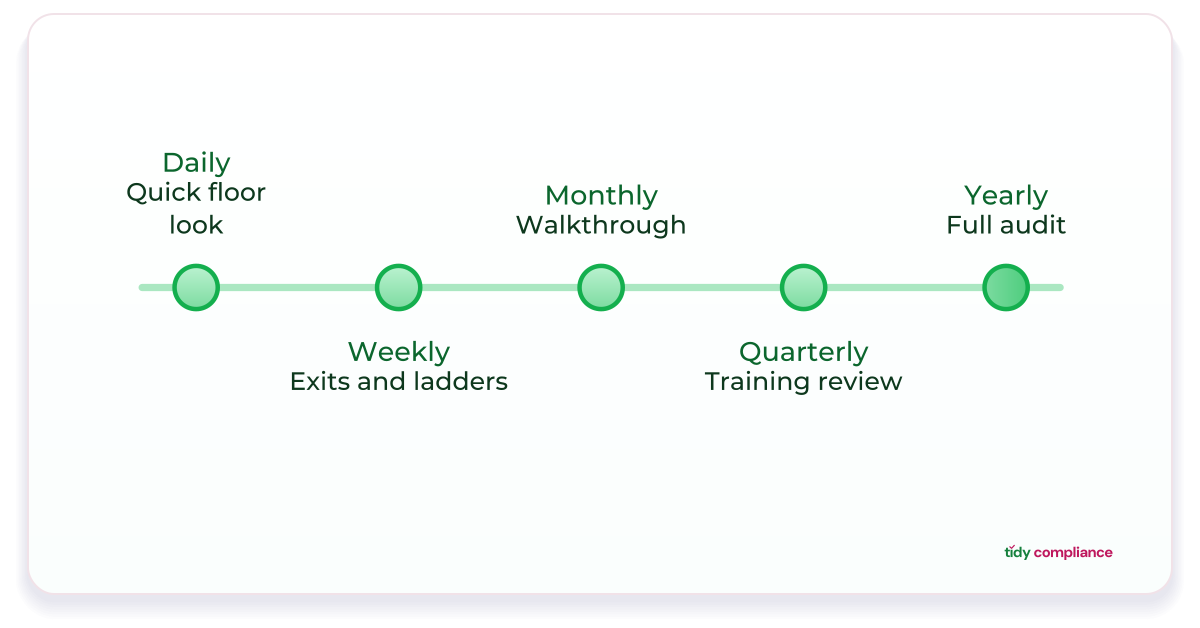
A one-time checklist is a snapshot. Put a short version on a monthly walkthrough, give each area an owner and keep the results in one folder. If you are new to the rules, my OSHA compliance guide explains the basics behind these checks, and the notes on OSHA compliance for small business show what to prioritize with limited time.
Software can hold training records and send reminders. If you are weighing options, see my ranking of OSHA compliance software.
Contractors, Temporary Workers and Visitors
Safety duties do not stop at your own payroll. Contractors, temporary workers and visitors share your site, and a hazard you create can hurt them. Brief them on site rules, emergency exits and the hazards of the areas they enter, and agree in writing who is responsible for what. Ask contractors for their own safety records before work begins.
How to Choose What to Fix First
Start with items that remove the most risk for the least effort. Labels, guards, clear exits and ladder checks are quick. Written programs and training take more time and often need help.
- Fix visible hazards and missing labels this week.
- Write or refresh the programs that apply to your work next.
- Schedule training and the recordkeeping routine with owners and dates.
- Repeat the checklist every quarter and after changes to equipment or tasks.
Questions About the OSHA Compliance Checklist
What Is an OSHA Compliance Checklist?
It is a short list of safety topics you use to check that your workplace, programs and records meet the OSHA standards that apply to you. It helps you find gaps before an inspection or an injury.
Is This Checklist Legal Advice?
No. It organizes your review and helps you find gaps. Which standards apply depends on your industry and tasks, so confirm with OSHA, your counsel or a qualified safety professional.
Does Passing This Checklist Mean I Am Compliant?
No. The checklist covers common areas and does not list every standard. It shows where to look, and a full audit tests more deeply against the standards for your work.
How Often Should I Run the Checklist?
A full pass twice a year and a short walkthrough monthly works for many employers. Run it again after new equipment, new chemicals or a new site.
Who Should Own Safety Compliance in a Small Business?
One named person, often an owner, operations lead or safety coordinator, should hold the list and the records. Give them time and the authority to stop unsafe work.
What Records Should I Keep?
Typical records include hazard assessments, written programs, training sign-in sheets, inspection checklists, chemical lists with safety data sheets and injury and illness logs. Retention periods depend on the record, so check the current requirements.
When Should I Bring in a Consultant?
When you do not know which standards apply, when your programs are old, when an inspection or customer audit is coming or when the first pass finds many gaps. A consultant ranks them and writes the missing documents.
Sources
Disclaimer: This article is general compliance information and not legal advice. Requirements depend on your location, industry and facts, so confirm what applies to you with qualified counsel or the issuing authority.
Was this guide helpful?
Thanks for your feedback.
Odessa Whitfield
Odessa leads the Tidy editorial team and works with the compliance consultants to turn real client projects into practical guides on regulations, frameworks, policies and audit preparation. Before joining Tidy, she worked in compliance and risk roles, writing and maintaining policy sets for regulated organizations. Every article goes through a consultant who has done the work in practice, and she updates guides when a rule, framework or tool changes. She works remotely from the United States.