Quick Summary
- Small employers still owe a safe workplace, but many paperwork duties depend on size and industry.
- A monthly site walk and a dated hazard list are the cheapest wins.
- OSHA offers a free, confidential On-Site Consultation Program for small businesses.
- Short training sessions with a sign-in sheet beat annual lectures with no proof.
Most small employers I talk to about safety are not ignoring it. They are busy, and OSHA looks like a wall of rules written for factories. A twelve-person landscaping crew, a dental office and a machine shop all fall under the same agency, and the first thing I tell them is that the basics are smaller than they fear. As part of my OSHA compliance consulting work, I start small teams with a short list of habits and leave the heavy programs for later.
The simple wins below are the ones I see pay off fastest. Each one is cheap, takes hours rather than weeks and leaves a record you can show an inspector. Start with the table to see what usually applies at your size, then work through the wins in order.
What Usually Applies to a Small Employer
OSHA covers most private employers, whatever the headcount. Size changes some paperwork duties, not your basic duty to keep the workplace free of recognized hazards. Industry matters more than headcount: a roofing crew has a very different list from an accounting office.
| Area | What often applies at small size | Where to check |
|---|---|---|
| General duty | Keep the workplace free of recognized serious hazards | OSHA small business pages |
| Injury and illness records | Employers with 10 or fewer employees are partially exempt from routine recordkeeping, and some low-hazard industries are too, but exceptions exist | OSHA recordkeeping page |
| Reporting serious events | Every covered employer reports work-related fatalities, inpatient hospitalizations, amputations and eye loss, regardless of size | OSHA recordkeeping page |
| Hazard communication | Applies if workers use hazardous chemicals, such as cleaners, solvents or fuels | OSHA hazcom page |
| Training and PPE | Depends on your tasks, such as ladders, machinery or noise | Standards for your industry |
| Free help | The On-Site Consultation Program for small businesses | OSHA consultation page |
Check each row against your own industry and state. Some states run their own occupational safety programs with different details, and exemptions have conditions. The table is a starting map, not a ruling, and my OSHA compliance guide explains how the pieces fit together.
1. Walk the Site With a Fresh Pair of Eyes
The cheapest safety tool is a thirty-minute walk with a notepad. Look at floors, exits, ladders, cords, guards, chemicals and anything that makes you wince. In small shops I find the same few hazards again and again: blocked exits, damaged ladders, missing machine guards and cluttered walkways.
Write down what you see, who will fix it and by when. A dated list is already better than most small employers have. Repeat the walk monthly, and invite one employee each time, because workers notice what owners no longer see.
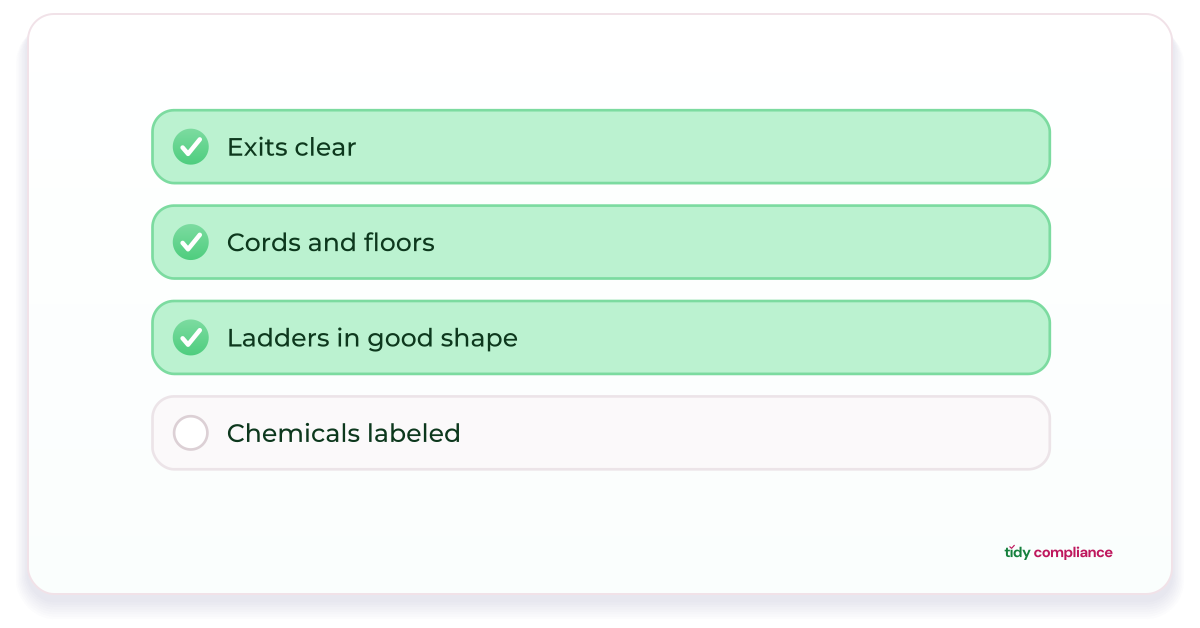
- Exits and aisles clear and lit
- Ladders, cords and tools in good condition
- Machine guards in place
- Chemical containers labeled and stored properly
2. Use the Free On-Site Consultation Program
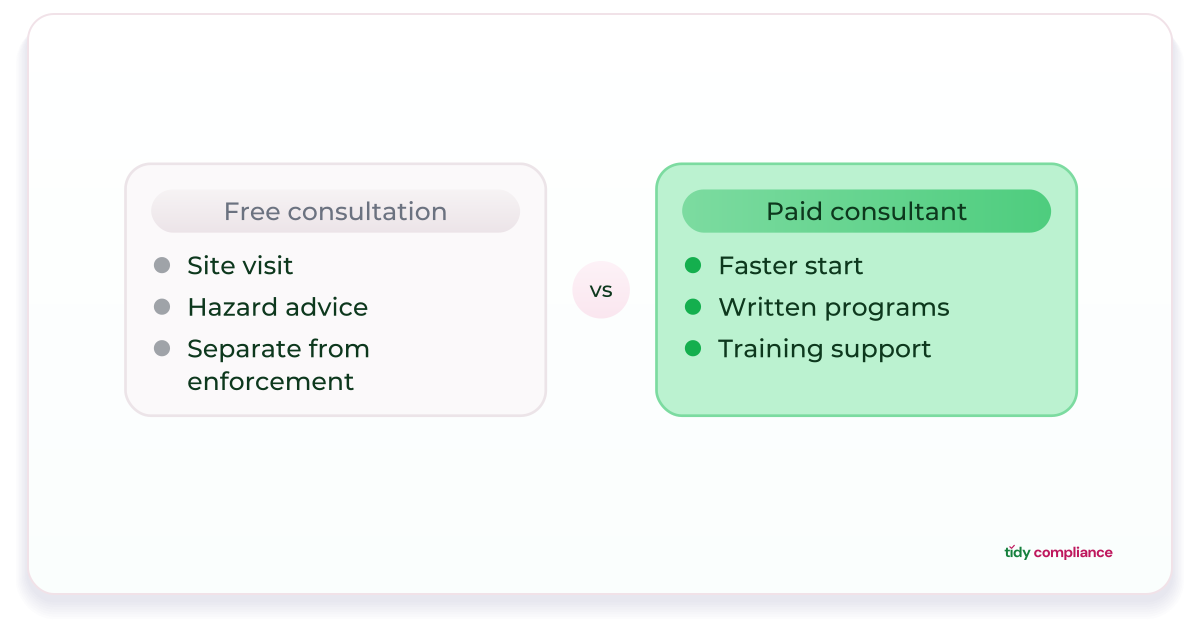
OSHA runs a free and confidential On-Site Consultation Program for small and medium-sized businesses, delivered through state agencies and separate from enforcement. A consultant visits, identifies hazards and helps you fix them. OSHA states that consultants do not issue citations or penalties, and your information is not passed to enforcement staff, as long as you correct serious hazards on an agreed timeline. The details are on the OSHA consultation page.
I treat it as the best first move for a small employer with a real hazard question. Wait times differ by state, so ask early. A private consultant can still help with the program around the visit, for example by turning the findings into written procedures and training.
3. Learn Your Recordkeeping Duties Once
Recordkeeping confuses small employers more than any other topic, because the rules depend on headcount and industry. First find out whether you are partially exempt. If you are not, you keep the OSHA 300 log, the 300A annual summary and a 301 incident report for each recordable case, and you post the summary at the time OSHA specifies. Check the current requirements on the OSHA recordkeeping page.
Even when you are exempt from routine records, still report serious events on time and still write down every injury, even small ones. A simple log with date, person, what happened and what you changed catches patterns. Two cut hands from the same tool in a month is a message.
- Decide once whether you are exempt, and write down why
- Name one person who keeps the log
- Know who calls OSHA after a serious injury and how
4. Label Chemicals and Keep the Safety Data Sheets
If your workers use cleaners, paints, fuels or solvents, the Hazard Communication standard probably applies. In plain terms you need labeled containers, a safety data sheet for each hazardous product, a short written program and training. OSHA explains the standard on its hazard communication page.
The simple win is a binder or shared folder of data sheets with a one-page list of products. Walk the shop and compare what you find with the list. You will discover a few containers no one remembers buying. Remove them or label them, then add the product to the list.
5. Train in Short Sessions and Write It Down
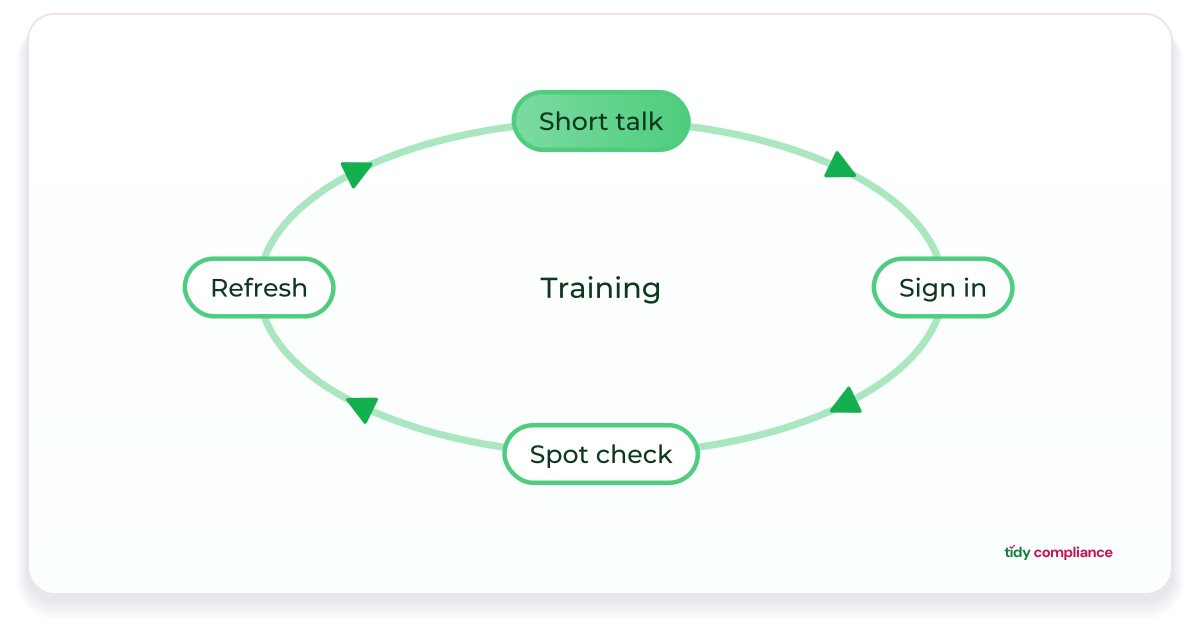
Safety training for a small team does not need a classroom. Ten minutes at the start of a shift on one topic works better than an annual lecture. Pick the hazard that is most likely to hurt your people, such as ladder use or lifting, show the right way and let workers ask questions.
Record who attended, the date and the topic. In my client work the training itself is usually fine, but the proof is missing. A sign-in sheet takes thirty seconds and is worth a lot in an inspection or an insurance review. New hires get the same talk on day one, before they work alone.
| Topic | Who needs it | How often to refresh |
|---|---|---|
| Ladders and falls | Anyone working at height | At hire and when tasks change |
| Chemical hazards | Anyone using hazardous products | At hire and when products change |
| Lifting and ergonomics | Warehouse, healthcare and trades staff | Every few months in a short talk |
| Emergency exits and fire | Everyone | At hire and after any layout change |
6. Write a Short Emergency and Injury Plan
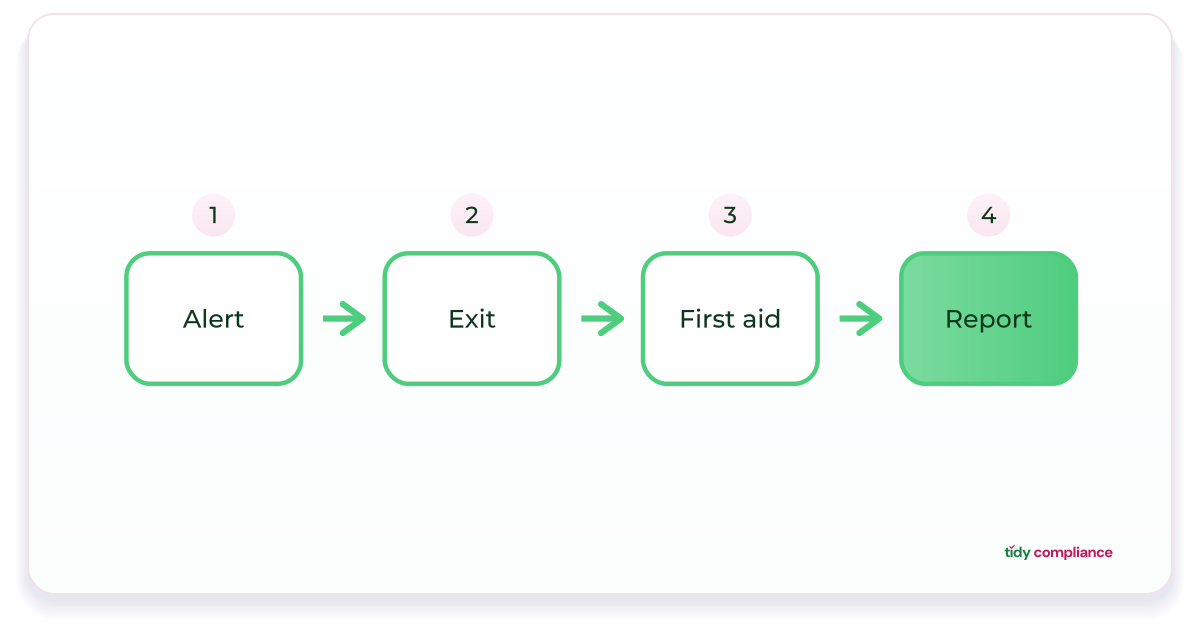
A one-page plan answers what happens when someone is hurt or a fire starts. List the nearest clinic, who calls emergency services, where first aid supplies are kept, who has been trained and where people meet outside. Post it by the time clock or the break room door.
Run it once as a drill. You will find the first aid kit is empty or that nobody knows where the fire extinguisher is. That is the point of a drill. Fix the gaps and note the date. The same plan also tells you who reports a serious injury to OSHA within the required time.
- Clinic address and phone number posted
- First aid kit stocked and checked monthly
- Named person to call emergency services and OSHA
- Meeting place outside for evacuations
7. Fix Things in Order of Danger
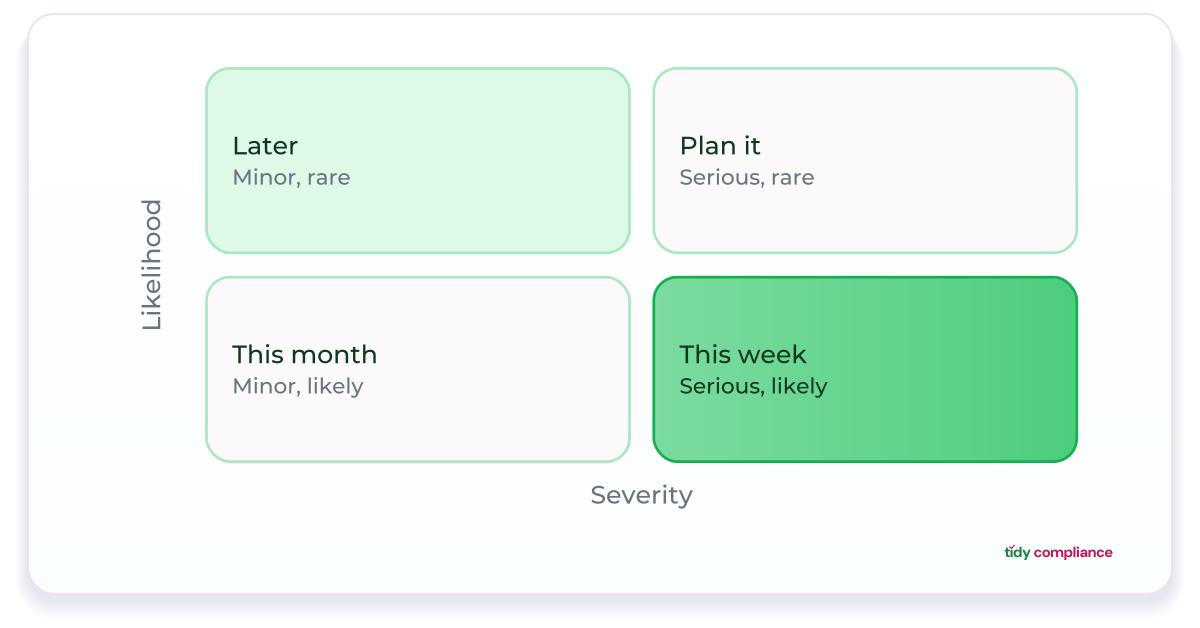
You will always have more hazards than budget. Rank them by how badly someone could be hurt and how likely that is. A missing guard on a saw beats a faded sign. Put the top three on a list with names and dates, and review the list at the monthly walk.
Do not hide behind perfect. A small employer that fixes the top three hazards every month for a year is far safer than one that plans a full program and never starts. If you want to see how an outsider would judge your progress, read about an OSHA compliance audit, and use the OSHA compliance checklist to confirm nothing basic is missing.
Mistakes That Cost Small Employers the Most
Small employers rarely fail because of a clever violation. They fail on basics that were easy to see. The table pairs the habit I see most with the fix.
| Mistake | In practice | Better habit |
|---|---|---|
| Assuming exemption without checking | Paperwork skipped because someone said small shops do not need it | Confirm with OSHA's pages or a consultant and write it down |
| Training with no proof | Everyone was told, nobody signed | Sign-in sheet for every session |
| Fixing hazards without a record | Guard repaired, nothing noted | Dated line on the hazard list |
| Treating contractors as someone else's problem | Subcontractor crew works without rules | Brief them on your site hazards before they start |
| Waiting for an inspector | No routine, only panic | Monthly walk and quarterly review |
Temporary workers and contractors deserve a note. Staffing agencies and host employers often share responsibility, so agree in writing who trains whom and who provides protective equipment.
When Software or a Consultant Starts to Make Sense
You can run all seven wins with a spreadsheet and a shared folder. Add a tool when the walk-through results pile up, when you have several sites or when you want reminders. A mobile inspection app at a few dollars per user a month is often enough. My ranking of OSHA compliance software shows the options and published prices.
A consultant helps when a hazard needs an expert, when an inspection is coming or when you have no one to own the program. Ask for a gap assessment first, with a ranked list and a fixed quote. Many small teams do best with a mix: the free state consultation for hazards, a spreadsheet for tracking and an occasional outside review.
How to Start This Week
Do not try all seven wins at once. Pick the order that matches your risks and keep the first month light.
- Week 1: walk the site and write the hazard list.
- Week 2: fix the top three items and book the free consultation if you need it.
- Week 3: sort out chemical labels and data sheets.
- Week 4: hold your first ten-minute training and keep the sign-in sheet.
After that, repeat the walk monthly and add one new habit each quarter. Within a year you have a living program that is small, cheap and real.
Sources
OSHA: On-Site Consultation Program, OSHA: Recordkeeping, OSHA: Hazard Communication.
Questions About OSHA Compliance for Small Businesses
Does OSHA Apply to Small Businesses?
Yes. Most private employers are covered regardless of size. The general duty to provide a safe workplace applies to everyone, while some recordkeeping duties depend on headcount and industry.
Are Businesses with Fewer than 10 Employees Exempt from OSHA?
Not from OSHA as a whole. Employers with 10 or fewer employees are partially exempt from routine injury and illness recordkeeping, and certain low-hazard industries are too, but all covered employers must still report fatalities and certain serious injuries. Check the OSHA recordkeeping page for details.
What Is the OSHA On-Site Consultation Program?
It is a free and confidential service for small and medium-sized businesses, run through state agencies and separate from enforcement. A consultant helps you find and fix hazards. Availability and wait times differ by state.
What Are the Most Common OSHA Problems for Small Employers?
In my experience they are missing hazard communication, untrained workers, blocked exits, unguarded machines and no proof of training. All are fixable with low-cost habits.
Do I Need a Written Safety Program?
Some standards require written programs, such as hazard communication in workplaces with hazardous chemicals. Even where it is not required, a short written plan makes training and follow-up easier. Check the standards for your industry.
How Much Does OSHA Compliance Cost a Small Business?
The basics cost mostly time: a monthly walk, short training and a hazard list. Real spending goes to fixing hazards, protective equipment and, optionally, software or a consultant. A free state consultation can reduce outside costs.
Do I Need a Consultant to Be Compliant?
Not always. Many small employers manage with the free state consultation, OSHA's published guidance and a simple tracking sheet. A consultant is useful for complex hazards, inspection prep or when no one inside can own the program.
Disclaimer: This article is for general information only and isn’t legal, financial or tax advice. Treat figures as estimates from typical work and confirm details with your providers before you act.
Was this guide helpful?
Thanks for your feedback.
Odessa Whitfield
Odessa leads the Tidy editorial team and works with the compliance consultants to turn real client projects into practical guides on regulations, frameworks, policies and audit preparation. Before joining Tidy, she worked in compliance and risk roles, writing and maintaining policy sets for regulated organizations. Every article goes through a consultant who has done the work in practice, and she updates guides when a rule, framework or tool changes. She works remotely from the United States.