Quick Summary
- You do not need a department. A short handbook, clean hiring files and a yearly calendar cover most small-business risk.
- Pay and classification mistakes cost the most, so check overtime rules and contractor status first.
- Rules and thresholds change by state and by headcount, so recheck them each time you hire.
- Use software for reminders and storage, and bring in an expert for judgment calls.
If you run a company with ten, thirty or eighty people, HR compliance can feel like a rulebook written for someone else. It is written for you too, and the rules often arrive before you have anyone to handle them. Many owners I talk to with HR compliance consulting questions start with the same sentence: "I just never had time."
This guide covers the simple wins first. They cost little, they take hours rather than weeks, and they remove the problems I see most often in small employers. It is general information and not legal advice, so check state and local rules with an employment attorney or the relevant agency.
Why Small Employers Get Caught
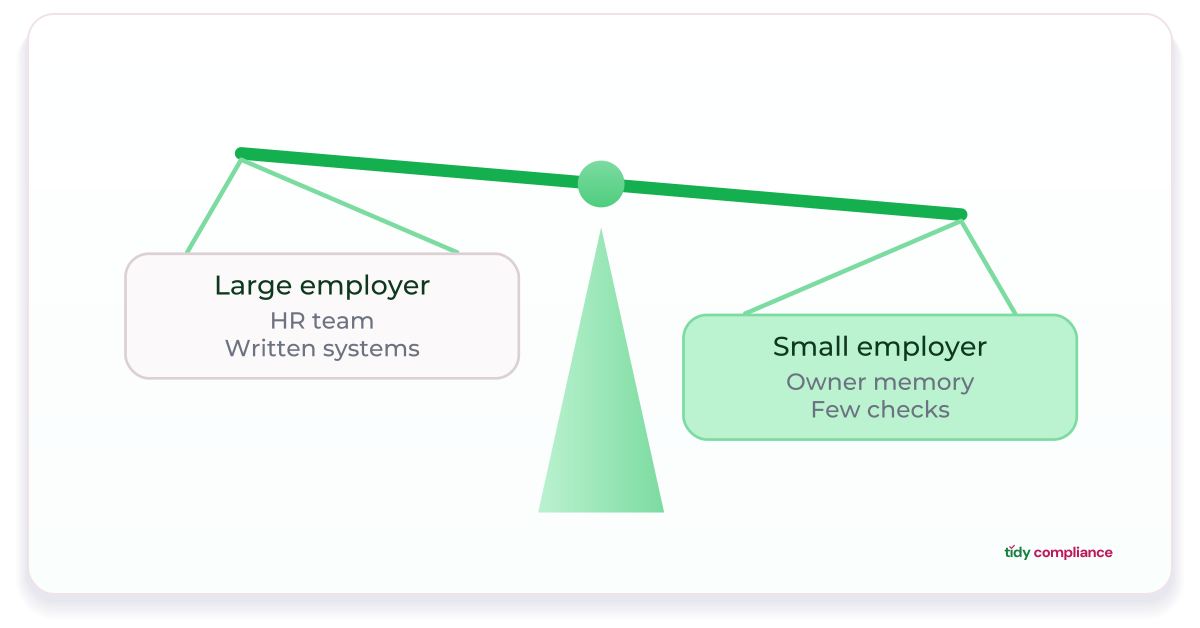
Small companies are not careless. They are busy, and the owner often handles HR on top of sales, delivery and cash. The result is a pattern: informal pay arrangements, paperwork that gets done late and policies that live in someone's head.
Big employers have the same risks but also have systems. A small company has fewer people to affect, which is good, and fewer people to catch mistakes, which is not. One misclassified role or one skipped form does not feel like a problem until a former employee files a claim or an agency asks for records.
The good news is that a few habits cut most of this exposure. I rank them below in the order I would tackle them.
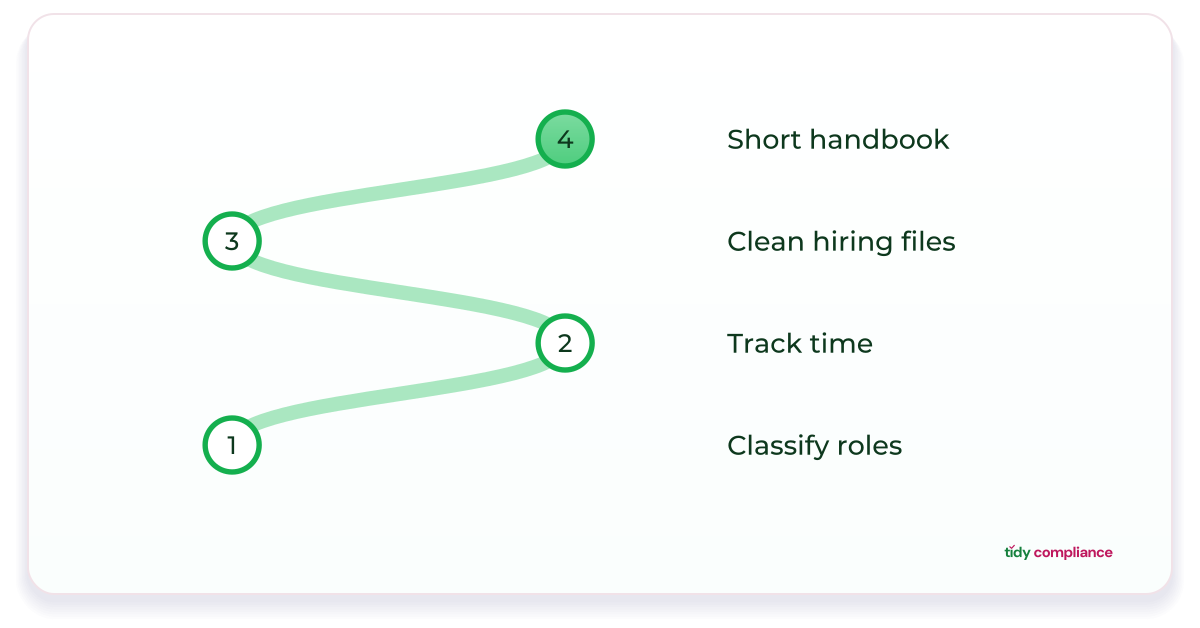
Seven Simple Wins, in Order
| Win | Time to set up | Risk it reduces |
|---|---|---|
| 1. Classify every worker correctly | A few hours | Unpaid overtime and contractor disputes |
| 2. Record working time properly | One afternoon | Back-pay claims |
| 3. Build clean hiring files | One day | Missing or late forms |
| 4. Write a short handbook | Two to three days with review | Inconsistent decisions |
| 5. Set a leave routine | A few hours | Late notices, unequal treatment |
| 6. Separate and protect records | A few hours | Privacy problems |
| 7. Put the year on a calendar | One hour | Missed filings and renewals |
1. Classify Every Worker Correctly
Start with two questions for each role. Is the person an employee or a contractor? If an employee, is the role exempt from overtime or not? Both answers are decided by tests, not by what you call the person or what you agreed to pay. The U.S. Department of Labor explains the federal tests on its Fair Labor Standards Act pages, and many states apply stricter ones.
I would write down your reasoning for each role, including the duties and the working arrangement, and ask an attorney to review the borderline ones. A salaried office manager who spends most of the week on routine tasks is a frequent example of a role that needs a second look. So is a long-term contractor who works set hours on your premises.
2. Record Working Time Properly
For employees who are owed overtime, you need accurate records of hours worked. A simple time-tracking tool works. What matters is that people record real start and stop times, including short tasks before and after shifts, and that managers do not edit them without a note.
Once a month, compare a few time records against the pay register. If hours and pay disagree, find out why. This one habit finds more problems than any other check I run in smaller companies.
3. Build Clean Hiring Files
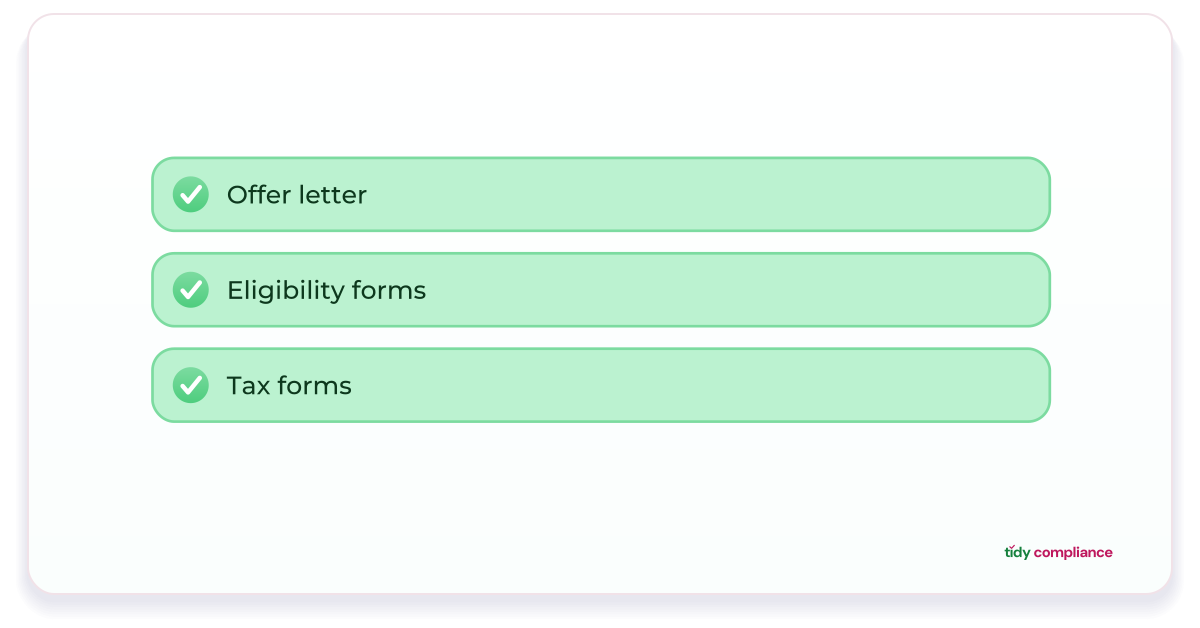
Give every new hire the same set of documents in the same order: offer letter, tax forms, the employment eligibility form with the supporting documents handled as the rules require, a signed handbook acknowledgment and any state notices. Use a one-page checklist and tick it off for each person.
Keep the employment eligibility paperwork in its own folder, separate from the general personnel file. If you are not sure how to complete the form, the U.S. Citizenship and Immigration Services guidance explains each section.
4. Write a Short Handbook
A good small-business handbook runs 15 to 25 pages. Cover the basics in plain language: how and when people are paid, time off, conduct, anti-harassment and complaint steps, safety and how to raise a concern. Leave out anything you will not enforce, because a rule that is ignored is worse than no rule.
Ask an employment attorney to review it for the states you operate in, and have each employee sign an acknowledgment. When you hire in a new state, review the handbook again, because notices and leave rules differ.
5. Set a Leave Routine
Leave rules are a patchwork of federal, state and local laws, and some apply only above a certain size. Write down the leave you offer and the steps for a request: who gets the request, who decides, how fast you reply and where you file the paperwork.
The important habit is that managers send leave questions to one person. When a manager decides alone, two people in the same situation get two different answers, and that inconsistency causes more disputes than the leave itself.
6. Separate and Protect Records
Keep medical and leave documents, background checks and employment eligibility forms apart from the general personnel file, with access limited to the few people who need them. Set a retention period for each type of record and delete or archive on schedule, after checking the minimum periods that apply to you.
7. Put the Year on a Calendar
A calendar turns a vague duty into a date. Use the table below as a template and change it to match your states and plans.
| When | What to do |
|---|---|
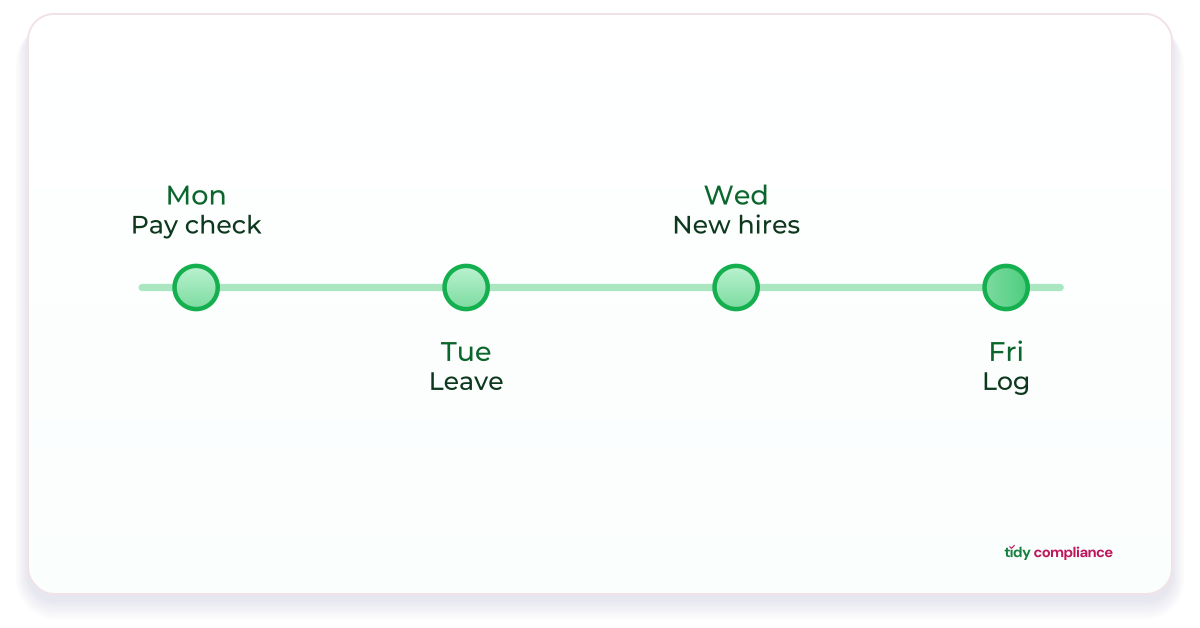
| Every month | Compare time records with pay, check new-hire files and review open leave cases |
| Every quarter | Review contractor list, update the org chart and check for new locations or states |
| Twice a year | Run manager refreshers on timekeeping, leave requests and complaints |
| Every year | Review the handbook, run a short audit and confirm required filings and notices |
For the yearly review, my HR compliance audit method scores gaps by risk, and the HR compliance checklist gives you a ready-made list to start from.
What a Light Version Looks Like in Practice
Picture a company of 25 people in two states. The owner names the office manager as HR owner and gives her two hours a week. In the first month, she lists every worker and marks each as employee or contractor, exempt or non-exempt, and sends the borderline cases to an attorney. In month two she builds a new-hire checklist and fixes the files of current staff. In month three the handbook goes to attorney review.
After that the routine takes over. Each month she compares time records with pay for five people, reviews open leave cases and checks that new hires have complete files. Each quarter she updates the contractor list. Once a year she runs a short audit. The total effort is a few hours a month, and the owner reads a one-page summary every quarter.
What to Buy and What to Skip
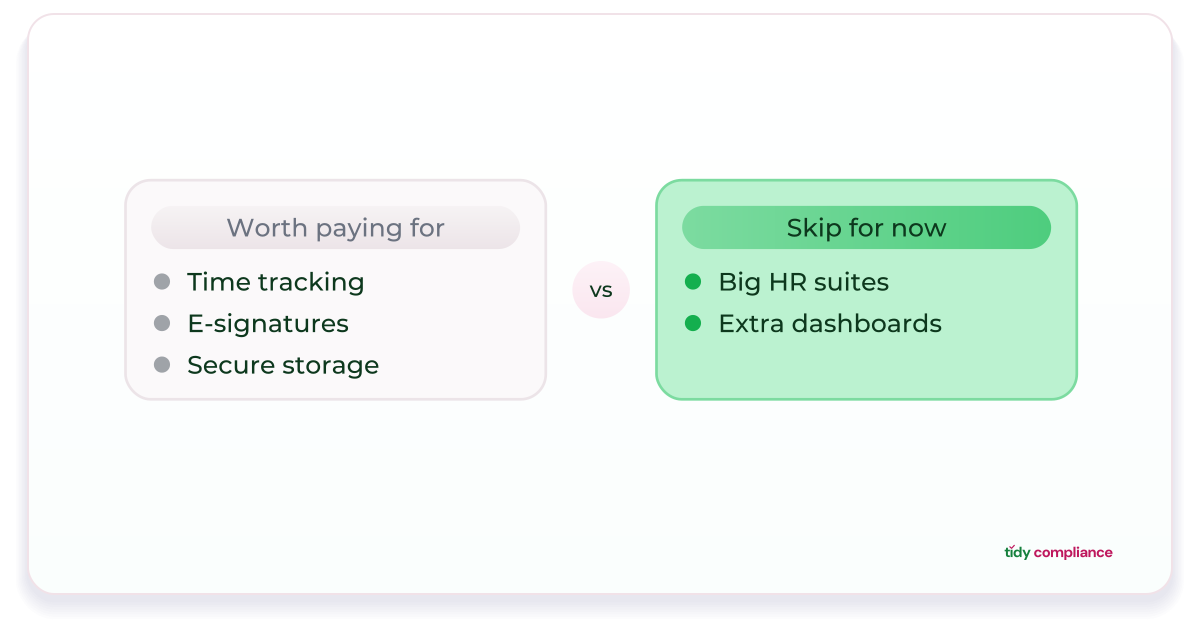
Small teams rarely need an enterprise platform. A payroll provider with time tracking, a document folder with restricted access and a way to collect e-signatures cover most needs. Compare options with care, because the cheapest tool often leaves out reminders and reporting. I compare the main choices in my review of HR compliance software.
Do not buy a tool to solve a decision problem. Software will not tell you whether a role is exempt. It will only record the answer you gave it.
Who Owns HR Compliance When Nobody Is in HR
Give one person the job, even if it takes two hours a week. That person owns the calendar, the folders and the question box for managers. Name a backup. In a company of 20, this is often the office manager or the finance lead, and the owner reviews the calendar each quarter.
Train managers on the three moments where small mistakes become large ones: recording hours, answering a leave request and responding to a complaint. A 45-minute session twice a year does the job. The habits listed in HR compliance best practices go deeper on each of these.
Plan for the Next Thresholds
Many rules start when you pass a headcount, open in a new state or add a type of benefit. Look at your hiring plan for the next 12 months and ask what changes at each stage. Some employers are surprised to find that a hire in a new state adds notices, leave rules and tax filings on the same day.
Keep an eye on how rules are changing as well. Pay transparency, remote work across state lines and automated hiring tools are all moving, and I cover the main directions in HR compliance trends. Check the current status of any rule with the agency or your attorney before you act on it.
How to Choose Help That Fits a Small Team
Ask any adviser four questions. Will you work from a fixed scope and a fixed price? Will you leave me with documents I can edit? Can you show me an example of a deliverable? Which decisions will you leave to my attorney? Good advisers answer plainly. If you want a person to walk through your situation, a free call is a low-risk way to start.
Questions About HR Compliance for Small Business
Do Small Businesses Really Need a Formal HR Compliance Program?
Yes, though it can be light. Many employment rules apply from your first employee, and others start at headcount thresholds that vary by law and by state. A formal program for a small team can be a handful of documents, a calendar and a folder. The point is to be able to show what you do and when you did it.
At What Number of Employees Do the Rules Change?
Several federal and state rules start at specific employee counts, and the counts differ between laws. I will not give you a single number because it depends on the rule and on how your state counts employees. Look up each rule for your state, and review the list again each time you hire.
Do I Need an Employee Handbook?
Not by law in most cases, but I recommend one. A short handbook gives you a place to state your pay practices, time off, conduct and complaint process, and it lets you show that every employee received the same information. Have an employment attorney review it, because state rules differ.
Is a PEO or an HR Outsourcing Service a Good Idea?
It can be, especially if you lack time or expertise. A PEO takes over payroll, benefits and many filings, while an HR service may only advise. Read the contract to see which compliance tasks stay with you, because the employer usually keeps responsibility for decisions about people.
How Much Should a Small Business Spend on HR Compliance?
It depends on your headcount, states and industry. I see small employers spend the most when they fix problems after a complaint, and the least when they spend a few hours a month on routine checks. Ask for fixed-price quotes and compare them with the cost of one back-pay claim.
What Is the Biggest Mistake Small Employers Make?
Treating people as contractors, or salaried staff as exempt, because it is convenient. Both choices have defined tests, and a wrong call can reach back years. I would review these two decisions before anything else.
Can HR Software Replace a Consultant?
Software handles reminders, forms, storage and tracking well. It does not tell you which rules apply to you or whether your practices are sound. Most small employers get the best result from software for the routine and a consultant or attorney for the judgment calls.
Sources
- U.S. Department of Labor, Fair Labor Standards Act guidance
- U.S. Citizenship and Immigration Services, Form I-9
- U.S. Small Business Administration, hire and manage employees
Disclaimer: This article is for general information only and isn’t legal, financial or tax advice. Treat figures as estimates from typical work and confirm details with your providers before you act.
Was this guide helpful?
Thanks for your feedback.
Odessa Whitfield
Odessa leads the Tidy editorial team and works with the compliance consultants to turn real client projects into practical guides on regulations, frameworks, policies and audit preparation. Before joining Tidy, she worked in compliance and risk roles, writing and maintaining policy sets for regulated organizations. Every article goes through a consultant who has done the work in practice, and she updates guides when a rule, framework or tool changes. She works remotely from the United States.